
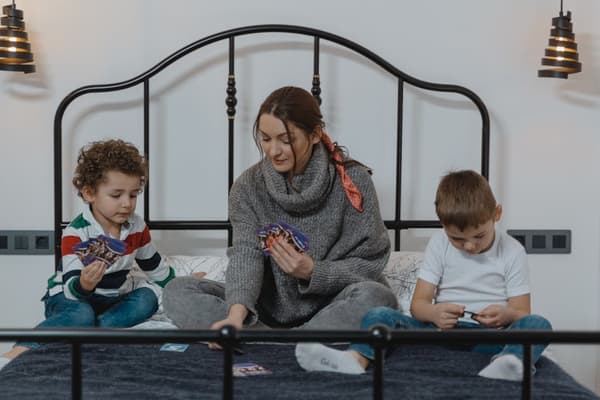
How to Play
Kwartet is the classic Dutch children's card game of asking and collecting. Players are dealt cards from a themed deck of quartets (groups of four related cards) and take turns asking named opponents for specific cards; if the opponent has it, they must hand it over. Complete quartets score 1 point; the player with the most quartets wins.
Kwartet is the classic Dutch and Flemish children's card game of collecting sets of four. Players are dealt cards from a themed deck composed of many quartets (groups of 4 related cards on a common topic, like 'Composers', 'Dinosaurs', 'Football clubs'). On your turn, you name a specific card held by a specific opponent and ask them for it by its full label; if they have it, they must surrender it and you may ask again, otherwise your turn ends and the next player asks. When you assemble all four cards of a quartet you lay them face-up in front of you as a completed set. Kwartet differs from its close cousin Go Fish in two crucial ways: (1) there is usually no draw pile (all cards are dealt at the start, so every card is in someone's hand), and (2) you must ask for a specific named card (not just 'do you have any cats?'), which makes the game much more about listening to what has already been asked than about lucky guesses. The player with the most completed quartets when all cards have been distributed into sets wins. It is the archetypal learning-the-rules card game for Dutch and Belgian children and the basis for hundreds of themed educational decks.
Quick Reference
- 3-6 players; 32-card themed Kwartet deck (8 quartets of 4 cards).
- Deal all cards evenly; 4 players get 8 cards each.
- Ask a specific opponent by name for a specific card; you must already hold at least one from that quartet.
- If they have it, take it and ask again; if not, turn passes.
- Lay a completed quartet face-up the moment you have all 4 cards.
- Each completed quartet = 1 point.
- Most quartets when the deck is exhausted wins.
Players
3 to 6 players works best; 4 is the classic number. With 2 players the deduction breaks down because every card not in your hand is in the other player's, and the game collapses into a memorisation drill. With 7+ players the hand size becomes too thin to make asking productive. Each player plays for themselves; there are no partnerships. The first player is chosen by any agreed method (youngest, drawing the lowest card, or clockwise from the dealer).
Card Deck
A dedicated Kwartet deck of typically 32 cards organised into 8 quartets of 4 cards each (some modern commercial decks have 48 cards in 12 quartets, or 40 cards in 10 quartets). Each card carries the theme name at the top and the specific subject below; the four cards of one quartet share the theme (e.g., 'Dutch painters' with cards labelled 'Rembrandt', 'Vermeer', 'Van Gogh', 'Mondriaan'). Cards are labelled so every card in a quartet is identifiable by name. A standard 52-card deck can substitute by treating each rank (A, 2, 3, ..., K) as a quartet of four (one of each suit), giving 13 quartets; in that adaptation you ask by rank (e.g., 'Do you have the 7 of Hearts?'). Suit rank ordering is not used in Kwartet.
Objective
Collect the most completed quartets by the end of the game. You complete a quartet when all four of its cards are in your hand at the same time; you then lay them down on the table as a completed set and keep them there. The game ends when every card has been sorted into a completed quartet (equivalently, when no player holds any unpaired cards). The player with the most quartets wins; ties are broken in favour of the player who completed their last quartet earliest.
Setup and Deal
- Shuffle the entire Kwartet deck (32, 40, or 48 cards depending on edition) so the quartets are distributed randomly.
- Deal the cards out evenly, one at a time, clockwise, starting with the player to the dealer's left.
- 32-card deck with 4 players: each player receives 8 cards. 32 cards with 3 players: each gets 10 cards and a pile of 2 cards is left face-down to the side (or the dealer takes them). 32 cards with 5 players: each gets 6 cards and a side pile of 2. 48-card deck with 4 players: 12 cards each.
- Players pick up their hand and sort it by theme (each quartet's cards together), keeping cards hidden from opponents. A player may announce any already-completed quartet immediately by laying it face-up in front of them.
- The player to the dealer's left takes the first turn.
Gameplay
- On your turn, choose an opponent and ask them by name for a specific card: for example, 'Anna, do you have Vermeer from the Dutch painters quartet?' You must already hold at least one card from the same quartet in your own hand; asking for a card from a quartet you have zero cards in is illegal.
- If the asked player has the card, they must hand it over immediately and you take another turn: you may ask the same or another opponent for another card. You continue asking as long as each request succeeds.
- If the asked player does not have the card, they simply say 'no' and your turn ends. Play passes clockwise.
- Completing a quartet: The moment you hold all four cards of a quartet, lay them face-up in front of you as a completed set. Completing a quartet does not give you an extra turn (house rule: some groups grant a bonus turn; agree before play).
- Running out of hand cards: If at any time your hand is empty but the game is not over (other players still hold cards), you are out for the rest of the game; your completed quartets stay on the table in your tally.
- Asking and information: Every question and every answer reveals information to the whole table. Expert players listen for every card named; once you have heard all four cards of a quartet mentioned, you can usually deduce who has which.
- End of game: The game ends when every card in the deck has been placed into a completed quartet on some player's table.
Scoring
- Each completed quartet scores 1 point.
- At game end, each player counts their face-up quartets; the most quartets wins.
- If two players tie for most, the player who completed their last quartet earliest wins the tie. If still tied, play another hand.
- Kwartet is usually played as a single hand rather than a cumulative series; for longer sessions, keep a running tally across multiple games.
Winning
The player with the most face-up quartets at the end of the hand wins. A typical 32-card, 4-player hand ends with totals in the range of 0-4 quartets each (8 total). Skilled players routinely end with 3 or 4 of the 8 quartets; a novice often ends with 0.
Common Variations
- Themed educational decks: Decks built around school subjects (biology, geography, history, art) turn Kwartet into an informal teaching tool; each card's subject carries a short fact.
- Bonus-turn rule: Completing a quartet grants one extra turn; rewards aggressive asking.
- Happy Families (English variant): Same rules; themed around cartoon families ('Mr Bun the Baker'); first published in 1851.
- Authors (American variant): The English-speaking cousin; quartets are novels by famous writers. Same mechanical rules.
- Memory Kwartet: A subset of cards starts face-down in the middle of the table; players may reveal one on their turn as an additional information source.
- Fish Kwartet hybrid: Adds a draw pile; if your request fails you draw one card from it, as in Go Fish.
- Standard-deck Kwartet: Uses a 52-card deck as 13 quartets (one per rank). Cards are asked by rank plus suit.
- Quartets with suits as quartets: Alternative standard-deck use where each suit is a 13-card group; only suits are asked. Rarely used.
Tips and Strategy
- Track every question. The full card list of each quartet is public on the box; every name already asked is known. By round 3 you should have a rough map of who holds which cards in the quartets you care about.
- Ask for the rarest cards first. Once you identify a quartet where three of the four cards have been asked about, asking for the fourth is near-certain; asking confirms its location.
- Do not give away your hand. Every card you ask for reveals that you hold at least one card from that quartet. If your strategy is to complete a 'Dinosaurs' quartet, you have now told opponents which quartet you are chasing.
- Spread your questions. Asking the same opponent repeatedly reveals your hand size; spreading asks across opponents conceals your progress and extracts different information from each.
- Ask bluff questions on turns where you can afford to be wrong. If you already have 2 of the 4 cards of a quartet and are considering asking for a 3rd, but you know another opponent holds it with probability 80%, asking the 20% opponent first hides your real target (though you will likely fail the ask).
- Remember the whole card list. Dutch Kwartet decks usually list all 32 card names on the box and on a reference card; knowing the full roster at the start lets you deduce hand contents faster.
- Listen to who got a card. If opponent A asked B for 'Rembrandt' and B handed it over, A now holds Rembrandt and B is out of that quartet. Update your mental tally.
- Late-game focus. Once 6 of the 8 quartets are on the table, the last 2 quartets are usually in someone's hand; a single correct ask can steal both. Save a known-target ask for the last possible turn.
Glossary
- Quartet: A group of 4 cards sharing a common theme. The deck is composed of several quartets (8 is the standard).
- Theme: The category name printed on a card (e.g., 'Dutch painters', 'Dinosaurs'); cards in one quartet share a theme.
- Ask / request: The action of naming a specific card held by a specific opponent and asking for it.
- Hand out: Handing a requested card to the asker when you have it; mandatory in the base game.
- Lay down / complete: Placing all four cards of a quartet face-up in front of you once you have them; this locks them in as a scored set.
- Bonus turn: Optional variation rule granting an extra turn when you complete a quartet.
- Happy Families / Authors / Go Fish: International cousins of Kwartet with minor rule differences.
Tips & Strategy
Kwartet is information game: every ask exposes who holds what. Listen to every question, track every 'yes' transfer, and spread your own asks across opponents to hide which quartet you are chasing. Once three cards of a quartet have been asked about, the fourth is almost certainly pinpoint-locatable; save that ask for a high-value turn. Do not ask repeatedly for cards in the same quartet; you will simply broadcast your strategy.
Kwartet rewards careful listening and pattern-matching far more than its reputation as a children's game suggests. Expert Kwartet players maintain a mental deduction table: each opponent's hand is tracked as a set of 'confirmed holdings' (cards they accepted or asked for) and 'likely gaps' (cards they asked for unsuccessfully). The decision of which opponent to ask is thus an optimisation between extracting new information and making progress on your own quartets. Deliberately asking for a card you do not need, to mislead opponents, is a legitimate advanced tactic.
Trivia & Fun Facts
More than 1000 distinct themed Kwartet decks have been published in the Netherlands alone since 1900. Themes range from Dutch Golden Age painters to cycling champions to popular TV shows to highly niche topics like types of Dutch windmill or the regiments of the Dutch 19th-century army. Some themed decks have become collector's items commanding hundreds of euros at auction. The phrase 'kwartet maken' (to make a quartet) has entered Dutch slang to mean 'assembling a complete collection'.
-
01In Kwartet, before you may ask an opponent for a specific card, what must be true of your own hand?Answer You must already hold at least one card from the same quartet as the card you are requesting. Asking for a card from a quartet you have zero cards in is illegal in the base rules, because it would otherwise let players randomly mine opponents' hands without any commitment of their own.
History & Culture
Kwartet is the Dutch and Flemish version of the international 'Families' card game family, which also includes English Happy Families (first published 1851 by John Jaques of London) and American Authors (1861). The Dutch Kwartet tradition has a particularly strong educational branch: publishers such as Piatnik, Jumbo, and Djeco issue hundreds of themed decks on Dutch history, geography, biology, and arts for use in schools. Children learn the rules of card play, deduction, and turn-taking through Kwartet, making it the first 'real' card game many Dutch and Flemish children encounter.
Kwartet is the single most widely-taught card game to Dutch and Belgian children; almost every household has at least one themed deck, and schools regularly use themed Kwartet decks as a classroom activity for teaching history, science, or language. The game is a shared cultural memory across generations and is often the first card game a child plays with grandparents. Themed decks commemorate everything from Dutch football legends to Rembrandt's paintings, making Kwartet simultaneously a game and an informal cultural encyclopaedia.
Variations & House Rules
Bonus-turn gives an extra turn for completing a quartet. Themed educational decks turn the game into a teaching tool. Happy Families and Authors are the English and American cousins. Memory Kwartet adds face-down centre cards. Fish Kwartet adds a draw pile for failed asks. Standard-deck Kwartet uses rank-based quartets from a 52-card deck.
For younger players (ages 4-6), use a deck with fewer quartets (5-6 quartets, 20-24 cards) and allow asking by theme alone ('any dinosaur?'). For older players or educational settings, require the asker to say one fact about the theme before asking. For larger groups, combine two themed decks into one 64-card super-deck and deal for 6 players.


