
How to Play
Tripoli is a three-phase chip-and-card game (Hearts boodle, Poker, Michigan stops) played on a labelled board with a dummy hand; first to play out wins the Kitty plus opponents' card-count chips.
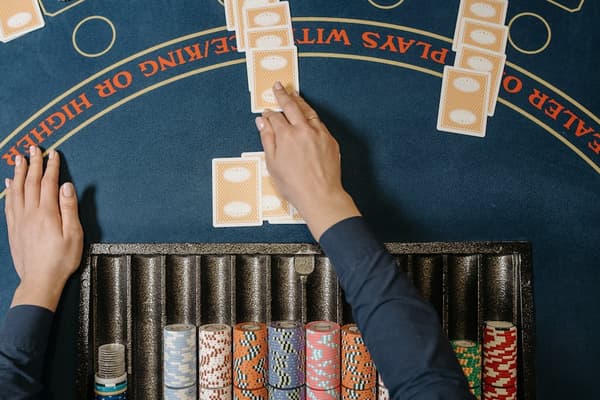
Tripoli (also Tripoley, Royal Rummy, or Michigan Rummy when sold without the board) is a three-phase combination card-and-chips game that bundles three smaller games into one round: a Hearts collection phase, a five-card Poker phase, and a Michigan stops (sequence shedding) phase. It is played around a printed board with labelled chip sections (the four Hearts boodle cards K-Q-J-10, the Pot, the Kitty/8-9-10, and the King-Queen pair), each section receiving an ante before the deal. Each round, players collect the chips on each section if they hold or play the relevant card. The stops-phase winner collects the Kitty and gets one chip per card remaining in opponents' hands. Sessions usually run until one player breaks the bank or for an agreed time.
Quick Reference
- 3-9 players around a labelled Tripoli board.
- All players ante chips on each section before the deal.
- Deal the full deck plus a dummy hand (set aside) clockwise.
- Phase 1: Collect chips for any boodle cards (Hearts A-K-Q-J-10, K-Q pair, 8-9-10 kitty) you hold.
- Phase 2: Show your best 5-card poker hand; best wins the Pot.
- Phase 3: Lead the lowest card of your longest suit; play stops when no one holds the next-higher card.
- Hearts boodle and King-Queen sections: instant collection by holders.
- Pot: best 5-card poker hand.
- Kitty + 1 chip per card in opponents' hands: stops-phase winner.
Players
3 to 9 players. The boards typically support up to 8 or 9 seats; with 3-4 players the dummy hand becomes especially important. Each player plays for themselves; deal rotates clockwise after each round.
Card Deck
One standard 52-card deck, no jokers. Suits are equal (no trump). For the stops phase, ranks within each suit go from 2 (low) to Ace (high). Boodle cards (the Hearts K, Q, J, 10) and the King-Queen pair are the chip-payout sections of the board. The 8-9-10 kitty section requires holding all three of the 8, 9, 10 of one suit.
Objective
Win the most chips across the three phases of each round, and across the session, accumulate the largest chip stack. Sessions are typically played to break-the-bank or for an agreed number of rounds; the player with the most chips wins.
Setup and Deal
- Lay the Tripoli board (or, in the boardless version, eight labelled chip cups) in the centre of the table. The labelled sections are: Heart-A, Heart-K, Heart-Q, Heart-J, Heart-10, the Pot (poker pool), the Kitty (8-9-10 bonus), and the King-Queen pair (a player must show both cards in any one suit).
- Anteing: Before the deal, the dealer places 2 chips on each section and every other player places 1 chip on each section. (House rule may set even antes.) Carryover chips from previous rounds remain on unclaimed sections.
- Dealing: Dealer deals the entire deck one card at a time clockwise to all players plus one extra dummy hand to the dealer's left. Some hands will have one more card than others; this is acceptable.
- Misdeal: A card exposed during the deal voids the deal; the same dealer redeals.
Gameplay
- Phase 1: Hearts boodle: Any player holding the Ace, King, Queen, Jack, or 10 of Hearts immediately collects the chips on that respective section. Players holding both the King and Queen of any one suit collect the King-Queen section. Players holding the 8, 9, and 10 of any one suit collect the Kitty section. Sections held in the dummy hand are not collected and roll over.
- Phase 2: Poker: Without rearranging or exchanging cards, each player selects their best 5-card poker hand from the cards in their hand (cards in excess of 5 are simply ignored for the poker comparison). Standard poker rankings apply: Royal Flush > Straight Flush > Four of a Kind > Full House > Flush > Straight > Three of a Kind > Two Pair > One Pair > High Card. The player with the highest 5-card hand collects the chips on the Pot section.
- Phase 3: Stops (Michigan): Starting with the player to the dealer's left, the first player plays the lowest card in their longest suit face up to the table. The next player in turn (clockwise) must play the next-higher card of the same suit if they hold it; if no one holds it, the sequence stops. The player who played the last card of the stopped sequence then starts a new sequence with the lowest card of any suit they choose (the new lead may be any rank, not necessarily a 2).
- Stops triggers: Sequences stop when the rank Ace is reached (Aces are the highest rank), or when no player holds the next card of the suit (because it is in the dummy hand or has already been played).
- Winning the stops phase: The first player to play their last card wins. Each opponent pays them 1 chip for every card still in their hand, and the winner also collects the chips on the Kitty section (in some house rules, only if it was not already collected during the Hearts phase).
- End of round: Reset the board, ante for the next round, redeal. Unclaimed chips on any section remain for the next round.
Scoring
- Hearts boodle: 1 chip ante per player per section, multiplied by section. A player holding the K of Hearts collects the K-Hearts section (typically 4-9 chips depending on player count and previous rollover).
- Poker pool: Best 5-card poker hand collects the entire Pot section.
- Stops winner: Collects the Kitty section + 1 chip per card remaining in each opponent's hand at the moment the winner plays out.
- Carryover: Unclaimed sections (often because the relevant card sat in the dummy hand) roll over to the next round; the next round's anteing adds to the existing pile.
- No fixed game total: Players track running chip stacks; sessions usually end at an agreed time or when one player goes bust.
Winning
- Round-by-round: Each chip section is settled separately during the round; the stops phase produces a clear single winner.
- Session winner: The player with the largest chip stack at the end of the agreed session length wins.
- Bust: A player who loses all their chips is out; the session continues until a winner emerges.
- Tie-breakers: Tied poker hands split the Pot section. Ties in the King-Queen section split between holders.
Common Variations
- No-Poker Tripoli: Skip the poker phase for faster two-phase rounds; useful for very young players.
- Auction Kitty: Before the stops phase, players bid chips to swap their hand with the dummy hand; the highest bidder swaps and the bid chips go to the Kitty.
- Michigan (boardless): The same game played without a printed board, using marked piles of chips for each section. This is the original 19th-century form.
- Boodle: A British 19th-century cousin where the boodle cards are the A of Hearts, K of Clubs, Q of Diamonds, J of Spades.
- Pope Joan: Older 18th-century ancestor with similar phases but a Joker (Pope) as a special card.
- Newmarket: Closely related British family game, often confused with Michigan or Tripoli.
Tips and Strategy
- The stops phase delivers the most chips per round; play conservatively and aim to be the player who runs out of cards.
- When you must lead in the stops phase after a stopped sequence, lead a suit where you hold consecutive cards (so you can keep playing in the resulting sequence).
- Track which cards are in the dummy hand by noting which sequences stop early; if the 9 of clubs stops a sequence and you don't hold the 10 of clubs, the 10 is in the dummy.
- In the auction-kitty variant, the dummy is a high-value swap when your own hand is poor; bid up to half your remaining chips when you have nothing to lose.
- Heart boodle pickups are pure luck; do not invest energy in trying to control them.
- Save your Aces for late stops sequences; an Ace played mid-sequence stops it and gives you a free new lead.
Glossary
- Boodle cards: The Hearts A-K-Q-J-10 (and in some variants, the K of Clubs, Q of Diamonds, J of Spades).
- Pot: The poker chip section, won by the best 5-card hand.
- Kitty: The 8-9-10 chip section and the bonus pot for the stops winner.
- Dummy hand: The extra hand dealt to the dealer's left and never played from; chips for sections held in the dummy roll over to the next round.
- Stops: A stopped sequence in the third phase (when no player holds the next-higher card of the suit).
- Ante: Chips placed by every player on every board section before each round.
- Carryover: Chips on unclaimed sections that remain for the next round.
Tips & Strategy
The stops phase delivers the most chips per round; aim to be the player who plays out first. Save Aces for late stops sequences (each Ace played stops the suit and grants you a fresh lead).
Winning the stops phase is the most profitable single goal. Lead suits where you hold consecutive cards so you can continue the sequence after others play; avoid starting sequences that hand the lead-back to opponents holding the suit.
Trivia & Fun Facts
Tripoley boards often feature a distinctive rotating tray with labelled chip compartments, and many family heirloom boards have been passed down for three or four generations in the United States. The 'dummy hand' rule is unique among classic card games for explicitly removing 5-13 cards from play each round.
-
01What three phases make up a round of Tripoli?Answer A Hearts boodle phase (collecting chips for held bonus cards), a five-card Poker phase, and a Michigan stops phase (a sequence-shedding race for the Kitty).
History & Culture
Tripoli descends from 18th-century Pope Joan and 19th-century Michigan/Boodle, all of which combined boodle-card chip pickups, hand-comparison, and card-shedding sequences on a special board. The Tripoli/Tripoley brand-name board appeared in mid-20th-century American game catalogues and made the format a family-night staple.
Tripoli (sold under brand names Tripoley and Royal Rummy) has been a staple of North American family game nights since the 1930s. The game is a common multi-generational tradition in many American families and a regular feature of holiday gatherings.
Variations & House Rules
No-Poker Tripoli skips the second phase for faster rounds. Auction Kitty allows bidding to swap hands with the dummy. Boardless Michigan uses chip cups instead of a printed layout. Boodle and Newmarket are British cousins.
Adjust the per-section ante to control session pace. Use play money instead of chips for a family-friendly version. Add a 'must-lead-from-low' rule in the stops phase for a more strategic game.


