
How to Play
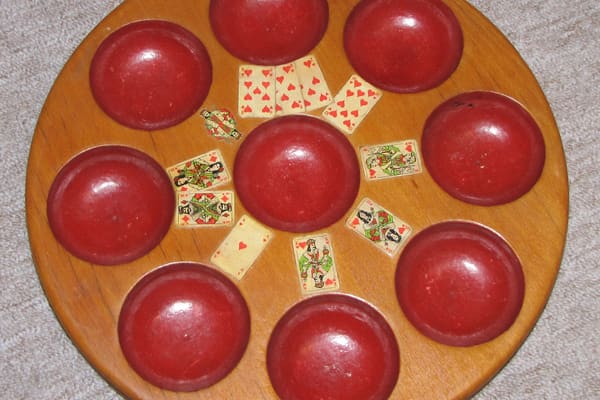
Poch is a 15th-century German three-phase card game that blends pay-the-board compartment claiming, a poker-style bluffing round, and a stops-family shedding race. Its Pochen phase (where 'to poch' means 'to boast') is widely regarded as the direct ancestor of modern Poker.
Poch (also called Pochen, Pochspiel, or Pochbrett) is an old German card game dating to the 15th century and widely credited as the grandfather of modern Poker. Played on a special board with nine compartments for collecting stakes, Poch combines three distinct phases: a pay-the-board phase where card-holders claim compartment stakes, a Pochen (poker-like bluffing) phase where players bet on their best matched-rank set, and a shedding phase where players race to empty their hands. Uniquely among early European games, Poch already featured the bluff element that made it Poker's direct ancestor.
Quick Reference
- 3-8 players around a Poch board with 9 labelled compartments.
- Each player antes one chip to every compartment.
- Deal all cards evenly; turn the last card for trumps.
- Phase 1: Claim compartments by holding the required trump cards.
- Phase 2 (Pochen): Bet on your best rank-matched set (pair/triple/four) or fold.
- Phase 3 (Shedding): Play cards in suit-sequence; first to empty hand wins the Pinke.
- Board compartments pay chip-by-chip for specific trump cards.
- Poch compartment: to the Pochen winner or last stander.
- Pinke: to the first shedder; plus 1 chip per remaining card in opponents' hands.
Players
Poch works for 3 to 8 players, best with 4 to 6. All players play individually; no partnerships. Play proceeds clockwise. A Poch set (either a physical wooden board or a drawn-on paper) and a supply of chips are needed.
The Poch Board
- A traditional Poch board has 9 compartments, each labelled with a specific card or combination that earns chips during play:
- Ace, King, Queen, Jack, Ten (five compartments): One compartment per rank. The player who holds the specified card in the trump suit claims that compartment.
- Marriage (Marriage / Ehepaar): Claimed by the player holding the King and Queen of the trump suit.
- Sequence (Sequenz): Claimed by the player holding the 7-8-9 of the trump suit (or higher variant; varies).
- Poch: The pot for the Pochen (bluffing) phase.
- Pinke / Centre: The pot for the final shedding phase.
- Before each deal, every player contributes one chip to each of the nine compartments.
Card Deck
- Use a 32-card German pack (7 through Ace) for 3-4 players, or a 52-card deck for 5-8 players. Agree on deck size before play.
- Card rank within each suit (for shedding): 7 (low), 8, 9, 10, J, Q, K, A (high) in the 32-card game; 2 through A in the 52-card game.
- Card values for the Pochen phase are by rank only: pairs (two same-rank), threes-of-a-kind, fours-of-a-kind.
Objective
Win chips by: (a) holding the specific cards required to claim compartments on the Poch board, (b) winning the Pochen bluffing phase with the highest matched-rank set, and (c) being the first to empty your hand in the shedding phase. At the end of the session, whoever has the most chips wins. Poch is traditionally played as a cash game where chips have agreed monetary value.
Setup and Deal
- Every player antes one chip into each of the nine compartments of the Poch board before the deal.
- The dealer shuffles, the player to the dealer's right cuts, and the dealer deals all cards out evenly, one at a time. Any remaining cards (when not divisible) are dealt face-up to the centre to the player whose turn comes up; those cards are 'dead' and do not play.
- The dealer turns the next card face-up (or the last card dealt to themselves) to establish the trump suit for this deal. If the turned-up card is an honour matching a board compartment (Ace, King, Queen, Jack, 10), the dealer immediately claims that compartment.
Phase 1: Pay the Board
- Each player in turn (starting left of dealer) announces whether they hold any of the key trump cards: Ace, King, Queen, Jack, 10 of trumps, Marriage (K+Q of trumps), and Sequence (7-8-9 of trumps).
- The holder of each specified card takes the chips in the corresponding compartment.
- Unclaimed compartments: If no player holds a specified card, the chips stay in that compartment for the next deal.
- Phase 1 is purely informational: cards are not played, merely revealed for compartment purposes.
Phase 2: Pochen (Bluffing Round)
- Players secretly check their hand for matched-rank sets: pairs (2 cards same rank), triples (3 same rank), or fours (4 same rank). A set can use any suits.
- Starting left of dealer and going clockwise, each player announces 'Pass' or bets chips into the Poch compartment.
- Once a player bets, subsequent players must either call (match the bet), raise (add more), or fold (drop out of this phase).
- Showdown: After betting concludes with all remaining players having matched, the remaining players reveal their best matched-rank set. The highest set wins the Poch compartment chips. Fours > Triples > Pairs. Ties on rank are broken by higher rank (a pair of Aces beats a pair of Kings).
- Last-player-standing: If everyone but one folds, that player wins the Poch compartment chips without showing their cards. Bluffing is explicitly allowed.
Phase 3: Shedding
- The winner of the Pochen round leads first (or the player to the dealer's left if nobody was in the Pochen).
- The leader plays any card, announcing its rank.
- The next player must play the next-higher card of the same suit (playing a Queen of Hearts after a Jack of Hearts, for example).
- If nobody can follow with the next higher card of that suit, the sequence stops; the last player to play in it leads the next sequence with any card.
- The Ace is the highest card; once an Ace is played, that suit's sequence ends.
- First player to empty their hand wins the Pinke / Centre compartment. Each other player pays the winner one chip per card remaining in their own hand.
Scoring and Winning
- Board compartments: Claimed by holding the specified card at the deal; chips paid directly to that player.
- Unclaimed compartments: Carry over to the next deal.
- Poch / bluffing pot: Paid to the highest revealed set or the last-remaining bettor.
- Pinke / Centre: Paid to the first player to empty their hand in the shedding phase.
- Per-card penalty: Each losing shedder pays the winner one chip for each card left in their hand.
- Match winner: The player with the most chips at the end of the agreed session wins. No fixed ending; play until a time or chip limit is reached.
Common Variations
- 32-card Poch: The classic; 3-4 players, faster.
- 52-card Poch: Accommodates 5-8 players; longer sessions.
- Poch without Pochen: Skip the bluffing phase for pure collect-and-shed play. Simpler for beginners.
- Bayerisch Poch (Bavarian): Uses a Bavarian 36-card pack; slightly different honour set for compartments.
- Dreierpoch: Three-handed version with condensed compartments.
- Progressive Poch: Unclaimed compartments carry over and double each undealt round, creating jackpots that can swing a session.
Tips and Strategy
- Chase the Centre. The Pinke is usually the biggest single payoff of the hand; prioritise the shedding phase in your thinking.
- Bluff selectively in Pochen. Betting big with a weak pair is only profitable if you can read opponents. New players should bet only with trips or better.
- Break up opponents' sequences in shedding. If you hold a key card (like a J that would continue a run of 10-J-Q of hearts), play it only when you must; withholding it stops the sequence and gives you the next lead.
- Count compartments before antes. A carried-over Sequence compartment from the previous deal is already worth several chips; that changes risk/reward.
- The Ace-in-hand weapon. Holding an Ace in a shedding-phase sequence means you can always break an opponent's run; save your Aces for contested suits.
Glossary
- Pochbrett: The physical Poch board with nine labelled compartments.
- Ante: One chip placed into each compartment before the deal.
- Compartment: A scoring section of the board; paid to whoever holds the specified card(s).
- Marriage / Ehepaar: The King + Queen of trumps.
- Sequence / Sequenz: The 7-8-9 of trumps (or other three-card trump run).
- Pochen: The bluffing-round name; from the German 'pochen' meaning 'to knock / to boast'.
- Pinke / Centre: The shedding-phase pot; biggest single compartment.
Tips & Strategy
The Pinke (Centre) compartment is where the biggest payouts come from; focus your endgame thinking on shedding your cards. In Pochen, bet only with genuine triples or fours at first; save bluffing until you have read your opponents over several hands. Remember that unclaimed compartments carry over, sometimes creating jackpot pots that transform the economics of a late deal.
Poch rewards players who can separate the three phases' strategies in their minds. The compartment claims are pure luck; Pochen is a poker skill; shedding is a stops-family strategic race. Top players treat each phase almost as a separate game, with shedding strategy (which sequences to start, which to stop) as the decisive skill over a full session.
Trivia & Fun Facts
The German verb 'pochen' means both 'to knock' (as at a door) and 'to boast'; both meanings survived into the English word 'poker' through the game Poque. A beautifully inlaid 17th-century Poch board owned by the Bavarian state museum is estimated to be one of the oldest surviving gambling boards in Europe.
-
01Through which French card game does Poch connect to the modern game of Poker?Answer Poque, a French derivative of Poch that was brought to New Orleans and Americanised into 'Poker' during the 19th century.
History & Culture
Poch is documented in German sources from as early as 1441 and was described in detail in card-game manuals of the 15th and 16th centuries. It spread across Central Europe, reaching France by the 17th century where it evolved into the game 'Poque' in New Orleans. Poque became Americanised as 'Poker' in the 19th century, making Poch the grandfather of modern poker. The physical Poch board, with nine compartments, is still manufactured in Germany today.
Poch is one of the oldest living German card games and a pillar of the country's card-gaming heritage. Traditional wooden Poch boards are heirloom items in some German households; the game sits in the same cultural space as Skat but with a much older lineage and more family-gambling flavour.
Variations & House Rules
32-card Poch is the classic small-group form; 52-card Poch accommodates larger groups. Bavarian Poch uses a German 36-card pack. Progressive Poch lets unclaimed compartments accumulate and double each deal, creating jackpots.
If you don't own a Poch board, draw nine labelled squares on a sheet of paper. For a faster game, skip the Pochen phase (Phase 2). For a lively house-party version, use progressive compartments so unclaimed sections build into jackpots.


