
How to Play
The British and Australian home form of 21. Two cards face down, action choices Twist/Stick/Buy/Split, premium hands Pontoon (2:1) and Five-Card Trick (2:1), banker wins all ties, beating the bank with a Pontoon takes over the bank.
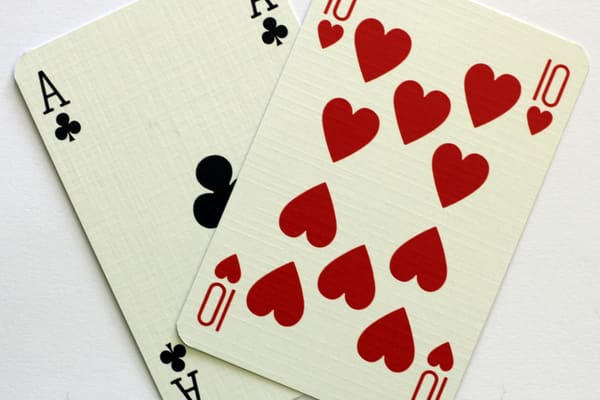
Pontoon is the British domestic cousin of Blackjack and the form of 21 most commonly played in British and Australian homes, pubs, and army barracks. Each deal, one player acts as banker and the rest place bets. Every player gets two cards face down (banker included), and players in turn choose to Twist (hit, face up), Stick (stand, minimum hand 15), Buy (take one face-down card and raise the bet), or Split a matching pair. The premium outcomes are a Pontoon (two-card 21 of Ace plus a ten-value card, paying 2:1) and a Five-Card Trick (any five cards totalling 21 or less, paying 2:1). The banker keeps their cards hidden until all players have acted, the banker wins all ties, and a player who beats the banker with a Pontoon takes the bank. Pontoon is faster, more volatile, and more aggressive than Blackjack precisely because the banker edge is compensated for by these player-friendly premium hands and by the tie-winning rule.
Quick Reference
- 3-8 players, one acts as banker. Cut high card for first banker.
- Each player gets 2 cards face down (banker too).
- Bets placed after first card is seen.
- Twist (hit), Stick (min 15), Buy (+bet, face-down card), or Split matching pair.
- Five cards under 22 = Five-Card Trick, pays 2:1.
- A Pontoon (A + 10-value) pays 2:1 and takes the bank.
- Banker wins all ties.
- Banker bust pays 1:1 (or 2:1 for premium hands).
- Banker Pontoon collects double from everyone.
Players
Three to eight players with one banker role. The banker is chosen initially by cutting for the highest card and normally rotates to the player who beats the bank with a (non-split) Pontoon. With two players the game works but is dull; groups of five to eight are ideal. Each hand lasts 30 to 60 seconds and a session is typically an hour or two.
Card Deck
- One standard 52-card deck for up to five players; two decks (104 cards) shuffled together for six to eight.
- Card values: Ace = 1 OR 11 (holder's choice each time the hand is totalled); 2 through 10 = face value; Jack, Queen, King = 10 each.
- Suits do not matter in Pontoon.
- A hand is called 'soft' if any Ace is being counted as 11 and 'hard' if every Ace counts as 1.
Objective
Beat the banker's total without exceeding 21. The hand rankings from best to worst are: Pontoon (two-card 21), Five-Card Trick (any 5 cards totalling 21 or less), regular 21 from three or four cards, and lower totals compared on face value. Bust hands (over 21) lose automatically. The banker wins all ties. A player holding a Pontoon wins at 2:1 and traditionally takes over as banker for the next deal.
Setup and Deal
- Agree betting minimum and maximum. Cut for first banker (high card takes it). The banker owns the bank and pays or collects all bets personally, so start with enough chips for everyone's potential wins.
- The banker shuffles thoroughly, the player to their right cuts, and the banker deals one card face down to each player including themselves, starting with the player to their left and going clockwise.
- Players look privately at their first card. Going clockwise from the banker's left, each player places a bet within the agreed min-max limits.
- The banker deals a second card face down to each player, ending with themselves. Players peek at their two-card hand.
- Immediate Pontoon check: If the banker's hand is a Pontoon, they expose it at once and collect DOUBLE stakes from every player (no player action occurs). The banker then retains the bank for the next deal.
- Otherwise play proceeds with player actions.
Player Actions
- Going clockwise from the banker's left, each player resolves their hand completely before the next player acts.
- Declare Pontoon: If you hold a Pontoon (Ace plus any ten-value card), expose the ten face down and the Ace face up. You automatically win 2:1 when the banker finishes, unless the banker also has a Pontoon.
- Split: If your two cards are the same rank, you may place a second bet equal to the first and split them into two separate hands. The banker deals a fresh second card to each split hand. Each hand is then played independently. Re-splitting further pairs is allowed in most houses.
- Buy (equivalent to Double Down, but flexible): Raise your bet by any amount between your original stake and TWICE your original stake, and take ONE card face down. You may Buy up to three times (taking your hand to 5 cards maximum), each time raising by an amount no greater than the previous buy. Once you have started Twisting, you may not Buy again.
- Twist (equivalent to Hit): Ask for a card face up without changing your bet. You may Twist any number of times up to a 5-card hand. After Twisting at least once, you may not Buy for the rest of this hand.
- Stick (equivalent to Stand): Stop drawing. You may only Stick on a hand total of 15 or higher. Below 15 you must Buy or Twist.
- Bust: If your total passes 21, expose your hand and hand your stake to the banker. Your hand is dead for this deal.
- Five-Card Trick: If you reach five cards without busting, expose them; you have a Five-Card Trick and will be paid 2:1 unless the banker also makes a Five-Card Trick or a Pontoon.
Banker's Play and Settlement
- After the last player acts, the banker reveals both hole cards. The banker may then Twist (deal themselves face-up cards one at a time) or Stick as they please; there is no forced soft-17 rule as in casino Blackjack.
- Banker busts: The banker pays every surviving (non-bust) player's stake: Pontoons and Five-Card Tricks get 2:1; regular hands get 1:1.
- Banker stands on 21 or less (2-4 cards): Each player hand is compared. A player beats the banker ONLY by having a strictly higher total; ties go to the banker. Pontoons and Five-Card Tricks that beat the banker pay 2:1. Regular winning hands pay 1:1.
- Banker makes a Five-Card Trick: Only a player Pontoon beats it (paying 2:1). All other player hands lose double their stake.
- Banker makes a Pontoon: Nothing beats it. All player hands pay double stakes.
Taking Over the Bank
- A player who beats the banker with an unsplit Pontoon (two-card 21) takes the bank for the next deal. If multiple players do so in the same deal, the one closest to the banker's left takes it (or the players may negotiate).
- The outgoing banker may optionally sell the bank to any player willing to buy it for an agreed price rather than passing it via Pontoon.
- If no player earns or buys the bank, the current banker deals another hand.
Winning
There is no end-game target; Pontoon is scored in chips won or lost per hand. A session ends when the agreed playing time is up or when one player has all the chips. Some groups play to a fixed number of deals with rotating banker so everyone gets equal opportunity to profit from banker ties.
Common Variations
- Spanish Pontoon / Pontoon 21: Uses a Spanish 48-card deck (no 10s). Tens are absent so regular 20s and 21s are rarer, and a bonus table rewards multi-card 21s more richly.
- Malaysian Pontoon: The banker must stand on 17 soft or higher and Pontoon pays only 3:2. Ties push to the player rather than banker.
- Ace-High Pontoon: Hits on Ace-King are paid 2:1 as a secondary premium hand.
- Sudden-death Pontoon: First player to hit Pontoon wins immediately; hand ends with no further action.
- Rotating banker: Banker role rotates clockwise after every deal, rather than waiting for a Pontoon; gives all players the house-edge advantage in turn.
Tips and Strategy
- Always Twist or Buy on totals of 14 or below; the rules forbid Sticking under 15.
- On 15 to 16, whether to Stick depends on the Five-Card Trick potential. If you already hold 3 or 4 cards and can reach 5 without likely busting, Buy or Twist; otherwise Stick.
- On hard 17 to 20, always Stick; the banker needs to match your exact total to tie you out.
- Split Aces and 8s always. Split other pairs only if the banker has not already gone to play.
- Avoid Buying on hard 12 to 16 if there are many 10s unseen in the deck; a face-down bust card is a double loss because you cannot see it and must uncover it later.
- If you are the banker, stand on 17 or higher against full tables; your edge comes from the tie-wins rule.
Glossary
- Pontoon: A two-card 21 consisting of an Ace plus any ten-value card; pays 2:1 and normally transfers the bank.
- Five-Card Trick: Any hand of five cards totalling 21 or less; pays 2:1.
- Twist: Take one more card face up, no bet change (equivalent to Hit).
- Stick: Stop drawing (equivalent to Stand). Minimum hand 15 required.
- Buy: Take one card face down and raise the bet; maximum three Buys per hand.
- Split: Separate two matching cards into independent hands with a new equal bet.
- Bust: A hand total over 21; automatic loss.
- Bank: The role of dealer who pays and collects bets personally.
Tips & Strategy
Aim for a Five-Card Trick whenever you hold 12 to 15 across three cards; even breaking even on fourth and fifth cards is worth the risk. Split Aces and 8s always; never split 5s or 10s. As banker, the tie-wins rule is your edge; stick on 17+ and let busted players bring in stakes.
Pontoon's ban on Sticking below 15 forces more aggressive play than Blackjack. Combined with banker-wins-ties, this pushes the break-even threshold up: if you are Sticking on 17 in Blackjack, you should often Twist on 17 in Pontoon against a strong-looking banker. The Five-Card Trick is mathematically generous, rewarding patient multi-card hands.
Trivia & Fun Facts
Rudyard Kipling's 1890s stories already mention 'Van-John', an earlier British corruption of Vingt-Un that eventually settled on 'Pontoon' during WWI. In Australian outback pubs, Pontoon is still commonly called 'Pontoon' rather than 'Blackjack', making it one of the clearest markers of British-versus-American card vocabulary.
-
01What is the minimum hand total a player needs before they may Stick in Pontoon?Answer 15.
-
02What does a player who beats the banker with an unsplit two-card 21 (a Pontoon) traditionally win besides 2:1 on their bet?Answer The right to take over as banker for the next deal.
History & Culture
Pontoon and its name date to British soldiers during the First World War who played French Vingt-et-Un in the trenches. 'Pontoon' is a phonetic corruption of 'Vingt-Un' filtered through soldier slang. The game became a staple of British army messes and then spread to civilian homes and pubs, displacing straight Blackjack in British domestic play.
Pontoon is embedded in British pub culture, family Christmas card games, and Commonwealth military tradition. Its terminology (Twist, Stick, Buy, Pontoon) has bled into British English as a whole; phrases like 'a bit of a pontoon' meaning a risky move trace back to the game.
Variations & House Rules
Spanish Pontoon removes the 10s for richer multi-card 21s. Malaysian Pontoon softens the banker edge with soft-17 stands and pushes. Rotating-banker versions give every player equal edge. Sudden-death Pontoon ends the hand on the first two-card 21.
For a low-stakes home game, limit each Buy to exactly the original stake (no increases) to reduce bankroll pressure. Use coloured tokens for the banker role so it visibly passes. In mixed-experience groups, let new players ignore the Buy action entirely.


