
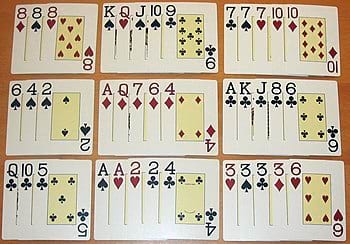
How to Play
A 2 to 4 player poker game where each player arranges 13 cards into three hands: a 5-card back (strongest), a 5-card middle, and a 3-card front (weakest). Back, middle, and front are compared head-to-head with opponents; fouling (mis-ordering) costs all three hands.
Chinese Poker (also Pusoy, 十三張 in Cantonese 'Shi San Zhang' meaning 'thirteen cards') is a 2 to 4 player partition-and-compare poker game where each player is dealt 13 cards and must arrange them into THREE poker hands: a 5-card back (strongest), a 5-card middle, and a 3-card front (weakest). The single inviolable rule is that back ≥ middle ≥ front by standard poker hand rank; violating this hierarchy is called a foul and costs the fouling player as if they had lost all three hands. In 3-card hands, flushes and straights are not considered; only pairs and high-card totals count. After all players set their hands (blind or sequentially depending on the variant), everyone reveals simultaneously and each player's hand is compared to every other player's corresponding hand: each player's back against every other player's back, middles against middles, fronts against fronts. Standard scoring awards 1 unit per won hand, with bonuses for winning 2 of 3 (+1), winning all 3 (scoop: +3 in the 1-6 method or +1 in the 2-4 method), and royalties for premium hands (straight flush in back, quads in middle, trips in front). The game is a staple of casino poker rooms across East and Southeast Asia (Hong Kong, Macau, the Philippines, Singapore, Vietnam) and has a thriving online tournament scene under its Open-Face Chinese Poker (OFC) variant, where cards are dealt and placed one at a time, adding a dramatic real-time strategic layer absent from classic Chinese Poker.
Quick Reference
- 2 to 4 players. Standard 52-card deck; deal 13 cards to each player.
- Each player privately arranges cards into back (5), middle (5), and front (3) rows.
- Back ≥ middle ≥ front in poker hand strength; violation = foul.
- All players reveal simultaneously (classic) OR place cards one at a time (OFC).
- Compare each player's back against every opponent's back, middle to middle, front to front.
- Award units for each hand won, bonuses for scoops, royalties for premium hands.
- 1-6 method: +1 per hand won; scoop (all 3) pays double (6 units).
- Foul: lose 3 units per opponent, forfeit royalties.
- Royalties: straight flush back +10, quads middle +8, trips front +3, flush back +4.
Players
2, 3, or 4 players, each playing for themselves. Best at 3 or 4 players; 2-player Chinese Poker is tactically shallower. Play is simultaneous (all players set hands at once in classic form; one card at a time in OFC). Deal rotates clockwise. A single hand takes 3 to 10 minutes classic, 5 to 15 minutes OFC; a match is an open-ended series with running chip totals. In casino settings, chips are exchanged hand by hand; in home play, a scorecard tracks units.
Card Deck
One standard 52-card French-suited pack, jokers removed. For 4 players, the entire deck is distributed evenly (13 cards per player). For 3 players, 13 cards are dealt and the final card is set aside (or all 52 are dealt with one player getting 14 in some variants). For 2 players, 13 cards each plus 26 in an unused stock. Card ranking and hand types are standard: Ace high (or low in wheel-type straights), no jokers, no suit tiebreak.
Objective
Build three valid poker hands (back 5-card, middle 5-card, front 3-card) obeying the back ≥ middle ≥ front hierarchy, and beat as many of each opponent's corresponding hands as possible. Avoid fouling (mis-ordering your hands). Score from individual hand wins, scoop bonuses, and royalties. Over a session, finish with the highest chip or unit total.
Setup and Deal
- Agree on the scoring method (1-6 or 2-4), royalty schedule, and any house rules before the first hand.
- Choose dealer; deal rotates clockwise each hand.
- Shuffle the 52-card deck thoroughly. Deal 13 cards face down to each player (4-player game uses the whole deck; 3-player game sets 13 cards aside; 2-player deals 13 each with remainder unused).
- Each player privately arranges their 13 cards into three piles: back (5 cards, strongest), middle (5 cards, between), and front (3 cards, weakest).
- The back and middle use standard 5-card poker hand rankings. The front uses 3-card hand rankings: high card, pair, three of a kind. No straights or flushes in the 3-card front.
- When all players are ready, hands are revealed simultaneously.
Hand Hierarchy and Rankings
- Mandatory order: back ≥ middle ≥ front. The back hand must be at least as strong as the middle; the middle at least as strong as the front. Violation = foul.
- 5-card hand rankings (standard poker, high to low): Royal Flush > Straight Flush > Four of a Kind > Full House > Flush > Straight > Three of a Kind > Two Pair > One Pair > High Card.
- 3-card hand rankings (front only, high to low): Three of a Kind > One Pair > High Card. Straights and flushes are NOT counted in the 3-card front; only rank-based hands matter.
- Tiebreakers: when two hands are of the same type, compare by rank: a pair of Kings beats a pair of 8s, an Ace-high flush beats a King-high flush, and a full house with higher trips beats a full house with lower trips. No suit tiebreak; equal hands split points evenly (each wins half a unit).
- Examples of valid arrangement: back = flush (K-high), middle = straight (9-high), front = pair of 7s. Back > middle > front checks out.
- Fouled arrangement: back = pair of 9s, middle = three of a kind 8s, front = pair of 4s. Middle > back: foul.
Special Hands: Dragons and Naturals
- Thirteen Unique Ranks (Dragon): a player dealt one card of each of the 13 ranks (A through K) may declare a Dragon and automatically wins against every other player without setting hands. In some variants, a Dragon pays a fixed bonus (3 units per opponent) plus the scoop.
- Three Flushes: all 3 hands being flushes (back and middle are 5-card flushes; front is all same-suit) is a declared natural worth 3 units per opponent.
- Three Straights: all 3 hands being straights (front = 3 consecutive ranks of any suits) is worth 3 units per opponent.
- Six Pairs: 6 distinct pairs in the 13 cards (one of each rank paired). Bonus = 3 units per opponent.
- Four Triples: 4 separate three-of-a-kinds (12 cards) plus 1 remainder. Worth 4 units per opponent.
- Natural declarations: made INSTEAD of setting hands; the natural is revealed at showdown and wins automatically.
Scoring Systems
- Basic (1-2 method): 1 unit per hand won (each player's back vs. each opponent's back, middle vs. middle, front vs. front). Winning 2 of 3 pays +1 additional unit; winning all 3 ('scoop') pays no extra (just 3 units).
- 1-6 method (most common in casinos): 1 unit per hand won. Winning 2 of 3 still pays 2 units; winning ALL 3 (scoop) pays DOUBLE = 6 units total (or 3 if normal + 3 for scoop bonus).
- 2-4 method (modern home play): 1 unit per hand won; +1 if you win 2 of 3, +1 more if you win all 3 = total 4 units on a scoop.
- Royalties (bonus payments, paid in addition to hand wins): straight flush in back = 10 units, four of a kind in middle = 8, full house in middle = 2, three of a kind in front = 3, flush in back = 4, straight in back = 2, quads in front = 22. Exact schedules vary by house.
- Foul penalty: if you foul (back < middle or middle < front), you pay as if you lost all 3 hands (3 units) to each opponent, PLUS any royalties you would have scored are forfeited. In most schedules, fouled players ALSO pay all bonuses opponents earn that hand.
- Mis-set (3-card front stronger than 5-card middle by rules): automatic foul.
- All pay in one direction: each player settles with every other player separately; losses and wins per opponent are summed into the hand's net score.
Open-Face Chinese Poker (OFC) - The Modern Variant
- OFC changes Chinese Poker from a set-hand game into an incremental-build game. Cards are dealt and placed one at a time; players cannot rearrange after placement.
- Initial deal: each player receives 5 cards face down and places them face up on their own three rows (back, middle, front) in any legal slots.
- Subsequent draws: one card at a time, dealt to each player in turn. Each card must be placed in a legal slot (back, middle, or front, with row size limits: 5-5-3). Placed cards cannot be moved.
- After 13 cards: each player's rows are filled. Back/middle/front hierarchy is evaluated; fouls cost as in classic.
- Royalties scale up in OFC: specific premium hands pay much larger bonuses, for example royal flush in back = 25, four of a kind = 10, full house = 6.
- Fantasyland: achieving QQ or better in the FRONT row (without fouling) grants you Fantasyland on the next hand: you are dealt all 13 cards at once and may set them privately before revealing. Fantasyland is an enormous advantage and drives most high-stakes OFC play.
- Pineapple variant: each turn deals 3 cards; you place 2 and discard 1. Faster, more dramatic.
Winning
Chinese Poker has no fixed session target. Matches are open-ended series of hands with running chip totals. Sessions end by mutual agreement, fixed hand count (often 10 or 20), or chip exhaustion. The player with the most chips or units at session end wins. In casino settings, each hand is a separate settlement and players can enter or leave between hands.
Common Variations
- Classic Chinese Poker (set-hand): the traditional form; players arrange all 13 cards before revealing.
- Open-Face Chinese Poker (OFC): cards dealt and placed one at a time; no rearrangement. Dominant modern form.
- Pineapple OFC: OFC with 3-card deals each turn, placing 2 and discarding 1. The most common tournament version.
- Progressive OFC: royalty values scale with pot size or blind levels.
- Fantasyland OFC: the reward for QQ+ in the front enables the Fantasyland full-deal advantage next hand.
- Super Bowl OFC: three or more consecutive Fantasylands.
- 2-7 Chinese Poker: low-only front row (A-5-4 is a valid front lock).
- Philippines Pusoy: traditional Filipino form of classic Chinese Poker; standard 1-6 scoring.
- Hong Kong Chinese Poker: casino form with additional side-bet options.
- Variable-blind Chinese Poker: each hand uses a rising ante so late-game hands are worth more.
Tips and Strategy
- Always check for a foul first. Before committing, mentally verify that your back ≥ middle ≥ front. Fouling is the single biggest mistake in Chinese Poker; a fouled hand costs you 3 units per opponent plus forfeiting royalties.
- Balance strength across the three hands. A super-strong back with a weak middle often loses the middle AND cannot win the front; consider sacrificing one back card to a more balanced distribution.
- Fronts: pairs matter most. A pair in the front is a strong hand (three of a kind is very rare in 3 cards). Even a pair of 6s in front will often beat opponents' high-card fronts.
- Middle: straights and flushes are premium. A 5-card middle of 10-high or better straight or flush will win against most opponents; a two-pair or three-of-a-kind middle is strong but not premium.
- Scoop vs. split strategy. Winning 2 of 3 is often enough in cash play because it pays 2 units. Going for the scoop is worth it ONLY when you have a clear back-middle-front arrangement that dominates.
- Count suits and ranks in a foul check. If you hold 4 suited cards, your back should probably be the flush; check whether the middle has enough to clear the flush's rank.
- OFC placement discipline. In OFC, do not commit too early to a specific hand. Keep options open until card 7 or 8, then lock in the plan.
- Royalty chasing. High royalties (straight flush back = 10 units, quads middle = 8) can swing a hand dramatically. If you have 4 to a flush or a pair in back, consider structuring the rest of the hand around completing the premium.
- Fantasyland in OFC is worth significant risk. A QQ front is roughly +10 EV in expected future hand-score; taking a 20 percent foul risk to land it is often net positive.
Glossary
- Back: the strongest 5-card hand, placed at the 'back' row of a player's three rows.
- Middle: the intermediate 5-card hand, placed between front and back.
- Front: the weakest 3-card hand, placed in front. Uses simplified 3-card ranking (no straights or flushes).
- Foul: setting hands out of order (back < middle, or middle < front). Costs 3 units per opponent, voids royalties.
- Scoop: winning all three hands against an opponent. Usually pays double in 1-6 method.
- Royalty: a fixed bonus payment for premium hands such as straight flush, four of a kind, or full house, paid in addition to normal hand wins.
- Dragon / 13 Unique: a natural hand of all 13 ranks (A-2-3-4-5-6-7-8-9-10-J-Q-K). Automatic win.
- Fantasyland (OFC): an advantage earned by making QQ or better in the front row; next hand you see all 13 cards at once.
- OFC / Open-Face Chinese Poker: the incremental-placement variant, now the dominant tournament form.
- Pusoy / Shi San Zhang: the game's Filipino and Cantonese names.
Tips & Strategy
Always check for a foul first; a fouled hand costs 3 units per opponent plus forfeited royalties and is the single biggest mistake in Chinese Poker. Balance strength across the three hands rather than loading everything into the back; a super-back with a weak middle typically loses the middle. Fronts are about pairs: a pair of 6s in the front usually beats opponents' high-card fronts. Scoop-chasing is worth it only when your arrangement clearly dominates; winning 2-of-3 for 2 units is often enough. In OFC, keep placement options open until card 7 or 8 before committing; early lock-in is the common mistake. Chase the Fantasyland trigger (QQ+ front) in OFC even at a modest foul-risk; Fantasyland's full-deal advantage is worth roughly +10 EV on the next hand.
Chinese Poker rewards holistic hand arrangement more than any single-hand poker decision. The key decision is how to distribute strength across three rows, which depends not only on your cards but on what opponents are likely to show (in OFC, partial information about opponents is visible as they place). Strong players think in terms of scoop probability versus 2-of-3 probability and size their aggression accordingly. The foul-check discipline separates beginners from intermediates; the placement order discipline (in OFC) separates intermediates from experts.
Trivia & Fun Facts
Chinese Poker was featured in the 2013 World Series of Poker Open-Face Chinese Poker event, which awarded over $400,000 in prize money. Fantasyland in OFC is often called the 'Holy Grail' of the game because a player locked into a Fantasyland streak can dominate a session almost single-handedly. The Philippine variant Pusoy is so popular that streaming sites and mobile apps dedicated to Pusoy routinely top Asian app-store card-game charts.
-
01What is the significance of Fantasyland in Open-Face Chinese Poker, and how does a player earn entry to it?Answer Fantasyland is an enormous advantage state where the player is dealt all 13 cards face-down at once at the start of the next hand and may set all three rows privately before revealing, rather than placing cards one at a time. A player earns Fantasyland by arranging a pair of Queens or better in the 3-card front row, without fouling, in the current hand.
-
02What does it mean to 'foul' in Chinese Poker, and what is the penalty?Answer Fouling means setting your hands out of hierarchy so that back < middle or middle < front, violating the strict back ≥ middle ≥ front rule. A fouled player pays as if they lost all three hands (3 units per opponent) and forfeits any royalties they would have earned that hand.
History & Culture
Chinese Poker (十三張, Shi San Zhang) originated in China and spread across East and Southeast Asia in the mid-20th century, becoming a staple casino game in Hong Kong, Macau, Taiwan, the Philippines (as Pusoy), Singapore, and Vietnam. The 'Russian Poker' alternative name dates from the 1990s Russian gambling scene, where the game had a brief boom. Open-Face Chinese Poker (OFC) emerged in Russian gambling clubs in the 2000s and became a global phenomenon during the 2010s poker boom, with major tournament circuits in Las Vegas, Prague, and Barcelona. OFC's introduction of Fantasyland and real-time placement decisions gave the classic game fresh competitive depth.
Chinese Poker is a defining card game of East and Southeast Asian gambling culture, with decades of continuous casino presence in Hong Kong, Macau, the Philippines, and Taiwan. Its modern incarnation OFC has brought the game to global poker-tournament circuits and online platforms, making it one of the fastest-growing competitive card games of the 2010s and 2020s. Major tournaments include the WSOP OFC event, the European OFC Cup, and Asia-wide Pusoy championships.
Variations & House Rules
Classic Chinese Poker is the set-hand form. Open-Face Chinese Poker (OFC) introduces incremental placement with no re-arrangement. Pineapple OFC adds 3-card deals with 1 discard. Fantasyland OFC rewards QQ+ fronts with a full-deal advantage on the next hand. Philippine Pusoy and Hong Kong Chinese Poker are regional casino forms. Scoring methods vary between 1-2, 1-6, and 2-4 systems.
Beginners should start with classic 4-player Chinese Poker using 1-2 scoring and skip royalties until the foul-check becomes reflex. Use the 1-6 method (scoop = 6 units) for more exciting cash-game swings. For a tournament feel, use Pineapple OFC with Fantasyland; this is the dominant modern competitive form. New players benefit from a printed reference card showing hand rankings and the foul-check rule.


