
How to Play
Guts is a fast and intense poker side game for 2 to 10 players where everyone is dealt 2 or 3 cards and simultaneously declares 'in' or 'out'. The best in-hand wins the pot, but every losing in-player must match it, creating a snowballing pot.
Guts is a high-tension poker side game for 2 to 10 players where everyone is dealt a tiny hand (commonly 2 or 3 cards) and simultaneously declares 'in' or 'out' by opening their fist to reveal a chip (in) or no chip (out). Players who declared in show their cards; the best hand wins the entire pot, and every other in-player must MATCH the pot they just lost (refreshing the pot for the next round). The result is a pot that snowballs rapidly: a $5 pot with 3 in-players and one winner balloons to $10 instantly. The game continues until only one player stays in unopposed (winning the pot without a match), or until the table agrees to stop.
Quick Reference
- 2 to 10 players, standard 52-card deck.
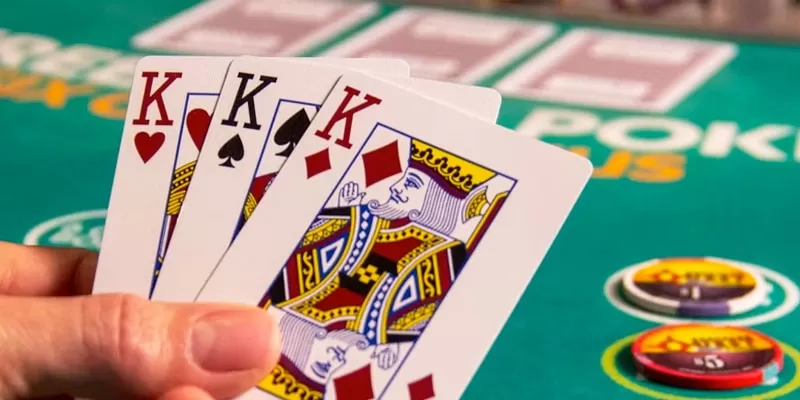
- Everyone antes; dealer deals 2 cards (2-Card Guts) or 3 cards (3-Card Guts) face-down to each player.
- Each player privately decides; takes a chip into a closed fist (in) or holds it visible (out).
- All players simultaneously open fists. Chip showing = in.
- If only one in-player: they take the pot uncontested without revealing.
- If 2+ in-players: best hand wins the pot; every other in-player matches the pot into the next round.
- Pair of 10s+ is the conventional 'in' threshold in 2-Card Guts.
- Pots snowball: 3 losers in a 5-chip pot turn it into 20 chips next round.
Players
2 to 10 players, each playing for themselves (no partnerships). 4 to 7 players is the practical sweet spot. Choose a dealer at random; the deal rotates clockwise after every round (a 'round' is one ante + one in/out + one showdown). Stakes can escalate dramatically; agree on a buy-in floor and a per-round bet cap before play to prevent the pot from spiralling out of friendly territory.
Card Deck
One standard 52-card deck, no jokers. Standard poker rank order: A (high or low for straights, where allowed), K, Q, J, 10, 9, 8, 7, 6, 5, 4, 3, 2. Suit order (when needed for tiebreakers) is Spades > Hearts > Diamonds > Clubs. Hand rankings used depend on the variant: 2-card Guts uses pairs > high card with no straights or flushes; 3-card Guts uses 3-card poker rankings (Straight Flush > 3-of-a-kind > Straight > Flush > Pair > High Card).
Objective
On each round, decide whether you have a strong enough hand to stay 'in' and contest the pot. Win the pot if you have the best in-hand; if you stay in and lose, match the pot (paying again the amount that was already in it). Across the session, finish with more chips than you started; the game ends when only one player declares in (winning unopposed) or by table agreement.
Setup and Deal
- Agree the ante per player (commonly 1 chip).
- Each player puts their ante into the central pot.
- Choose a dealer; deal rotates clockwise after each round.
- Deal: The dealer deals the agreed number of cards face-down to each player: 2 cards (Two-Card Guts) or 3 cards (Three-Card Guts). Each player looks at their own cards privately.
- Get-ready: Each player takes a chip (or other small token) and places their hand under the table or behind a closed fist. They will either enclose the chip in a closed fist (in) or hold it visibly outside their fist (out).
- Misdeal: if any player has the wrong number of cards or a card is exposed during the deal, reshuffle and redeal; antes stay in the pot.
Gameplay
- Simultaneous declaration: All players hold their closed fists above the table. On the dealer's count of three, every player opens their fist at the same moment. A chip in the fist = in (committing to play for the pot). No chip = out (folding without penalty).
- No one is in: If every player declares out, the round is dead; the dealer collects all cards, redeals after another round of antes, and the pot grows.
- One player is in (unopposed): That player wins the entire pot without showing their cards and without matching. The pot is reset (each player antes again to start a new round).
- Two or more players are in: Each in-player reveals their cards face-up. The best hand wins the pot outright; every other in-player must match the pot they just lost by paying that amount into the next round's pot.
- Pot match: If the pot was, say, 8 chips and three players stayed in, the winner gains 8 chips; the two losers each pay 8 chips into the next round's pot, which now starts at 16 chips (plus any new antes if you continue requiring them).
- Tied best hand: Split the pot evenly between tied winners. Tied losers each match the pot independently.
- Next round: The deal rotates clockwise. If the rules require it, players ante again; otherwise the matched losses fund the next pot. Continue until a single in-player wins unopposed without anyone needing to match.
Scoring
- Per-round settlement: Chips move immediately at the showdown. The winner takes the pot; in-losers each match the pot into the next.
- Two-Card Guts hand rankings (high to low): Pair (higher pair beats lower) > High Card (highest card beats next; tie broken by second card, then by suit if exact tie). No straights or flushes in 2-card Guts.
- Three-Card Guts hand rankings (high to low): Straight Flush (3 consecutive same-suit) > 3-of-a-Kind > Straight (3 consecutive any suit) > Flush (3 same-suit not consecutive) > Pair > High Card. Note: in 3-card poker, Straight outranks Flush (different from 5-card poker).
- Pot growth: A pot can double or triple every round. After 3 or 4 successive matched rounds, the pot can easily be 10x to 30x the original ante.
- No fixed match length: The game ends when (a) someone wins a round unopposed, (b) players agree to stop, or (c) a player is unable or unwilling to match a pot.
Winning
- Round winner: The single in-player with the best hand at showdown takes the pot.
- Game-ending unopposed win: The first time after a matched round that exactly one player declares in, they take the entire (large) pot uncontested and the game ends or resets.
- Session winner: The player with the most chips when the table calls stops.
- Bust-out rule: A player who cannot or will not match a pot they lost is eliminated for the rest of the session (their pre-existing chips remain).
- Tie-break for absolute hand ties: Suit order Spades > Hearts > Diamonds > Clubs settles otherwise-identical 2-card high-card ties.
Common Variations
- Two-Card Guts (No Straights/Flushes): Pairs and high cards only; the simplest and fastest form.
- Three-Card Guts: 3 cards each, full 3-card poker rankings (Straight Flush > 3-of-a-Kind > Straight > Flush > Pair > High).
- Monte Carlo Guts: An additional community card is dealt face-up after declarations; in-players combine it with their own cards.
- Pass the Trash: After looking at their cards, each player may pass one to the player on their left before declaring.
- Hi-Lo Guts: Two pots run simultaneously: one for the highest hand, one for the lowest. Players declare in for high, low, or both.
- No Peek: Players declare in/out without looking at their cards; pure thrill, minimum strategy.
- Pot Cap: Maximum pot size is capped (e.g., 50 chips) to prevent runaway escalation. Highly recommended for casual nights.
- Wimp-Out (single in wins immediately): Reinforces that a single in-player wins without revealing their cards (standard rule made explicit).
- Table-Stake Guts: All chips are pooled at start; each round's match is capped at the player's remaining chips.
Tips and Strategy
- Only stay in with premium hands. In 2-card Guts, a pair of 10s or better is the conventional in-threshold; in 3-card Guts, a Pair or better (with at least one face card) is reasonable.
- The pot size changes everything. With a small pot (1-2 chips), even mediocre hands are worth a 50/50 stab; with a 30-chip pot, even a low pair is too risky.
- Count expected in-players. If you suspect 3 or more players will declare in, the win probability of even a strong pair drops sharply; hold for a stronger hand.
- Watch for collusion patterns. In friendly games, two players who consistently in/out together can manipulate the pot; keep an eye on declaration timing.
- Monitor pot escalation. A pot that has grown 5x in three rounds is signalling that other players are bluffing in; tighten up.
- Use the unopposed-win exit. When the pot is huge, declare in only with monster hands; if everyone else folds, you take the pot without revealing or matching.
- Set a personal stop-loss. Decide before the game how many chips you are willing to lose; walk when you hit it.
Glossary
- In: Declaring intent to play for the pot; if you lose, you pay a match equal to the pot.
- Out: Folding without penalty (no chip in fist).
- Match (the pot): The penalty paid by every in-player who lost the showdown: each pays the size of the pot they just lost into the next round's pot.
- Unopposed win: The single in-player wins the pot without showing cards and without anyone matching.
- Showdown: The reveal of hands by in-players, comparing under the agreed ranking.
- Snowball pot: The phenomenon where matched losses cause the pot to grow exponentially round over round.
- Two-Card / Three-Card Guts: The two main variants, distinguished by how many cards are dealt and which hand rankings apply.
- Pot cap: A house rule limiting the pot's maximum size; recommended for friendly play.
Tips & Strategy
Only stay in with premium hands (a pair of 10s or better in 2-card Guts; a pair plus a face card in 3-card Guts). The pot can double or triple every round, so set a personal stop-loss before sitting down. Use a pot cap house rule for friendly games to prevent runaway escalation.
Guts is partly a math game (count outs, count probable opponents) and partly psychology (read the room: are people getting bolder or more cautious as the pot grows). The decision to stay in must factor in both hand strength and the expected number of opponents who will also stay in; fewer expected opponents reduce risk dramatically.
Trivia & Fun Facts
A single round of Guts can double or triple the pot, making it one of the most financially volatile card games on the kitchen table. Three-Card Guts uses 3-card poker rankings where Straight beats Flush (the opposite of 5-card poker), because 3-card Straights are statistically rarer.
-
01What happens to losing players who stayed 'in' during a round of Guts?Answer Each losing in-player must MATCH the pot they just lost, paying that amount into the next round's pot. This is what causes the pot to snowball round over round.
History & Culture
Guts evolved from informal poker side games in mid-20th-century America, particularly popular in military barracks, college dormitories, and late-night home-game tables. The simultaneous in/out declaration mechanic is its defining innovation, dating from at least the 1950s.
Guts is a staple of poker-night side games and is renowned for creating memorable, dramatic pot swings. It is one of the few card games where the financial damage from a single bad decision can dwarf the rest of the evening's stakes combined.
Variations & House Rules
Two-Card and Three-Card Guts are the main forms. Monte Carlo Guts adds a community card. Pass the Trash adds a pass-one phase. Hi-Lo Guts splits the pot. No Peek is pure thrill. Pot Cap and Table-Stake variants tame escalation.
Always set a pot cap (e.g., 50 chips) for casual play; without it, the snowball can drive friends to bankruptcy. For new players, start with Two-Card Guts and a 5-chip cap; introduce Three-Card Guts and uncapped pots only once everyone understands the math.


