
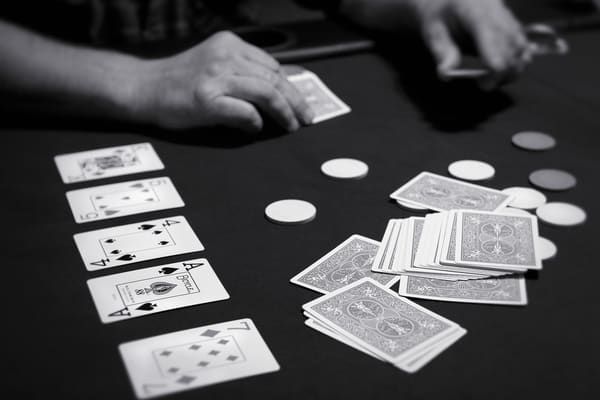
How to Play
The world's most popular poker variant: each player gets 2 hole cards, 5 community cards are shared, and the best 5-card hand wins. Four betting rounds (pre-flop, flop, turn, river); typically played No-Limit with stack-sized all-in bets.
Texas Hold'em is by any measure the most widely played poker variant in the world, the featured game of the World Series of Poker Main Event and the dominant game in modern casino poker rooms and online sites. Each player receives two private 'hole' cards and five shared community cards are dealt face up across the table in three stages (flop: 3 cards, turn: 1 card, river: 1 card). A player's best five-card poker hand is chosen from any combination of their two hole cards and the five community cards, including using zero, one, or both hole cards. Four betting rounds punctuate the dealing (pre-flop, flop, turn, river); players fold, check, call, bet, or raise. The last player standing (or best hand at showdown) wins the pot. Most commonly played No-Limit, allowing any stack-sized all-in bet at any time and producing the dramatic swings that made the game a global television phenomenon in the 2000s.
Quick Reference
- 2 to 10 players, standard 52-card deck.
- Dealer button rotates clockwise; small blind and big blind post forced bets.
- Each player dealt 2 face-down hole cards.
- Pre-flop betting round begins clockwise of the big blind.
- Flop: 3 community cards dealt; second betting round.
- Turn: 4th community card; third betting round.
- River: 5th community card; final betting round, then showdown.
- Best 5-card hand of the 7 available cards wins the pot.
- Hand rankings: high card < pair < two pair < trips < straight < flush < full house < quads < straight flush < royal flush.
- Ties split the pot equally.
Players
2 to 10 players per table. Two-player 'heads-up' is the purest form and has the sharpest strategic demands. The most common full-ring table is 6 or 9 players; many casino cash-game tables now use 6-max (six seats). Play proceeds clockwise; the dealer button rotates clockwise after each hand to equalise positional advantage. Sessions range from a single 10-minute cash-game orbit to a multi-day tournament.
Card Deck
One standard 52-card French-suited pack with jokers removed. Suits are unranked for hand comparison. Card ranking within a hand: Ace (high, also low in a 5-4-3-2-A wheel straight), King, Queen, Jack, 10, 9, 8, 7, 6, 5, 4, 3, 2. Standard poker-hand rankings apply.
Objective
Win chips by either (a) having the best 5-card hand at showdown, or (b) forcing all other players to fold their hands before showdown through aggressive betting. The winner of each hand takes the entire pot; ties split the pot evenly among tied hands. A tournament winner is the last player with chips; a cash-game 'winner' is whoever leaves the table with more chips than they bought in with.
Setup and Deal
- Place the dealer button in front of the nominal dealer (who does not physically deal in a casino; a pit dealer does, but the button marks the positional dealer for each hand).
- Small blind: The player immediately clockwise of the button posts the small blind (typically half the big blind).
- Big blind: The next player clockwise posts the big blind (the stake size of the table, e.g. $2 at a $1/$2 table).
- The dealer shuffles the 52-card deck and deals 2 face-down hole cards to each player, one at a time starting with the small blind.
- Each player looks only at their own hole cards; the cards remain private for the entire hand unless and until revealed at showdown.
Betting Rounds and Dealing
- Pre-flop betting: Begins with the player clockwise of the big blind (Under-the-Gun or UTG) and proceeds clockwise. Each player folds, calls (matches the big blind), or raises (bets more). The betting round continues until all active players have matched the highest bet or folded.
- Flop: The dealer 'burns' (discards face-down) the top card of the deck, then deals three community cards face-up in the centre of the table. These are shared by all active players.
- Flop betting: Begins with the first active player clockwise of the button (small blind if still in). Players may check (pass with no bet), bet, call, raise, or fold.
- Turn: Burn one card, deal one community card face-up next to the flop (4 community cards total).
- Turn betting: Another round, same rules as flop.
- River: Burn one card, deal the fifth and final community card face-up (5 community cards total).
- River betting: The final betting round.
- Showdown: If two or more players remain after the river betting, hands are revealed. The last aggressor (last player to bet or raise on the river) shows first; if everyone checked, the first active player clockwise of the button shows first. The best 5-card hand wins the pot. Ties split equally.
- Before showdown: If at any point in the hand every active player except one folds, the remaining player wins the pot without revealing their hole cards.
Hand Rankings (high to low)
- Royal Flush: A-K-Q-J-10 all of the same suit.
- Straight Flush: Five cards of the same suit in sequence (e.g., 9-8-7-6-5 all hearts).
- Four of a Kind: Four cards of the same rank plus any kicker.
- Full House: Three of a kind plus a pair.
- Flush: Five cards of the same suit, not in sequence.
- Straight: Five cards in sequence, mixed suits. Ace may be high (A-K-Q-J-10) or low (5-4-3-2-A wheel); no wrap-arounds.
- Three of a Kind: Three cards of the same rank plus two unmatched kickers.
- Two Pair: Two pairs of different ranks plus one kicker.
- One Pair: Two cards of the same rank plus three unmatched kickers.
- High Card: Five unmatched cards; the highest card wins, ties broken by the next-highest kicker and so on down the hand.
- Within the same category, the rank-specific hand (e.g., a pair of Kings beats a pair of Jacks) wins; ties are broken by kickers.
Betting Structures
- No-Limit Hold'em (NLHE): Most common format. A player may bet or raise any amount from a minimum raise up to all of their chips at the table (all-in). Produces maximum variance and strategic depth.
- Pot-Limit Hold'em (PLHE): Bets and raises may be any amount up to the current size of the pot. Less common than No-Limit in Hold'em specifically (more common in Omaha).
- Fixed-Limit Hold'em (Limit): Bets and raises are fixed amounts: a 'small bet' pre-flop and on the flop, a 'big bet' (double the small bet) on the turn and river. Four bets per street maximum.
- Minimum raise rule: A raise must be at least equal to the size of the previous bet or raise on that street (or the big blind, pre-flop first raise).
- All-in and side pots: A player with insufficient chips to call a bet goes 'all-in' for what they have. Any additional action by other players creates a side pot that the all-in player cannot win; only the main pot (up to the all-in's chip count × number of contributors) can be won by the all-in.
Winning
Each hand ends with one or more players winning the pot. A cash-game session ends when a player decides to leave; a player 'wins' a session by leaving with more chips than they bought in with. A tournament ends when one player holds all the chips; that player wins first prize per the prize pool structure.
Common Variations
- Tournament Hold'em: Fixed buy-in converts to a starting stack; blinds escalate on a timed clock; players are eliminated as they bust out; winner is last player with chips. Includes freezeouts (no rebuys), rebuys, and re-entries.
- Cash Game (Ring Game): Fixed blinds; chips represent real money; players may buy in or leave at any time.
- Sit-and-Go: Small single-table tournament that starts when a fixed number of players register (usually 6 or 9); typical prize structure pays top 2 or 3 players.
- Hyper-Turbo: Tournament format with very short blind levels (2-3 minutes) producing an extreme-variance format, popular online.
- Heads-Up: One-on-one Hold'em. Blinds are posted differently (button = small blind, opponent = big blind); the button acts first pre-flop and last post-flop.
- Bomb Pots: Home-game variation where every player posts a forced bet pre-flop, the flop is dealt immediately, and players begin acting on the flop; creates large pots without preflop play.
- Straddle: A voluntary blind post by the player UTG equal to double the big blind (doubling the effective big blind for that hand); adds action to cash games.
Tips and Strategy
- Position is the single most important factor in Hold'em: acting last on every post-flop street means you see what your opponents do before you decide. Play more hands from the button and cutoff; play fewer from under-the-gun and early positions.
- Starting hand selection matters. The top premium hands (AA, KK, QQ, AKs) should be played aggressively from any position; medium pairs and suited connectors prefer late position or multi-way pots.
- Pot odds and implied odds: when deciding whether to call a bet with a drawing hand, compare the cost of the call to the size of the pot. Chasing a flush draw (9 outs, ~36% to hit by the river) for 30% pot odds is profitable; chasing for 50% pot odds is not.
- Aggression beats passivity. Calling is weaker than betting or raising because calling only wins at showdown, while betting wins both at showdown AND when opponents fold.
- Observe opponent tendencies over tells. A player who raises 40% of pots is a loose aggressive player; a player who enters 10% of pots is a tight player. Adjust your strategy (bluff the tight, value-bet the loose) accordingly.
- Bankroll management: a conservative No-Limit cash-game bankroll is at least 20 to 30 buy-ins at your chosen stake; tournament bankrolls need 100+ buy-ins to absorb variance.
Glossary
- Hole cards: Your two private face-down cards.
- Community cards: The five shared face-up cards (flop, turn, river).
- Dealer button: The disc marking the nominal dealer position; rotates clockwise after each hand.
- Small blind, big blind: Forced pre-flop bets by the two players clockwise of the button.
- Pre-flop, flop, turn, river: The four streets (betting rounds) of a Hold'em hand.
- Position: Your seat relative to the button. Late position (button, cutoff) is strongest; early position (UTG, UTG+1) is weakest.
- Call / Raise / Fold / Check / Bet: The five betting actions available to a player.
- All-in: Betting every chip you have at the table.
- Side pot: The pot created when some players have more chips than an all-in player; only covering players can win it.
- Showdown: Revealing hands after the river betting ends; best 5-card hand wins.
- Kicker: An unpaired card used to break ties between hands of the same category.
Tips & Strategy
Position is everything: play more hands from the button and cutoff, fewer from early position. Know pot odds and only chase draws when the pot is paying you at least your draw's odds (a flush draw needs roughly 4:1 pot odds). Aggression beats passivity; betting wins at showdown AND on folds, while calling only wins at showdown. Observe opponent tendencies (loose vs tight, passive vs aggressive) and adjust.
Texas Hold'em is a game of incomplete information and long-run expected value. Position (acting last post-flop) gives you a structural edge on every hand; disciplined position-aware hand selection beats random aggressive play across a large sample. Modern solver-derived strategy emphasises balanced ranges (value hands and bluffs in similar frequencies at each bet size) to prevent exploitation. Players who memorise specific starting-hand charts without understanding the underlying logic (position, stack size, opponent profile) plateau quickly; players who learn pot odds, implied odds, and opponent modelling continuously improve.
Trivia & Fun Facts
Texas Hold'em is the centrepiece of the World Series of Poker Main Event, held annually in Las Vegas with a $10,000 buy-in and typically $8-10 million top prize. The Texas State Legislature formally recognised Robstown, Texas as the birthplace of Texas Hold'em in 2007. The 2003 Main Event win by amateur Chris Moneymaker, broadcast on ESPN with hole-card cameras, is widely credited with transforming poker from a niche card game into a global television sport and online phenomenon.
-
01What Texas town is formally recognised as the birthplace of Texas Hold'em, and in what year was it introduced to Las Vegas?Answer Robstown, Texas; it was introduced to Las Vegas in 1967 by a group of Texan gamblers including Doyle Brunson and Amarillo Slim.
-
02What is the 'Moneymaker effect' and why does it matter to Texas Hold'em's history?Answer The term refers to amateur Chris Moneymaker's 2003 World Series of Poker Main Event win (earned by qualifying through a $39 online satellite), which sparked a massive global poker boom and cemented Hold'em as the world's dominant poker variant.
History & Culture
Texas Hold'em is believed to have originated in the small Texas town of Robstown in the early 1900s and was introduced to Las Vegas in 1967 by a group of Texan gamblers including Crandall Addington, Doyle Brunson, and Amarillo Slim. It first appeared at Binion's Horseshoe in downtown Vegas that year and became the featured game of the World Series of Poker when Benny Binion founded the series in 1970. The 2003 Main Event win by amateur Chris Moneymaker (who qualified through a $39 online satellite) sparked the 'Moneymaker effect' and the global poker boom of 2003-2010, during which Hold'em displaced other poker variants as the dominant form worldwide.
Texas Hold'em is the canonical modern poker game, globally associated with the World Series of Poker, James Bond's 'Casino Royale' (2006 film), and the televised poker boom of the 2000s. It is played in almost every casino in the world, on hundreds of online poker sites, and in home games across every continent. The game has generated a massive body of strategic literature (Harrington, Sklansky, Brunson), a professional player subculture, and one of the largest annual recurring prize pools in any card game worldwide.
Variations & House Rules
Tournament Hold'em uses escalating blinds and elimination until one player holds all chips. Cash games use fixed blinds and chips represent real money. Sit-and-Go is a single-table mini-tournament. Heads-Up is 1v1 Hold'em with modified blind positions. Bomb Pots and Straddle are home-game action boosters. Betting structures (No-Limit, Pot-Limit, Fixed-Limit) radically change tactical play.
For home games, start with $5/$10 cent blinds and $20 buy-ins so novices experience real decisions without real financial risk. Introduce tournament structure (escalating blinds every 15-20 minutes, one rebuy allowed in the first hour) for longer games. Use a Bomb Pot every 10 hands (everyone posts a big-blind-size bet and the flop is dealt) to build a party atmosphere. Consider removing the river street for faster rounds with beginners.


