
How to Play
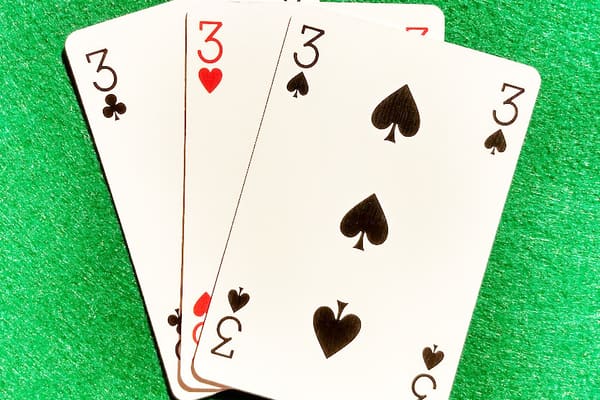
Three-Card Brag is a classic British gambling card game and a direct ancestor of Poker. Each player gets 3 cards; a single betting round follows with two betting modes (open and blind-at-half-cost). Prial (three of a kind) is the top hand and three 3s beats three aces; A-2-3 is the best run and running flush.
Three-Card Brag (or simply Brag) is a classic British gambling card game, a direct ancestor of modern Poker and a mainstay of pubs, working-men's clubs, and family Christmases across the UK. Four to eight players use a standard 52-card pack; each is dealt 3 cards face-down. A single continuous betting round follows, with players either FOLDING or BETTING at least the current stake to stay in. There is no 'checking' and no drawing new cards. Two unusual features define the game's character. First, a player may play BLIND (without looking at their cards), and a blind player bets at HALF the open rate, giving bluffers a huge structural weapon. Second, hands rank in an unusual order: a PRIAL (three of a kind) is highest, with three 3s being the strongest prial of all, beating even three aces; and the highest running flush is A-2-3 (not Q-K-A). When just two players remain, one may pay DOUBLE the current stake to SEE their opponent; both hands are revealed and the higher-ranked hand wins the pot, with ties going to the non-seeing player. A 'seen' blind is impossible: you cannot see a blind player; you can only see another open player. Brag is as much a game of psychology as hands.
Quick Reference
- 4 to 8 players with a standard 52-card deck.
- Agree stakes, ante into the pot, and deal 3 cards face-down to each.
- Cards are NOT reshuffled between hands; used cards go under the stock.
- Single continuous betting round starting left of dealer.
- Play OPEN (look at cards, bet full stake) or BLIND (no look, bet half-stake).
- No checking; bet or fold to stay in. When 2 remain, either open player may SEE by paying double the stake.
- Rankings: Prial (three of a kind, 3-3-3 highest) > Running Flush (A-2-3 top) > Run (A-2-3 top) > Flush > Pair > High Card.
- Tied hands at a see: non-seer wins.
- You cannot see a blind player.
Players
4 to 8 players, each for themselves (occasionally 2 or 3 for a very short game). The British pub standard is 5 or 6 players. A single hand takes 3 to 10 minutes; an evening session runs 1 to 3 hours. Turn order is clockwise; the dealer is chosen by cut (highest card) and rotates clockwise. Games are played for money in most pubs, or for chips in family settings.
Card Deck
- Standard 52-card French-suited pack. No jokers.
- Card rank (for hand comparison): A (high), K, Q, J, 10, 9, 8, 7, 6, 5, 4, 3, 2 (low), with the notable Brag-specific rule that A-2-3 of the same suit is the HIGHEST running flush (and A-2-3 is the HIGHEST run).
- Suits are equal except where noted for tiebreaker edge cases (see Tiebreakers below).
- Chips or coins are needed for stakes; a minimum unit (commonly 10p, 50p, or £1) is agreed before the session.
Objective
Win the pot on each hand, either by having the highest-ranking 3-card hand at a SEE (the forced showdown) or by betting aggressively enough that every other player folds. Over a session, the player with the most chips wins.
Hand Rankings (Highest to Lowest)
- Prial (three of a kind): three cards of the same rank. Threes (3-3-3) is the highest prial; then A-A-A, K-K-K, Q-Q-Q, down to 2-2-2.
- Running Flush (straight flush): three consecutive cards of the same suit. A-2-3 is the highest running flush, then A-K-Q, then K-Q-J, down to 4-3-2.
- Run (straight): three consecutive cards of mixed suits. A-2-3 is the highest run; otherwise ranked by top card.
- Flush: three same-suit cards, not in sequence. Compared by highest card, then middle, then lowest.
- Pair: two of a rank plus a kicker. Ranked by the pair's rank, then by the kicker.
- High card: no combination. Ranked by highest card, then middle, then low.
- Tiebreakers: in equal-ranked hands (e.g., two players both hold K-high flushes with the same three ranks in different suits), the hand of the SEEING player loses; ties go to the player who was SEEN, not the seer.
Setup and Ante
- Agree the minimum stake and any maximum before dealing.
- Each player antes one unit into the pot (optional but typical; some Brag schools only ante when a prial was dealt on the previous hand).
- The dealer shuffles only if the previous hand was decided by a SEE ending in a prial; otherwise used cards are placed under the stock, so Brag is one of the few games where cards are not reshuffled every deal.
- The player to the dealer's right cuts (unless cards were not reshuffled; then no cut).
- Deal 3 cards face-down to each player, one at a time, clockwise.
- The dealer's left begins the betting.
Playing a Hand: Open vs Blind
- Each player decides, BEFORE looking at their hand, whether to play OPEN (look at the cards) or BLIND (never look at the cards).
- The first player to bet (left of dealer) must contribute at least the minimum stake to stay in. Subsequent bets may equal or RAISE the current stake.
- Open (seen) bets: if you have looked at your cards, you must bet the current stake in full to stay.
- Blind bets: if you have not looked, you bet HALF the current open stake. A blind player may also raise; a blind raise becomes the new 'open' stake (doubled when a subsequent seer calls).
- No checking: you may not pass without folding or betting at least the current stake (blind or full).
- Folding: discard your hand face-down; you forfeit any bets already in the pot.
- A blind player may look at their cards at any point; from the next bet they are an open (seen) player at the full rate.
- A blind player who wins a hand (all opponents folded) may choose to KEEP their blind hand for the next deal; they are dealt a new blind hand, must commit to one or the other without looking at both, and continue as a blind player.
The See (Showdown)
- When only TWO players remain in the hand, either open player may choose to SEE the other by paying DOUBLE the current open stake into the pot.
- You cannot see a blind player. If the remaining opponent is blind, the open player can only fold or continue betting. The blind player can be seen only after they look (becoming open) or if you yourself are also blind (see below).
- Blind-vs-blind see: a blind player may see another blind player by paying the equivalent of 2 blind stakes (equal to one open stake).
- After a see is paid, both remaining players reveal their hands; the higher hand wins the pot. If the hands are identical in rank and cards, the non-seer wins (the seer takes a penalty for forcing a reveal).
- If all but one player has folded before a see, the last player standing wins the pot without revealing their cards.
Between Hands: The Non-Reshuffle Rule
Brag has an unusual convention: used cards are NOT shuffled back into the deck after each hand. Instead, the used cards are placed at the bottom of the current deck, and the next deal continues from the top. Cards accumulate memory across hands; experienced players track roughly which cards have been active recently. Reshuffling is triggered only by specific events (for example, a prial appearing at showdown, or when all used cards are below the undealt cards).
Winning
No fixed endpoint exists; the session ends when the group decides (often at a pub's last orders, or after a pre-agreed time). The winner is whoever has accumulated the most chips or money across the session. In casual home play, set a 20- or 30-hand limit; the player with the most chips at the end wins the match.
Common Variations
- Four-Card Brag: players are dealt 4 cards and discard 1 before the betting round. Discards act as tiebreakers; hand rankings are similar but adapted to 4-card combinations.
- Five-Card Brag: 5 cards dealt, 2 discarded; richer hand-building phase before betting begins.
- Seven-Card Brag (Stud Brag): each player receives 7 cards and forms two 3-card hands plus a discard; unusual and specialised.
- American Brag: the 19th-century American variant, with wild cards (often 9s or Aces) and rules closer to early Poker.
- Lowball Brag / Low Brag: the lowest 3-card combination wins, with 2-3-4 of mixed suits (an 'ace-low' straight) being the best.
- Open stake / no-blind: some pub schools forbid blind play for simpler beginner sessions; bluffing loses its structural edge.
- Pot limit: raises capped at the current pot size; used in organised tournaments.
- Teen Patti: the dominant Indian relative of Brag, played across South Asia with nearly identical mechanics; see its own entry for cultural differences.
Tips and Strategy
- Play blind early in a session to apply pressure at half the stake; even average cards can win if opponents fold.
- Stay blind only as long as the pot size justifies the risk. Once the open stake becomes large, look and commit, or fold.
- Track which opponents have been aggressive; a player who has already bluffed once is more likely to do it again, and you should call more readily.
- Three 3s is the nuts (best hand). If you hold it, slow-play: small bets until the pot is huge, then raise.
- A-2-3 is the best run and running flush; it confuses newcomers who expect A-K-Q. Remember that rule.
- When forced into a see, prefer it against a seeming bluffer (who is betting aggressively on a short stack of previous wins); avoid seeing a player who plays tight.
- Avoid betting light at the table minimum forever. Tight players bleed slowly; aggressive players either dominate or bust, but they show card agency.
Glossary
- Prial: three cards of the same rank; the top hand rank, with 3-3-3 the highest prial.
- Running flush: three consecutive cards of the same suit; A-2-3 highest.
- Run: three consecutive cards, any suits; A-2-3 highest.
- Blind: playing without looking at your cards; blind bets cost half the open stake.
- Open / seen: playing with knowledge of your cards; bets cost the full stake.
- See: a paid showdown (double the current open stake) when two players remain; both expose cards and high hand wins.
- Stake: the current bet amount required to stay in the hand.
- Tie / stand-off: equal-ranked hands at a see; the non-seer (the player who was seen) wins.
- Ante: optional pre-hand contribution by every player.
Tips & Strategy
Play blind early to pressure opponents at half the stake; bluffing from the blind is the signature Brag weapon. Remember the unusual hand rankings: three 3s is the highest prial (it beats three aces), and A-2-3 is the highest run and running flush (not A-K-Q). When two players remain and you are in profit, it is often right to see rather than continue betting; but never see a blind player (you cannot). Track aggressive opponents; a player who bluffed once is statistically likely to bluff again, which makes calling them correct.
Brag is as much a bluffing game as a hand-ranking game. The blind rule is the central strategic weapon: betting at half-cost from the blind lets a player apply enormous pressure for little chips, especially when the pot is still small. Tracking opponent aggression across hands matters more than any single hand; a player who has just won on a big bluff is likely to try again soon. Tiebreaker awareness (non-seer wins equal hands) shifts many borderline see decisions; a good rule of thumb is: see if you think you have even a slight edge over the opponent's range, because a tied hand hurts them, not you.
Trivia & Fun Facts
The English verb 'to brag' originally meant to display ostentatiously; the game takes its name from the betting behaviour it rewards. The unusual rule that three 3s beats three aces is often explained historically as an attempt by tavern players to give the lowest card a brief moment of glory, and it is a classic trap for players whose Poker instincts tell them 'aces always top'. Brag is one of the few commercially published card games where cards are NOT reshuffled after every hand under standard rules.
-
01In 3-card Brag, what is the single highest prial (three of a kind), and why does this rule often surprise new players?Answer Three 3s (3-3-3) is the highest prial, beating even three aces (A-A-A). This inverted-ranking rule surprises players familiar with Poker, where aces are always the top rank. The rule is a deliberate Brag tradition, not an error, and gives the lowest-numbered card a unique hand-winning role.
-
02What does it mean to 'see' your opponent in 3-card Brag, and what restriction applies to seeing a blind player?Answer 'Seeing' is paying DOUBLE the current open stake to force a showdown when two players remain; both then expose cards and the higher hand wins the pot. The key restriction is that you CANNOT see a blind player: you can only see another open player. A blind opponent must first choose to look at their cards (becoming open) before you can pay to see them.
History & Culture
Brag is documented in England from the mid-18th century and derives from older three-card staking games such as Primero (16th century). It is the direct ancestor of Poker: American gamblers in the 19th century added a draw phase and five-card hands to Brag's structure, producing the Flush Draw and Poker Draw variants that became classic Poker. Brag remains a pub and working-men's-club staple across the UK, often played during lunch hours and evening sessions for small stakes.
Brag is an emblematic British pub and club card game, widely played across England, Wales, and Scotland. It has been a fixture of working-class gambling culture since Victorian times, and it retains strong regional identities (Manchester, Yorkshire, and East End London schools all have their own house-rule variants). As Poker's direct ancestor, Brag also has a strong historical status in the development of modern gambling games.
Variations & House Rules
Four-Card Brag (4 dealt, 1 discarded) and Five-Card Brag (5 dealt, 2 discarded) are the main home variants. Seven-Card / Stud Brag is more complex and rare. American Brag (with wild cards and simpler betting) is an older relative that fed into Poker. Lowball Brag inverts the hand ranking. Pot-limit Brag is used in organised modern tournaments. The Indian cousin Teen Patti is mechanically identical and hugely popular across South Asia.
For new players, play open-only (no blind rule) for the first session so they learn hand rankings without the bluff pressure. For pubs, enforce a fixed table minimum (10p or £1 per unit) to keep stakes casual. For longer sessions, introduce a pot-limit raise cap so single aggressive players cannot blow the bank. Reshuffle on every hand (rather than placing used cards at the bottom) if card-memory feels unfair to newcomers.


