
How to Play
Rook is a 4-player partnership trick-taking game played with a dedicated deck of numbered cards, four colors from 1 to 14 plus a distinctive Rook bird card, instead of standard suits. Players bid for the right to name trump and rework their hand using a hidden 5-card nest, then play out 13 tricks to capture point-cards worth 120 points in total per deal. The bidding partnership must capture at least as many points as its bid or be 'set' and lose points equal to the bid; the defending partnership simply banks whatever it captures. Matches typically run to 300 points, and the game remains especially popular across the American Midwest and in Mennonite and Amish communities that historically avoided standard playing cards.
Rook is a 4-player partnership trick-taking game played with a dedicated deck of numbered cards instead of standard suits, originally created in the early 1900s as a card game acceptable to religious communities who considered ordinary playing cards inappropriate because of their gambling associations. Players bid for the right to name a trump color and rework their hand from a hidden 5-card nest, then play out 13 tricks to capture point-cards worth 120 points in total per deal. The bidding partnership must capture at least as many points as its bid or be 'set' and lose points equal to the bid, while the defending partnership simply banks whatever points it wins. Matches typically run to a target of 300 points across several deals. Rook remains especially popular across the American Midwest and Bible Belt, and in Mennonite and Amish communities, where it is often the primary card game played in the household.
Quick Reference
- 4 players in 2 fixed partnerships; deal 13 cards to each player from the 57-card Rook deck.
- Set the remaining 5 cards face-down as the nest; agree a match target (300 points) and minimum opening bid (70) beforehand.
- Bidding proceeds clockwise from the dealer's left in multiples of 5 points.
- Highest bidder takes the nest, names trump, and buries 5 cards back down to a 13-card hand.
- Bidder leads the first trick; players must follow the color led or may play any card, including trump, if void.
- Highest trump played wins the trick, or the highest card of the color led if no trump was played; the Rook card always wins outright.
- Each side totals the point-cards its tricks captured; the bidder's buried cards also count for the bidding side.
- Bidding side scores its actual points if it met its bid, or loses points equal to the bid if it fell short ('set').
- Defenders always score whatever points they captured, regardless of the bid's outcome.
Players
Exactly 4 players in 2 fixed partnerships, with partners seated opposite each other. Rook also scales down to a 3-player 'cutthroat' game with no partnerships and a larger individual hand, and up to 5- or 6-player forms exist in various house rules, though these are far less common than the standard 4-player partnership game. Play proceeds clockwise from a rotating dealer position. A single hand takes about 15-20 minutes including bidding; a full match to 300 points typically runs 60-90 minutes.
Card Deck
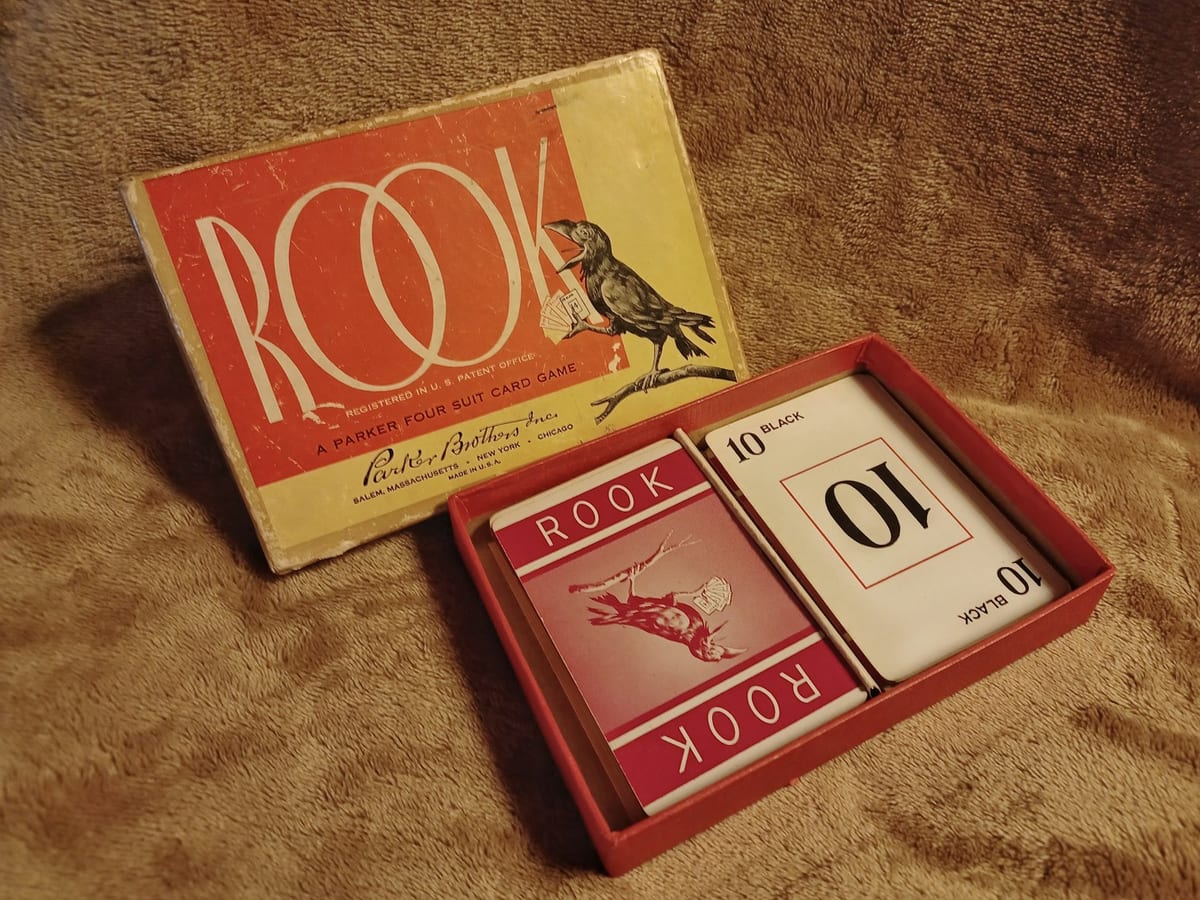
- A dedicated 57-card Rook deck: four colors, Black, Red, Yellow, and Green, each numbered 1 through 14 (56 cards total), plus one special Rook card showing a black bird. There are no standard suits, jacks, queens, or kings anywhere in the deck.
- Rank order within a color (high to low): 14, 13, 12, 11, 10, 9, 8, 7, 6, 5, 4, 3, 2, 1. Every card is simply a number; the 1 is the lowest card in its color, not a reversed high card.
- Point cards: in every color, the 5 is worth 5 points, and both the 10 and the 14 are worth 10 points each. All other numbers (1, 2, 3, 4, 6, 7, 8, 9, 11, 12, 13) are worth 0 points but still win tricks normally.
- Total points in play: 100 points across the four colors' point-cards (25 per color) plus the Rook card's own 20 points, for exactly 120 points available in every deal.
- The Rook card is an automatic trump. Whichever color is named trump for the hand, the Rook card outranks even the 14 of that color and cannot be beaten by any other card in the deck.
Objective
Bid for the right to name a trump color, then work with your partner to capture point-cards in tricks. If your partnership's total captured points, including any point-cards buried from the nest, meet or beat your bid, you score the full number of points you actually captured. If you fall short, you are 'set' and lose points equal to your bid instead. The opposing partnership simply banks whatever points it captures, regardless of the bid's outcome. The first partnership to reach the agreed target score, 300 points is standard, wins the match.
Setup
- Shuffle the full 57-card Rook deck.
- Deal 13 cards to each of the 4 players, one at a time clockwise, starting with the player to the dealer's left.
- Place the remaining 5 cards face-down in the center as the 'nest' (also called the widow). Nobody looks at the nest until the bidding is decided.
- Agree the match target (300 points is standard) and the minimum opening bid (70 points is the usual house minimum) before the first hand.
- After each hand, the deal passes one seat clockwise.
Bidding
- Starting with the player to the dealer's left and moving clockwise, each player in turn either passes or names a bid higher than the previous bid, in multiples of 5 points.
- Minimum opening bid: most tables require the first bid to be at least 70; a player unwilling to go that high simply passes.
- Bidding continues around the table, with passed players dropping out, until only one player is still bidding. That player becomes the bidder, and their partnership becomes the bidding side for the hand.
- If every player passes without a bid, the hand is thrown in and redealt by the same dealer, or, in some house rules, the dealer is forced to accept the minimum bid.
- The winning bidder picks up all 5 nest cards, adding them to their hand for a total of 18 cards, and privately decides the trump color.
- The bidder announces the trump color, then discards 5 cards face-down (buried) to return to a 13-card hand. The point value of every buried point-card counts toward the bidding partnership's total at the end of the hand, exactly as if it had been captured in a trick.
Gameplay
- The winning bidder leads the first trick, in any color they choose.
- Follow suit if possible. Each other player, in clockwise order, must play a card of the color led if they hold one.
- If void in the color led, a player may play any card in hand, including a trump card or the Rook card.
- Winning the trick: if no trump was played, the highest card of the color led wins. If one or more trumps were played, the highest trump played wins; the Rook card beats every other card outright. The trick winner gathers the four cards face-down and leads the next trick.
- The Rook card counts as trump whenever it is played, whether led or played on another color; a player leading the Rook card is considered to have led trump.
- Play continues until all 13 tricks have been taken; every card in every hand is eventually played.
Scoring
- After all 13 tricks are played, each partnership adds up the point-cards (5s, 10s, 14s, and the Rook card) captured in the tricks it won.
- Add the buried nest cards to the bidding side. The point value of every point-card the bidder discarded into the nest during bidding is added to the bidding partnership's total, regardless of who would otherwise have captured it.
- Bid made: if the bidding partnership's total (tricks plus buried cards) is equal to or greater than its bid, it scores the FULL number of points it actually captured, which can be more than the bid itself.
- Bid failed ('set'): if the bidding partnership's total falls short of its bid, it scores NEGATIVE its bid amount for the hand, regardless of how many points it actually captured.
- Defenders always score their captured points. The non-bidding partnership banks whatever points its tricks contain, win or lose, since it was never at risk of being set.
- Record both partnerships' running totals after every hand; a match can include negative team scores after a failed high bid.
Winning
The match ends the moment a partnership's running score reaches or passes the agreed target, 300 points in the standard game, at the close of a completed hand. Because a failed bid subtracts the FULL bid amount from the bidding team's score, a match can swing sharply: a partnership sitting near the target can be pushed back to a much lower or negative score by one overly ambitious bid. If both partnerships cross the target in the same hand, the higher total wins; if the two totals are exactly tied, the players deal and play one additional hand as a tiebreaker.
Variations
- Adjusted nest size: some tables use a 4-card or 6-card nest instead of 5, changing how much of the deck the bidder can rework; agree the nest size before dealing.
- No-nest (straight) Rook: deals out the entire deck evenly with no nest at all, removing the bidder's ability to improve their hand; bidding becomes purely a hand-strength contest.
- Called-card partnership: instead of bidding for a known partner, some house rules let the bidder call a specific card to secretly determine their hidden partner for the hand.
- Cutthroat (3-player) Rook: no partnerships; each player plays for themselves with a larger individual hand and nest, and points are tracked per player rather than per team.
- Double bird: some vintage and specialty decks include a second Rook card, worth an extra 20 points and ranking just below the original Rook card.
Tips and Strategy
- Count your certain point-cards before bidding. Only bid confidently on the 14s, 10s, and 5s you hold in a color you could plausibly name as trump; the many zero-point numbers in the deck win tricks but add nothing to your score.
- A long trump color beats scattered high cards. A hand with 5 or more cards in one color plus the Rook card is usually strong enough to draw out opposing trump within two or three leads and then run the remaining tricks safely.
- Bury your weakest exposed point-cards, not your control trump. Points buried in the nest are locked into your side's score immediately, so bury cards you would likely lose in play anyway rather than trump you need to manage the hand.
- Watch what your partner discards on tricks they cannot win. A partner's discard signals which colors they are short in and helps you judge whether to keep leading trump or switch to developing a side color.
- Defenders should count captured points, not tricks. Since the Rook card and the 14s carry most of the value, a defending side that captures one trick containing the Rook card may score more than a side that wins several tricks of zero-point filler.
Glossary
- Trick: one round of each of the four players playing a single card; the highest card of the color led, or the highest trump if any was played, wins it.
- Trump: the color named by the winning bidder that outranks the other three colors for the rest of the hand.
- Nest (widow): the extra cards dealt face-down at the start of the hand; the winning bidder picks them up and discards back down to a full hand.
- Bury: to discard a card face-down after picking up the nest; buried point-cards count for the bidding side at the end of the hand.
- Follow suit: to play a card of the same color as the one led, when you hold one; Rook requires this whenever possible.
- Set: to fail your bid, losing points equal to the bid amount instead of scoring the points captured.
- Point-card: any 5, 10, or 14, or the Rook card; the only cards worth score at the end of a hand.
Tips & Strategy
Before bidding, count only your certain point-cards, the 14s, 10s, and 5s you hold in a color you could plausibly name as trump, since the many zero-point numbers in the deck win tricks but add nothing to your score. A hand with 5 or more cards in one color plus the Rook card is usually strong enough to control the hand from the first trick. When you win the bid, bury your weakest, most exposed point-cards from colors you cannot protect rather than trump you will need to draw out opposing cards; buried points are locked in immediately regardless of how the rest of the hand plays out. As a defender, watch for what your partner discards when unable to follow a color; that tells you which colors they are short in and helps you decide whether to keep supporting trump leads or develop a side color instead. Track how many points, not tricks, have been captured; a single trick containing the Rook card is worth more than several tricks of zero-point filler.
The deepest skill in Rook is bidding discipline: overbidding by even 10-15 points on a shaky hand can turn a comfortable lead into a deficit once the 'set' penalty is applied, since the penalty is the full bid amount rather than the shortfall. The second skill is nest management: a skilled bidder reads the 5 nest cards not just for points but for how they reshape which color to declare trump, sometimes abandoning their pre-bid plan entirely once the nest is seen. The third skill is tracking buried and played point-cards throughout the hand; because only 3 numbers per color (the 5, 10, and 14), plus the trump-wide Rook, actually matter for score, strong players effectively reduce a 57-card deck to a compact scoring puzzle in their head.
Trivia & Fun Facts
The Rook card, showing a black crow-like bird, is worth 20 points on its own, more than a full color's worth of 5s, 10s, and 14s combined would be if any single one were missing. Despite having no aces or face cards, Rook still totals exactly 120 points per deal, a scoring pool comparable in size to several unrelated trick-taking games worldwide. Because the deck avoids suits and gambling imagery entirely, Rook decks have historically been sold in general stores and given as gifts in households that would never have permitted standard playing cards through the door. Some vintage Rook decks included two Rook cards instead of one, a printing variation collectors still look for today.
-
01How many total points are available to capture in a single hand of Rook, and which single card is worth the most on its own?Answer 120 points are in play every deal (100 from the 5s, 10s, and 14s across all four colors, plus 20 more), and the single most valuable card is the Rook card, worth 20 points by itself.
-
02What happens to a bidding partnership that fails to capture at least as many points as it bid?Answer The partnership is 'set': instead of scoring the points it actually captured, it loses points equal to the full amount of its bid for that hand.
History & Culture
Rook was introduced by Parker Brothers in 1906, originally marketed as offering the enjoyment of playing cards without the objections associated with standard decks, since it uses no aces, kings, queens, or jacks and none of the suit symbols associated with gambling. The game found a lasting home among religious communities, particularly Mennonites, Amish, and various Protestant denominations across the American Midwest and South, where standard playing cards were considered inappropriate but Rook's numbered deck was not. Parker Brothers, later absorbed into Hasbro, kept Rook in continuous production for over a century, and the game is still manufactured today under the Winning Moves label. Its distinctive black bird card became so recognizable that it lent the game an informal nickname, 'the Christian card game,' in parts of the country where it remains a household staple.
Rook occupies a distinctive niche as a card game built specifically to sidestep religious objections to gambling-associated playing cards, and it succeeded well enough to remain in continuous commercial production for well over a century. It is closely associated with Mennonite, Amish, and other Anabaptist and Protestant communities across the American Midwest and South, where it is often the primary, or only, card game played at family and church gatherings. Beyond its religious history, Rook is also fondly remembered as a staple of American childhood game closets throughout the 20th century, and it continues to be reprinted for a multigenerational audience that prizes it as much for its distinctive bird-card branding as for its bidding-heavy trick-taking play.
Variations & House Rules
Common variations include adjusting the nest to 4 or 6 cards instead of 5 for a different balance of hand improvement, playing a 'no-nest' version that deals the entire deck evenly and removes the nest altogether, and 3-player cutthroat Rook with no partnerships and a larger individual hand. Some house rules have the bidder call a specific card to secretly determine a hidden partner for the hand, similar to calling-a-partner variants in other trick-taking games. A small number of vintage sets include a second Rook card as a 'double bird' worth an extra 20 points.
For a shorter social game, lower the match target to 200 points; for a marathon session, raise it to 500. Raising the minimum opening bid above 70 speeds up bidding for experienced groups who find low bids too easy to win. New players often do better starting with a fixed, pre-announced trump color for the first few practice hands, removing the bidding step entirely until they are comfortable counting point-cards.


