
How to Play
The classical Malilla / Manille partnership trick-taking game: 32-card pack, the 10 (Manille) is the top card in every suit, strict-follow and strict-overtrump rules, 60 pips per deck, first side past 30 scores the difference. Match to 101.
Malilla (Spanish) or Manille (French/Belgian) is a 19th-century partnership trick-taking game in which the 10 of each suit, called the Manille (or Malilla in Spanish), is the top-ranking card and the Ace, called the Manillon, is second. Four players play in fixed partnerships with a 32-card piquet pack. The dealer fixes trumps by turning up the last card dealt; play is a strict-follow, strict-overtrump trick game with a tiny 32-card total and a mere 60 scoring pips spread across five ranks per suit. Partnerships score the difference between their captured pips and the neutral share of 30, and the first side to 101 (or another agreed target) wins the match. Malilla remains the family card game of northern Spain, Belgium, and parts of Mexico, prized for its disciplined trick play and its structured partner-signalling tradition.
Quick Reference
- 32-card piquet pack (A-K-Q-J-10-9-8-7 in 4 suits). 4 players, partners across.
- Deal 8 cards each anticlockwise; dealer turns up their last card for trumps.
- Rank: 10 (Manille) > A (Manillon) > K > Q > J > 9 > 8 > 7.
- Lead any card anticlockwise from dealer's right.
- Must follow suit; if cannot, must trump AND must overtrump if possible.
- Highest trump or highest card of led suit wins; winner leads next.
- Pips: 10=5, A=4, K=3, Q=2, J=1. 60 pips total, neutral share 30.
- Partnership with more than 30 scores the excess; opponents get 0.
- First side to 101 wins the match.
Players
Exactly 4 players in two fixed partnerships; partners sit across the table. The deal rotates one seat to the right (anticlockwise) after each hand. Match length is traditionally the first side to 101 points, which takes 40 to 70 minutes. Three-handed and two-handed forms exist (see Variations) but the classical game is 4-player partnership.
Card Deck
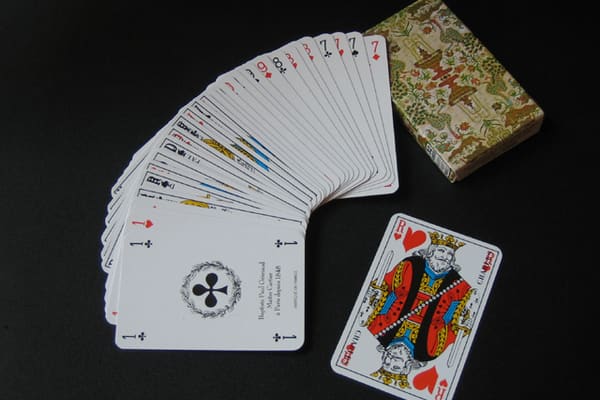
- 32-card piquet pack: A, K, Q, J, 10, 9, 8, 7 in each of four suits. Construct one from a standard 52-card deck by removing all cards 2 through 6.
- Card ranking within a suit, high to low: 10 (Manille / Malilla) > Ace (Manillon) > King > Queen > Jack > 9 > 8 > 7. The 10 sits ABOVE the Ace; this is the defining Malilla quirk.
- Scoring pip values: 10 = 5 points (the Manille), Ace = 4, King = 3, Queen = 2, Jack = 1. 9, 8, 7 = 0 points.
- Total scoring pips per deck: 60 (5 + 4 + 3 + 2 + 1 = 15 per suit × 4 suits). The neutral share (half the pips) is 30.
- Suits are only distinguished by the trump suit, which is fixed each hand by the dealer's up-turned last card.
Objective
Your partnership wants to capture more than 30 pips in a deal. For every pip you collect above 30, your side scores 1 match point; the opposing side loses the same (or scores zero, depending on house rules). Example: partnership A captures 36 pips in a deal, so A scores 6 and B scores 0. The first side to reach 101 match points wins the match.
Setup and Deal
- Cut for first dealer (lowest card deals). Deal rotates anticlockwise (to the right).
- The dealer shuffles, the player on the dealer's left cuts, and the dealer distributes all 32 cards in packets of 3 and 2 (or 4 and 4), anticlockwise starting with the player on the dealer's right. Each player ends with 8 cards.
- The dealer turns their OWN last card face up on the table; this card's suit is trump for the hand. The dealer then picks the card up into their hand before play begins.
- The player to the dealer's right leads the first trick.
Gameplay
- Lead: The opening leader plays any card face up to the centre.
- Follow suit (strict): Each player in anticlockwise order must play a card of the suit led if they hold one.
- Overtrump rule: A player unable to follow suit MUST play a trump if they have any, AND must play a trump HIGHER than any trump already in the trick if they can. If they can follow suit but not beat the current best card of that suit with a higher card, they still must follow. When overtrumping is impossible, they may play any trump (under-trumping is forced if no overtrump is available).
- Partners' exemption: Some traditions exempt a player from overtrumping when their partner is currently winning the trick; check house rules. The classical game enforces the overtrump rule against everyone.
- Discarding: A player holding neither the led suit nor any trump may play any card from hand as a throw-off; such a card cannot win.
- Winning the trick: The highest trump in the trick wins; if no trumps were played, the highest card of the led suit wins. 10s outrank Aces in the same suit.
- Next lead: The trick's winner leads the next trick. Play proceeds through all 8 tricks.
Scoring the Deal
- After all 8 tricks, each partnership collects the cards they captured and counts pip values: 10 = 5, A = 4, K = 3, Q = 2, J = 1, and 9/8/7 = 0.
- Last-trick bonus: In traditional Manille, the partnership winning the LAST (8th) trick adds 1 point to their pip total. The total pips in play including the last-trick bonus are therefore 61 in a bonus variant or 60 without (agree before play).
- The partnership with more than 30 pips scores the difference: pips - 30 = match points for the winners. The losers score 0 that deal.
- If pips split 30-30 exactly, nobody scores and the deal is re-dealt in some traditions; others record 0 for both sides.
- Record running totals and deal the next hand (with a new dealer).
Winning
The match is won by the first partnership to reach 101 match points (50 in a short game; 201 in a long one). If both sides would cross 101 in the same deal, the side with the higher total wins; if they are still tied, play continues until one side has a clear advantage.
Common Variations
- Spanish Malilla: Uses a 40-card Spanish-suited pack (1 through 7 plus 10 / Sota, 11 / Caballo, 12 / Rey). Rankings and scoring mirror the French form: the 9 functions as the Manille (top) because there is no 10, and pip values are the same (9=5, 1=4, 12=3, 11=2, 10=1). The scoring ceiling of 60 and the neutral share of 30 are unchanged.
- Manille Parlée (spoken Manille): Partners may openly discuss strategy during the hand within strict conventions (number of cards left in a suit, presence of specific high cards). This is the classical Belgian form.
- Manille Muette (silent Manille): No communication at all between partners; the purest and hardest form.
- Manille aux Enchères (Auction Manille): A bidding round precedes trumps: players bid how many pips their partnership will make in a suit of their choosing. The highest bidder names trumps. Partnership stays fixed.
- Three-handed Manille: Each player plays alone. A dummy hand is dealt to the centre or cards are removed; scoring compares each player's pips against 20 (40 for 3 players).
- Mexican Malilla: Commonly uses the French-suited 40-card pack (52 minus 8s, 10s), in which case the 9 serves as Malilla and the Ace is the Manillon; the rest of the ranking and pip values mirror the classical form.
Tips and Strategy
- The Manille (10 of each suit) is the most valuable single card in the game: 5 pips AND top rank. Capture opposing Manilles whenever possible.
- Never lead trumps blindly. In Manille the overtrump rule pulls opponents' trumps out fast, so leading from short side suits to force trumping by partners is the usual plan.
- When your partner leads a high card of a side suit (an Ace or King), play your Manille of that suit under it to give them the trick and hand control.
- Count trumps actively: with only 8 trump cards in the deck and the mandatory overtrump rule, most hands see every trump played by trick 5 or 6. Knowing who holds the last trump decides endgames.
- When you hold the Manille of trumps, protect it as long as possible. Lead a small trump first to draw out high trumps, then drop the Manille for a big capture.
- Avoid discarding Jacks early; at 1 pip apiece they add up, and they can still win trump-less side-suit tricks when lower cards have fallen.
Glossary
- Manille / Malilla: The 10 of each suit, the highest-ranking and most valuable card (5 pips).
- Manillon: The Ace, the second-highest card in each suit (4 pips).
- Trump: The suit set by the dealer's up-turned last card; outranks every other suit in play.
- Strict-follow / strict-overtrump: Rules requiring players to follow suit if able and to overtrump if unable to follow suit.
- Pips: The scoring value of captured cards; 60 total per deck, neutral share 30.
- Partnership: Two fixed partners seated across the table; all captures pool for the side's count.
- Parlée / Muette: Spoken and silent Manille traditions; parlée allows limited partner communication.
Tips & Strategy
The 10 (Manille) is 5 pips and the top card in every suit; capturing it is often the swing of a hand. Use the strict-overtrump rule against opponents: leading side-suit winners drags trumps out and leaves your partner's high cards free later.
Because only 60 pips exist and the neutral share is 30, a single Manille (5 pips) or Manillon (4 pips) can swing whether a hand scores at all. The strict-overtrump rule makes trump counting decisive: the side that knows who holds the last trump controls endgame leads. Silent Manille places the full burden on inference rather than signalling.
Trivia & Fun Facts
The word 'Malilla' in Spanish came to mean 'trump card' or 'key advantage' in general parlance, reflecting the game's cultural prominence. French 'Manille' similarly gave rise to figurative expressions for a decisive factor. The Manille-Ace-King-Queen-Jack ranking was later directly adopted by the American game Pinochle via 19th-century German immigrants who played Binokel with a similar scheme.
-
01Which card is the highest-ranking in every suit in Malilla (Manille) and what is its pip value?Answer The 10, called the Manille or Malilla; it is worth 5 pips.
-
02In the classical 32-card form, how many pips must a partnership capture to score any match points?Answer More than 30 (out of 60 pips in play); the excess over 30 becomes the match-point score.
History & Culture
Manille / Malilla emerged in southern France and northern Spain in the early 19th century as the aristocracy's favoured partnership trick-taking pastime before Belote overtook it around 1920. The Spanish-suited form travelled to Mexico and parts of Latin America with colonial-era playing cards, where the game remains a fixture of family card nights. The promotion of the 10 above the Ace makes Malilla one of the earliest documented card games with this distinctive card-ranking quirk, later echoed by Pinochle.
Malilla and its siblings form the backbone of family card gaming across the Pyrenees, in Flanders, in parts of Belgium, and across Mexican and Latin American Spanish-speaking communities. The game's endurance through two centuries of demographic and political change owes much to its blend of skilful partner-coordination and its compact 32-card simplicity.
Variations & House Rules
Manille Parlée allows coded partner communication; Muette forbids it. Auction Manille adds a bidding phase. Spanish Malilla uses a 40-card Spanish deck with the 9 as Malilla. Mexican variants sometimes replace piquet-pack rules with 40 French-suited cards.
For a shorter match, play to 51 points. For a beginners' round, drop the strict-overtrump rule; require only suit-following. Use a notepad to tally pip counts hand-by-hand; the scoring is arithmetic-intensive.


