
How to Play
Manille is a 4-player partnership trick-taking game from France and Spain where the 10 (Manille) is the highest card in every suit, followed by the Ace (Manillon). Uses a 32-card Piquet pack; teams race to 101 cumulative points.
Manille is a classic 4-player partnership trick-taking game from France and Spain, popular since the 17th century. The unusual signature is the card ranking: the 10 is the highest card (the Manille) and the Ace is second (the Manillon). Using a 32-card Piquet pack, teams compete for card points captured in tricks and aim to reach 101 over successive deals (or win the match at an agreed deal count).
Quick Reference
- Shuffle a 32-card Piquet pack; deal 8 cards each to 4 players in fixed partnerships across the table.
- Play counter-clockwise; dealer names trump (four suits) or 'en voiture' (no trump, doubles scoring).
- Eldest hand (to the dealer's right) leads the first trick.
- Follow suit if able; otherwise you must trump if you hold any, and you must overtrump a trump winner if you can.
- Rank order high to low: 10 (Manille, 5 pts), Ace (Manillon, 4), King (3), Queen (2), Jack (1), 9, 8, 7 (0 each).
- Highest trump wins the trick; otherwise highest card of the led suit.
- Per deal: 60 card points; winning team scores (captured minus 30), or a fixed 1-6 by margin in some houses.
- En voiture (no trump): scoring doubles. Match ends at 101 cumulative points.
Players
4 players in two fixed partnerships; partners sit across the table. The first dealer is chosen by cutting for low card; deal rotates counter-clockwise (the French convention) after each hand.
Card Deck
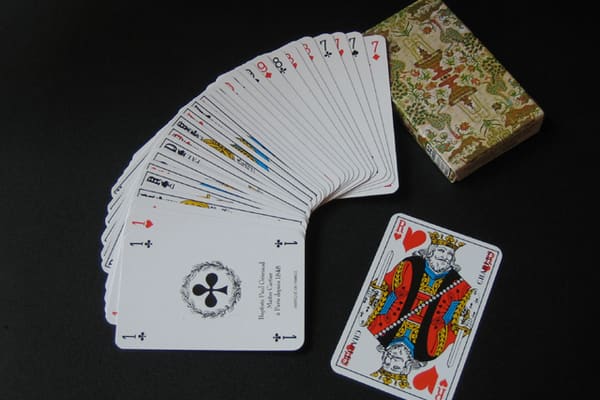
One 32-card Piquet pack (remove the 2s through 6s from a standard 52-card deck, leaving Ace, King, Queen, Jack, 10, 9, 8, 7 in each suit). Manille's distinctive rank order, high to low: 10 (Manille), Ace (Manillon), King, Queen, Jack, 9, 8, 7. The 10 outranks the Ace in every suit, including trump; this is the rule that defines the game.
Objective
As a partnership, capture more than half the 60 card points available in each deal by winning tricks that contain high-value cards. Over a series of deals, score a cumulative total; the first partnership to reach 101 points (or the highest score after an agreed number of deals) wins the match.
Setup and Deal
- Shuffle the 32-card pack. The dealer offers a cut to the player on the right.
- Deal 8 cards to each player, counter-clockwise in batches (commonly 3-2-3 or 4-4).
- Trump declaration: The dealer names trump from five options: clubs, diamonds, hearts, spades, or 'en voiture' (no-trump). Some groups turn the last card of the deck face-up to indicate trump instead; agree before play.
- First lead: The player to the dealer's right (eldest hand, since play is counter-clockwise) leads any card to the first trick.
- Misdeal: A void deal if a card is exposed or if players receive wrong counts; same dealer redeals.
Card Values
- 10 (Manille): 5 points and the highest rank.
- Ace (Manillon): 4 points and the second-highest rank.
- King: 3 points.
- Queen: 2 points.
- Jack: 1 point.
- 9, 8, 7: 0 points; they cannot win a trick unless they are the highest card of the led suit.
- Total: 60 card points per deal (5+4+3+2+1 per suit = 15; four suits = 60). Winning a majority (31 or more) wins the deal.
Gameplay
- Turn order: Play proceeds counter-clockwise. Each player in turn plays one card face-up.
- Must follow suit: If you hold any card of the led suit, you must play one.
- Must trump: If you cannot follow suit, you must play a trump if you hold any; discarding a non-trump on a non-trump-led trick is only legal when you are void in both the led suit and trump.
- Must overtrump: If a trump has already been played to the trick and you cannot follow the led suit, you must play a higher trump than the current winner if you hold one. If not, you may play any trump or discard.
- Partner-winning exception: In some houses, you are not required to overtrump when your partner is currently winning the trick (soft overtrump). Agree before play.
- Winning the trick: The highest trump wins; if no trump is played, the highest card of the led suit (by Manille's ranking: 10 > A > K > Q > J > 9 > 8 > 7) wins. Winner leads the next trick.
- End of hand: After 8 tricks, each team totals the card-point values in their captured tricks.
- Renege (revoke): Failing to follow suit or overtrump when required is a renege. Standard penalty: the offending team scores zero for the hand and the non-offending team takes all 60 points.
Scoring
- Per-deal score: Each team totals card points captured. If one team captures 36 or more, they score 6 (the margin above 30 = 6); 31-35 gives the scoring team exactly their margin (1 to 5). Falling short (30 or fewer) scores 0; some houses use point-difference scoring where the winning team scores captured-minus-30.
- No-trump (en voiture): When the dealer declares no trump, all captured points count double for the winning team.
- Match target: The match ends when one partnership reaches 101 cumulative points, or after an agreed fixed number of deals (commonly 12 or 50).
- Last-trick bonus (optional): Some groups award 1 extra point to the team winning the last trick.
Winning
- Match winner: First partnership to 101 cumulative points, or highest total after the agreed deal count.
- Tie-breakers: If both partnerships cross 101 on the same deal, the declaring team (the dealer's side) is checked first. A genuine tie after this is rare; play one more deal to resolve.
Common Variations
- Manille Parlée: Partners may openly discuss strategy during play; used for teaching.
- Manille Muette (silent): No talking or signalling permitted; the strict tournament version.
- Coinchée (Auction) Manille: Adds a bidding phase where players bid for the right to name trump, with doubling and redoubling calls.
- 3-player Manille: One player sits opposite a 'dummy' dead hand; modified scoring.
- En voiture (no trump): Any deal can be played no-trump; doubles the hand's scoring.
- Manille Aveugle (blind): Players hold their cards reversed; a party-game twist.
Tips and Strategy
- The 10 (Manille) and the Ace (Manillon) together hold 9 of each suit's 15 card points. Capturing both in the trump suit is usually decisive; aim to lead trump early when you or your partner holds them.
- Internalise the 10 > Ace ranking: standard Whist instincts mislead newcomers who keep leading Aces expecting them to win.
- Partner signalling is the heart of Manille: a lead of a low card often asks your partner to take the trick; a lead of a 9 or 8 of a side suit is usually a signal to trump.
- Count trumps played; with only 8 trumps in the deck, tracking them mentally is manageable and decisive. Once all trumps are out, your side's Aces and Kings become free winners.
- Never waste the Manille on a trick that an Ace or a lower trump would win; save it to capture an opponent's expected Ace or to seal the last trump.
Glossary
- Manille: The 10 of any suit; the highest-ranking card in Manille, worth 5 points.
- Manillon: The Ace of any suit; the second-ranking card, worth 4 points.
- En voiture: A no-trump declaration; all points double for the winning team.
- Piquet pack: The 32-card deck (A, K, Q, J, 10, 9, 8, 7 per suit) used across European trick-taking traditions.
- Coinchée: A double call in Coinchée (Auction) Manille, similar to Bridge's double.
- Parlée / Muette: 'Spoken' vs 'silent' partnership modes; Parlée allows open discussion, Muette forbids all signalling.
- Overtrump: The obligation to play a higher trump than the current trump winner of the trick when you cannot follow suit.
Tips & Strategy
The 10 (Manille) and Ace (Manillon) together are worth 9 of each suit's 15 points. Capturing both in the trump suit is usually decisive; lead trump early when you or your partner hold them.
Internalise the 10 > Ace ranking: Whist instincts about leading Aces as power cards mislead new players. Count trumps played; with only 8 trumps in the 32-card pack, tracking them mentally is manageable and decisive.
Trivia & Fun Facts
The name 'Manille' derives from the Spanish word for the 10 card; the Manille family spread across Europe from Iberia in the 17th and 18th centuries and influenced the rankings of Catalan Botifarra and several other regional games.
-
01What is the term for the highest card (the 10) in each suit in Manille?Answer The Manille; it sits above the Ace (called the Manillon) and is worth 5 points when captured.
History & Culture
Manille has been played in southwestern France and northern Spain since the 17th century. It remains a fixture of village cafés and social clubs across Languedoc, Catalonia, and the Basque country.
Deeply rooted in the culture of southern France and northeastern Spain; Manille has served as a social cornerstone of rural communities across the Pyrenees for centuries and is still played in organised club tournaments.
Variations & House Rules
Manille Parlée allows partners to discuss strategy openly and is used for teaching. Manille Muette (silent) forbids all signalling and is the tournament form. Coinchée Manille adds bidding, doubling, and redoubling. En voiture declares no trump and doubles the hand score.
For beginners use Manille Parlée so partners can discuss the unusual 10-high ranking openly. For a strategic match, play Muette with the no-trump en-voiture option available to the dealer.


