
How to Play
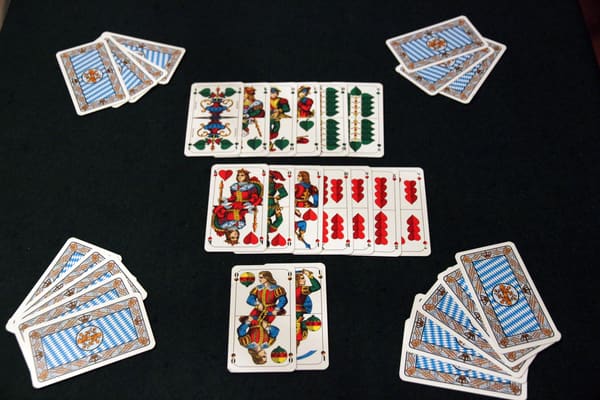
Sevens (Fan Tan, Domino, Parliament) is a classic international shedding game for 3 to 8 players. The entire deck is dealt; players extend four suit-rows that grow outward from the 7 of each suit, up toward King and down toward Ace. First to empty their hand wins.
Sevens (also Fan Tan, Domino, Parliament, Shichi Narabe in Japan) is a classic international shedding game for 3 to 8 players. The entire deck is dealt out and players take turns extending four suit-rows that grow outward from the 7 of each suit: up toward King and down toward Ace. The game opens with the (by convention) and ends when one player empties their hand. A deal takes 5 to 15 minutes; penalty-chip variants add running-total scoring across many deals.
Quick Reference
- Deal the 52-card deck clockwise to 3-8 players; some hands may have one extra card.
- The player holding the opens by playing it; diamond row starts.
- Play one card: a 7 to open its suit, or a card one rank above the top / one rank below the bottom of an open row in the same suit.
- If you cannot legally play, pass; in Fan Tan you pay a chip to the pot for each pass.
- Standard rule: you must play if able; voluntary passing is illegal or heavily penalised.
- Basic: first to empty their hand wins; no further scoring.
- Fan Tan / chip version: losers pay chips equal to remaining-card pip totals; a player still holding a 7 pays an extra penalty.
Players
3 to 8 players; every player for themselves (no partnerships). The first dealer is chosen by cutting for high card; deal rotates clockwise after each hand. Works well for any group size, though with more players cards become very unevenly distributed.
Card Deck
One standard 52-card deck, no jokers. All four suits (clubs, diamonds, hearts, spades) are used. Ranks within each suit: Ace (low) 2 3 4 5 6 7 8 9 10 Jack Queen King (high). Only the 7s function as 'starters'; all other cards only play when adjacent to a suit sequence already on the table.
Objective
Be the first to play every card from your hand onto the four suit sequences on the table. In penalty-chip versions, be the player with the lowest cumulative chip penalty across a series of deals; lowest score wins the session.
Setup and Deal
- Shuffle the 52-card deck thoroughly. The dealer offers a cut to the player on the right, then deals all cards clockwise, one at a time, to each player. With player counts that do not divide 52 evenly, some players will receive one more card than others; this is acceptable and does not affect play.
- Designate a playing area in front of the dealer where the four suit sequences will grow. Each suit's sequence will sit in its own row (for example, diamonds on the top line, hearts on the next, clubs, then spades).
- First play: The player holding the leads by placing it face-up on the table; this opens the diamonds row. If playing penalty-chip variants, every player may first ante one chip to a central pot.
- Misdeal: If a card is exposed during the deal or someone receives a wildly wrong number of cards, the deal is void and the same dealer redeals.
Gameplay
- Turn order: Play proceeds clockwise from the -playing leader.
- Legal plays: On your turn you may play one card that does one of the following: (1) a 7 of any suit not yet opened, placed on the table to open that suit's row; (2) a card one rank higher than the current top of an open row, in the same suit (extending upward toward King); (3) a card one rank lower than the current bottom of an open row, in the same suit (extending downward toward Ace).
- Pass if you cannot play: If no card in your hand satisfies any of the three legal-play options, say 'pass'. You lose nothing on a pass in the basic game; in penalty-chip variants you pay one chip to the pot for passing.
- Must play if you can (basic rule): In the standard international rules you must play if at least one legal play exists; voluntarily passing while able is illegal. In Fan Tan and other strategic variants, voluntary passing is allowed but carries a bigger chip penalty.
- Multi-card plays (optional variant): Some houses allow playing multiple cards in sequence on one turn when you hold a run (for example playing the 8, 9, and 10 of diamonds on a single turn after the diamonds row was extended to 7). The basic rule is one card per turn.
- Sequence limits: A row extends from the 7 of that suit down to the Ace (bottom) and up to the King (top), a total of 13 cards per row. Once the King and Ace ends are both played, the row is complete.
- Stockless: There is no stock or waste; every card is either in a hand or on the table. Cards played on the table stay face-up; the row ends are always visible.
- Illegal play: Placing an off-rank or wrong-suit card is illegal; the offender takes the card back and the turn passes. A player who voluntarily passes while holding a legal play (in must-play rule) loses chips in the penalty variant or loses a turn in the basic game.
- End of hand: The hand ends the instant one player plays their last card. All other players count their remaining cards for scoring.
Scoring
- Basic (no chips): The player who empties their hand first wins the hand; no further scoring. Start a new deal immediately.
- Card-count penalty (Fan Tan / chip version): Each loser counts their remaining cards at face value. Number cards count their pip (2 = 2, ..., 10 = 10); Jack = 11, Queen = 12, King = 13, Ace = 1 (or 15 in some variants). Each player pays chips to the round winner equal to their card-count total, or adds the total to a running penalty score.
- Pass penalty (Fan Tan): Every time a player passes (voluntarily or by necessity), they pay one chip to the central pot. A player caught passing while holding a legal play pays a heavier penalty (commonly five chips, or forfeit of the current deal).
- Sevens penalty: A player still holding a 7 at the end of the deal pays a larger penalty (for example 5 or 10 chips each) because they blocked the entire suit. Encourages players to release their 7s in a timely manner.
- Match format: Play an agreed number of deals (commonly 7 or 10) or until one player's chips run out; the highest-chip player wins the match.
Winning
- Hand winner: First to play all cards from their hand.
- Match winner: Most chips at match end (or lowest cumulative penalty if keeping running scores).
- Tie-breakers: In basic play, ties are impossible within a deal (only one player ends a hand first). In match totals, if two or more players are tied, play one extra deal between the tied players; winner takes the match.
- Showdown tie rule (Fan Tan): Some groups use a showdown: tied players receive zero for that round while everyone else scores by the standard remaining-card penalty, and the match continues.
Common Variations
- Fan Tan (American): Pass penalties and ante to a central pot; player to the left of the dealer starts (any 7 or pass). Bigger penalty for passing while able.
- Domino (German / Austrian): Built from an Unter (Jack) or Ober (Queen) in the German 32-card pack, or from the 7 in Skat-style play; rules otherwise identical.
- Parliament (British): The British name for the standard Sevens game.
- Shichi Narabe (Japanese): Played with 52 cards; players may choose to pass up to three times per hand at no cost.
- Multi-card turn: Allow playing sequences of consecutive cards in one turn; speeds the game up and rewards long runs.
- Flexible opener: Start with any 7 instead of strictly ; the player who holds the first playable 7 opens.
- Three-pass elimination: After three passes a player is eliminated from the current hand; prevents deadlocks.
Tips and Strategy
- The 7s are your biggest strategic lever. Releasing a 7 opens its entire suit for every player; holding it back blocks your opponents but also your own cards of that suit.
- Track which cards have been played on each row. Once the 10 of diamonds is out, any higher diamonds in your hand become free plays as soon as the row reaches them.
- If you hold a run of consecutive cards in one suit (for example 9-10-J-Q), release the lowest first; once the row reaches your lowest, you can dump the rest in turn.
- In chip variants, weigh the cost of a pass against the benefit of holding a card. An early pass costing one chip is often worth blocking a long suit.
- Save Aces and Kings for the tail end of a row; you cannot play around them, so releasing them early just enables other players.
- Watch opponents who repeatedly pass; if they are stuck on a particular suit it is safe to play cards that extend that suit (they cannot follow).
Glossary
- Row / sequence: The face-up line of cards for one suit on the table, growing outward from the 7 up to King and down to Ace.
- Opener / starter: A 7; the only card that can start a new row.
- Lead / leading: Playing the first card of the deal (the opener).
- Pass: A legal turn in which you play no card because nothing in your hand fits the three legal-play options; penalised by chips in the chip variants.
- Must-play rule: The standard convention that a player who has a legal play must take it; cannot voluntarily pass.
- Chip penalty / pot: The central chip fund fed by passes; the round winner collects it.
- Ante: A compulsory one-chip deposit at the start of each deal in chip variants.
Tips & Strategy
The 7s are your biggest strategic lever: releasing one opens the suit for everyone; holding one blocks opponents but also your own cards of that suit. If you hold a run of consecutive cards, release the lowest first and dump the rest in turn.
Track which cards have been played on each row; once a row reaches 10 of a suit, every higher card of that suit in your hand becomes a free play as soon as the row arrives at it.
Trivia & Fun Facts
Shichi Narabe in Japan is one of the most commonly played card games among children; the game's universal appeal across very different card cultures is unusual for a shedding game.
-
01Which card rank must be played to open a new suit row in Sevens?Answer A 7 of that suit; players holding a 7 of an unopened colour are obliged to play it when their turn comes.
History & Culture
Sevens has been played across Europe and Asia for centuries under many names; in Britain it is Fan Tan or Parliament, in France Dominos, in Japan Shichi Narabe ('Seven Arrangement'), in Germany either Sevens or Domino depending on the deck.
One of the most universally known card games in the world; popular across Europe, Asia, and the Americas as both a children's game and a serious strategic contest, featured in countless family card-game collections.
Variations & House Rules
Fan Tan (American) adds chip penalties for passing and passing-while-able. Multi-card-turn allows playing sequences in one go. Japanese versions allow up to 3 passes per hand at no cost. Flexible-opener lets any 7 start, not only [7♦].
Add chip stakes (one chip per pass, a big penalty for passing while able) for serious sessions. Drop the must-play rule and allow strategic passing for a tempo-control variant.


