
How to Play
Old Maid is the classic family card game for 2+ players: remove one Queen from a standard deck, deal the 51 cards evenly, discard pairs and draw blind cards from the next player's hand; whoever is left holding the unmatched Queen at the end is the 'Old Maid' and loses.
Old Maid is a classic children's and family card game for 2 or more players using a standard 52-card deck with exactly one Queen removed (usually the Queen of Clubs), leaving 51 cards. All cards are dealt out; players immediately discard any pairs from their hand face up; then on each turn a player offers their hand face down fanned out to the player on their left, who draws one card blind. The drawing player discards any new pair that results and then offers their hand to the next player on their left. Play continues clockwise until every card has been paired off except the lone unmatched Queen (the 'Old Maid'), which must still be in someone's hand. The player left holding the unmatched Queen at the end is the Old Maid and loses the game. Old Maid is a memory and deduction game with a strong element of luck; it is especially popular with children aged 5-10 as an introduction to card play.
Quick Reference
- Remove one Queen from a standard deck (51 cards remain).
- Deal all cards evenly to 2+ players.
- Immediately discard any pairs from your hand.
- Offer your hand face-down fan to the player on your left.
- They draw one card blind and discard any new pair.
- They then offer their hand to the next player and so on clockwise.
- No points; the player holding the unmatched Queen loses.
- Empty-hand players are 'out' and are skipped.
- Multi-round sessions: fewest losses wins.
Players
2 or more players, best at 4 to 6. Each plays for themselves; there are no partnerships. Play runs clockwise. The dealer role is informal and rotates each round (or does not rotate at all) since dealing confers no advantage or disadvantage. 2-player games are very short; 5-6 players gives the most suspense and deduction potential.
Card Deck
One standard 52-card deck with exactly one Queen removed, leaving 51 cards. Traditionally the Queen of Clubs is removed so the unmatched Queen (the Old Maid) is a different-suit Queen, but any single Queen removal works identically. Suits are relevant only for identifying matched pairs (the rule is rank-matching, not suit-matching). Ranks are relevant only for pairing. Card values and point values are irrelevant: the game has no scoring across pairs; only the identity of the final unmatched card matters.
Objective
Avoid being left holding the unmatched Queen (the 'Old Maid') when all other cards have been paired off and discarded. The loser is the Old Maid; everyone else wins equally. There is no relative ranking of winners; winning or losing is binary per round.
Setup and Deal
- Take a standard 52-card deck and remove one Queen (traditionally the Queen of Clubs). Set that Queen aside; it will not be used.
- Shuffle the remaining 51 cards thoroughly.
- Deal all 51 cards face down, one at a time clockwise. Some players will have one or two cards more than others; this is acceptable and does not affect play.
- Each player sorts their hand privately. Immediately discard all pairs face up in front of you. A pair is two cards of the same rank (e.g., two 6s, or two Kings) regardless of suit.
- Triplets and quadruplets: if you hold three of a kind, discard a pair and keep the third card. If you hold four of a kind, discard two pairs.
- The player to the dealer's left takes the first turn.
Gameplay
- Offer your hand: On your turn, fan your cards face down and offer them to the player on your left.
- Draw blind: That player selects and takes exactly one card from your fanned hand, blind (without seeing the faces).
- Evaluate and discard: The drawing player adds the card to their hand. If the new card completes a pair with a card already in their hand, they immediately discard that pair face up. If not, they simply keep the card.
- Run out of cards: A player whose hand becomes empty is out of the game (they cannot be the Old Maid) and is skipped in future rounds of offering and drawing.
- Continue clockwise: The player who just drew now offers their hand to the next player on their left, who draws one card, and so on around the circle.
- Endgame: Play continues until only one card remains among all hands: the unmatched Queen. The player still holding that Queen is the Old Maid and loses the round.
Scoring
- Old Maid uses no point system; losing a round makes you the Old Maid and ends the round.
- Multi-round sessions: For a longer match, play a fixed number of rounds (e.g., 5 or 7) and count how many times each player was the Old Maid. The player with the fewest Old Maid losses wins the session.
- Penalty variant: Each Old Maid loss earns 1 penalty point; first player to reach 3 penalty points is out of the session; last player un-eliminated wins.
- Silly penalty variant (children's parties): The Old Maid performs a playful forfeit like singing a song or making a silly face; no numeric scoring.
Winning
Every round has exactly one loser (the Old Maid) and every other player is considered a winner of that round equally. In multi-round sessions, the session winner is the player with the fewest losses. In elimination variants, the last player un-eliminated wins.
Common Variations
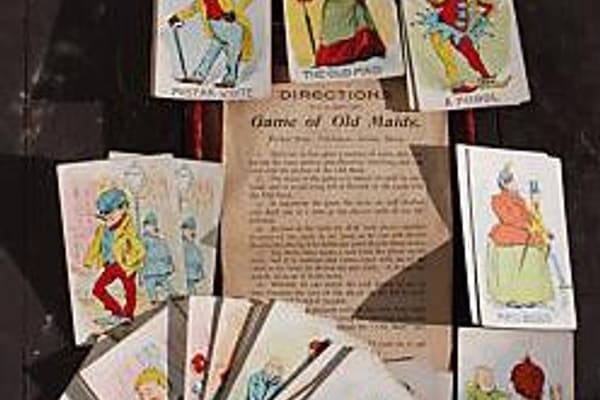
- Dedicated Old Maid deck: Commercial decks with themed character cards (Victorian lady figures in older sets; cartoon animals in children's modern sets) where each card has one unique mate except the Old Maid figure. Mechanics identical to the 51-card standard version.
- Black Peter (German Schwarzer Peter): Same rules; the unmatched card is a special 'Black Peter' (a chimney sweep or other joker-figure card) instead of a Queen.
- Two removed cards: Remove a Queen and a Jack; two unmatched cards remain at the end, and the two players holding them are the 'Old Maid and Old Bachelor'. Longer and more forgiving for large groups.
- Short-deck Old Maid: Remove cards 2 through 6 entirely, keeping only 7 through Ace (32 cards minus one Queen = 31 cards). Faster, especially with 4-6 players.
- Multi-deck Old Maid: For 8+ players, use two decks minus one Queen each (one unmatched card per deck). Two simultaneous Old Maids.
- Scored Old Maid: Each player starts with 10 chips; the Old Maid forfeits 1 chip per round. The last player with chips wins.
- Happy Families / Go Fish crossover: The draw-on-request variant, technically a different game (see Happy Families and Go Fish), is a close cousin and uses the same ranked-pair mechanic.
Tips and Strategy
- Place the Old Maid in the middle of your fan. Psychologically, most drawers instinctively pick from the edges; the middle position gets picked less often.
- Shuffle your hand between turns. Even though you know which card is the Queen, opponents may be tracking how you hold your hand; a quick re-fan conceals positional cues.
- Read the drawer's face after they pick. A visible relief or disappointment tells you whether they completed a pair or added to their risk; useful when it is next your turn to offer.
- When drawing, watch how the offerer holds their fan. A slightly protruding card may be the Queen (held apart to avoid accidentally feeling it themselves); avoid that position.
- Track the discarded pairs. Once three of a rank are on the table as pairs plus one card, you can deduce which suits remain; if your remaining card is a Queen, you may be the Old Maid.
- In a 5+ player game, the cards circulate 2-3 times before the endgame. A player who ends up with an odd number of cards mid-game has probably picked up the Queen; offer your hand carefully when they are next to you.
Glossary
- The Old Maid: The single unmatched Queen that circulates until the last player holds it.
- Pair: Two cards of the same rank; discarded face up as soon as held.
- Fan: The face-down spread of cards offered for an opponent to draw from.
- Out: A player with an empty hand; they cannot be the Old Maid and are skipped.
- Black Peter: The German variant and alternative name for the Old Maid card.
- Happy Families / Go Fish: Close-relative card games using the same ranked-pair matching, with draw-on-request mechanics instead of blind draw.
Tips & Strategy
Position the Queen in the middle of your offered fan (drawers pick edges more often), shuffle your hand between turns to hide positional cues, and watch each drawer's face for reactions that reveal whether they received a helpful card or the Queen.
Old Maid is primarily a luck game for beginners, but skilled players can squeeze 5-10 percent of expected value out of three techniques: Queen-in-middle fanning (makes it less likely to be drawn), hand-shuffling between turns (prevents opponents from tracking position), and reading drawer reactions (inferring who holds the Queen from unconcealed tells). Children learning the game develop these naturally as they play.
Trivia & Fun Facts
Old Maid is one of the few card games named after its losing condition rather than its winning condition; in most cultures it is a children's game used to introduce card-handling, pair-matching, and turn-taking. Commercial dedicated Old Maid decks have been published since the 1830s and often feature themed character art; the Victorian 'Old Maid' card in early sets was a stern-looking spinster figure, now replaced in modern children's sets with cartoon animals or fairy-tale characters.
-
01How many cards are in the Old Maid deck, and which card is removed?Answer 51 cards: a standard 52-card deck with exactly one Queen (traditionally the Queen of Clubs) removed.
-
02How does a player leave the game in Old Maid, and does that mean they win?Answer A player whose hand becomes empty is 'out' and takes no further part, but they are considered a winner of the round (they cannot become the Old Maid); only the single player holding the unmatched Queen at the end loses.
History & Culture
Old Maid evolved in 18th-century European parlour culture alongside other blind-draw matching games. The Queen-as-Old-Maid convention became standard in British play during the 19th century; the name reflects Victorian social anxiety about unmarried women (the 'old maid' stereotype). In Germany, Schwarzer Peter (Black Peter) uses a male figure (a chimney sweep) as the unmatched card but plays identically.
Old Maid is one of the most recognisable family card games in Western culture and a staple of children's introductory card play. The 'old maid' idiom (meaning the last unmarried person of a generation) was partly reinforced by the game's ubiquity in Victorian-era homes. Close cultural equivalents appear worldwide, from German Schwarzer Peter to French Vieux Garçon (Old Bachelor) to Japanese Baba-nuki (Pulling Grandma).
Variations & House Rules
Black Peter (Schwarzer Peter) is the German version with a male chimney-sweep figure instead of the Queen. Short-deck Old Maid removes cards 2-6 for a faster game. Multi-deck Old Maid scales for 8+ players with two unmatched cards. Dedicated commercial Old Maid sets replace standard cards with themed character art.
For very young children (ages 4-6), use a short deck (Aces plus court cards only, one Queen removed) for fast rounds. For a teaching round, have the offerer hold their hand face up for the drawer; removes deduction but teaches the core pairing mechanic. For a playful party version, agree silly forfeits for the Old Maid each round (singing, imitations).


