
How to Play
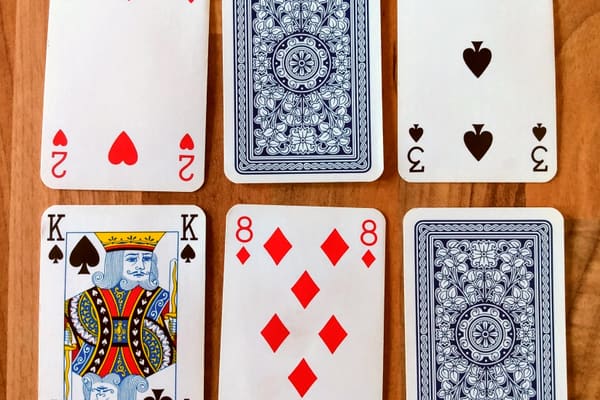
Golf is a modern North American 'low score wins' card game played as 9 holes (deals). Each player manages a face-down grid (usually 6 cards in a 2x3 grid), replacing high cards with lower ones and arranging matching ranks in the same column to cancel to zero. Kings are 0; Jokers are -2.
Golf is a modern North American card game named for its low-score-wins scoring, mimicking the sport: lower is better, and a match is typically 9 'holes' (deals). The most popular version is 6-Card Golf, played by 2 to 6 players with one or two standard 52-card packs. Each player is dealt 6 cards face-down and arranges them in a 2-row, 3-column grid; at the start of the hole, each player flips any 2 cards face-up and the others remain face-down. On each turn a player either draws from the face-down stock or takes the top of the face-up discard pile, and either REPLACES one grid card with the new card (placing the old one face-up on the discard pile) or DISCARDS the new card and flips over one face-down grid card. A hole ends when one player's entire grid is face-up; every other player takes one final turn and then scores. Card values are Ace=1, 2-9=face value, 10=10, Jack=10, Queen=10, King=0, Joker=-2; the critical scoring twist is that any two matching-rank cards in the same COLUMN cancel out to zero combined. A match is typically 9 holes; the player with the lowest cumulative score wins.
Quick Reference
- 2 to 6 players, standard 52-card deck plus 2 Jokers (2 decks for 5-6 players).
- Deal 6 cards each in a 2x3 face-down grid; flip any 2 face-up at the start of each hole.
- Remaining cards form the face-down stock; flip the top card face-up as the start of the discard pile.
- Draw from the stock or the top of the discard pile.
- Either REPLACE a grid card with the new card (old card goes to discard), or DISCARD a stock draw and FLIP one face-down card.
- You cannot immediately re-discard a card taken from the discard pile.
- A hole ends when any player turns all 6 cards face-up; all others get one final turn.
- Card values: A=1, 2-9=face value, 10/J/Q=10, K=0, Joker=-2.
- Matching-rank cards in the same column both count as 0 (column pair cancels).
- Total across 9 holes; lowest wins the match.
Players
2 to 6 players for 6-Card Golf with one 52-card pack (use 2 packs for 5-6 players if you want to reduce stock exhaustion). Variants range from 2-Card to 9-Card. A typical 9-hole match runs 30 to 60 minutes. Turn order is clockwise; the first dealer is chosen by cut (low card deals), and the deal rotates clockwise after each hole.
Card Deck
- Standard 52-card pack, usually with 2 Jokers added (54 cards); for 5 or 6 players add a second pack.
- Card values for scoring: Ace = 1, 2 through 9 = face value, 10 = 10, Jack = 10, Queen = 10, King = 0, Joker = -2.
- Column-pair cancellation: any two cards of the same rank occupying the SAME column of your 2x3 grid cancel each other out and score 0 combined (regardless of their individual values).
- Suits are irrelevant for scoring; only rank matters.
Objective
Achieve the lowest total score across the agreed number of holes (typically 9, like a round of golf). At each hole, reduce your 6-card grid to low values by replacing high cards with lower ones and by arranging matching ranks into the same column (where they cancel to zero). Negative scores (from Jokers and Kings) are the holy grail.
Setup and Deal
- Shuffle the pack(s). The player to the dealer's right cuts.
- Deal 6 cards face-down to each player, one at a time, clockwise.
- Each player arranges their 6 cards in a 2-row, 3-column grid face-down in front of them without looking.
- Place the remaining cards face-down in the centre as the stock. Flip the top card face-up beside it to start the discard pile.
- Each player simultaneously flips ANY 2 cards in their grid face-up (by convention, the two they flip become common knowledge).
- The player to the dealer's left takes the first turn.
Turn Flow (6-Card Golf)
- Draw: take the top card of the stock (face-down) OR the top of the discard pile (face-up). You must draw before any other action.
- Decide: you must now either REPLACE one grid card with the drawn card, or DISCARD the drawn card and instead FLIP one of your face-down grid cards face-up.
- Replace: take any card from your grid (face-up or face-down), place it face-up on the discard pile, and put the drawn card face-up in its slot. The grid slot is now face-up for the rest of the hole.
- Discard and flip: if you took from the stock, you may choose to discard it and instead flip one face-down card in your grid face-up. You may NOT immediately discard a card taken from the discard pile without doing a replace (the anti-stall rule).
- Turn passes clockwise.
Ending a Hole
- The hole ends the moment a player flips over or replaces their LAST face-down card, so that all 6 of their cards are face-up.
- Play continues clockwise; every other player receives ONE FINAL TURN to respond.
- After the final turns, every player flips the remaining face-down cards in their grid face-up and scores the hole.
- The player who ended the hole does NOT get a bonus or penalty by default; however, in the 'knock' variant (optional), they score a penalty of +10 if they do not have the lowest score for the hole.
Scoring a Hole
- For each column in your grid (top row card + bottom row card), check for column pairs: if the two cards in a column share a rank, they BOTH count as 0 points for the column.
- Otherwise, sum the face values of both cards in the column: Ace=1, 2-9=face value, 10/J/Q=10, King=0, Joker=-2.
- Total your three column scores for the hole's final score.
- Lowest total is the hole's best; negative totals are possible if your grid has Kings (0), column pairs (0), and Jokers (-2).
- Record each player's hole score on a 9-hole scorecard.
Winning the Match
After the agreed number of holes (9 is standard, though 18 is popular for a longer match), sum each player's hole scores. The lowest cumulative score wins the match. Ties can be broken by a sudden-death extra hole, or settled amicably.
Common Variations
- 4-Card Golf (Polish Polka / Polish Poker): 4 cards in a 2x2 grid. Faster rounds; fewer cancel opportunities. 3-7 players.
- 9-Card Golf: 9 cards in a 3x3 grid. Column pairs apply to the three cards in each column. Hole ends when any player exposes all 9. Longer, richer version for 3-6 players.
- Peek version (4-Card): players secretly peek at any 2 cards in their grid at the start of the hole (instead of flipping them face-up).
- Knock variant: any player may signal the end of the hole by knocking; others get one final turn. The knocker is penalised +10 if they do not have the lowest score.
- No-Jokers variant: omit Jokers; pure 52-card play, slightly higher average scores per hole.
- Double-deck variant: use two 52-card packs (plus Jokers) for 5 or more players, reducing stock exhaustion and allowing column pairs more often.
- Wild Twos: 2s count as -2 instead of +2 (turning them into semi-Jokers); sometimes used in family games.
- Multi-column cancellation: a house rule where matching ranks in the same ROW (not column) also cancel; more forgiving but changes positional strategy.
Tips and Strategy
- Prioritise column pairs. Two Jacks in one column is 0 points; two Jacks in different columns is 20 points.
- Keep Kings. A King on its own is 0; a King paired with a King is still 0 but also blocks the column. Kings are safe keeps.
- Jokers are gold. -2 each, or -4 for a matching Joker pair in a column (some rules zero that out; others keep -4). Always grab a Joker from the discard pile.
- Replace high cards first. A 10 or face card in your grid is 10 points of dead weight unless you can pair it.
- Keep the risk of unknown cards in mind. A face-down card could be anything; on average it is ~6 points, but could be 10 or a Joker. Flip deliberately.
- Track opponents' visible grids. If they already have two Queens showing, the remaining Queens are more likely in the stock or their own face-down cards.
- End the hole when you are confident your lowest-so-far grid is hard to beat in a single final turn; do not end early with a bad score.
- Remember the anti-stall rule: a card taken from the discard pile MUST be placed into your grid; you cannot immediately re-discard it.
Glossary
- Grid: your personal layout of face-down (then face-up) cards, typically 2 rows by 3 columns (6-Card Golf).
- Hole: one complete deal and round; a match is usually 9 holes.
- Column pair: two cards of the same rank in the same column of your grid; they cancel to 0.
- Stock: the face-down shared draw pile.
- Discard pile: the face-up shared pile where replaced or discarded cards go.
- Knock: in the optional knock variant, a player's signal to end the hole after one more round of play.
- Replace: swap a drawn card into your grid, sending the existing card to the discard pile.
- Flip: turn a face-down grid card face-up without using a drawn card (only after discarding a stock draw).
- Polish Polka / Polish Poker: regional names for 4-Card Golf.
Tips & Strategy
Column pairs are the whole strategic layer; two Jacks in one column score 0, but two Jacks in different columns score 20. Always grab Jokers (-2) from the discard pile when you can, and replace face cards first because each is 10 points of dead weight. Keep Kings (0 points on their own). Do not end the hole prematurely; ending when you have a 4-point grid often backfires if a single final turn from an opponent brings theirs lower. Remember that you cannot immediately re-discard a card you just took from the discard pile.
Column management is the hidden depth of Golf. Early in the hole, decisions should favour replacing high cards over flipping face-down cards (information is cheaper than reducing value). Once your visible grid has 2 or 3 face-up low cards, pivot to pair-hunting: take any card from the discard pile that would create a column pair. Endgame discipline matters: ending the hole too early with a 6-point grid is a mistake if the opponent's face-down cards are likely to average 6 points; wait until your lead is substantial.
Trivia & Fun Facts
The 9-card version produces the deepest strategy because three-card column totals create more opportunities for multi-card pair cancellations. A 'perfect' 6-card hand (three Joker-Joker columns) scores -12, an extreme rarity. The name Polish Polka for the 4-card version comes from mid-20th-century American card-game nomenclature that attached 'Polish' to several unrelated games as a generic exotic branding; it is not related to Poland specifically.
-
01In Golf card game, what happens when two cards of the same rank end up in the same column of your grid?Answer They 'cancel' and both count as 0 points for the column, no matter how high their individual values. Arranging column pairs is the central strategic layer; getting two Queens in one column turns 20 points of deadwood into 0.
-
02Why are Kings valued at 0 points rather than 10 in Golf, unlike most card games?Answer Kings are valued at 0 specifically because the low-score-wins scoring frame needs 'safe' face cards. Face cards are otherwise 10 points each, so Kings uniquely act as a neutral anchor: keeping a King is never worse than keeping any other face card, and a King paired with another King in a column still scores 0.
History & Culture
Golf is a modern North American card game, attested in American home-play rule books from the mid-20th century under several names (Polish Polka, Polish Poker, Six-Card Golf, Crazy Nines). Its defining feature is the sporting-inspired scoring model: each 'hole' mirrors a golf hole, and a 9-hole match mirrors a round of golf. The column-pair cancellation is what makes the game distinctive among low-score rummy relatives; similar mechanics appear in French games like Dame Pique but the sporting frame is uniquely American.
Golf is one of the most popular family card games in North America, alongside Rummy and Hearts, and is especially beloved in road-trip and camping settings where its short holes and simple scoring fit intermittent play. Its sporting-inspired structure makes it approachable to players who might find more abstract card-game scoring confusing.
Variations & House Rules
4-Card Golf (2x2 grid, Polish Polka name) is the fastest variant; 9-Card Golf (3x3 grid) is the deepest. The knock variant adds a strategic end-the-hole mechanic with a penalty for bad timing. Peek versions let players look at cards rather than flip them face-up. No-Jokers removes the -2 cards; double-deck supports 5-6 players without stock strain. Multi-column cancellation rules and wild-2 rules are common house tweaks.
Start with 6-Card Golf; it is the Goldilocks version (not too fast, not too slow) for most groups. Add the knock variant once players are comfortable. For family play with young children, use 4-Card Polish Polka and include Jokers for the delightful -2 scores. For a longer adult session, play 18-hole (instead of 9-hole) 9-Card Golf.


