
How to Play
Snap is a fast-paced and competitive card game suitable for small groups. Players must quickly recognize matching cards and call out 'Snap!' to win the game.
Snap is a classic 19th-century British children's matching game that tests observation and reaction time. The deck is dealt face-down to all players; on each turn a player flips the top card of their pile face-up, building personal face-up piles in front of them. The instant two face-up piles show the same rank (regardless of suit), the FIRST player to shout 'Snap!' collects both piles. Mistaken calls, ties, and empty-pile flips all feed a central 'Snap pool' with its own shout: 'Snap pool!' Players are eliminated when they run out of cards, and the last player holding any card wins.
Quick Reference
- Shuffle a standard 52-card deck.
- Deal all cards face-down evenly among players.
- Players take turns flipping their top card face-up onto their pile.
- When two face-up piles show the same rank, shout 'Snap!'
- First to call it wins both face-up piles.
- Wrong call turns your face-up pile into a snap pool.
- No point system; win by collecting all cards.
- Players who run out of cards are eliminated.
Players
2 to 6 players, each playing for themselves. Three or four is the sweet spot: enough face-up piles to generate matches, few enough to keep track of everyone's top card. With 2 players the match rate is lower (only two piles to compare). Very young children can play from age 4 with simple rules; Snap is traditionally one of the first card games taught. A single game runs 5 to 15 minutes; sessions typically play best-of-3 or 5 games.
Card Deck
- One standard 52-card pack; jokers removed.
- Only RANK matters; suits are ignored. A matches any other for the snap call.
- Some children's-merchandise 'Snap' decks are themed image-matching sets (e.g., fairy-tale Snap, animal Snap) with illustrations instead of rank; in those decks, a 'match' is two identical pictures.
- With 5 or 6 players the deal will be uneven; simply allow one or two players to start with one extra card.
Objective
Collect ALL the cards in the game by being the fastest player to call 'Snap!' whenever two face-up piles show the same rank. When a player runs out of both their face-down and face-up cards, they are eliminated; the last player still holding cards wins the game.
Setup and Deal
- Shuffle the 52-card deck. Any player may deal the first game; the winner of each game deals the next.
- Deal the entire deck face-down, one card at a time clockwise, until the deck is empty.
- Each player ends with a face-down stack of roughly 52/n cards in front of them; do not look at your stack.
- Leave a clear space in the middle of the table for the central 'Snap pool'.
- The player to the dealer's left begins.
Gameplay
- Flip in turn: in clockwise order, the active player takes the top card of their face-down stack and flips it face-up onto a face-up pile immediately next to their stack. Call out the rank: 'Eight'. Flips must be crisp and deliberate; no sneak-peeks or scooping extra cards.
- Watch every face-up pile. The moment any two face-up piles show cards of the same rank on top, any player may shout 'Snap!'. The first player to shout collects BOTH matching face-up piles and places them face-down on the bottom of their face-down stack.
- Snap pool (ties and mistakes): if two players call 'Snap!' at the exact same time, the two matched face-up piles are moved to the centre as the Snap pool. From that moment, any player who flips a card that matches the TOP card of the Snap pool may shout 'Snap pool!' to win the entire pool.
- Wrong call penalty: if a player shouts 'Snap!' when no match exists, their own face-up pile is moved to the centre as a (new) Snap pool, penalising them.
- Refreshing face-down stack: when your face-down stack is empty, turn your face-up pile face-down (without shuffling) to become your new face-down stack, and continue playing.
- Elimination: if you have no face-down AND no face-up cards, you are out of the game; play continues clockwise among remaining players.
- Snapping on your own flip: most house rules allow any player to call, including the one whose flip caused the match. Some tournaments restrict the call to players other than the flipper; agree beforehand.
Winning
The game ends when exactly one player still holds cards; that player wins. In practice, as elimination reduces the table to two players, Snap becomes a near-continuous match contest. A tournament session is typically best-of-3, best-of-5, or first-to-win-3-games wins. Ties are impossible in a single game (someone has to hold the last card); in a session, a tie is broken by a sudden-death game.
Common Variations
- Snap Cards / Picture Snap: themed commercial decks with matching illustrations (fairy-tale pairs, animals, superheroes). Match rule is 'identical picture' instead of rank.
- Speed Snap: every player flips simultaneously (no turn order); faster and more chaotic. Usually used only with 2-3 players because more piles get unmanageable.
- Double Snap: a correct 'Snap!' wins both piles AND forces the loser to give up one extra card from their stack. A harsher variant used in some tournaments.
- Single Pile Snap: only one central pile is used; players take turns flipping a card onto the centre and snap calls are made when the top card matches the one just below it. A simpler variant for very young players.
- Slapjack crossover: if you own a Slapjack deck (same game, matches only on Jacks), older children can play the hybrid variant: call 'Snap!' on any match but also call 'Slap!' on any Jack for a separate reward.
- Silent Snap: instead of shouting, players slam their hand flat on the matching pile; the fastest hand wins. More physically demanding and children find it hilarious.
- Animal Snap: each player is assigned an animal noise (cat, cow, sheep, dog, duck, frog, owl); instead of shouting 'Snap!', they must make their animal noise. A party-game variant.
Tips and Strategy
- Peripheral vision, not focus. Do not stare at the flipper's hand; keep soft focus on the entire table so you register every face-up pile at once.
- Flip away from yourself in a consistent motion so you do not reveal the card to yourself a fraction before your opponents.
- Call with your voice, not your hand. Shouting 'Snap!' is unambiguous; reaching for a pile before calling is sometimes disputed.
- Avoid false positives. When you are tired or excited, false 'Snap!' calls snowball; a wrong call is a penalty pool for everyone else.
- Watch the smallest piles. A player down to a few face-up cards has a narrow window to win a Snap and come back; they are almost always the first to call when their top card matches.
- Flip fast but accurately. A crisp single flip that everyone sees simultaneously beats a slow reveal (which lets you read it first).
- Snap pool awareness: after a pool forms, every subsequent match on the pool's top card has double stakes; stay alert to pool-eligible flips.
Glossary
- Face-down stack: your private undealt cards; you flip the top card when it is your turn.
- Face-up pile: your personal discard pile, built by flipping the top of your stack. The top card is the 'showing' card.
- Snap!: the called word (or slap) that claims a match between two showing cards.
- Snap pool: a central pile formed by a tie-snap or a wrong call; claimable by 'Snap pool!' when a new flip matches its top card.
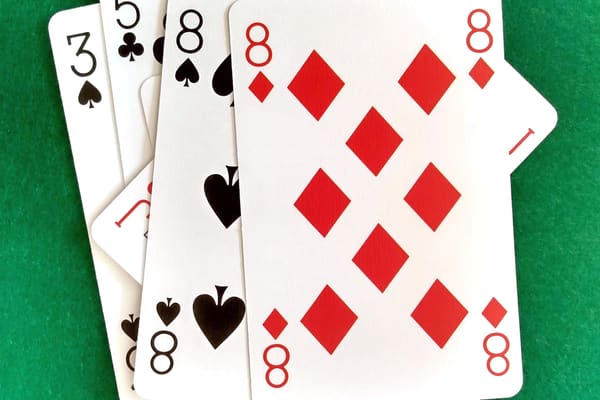
- Matching rank: same card value regardless of suit; e.g., 8♠ matches 8♥.
- Elimination: you are out of the game when both your stack and face-up pile are empty.
- Flipper: the player whose turn it is to reveal the next card.
Tips & Strategy
Stay focused and alert to quickly spot matching cards. Practice quick reflexes to call 'Snap!' before opponents. Be mindful of the speed of play to avoid mistakes.
Focus on improving reaction times and visual recognition to gain an advantage. Watch opponents' piles closely to anticipate matches.
Trivia & Fun Facts
Snap is often confused with Slapjack, but they are different games. In Snap, players match ranks; in Slapjack, players slap only on Jacks.
What other names is Snap known by? What is the objective of Snap?
History & Culture
Snap has origins dating back to the 19th century, often played as a children's game to enhance observation skills.
Snap is often played in social gatherings and family gatherings, serving as a source of entertainment and bonding.
Variations & House Rules
Variations of Snap include 'Single Pile Snap' where players draw from a single pile rather than having individual piles.
Players can adjust the speed of play to suit the group's preferences. Introduce house rules or unique variations to add excitement.


