
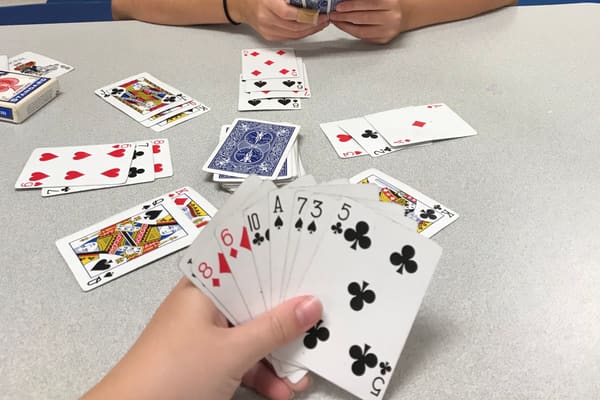
How to Play
Kings in the Corner is a classic American family card game for 2 to 5 players. Build downward in alternating colours on a cross-shaped layout, with Kings opening the corners; first to empty their hand wins.
Kings in the Corner is a classic American family card game for 2 to 5 players that plays like a shared solitaire. The centre of the table holds eight building piles in a cross-shaped layout: four edge piles (north, south, east, west of the stock) and four corner piles that begin empty and only Kings may start. Each turn a player draws one card from the stock and then freely plays as many cards as they can: building the edges downward in alternating colours (red on black, black on red), moving whole piles onto other piles when the bottom card fits, and placing Kings into empty corners to anchor new descending piles. The first player to empty their hand wins. It is a game of patience, quick counting, and opportunistic corner-grabs.
Quick Reference
- Deal 7 cards to each of 2-5 players (9 for 2 or 3 players for a longer game).
- Place the rest as stock; turn the top 4 cards face-up into the edge positions around it.
- Leave the four corner positions empty; only Kings may open them.
- Draw one card from the stock.
- Build edges downward in alternating colours; Kings open corners.
- Move whole piles onto other piles when the fit works, then fill the vacated slot from hand.
- First player to empty their hand wins the round.
- If stock runs out and no one goes out, fewest cards in hand wins.
- Optional multi-round scoring: Kings = 10, other cards = 1 each; play to 25 penalty points.
Players
2 to 5 players, each playing individually. With 2 players the game is brisk; with 4 or 5 the layout churns fast and tactical moves are more valuable. The first dealer is chosen by drawing for high card, and the deal rotates clockwise after each round.
Card Deck
One standard 52-card French deck, no Jokers. Only rank and colour matter for building. Ranking on layout piles, high to low: King, Queen, Jack, 10, 9, 8, 7, 6, 5, 4, 3, 2, Ace. Aces rank at the bottom. Building on edge and corner piles runs strictly downward in alternating colours: red cards (Hearts and Diamonds) go on black (Clubs and Spades), and vice versa.
Objective
Be the first player to discard every card from your hand by playing cards onto the shared cross-shaped layout. There is no separate scoring for the winner; it is a race to go out.
Setup and Deal
- Shuffle the 52-card deck. The player to the dealer's right cuts.
- Deal 7 cards to each player (or 9 each when only 2 or 3 play, for a longer game), face-down, clockwise one at a time.
- Place the remainder face-down in the centre as the stock.
- Deal the top four cards of the stock face-up from the stock into the four edge positions (north, south, east, west) to form the starting cross layout.
- Leave the four corner positions (north-east, north-west, south-east, south-west) empty; only Kings may open those piles.
Gameplay
- Turns pass clockwise. On your turn, perform the steps below in order; you may skip any step except the draw.
- Step 1 (Draw): Take the top card of the stock into your hand. If the stock is empty, skip this step.
- Step 2 (Play): You may now make as many legal plays as you wish in any order. Legal plays are:
- a. Build on an edge pile: Place a hand card on an edge pile if it is one rank lower and the opposite colour to the current top of that pile. For example, on a red Jack you may play a black 10.
- b. Place a King in a corner: A King from your hand can open any empty corner pile. Build on it downward in alternating colours just like an edge pile.
- c. Consolidate piles: Pick up an entire edge or corner pile and stack it onto another pile whose top card is one rank higher and the opposite colour to the bottom card of the moved pile. This frees the vacated position.
- d. Fill a vacated position: When an edge or corner slot is empty, place any card from your hand into it to start a new pile (Kings into corners, any card into edge positions).
- Step 3 (End turn): Announce that you are done; play passes to the next player clockwise.
- If the stock runs out, play continues with no draw phase until someone goes out or the game is declared over.
Winning
The first player to play their last card wins the round immediately. If the stock is exhausted and no one can make another play, the round ends and the player with the fewest cards remaining in hand wins; in the event of a tie, those players tie for the win.
Scoring (Optional Multi-Round Play)
- For a session game, play several rounds. After each round, each non-winner counts penalty points for cards still in their hand.
- Card values: Kings = 10 points each, other face cards (Q, J) = 1 point each, Aces and number cards = 1 point each. (Some groups use face value for number cards; agree before play.)
- The winner of each round scores 0.
- Play to an agreed target (commonly 25 or 50 penalty points). The player with the lowest cumulative score when another player hits that target wins the session.
Common Variations
- Classic Deal-10: Deal 10 cards per player instead of 7 for a longer, more strategic game.
- No Draw: Skip the draw phase; players must go out using only their starting hand. Requires a larger initial deal (often 13).
- Scoring Edition: Use the optional scoring above to play a multi-round session rather than single-round races.
- Six-Card Hand: For 5 players, deal only 6 cards each so the stock lasts longer.
- Royal Kings: Playing a King earns an extra turn in some family house rules, rewarding aggressive corner grabs.
Tips and Strategy
- Always take the draw even when you could skip it: larger hands give more legal plays, and the discard phase rewards options.
- Consolidate before building. Moving an entire pile onto another opens a vacated slot you can fill with any card, often your worst remaining hand card.
- Place Kings aggressively. A corner King not only anchors a new pile but lets you immediately build on it; waiting to play a King is usually wasted opportunity.
- Watch the colour flow. If all edge piles top out with the same colour, your cards of the opposite colour are gold; aim to empty slots so you can reset the layout.
- Hold low cards. Aces and 2s are easy to play to any long descending pile, so keep them for late-turn clean-ups rather than leading with them.
- Observe opponents' discards. Watch which ranks others play; avoid setting up the very card they most want to dump.
Glossary
- Stock: The face-down draw pile in the centre of the cross.
- Edge pile: One of the four piles laid out in the cardinal directions from the stock at setup.
- Corner pile: One of the four initially-empty piles in the diagonal positions; only Kings may open them.
- Layout: All eight possible pile positions around the stock.
- Build down: To play a card one rank lower than the current top.
- Alternating colours: Red on black or black on white on consecutive cards of a pile.
- Consolidate: Move an entire pile onto another legally, freeing the vacated slot.
Tips & Strategy
Consolidate piles whenever you can. Moving an entire pile onto another frees a slot and lets you dump any hand card into it, which is usually more valuable than simply building on an existing pile. Place Kings into empty corners the moment you draw them.
The true depth of the game lies in sequencing. Skilled players count how many legal continuation cards remain on each edge pile before building, ensuring they leave the layout with pathways their own remaining hand can traverse on the next turn.
Trivia & Fun Facts
Kings in the Corner is one of the few card games with a fixed cross-shaped layout on the table, making it as much a spatial puzzle as a card game. Players often comment that the first King laid in a corner tends to decide the pace of the whole hand.
-
01In Kings in the Corner, which cards are the only ones allowed to start a pile in the four corner positions?Answer Kings; no other card can open a corner pile.
History & Culture
Kings in the Corner is a 20th-century American family game that took its modern form in the 1960s. It shares a common ancestry with Klondike-style solitaires and the children's game Spite and Malice, and was popularised through mass-market boxed editions.
Kings in the Corner is a staple of North American family gaming, often learned at grandparents' houses and used in elementary classrooms to teach descending order, colour pattern recognition, and polite turn-taking.
Variations & House Rules
Deal-10 and Deal-13 variants lengthen the game, while the Scoring Edition tracks penalty points across rounds. Some families play that drawing a King grants an extra turn, adding pressure to stockpile Kings while your opponents cannot.
For younger players, remove the consolidate-pile rule; the game becomes simpler but loses strategic depth. For a stronger game, play to 50 penalty points and count Kings remaining in hand as 25.


