
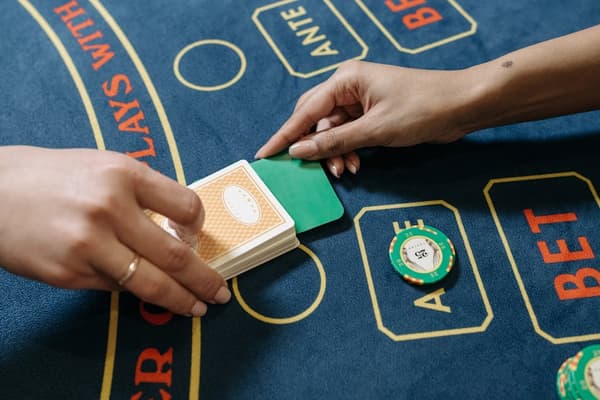
How to Play
In Between (Acey Deucey, Between the Sheets, Yablon) is a chance-based gambling card game for 2 to 10 players. Each turn the active player bets that a third card will rank strictly between two face-up posts; between pays from the pot, outside pays into the pot, and an exact match doubles the loss.
In Between (also Acey Deucey, Between the Sheets, Sheets, or Yablon) is a chance-based gambling card game for 2 to 10 players. Each player antes into a shared pot; on your turn the dealer lays out two face-up posts, you decide how much of the pot to bet that the next card falls strictly between them in rank, and a third card is revealed. Between wins the bet from the pot; outside loses the bet into the pot; an exact match (a 'post') loses double. Aces are flexible (high or low when dealt as the first post), and consecutive or matching opening posts trigger special rules. Sessions continue until the pot is busted or players agree to stop.
Quick Reference
- Each player antes into a shared pot at the start and whenever the pot empties.
- Choose a dealer; first active player is to the dealer's left.
- Dealer places two face-up posts in front of the active player; if either is an Ace, declare high or low (the second post Ace is always high).
- Active player bets between the minimum and the pot size (or passes when allowed).
- Dealer reveals a third card: between the posts wins from the pot, outside pays in, an exact match pays double in (quadruple for Ace-Ace).
- Win 1:1 from pot. Loss 1:1 into pot. Post-match 2x into pot (4x for Ace). Pair-posts triple-match 3x.
- Session ends by agreement; highest chip total wins.
Players
2 to 10 players, each playing for themselves (no partnerships). 4 to 8 players is the practical sweet spot. Choose a dealer by any agreed method; some house rules rotate the dealer between hands while others use one dealer for the whole session. Every player both contributes to the pot (via antes) and bets against it (on their turn), making it a single-table social-pot game.
Card Deck
One standard 52-card deck, no jokers (with 8+ players some groups use two combined decks). Ranks within each suit run 2 (low), 3, 4, 5, 6, 7, 8, 9, 10, Jack, Queen, King, Ace (high). Suits are irrelevant for outcomes; only rank matters. Aces have flexible ranking: when dealt as the first post, the active player may declare Ace-high (rank 14) or Ace-low (rank 1); when dealt as the second post or as the third card, an Ace is always Ace-high.
Objective
On each turn, accurately judge the spread (the number of ranks strictly between the two posts) and bet a sensible amount: a wide spread favours a big bet; a one- or two-rank spread is usually a losing proposition once you account for the post-match double penalty. Across the session, finish with more chips than you started; the player with the highest chip total at the end of play wins.
Setup and Deal
- Agree the ante per player (commonly 1 chip), and a bet floor / ceiling (commonly: minimum 1 chip, maximum capped at the current pot size).
- Each player puts their ante into a central pot.
- Choose a dealer; the first active player is the one to the dealer's left.
- On the active player's turn, the dealer places two face-up cards (the posts) in front of them.
- Ace declaration: If either post is an Ace, the active player announces high or low for that Ace before betting (an Ace dealt as the second post is always high by convention).
- Determine the spread: The spread is the number of ranks strictly between the two posts. Example: posts 5 and 10 have a spread of 4 (the ranks 6, 7, 8, 9 lie between). Posts 5 and 6 have a spread of 0. Two equal posts (e.g., 7 and 7) trigger the matching-posts rule (see Gameplay).
Gameplay
- Bet or pass: The active player decides how much to bet (between the agreed minimum and the current pot size). Some house rules permit a free 'pass' on bad spreads; others enforce a minimum bet on every turn.
- Draw the third card: The dealer turns the next card face-up between the two posts.
- Between (win): If the third card's rank lies strictly between the two posts, the active player wins their bet from the pot. The pot decreases by that amount.
- Outside (lose): If the third card's rank is above the higher post or below the lower post, the active player loses their bet into the pot. The pot increases by that amount.
- Post (exact match, double penalty): If the third card exactly matches either of the two posts (e.g., posts 5 and 10, third card is a 5 or a 10), the active player loses double their bet into the pot.
- Ace post (quadruple penalty): If a post was an Ace and the third card is also an Ace, the active player loses quadruple the bet into the pot. (Aces have higher post variance because of their position at the rank extremes.)
- Matching posts (pair, e.g., 7-7): When the two posts are the same rank, the active player bets higher or lower rather than between. If the third card matches the rank again (a third 7), the active player loses triple their bet into the pot.
- Consecutive posts (spread 0, e.g., 7 and 8): No rank lies between them; the active player is usually allowed to pass with no bet. Some house rules require a minimum ante regardless.
- Empty pot: When the pot is fully won, all players ante again to refresh it; the next player continues.
- Next turn: Play passes clockwise to the next active player whether the previous turn won or lost.
Scoring
- Per-turn settlement: All wins and losses settle instantly: chips move between the pot and the active player. No cumulative point-keeping beyond chip totals.
- Payout multipliers: Win (between) pays 1:1 from the pot. Loss (outside) pays 1:1 into the pot. Exact-match post pays 2x into the pot (4x for Ace-Ace). Matching-posts triple-match pays 3x into the pot.
- Session totals: Chip counts at the end of the session are the final scores. Anyone with more chips than they started has won; less, lost.
- Probability reference (single deck, two posts already removed): Win probability ≈ (spread × 4) / 50. Spread 1 ≈ 8%, spread 5 ≈ 40%, spread 9 ≈ 72%, spread 12 (Ace-low to King) ≈ 96%.
Winning
- Session winner: Highest chip total at the agreed end of play.
- No fixed-length sessions: Play continues by mutual agreement or until the pot is empty and players decline to re-ante.
- Ties: If two or more players are level, deal one extra turn each to break the tie; whoever nets more wins.
- Pot bust: When a player wins the last chip in the pot, the round ends; players re-ante to continue or end the session.
Common Variations
- Pot Limit (half-pot cap): Maximum bet is half the current pot, not the full pot. Extends sessions.
- Blind Bet: The third card is drawn face-down and revealed only after the bet is placed; prevents any dealer tells.
- AutoPot: Posts of A-2 (a 12-rank spread) force the active player to bet the entire pot automatically. A windfall but rare.
- Satan 6s: Three 6s (6-6 posts plus a 6 third card) cost the active player 6x their bet.
- Post Bet (side bet): Side wager on whether the third card will be an exact-match post; pays 10:1 if correct.
- No Double-Penalty: Drop the post (match) double-penalty so a match counts as a normal outside loss. Friendlier for beginners.
- Red Dog: A simplified casino version where the dealer plays the bank with fixed odds; no shared pot.
Tips and Strategy
- Spread math is the whole game. Probability of winning ≈ (spread × 4) / cards remaining in deck. With a spread of 3, you win only ~24%; with a spread of 7, ~56%; with a spread of 11, ~88%.
- Account for the post penalty. A spread of 3 has a small win edge but the 8% post-match rate doubles your loss; expected value goes negative below a spread of 5.
- Don't bet the full pot on a 50-50 spread. Expected value is zero, but variance is huge: one bad turn busts you out.
- Aces dealt as the first post: maximise the spread. If the other post is an 8, calling Ace-low gives you ranks 2 to 7 in between (spread 6); calling Ace-high gives you only 9 to King (spread 5). Always choose the bigger spread.
- Track which cards are gone. Once several specific ranks have been played out of the deck, your between-card pool shrinks; recalculate before betting heavy.
- Conserve chips when the pot is large. A large pot means losses cost more; only bet a fraction of the pot until your spread is genuinely favourable.
- Pass on consecutive posts. A spread of 0 is auto-loss in most house rules; take the free turn.
Glossary
- Posts: The two face-up cards dealt at the start of a turn; also the name for an exact-match third card that pays double.
- Spread: The number of ranks strictly between the two posts. Equal posts have a special pair-rule.
- Ante: The compulsory chip contribution to the pot at session start and whenever the pot empties.
- Pot: The central pool of chips that bets pay from (on wins) or to (on losses).
- Between / Outside: The two main outcomes: between = third card falls strictly between the posts (win); outside = third card is above or below both posts (lose).
- Ace-high / Ace-low: The flexible declaration when an Ace is dealt as the first post: rank 14 or rank 1.
- Post-match: An exact match between the third card and one of the two posts; pays double (4x for Ace-Ace).
- Pair posts: Two posts of the same rank; the active player bets higher-or-lower instead of between, and a third matching card costs triple.
Tips & Strategy
The whole strategy is spread math: probability of winning ≈ (spread × 4) / cards remaining. Avoid heavy bets below a spread of 5 because the post-match double-penalty kills the expected value, and never bet the full pot on a 50-50 spread (zero expected value, huge bust risk).
Ace flexibility is a tactical lever: when an Ace appears as the first post, always declare high or low to maximise the spread. The wider the spread, the smaller the post risk relative to the win probability, so spread 7+ is roughly the threshold for confidence betting.
Trivia & Fun Facts
With a perfect 12-rank Ace-low to King spread, the win probability tops 96% with a single deck, but the 4% loss outcomes plus post-match risk still keep the pot dynamic; full-spread autopot rules force the active player to bet everything when Ace-2 appears.
-
01What happens in In Between when the third card exactly matches one of the two face-up posts?Answer It is a 'post': the active player loses double their bet into the pot (or quadruple if an Ace matches an Ace).
History & Culture
In Between has roots in 19th-century American frontier gambling and survived as a barracks, college, and family card-night game throughout the 20th century. The casino simplification 'Red Dog' was a widespread Vegas table game from the 1930s onward.
In Between is a staple of casual card nights, military barracks, and college dormitories across the English-speaking world. Its simplicity, social pot mechanic, and dramatic swings have kept it on kitchen tables for over a century.
Variations & House Rules
Pot Limit caps bets at half the pot. Blind Bet hides the third card until after the bet. AutoPot forces full bets on A-2 spreads. Satan 6s charges 6x for triple-6s. Post Bet is a side wager. No Double-Penalty drops the match double-loss. Red Dog is the casino simplification.
For new players, drop the post (match) double-penalty so matches count as normal losses. Use a half-pot cap to extend the session. For larger groups, combine two decks to keep the deck depth fresh.


