
How to Play
Lansquenet is a 16th-century banking game of pure chance in which the Banker posts a stake, turns two cards (one for the Bank, one for the Punters) and then turns cards from the stock until one rank or the other is matched; whichever side is matched first wins the bets.
Lansquenet is a historical French and German banking game of pure chance, played since the 1500s in the camps of Landsknecht mercenaries. One player acts as the Banker and puts up a stake. The Banker turns two cards from a shuffled deck: one belongs to the Banker, the other to the Punters (all other players betting together against the Bank). After the Punters bet against the Banker's stake, the Banker turns cards one at a time from the stock. If a turned card matches the Punters' card in rank, the Punters win and the Banker pays; if it matches the Banker's card first, the Banker collects all bets. Suits are irrelevant; only rank matters, and the outcome is fixed by the order of the shuffled deck.
Quick Reference
- Pick a Banker; shuffle one or more 52-card decks.
- The Banker posts a bank stake they are willing to risk.
- Punters stake up to the remaining unmatched bank, proceeding anticlockwise from the Banker's right.
- The Banker turns two cards: left is the Banker's card, right is the Punters' card. Equal ranks = Banker wins immediately.
- The Banker then turns cards one at a time from the stock.
- First card matching the Banker's rank = Banker wins; first matching the Punters' rank = Punters win.
- Punters are paid even money on their stakes.
- Banker collects the full stakes of all Punters on a Banker win.
- Losing Banker passes the bank to the next player on the right.
Players
2 to about 10 players around a table. One player is the Banker; all others are Punters. Players draw cards to seat themselves; whoever draws the highest card becomes the first Banker. The role passes on certain losses (see Gameplay).
Card Deck
Traditionally six shuffled standard 52-card packs mixed into one shoe, though a single 52-card deck re-shuffled before each deal works equally well for casual play. Suits do not matter and there is no ranking order among the cards; the game is purely about matching ranks.
Objective
Banker: Win the Punters' stakes by having the Banker's card matched from the stock before the Punters' card is matched. Punters: Win even money on their stake by having the Punters' card matched first.
Setup and Deal
- Players draw cards to set seats and determine the first Banker; highest drawn card takes the bank.
- The Banker places a bank stake, an amount they are prepared to lose, on the table. This is the maximum the Bank can pay out on this deal.
- Shuffle all decks thoroughly; any player may cut. The Banker will deal and turn cards from this combined stock.
- Starting with the Punter on the Banker's right and proceeding anticlockwise, each Punter in turn may stake any amount up to the Banker's unmatched remaining stake (or pass), until either the bank is fully matched or all Punters have staked.
- If total Punter stakes exceed the Bank, the Banker may accept only as much as matches the bank; surplus stakes are refused and returned.
Gameplay
- The Banker turns the top two cards of the stock face-up on the table: the first goes to the Banker's left and is the Banker's card, the second goes to the Banker's right and is the Punters' card.
- Instant banker win: If these two cards are of the same rank (a 'doublet'), the Banker wins all stakes at once. The cards are set aside, a new bank stake may be posted, and the deal repeats.
- Otherwise the Banker now turns cards one at a time from the stock, placing each in front of whichever exposed card it matches in rank and leaving unmatched cards aside in a separate waste.
- When a card matches the Banker's card: the Banker wins all Punter stakes for the round. The Banker may then keep the bank (taking in winnings and optionally posting a fresh stake) or pass it on.
- When a card matches the Punters' card: the Banker loses. The Banker pays each Punter an amount equal to that Punter's stake, out of the bank stake. The bank then passes to the next player on the Banker's right, who becomes the new Banker.
- If the matched card is the very next card turned (the third card after the two openers), a 'first-card match' doubles the payout or loss in many house rules; modern casual play usually just treats it as a normal win or loss.
- Play continues until the stock is exhausted or the players agree to stop; bank changes happen whenever the Banker loses a round.
Scoring
- Punter wins are paid even money: a stake of 10 returns 10 in winnings plus the original stake.
- Banker wins collect each Punter's full stake.
- The Banker's risk per deal is capped at the posted bank stake; no Punter may stake more than the remaining unmatched portion of that stake.
- There is no house take; this is a peer-banked game, so all money passes directly between Banker and Punters.
Winning
- A single deal is won by whichever card (Banker's or Punters') is matched first from the stock.
- Across a session, each player keeps whatever net gains they collect; there is no formal endpoint. Casual sessions end when the agreed stake limit is reached or by common agreement.
- The Banker may voluntarily pass the bank to the next player after any winning deal; after a losing deal they must pass it on.
Common Variations
- Multiple Punter cards: Instead of one shared Punters' card, each seated Punter receives their own face-up card to bet on, and each is matched or not independently against the Banker.
- Short deck: For casual play with one 52-card deck, some circles remove all cards below a 7 to increase the frequency of matches and shorten deals.
- Sold bank: After a winning deal, the Banker may auction the bank to the highest bidder rather than passing it automatically.
- Fixed-rotation bank: Rather than pass on loss, the bank rotates every fixed number of deals, so both streaks of wins and losses affect the whole table equally.
- Capot: If the Banker's card appears twice in a row before any Punter match, the Banker wins a bonus payment equal to the bank (rarely played today).
Tips and Strategy
- Lansquenet has no meaningful strategy once the deal begins; the cards are already in order when the shuffle ends. Everything else is bankroll management.
- As Banker, post a stake you are genuinely willing to lose; oversized bank stakes are the single fastest way to go broke, because a losing deal wipes out the whole stake at once.
- As Punter, diversify across multiple small deals rather than betting the maximum on a single deal; the volatility of a single-deal win is high but the expected return is the same.
- If the table agrees to use multiple Punter cards, betting the Punter position with the lowest count of exposed same-rank cards gives the best (but still break-even) chance of matching first. Track matched ranks in the waste pile.
- Set a firm loss limit before you sit down, and leave when you reach it; this is a pure gambling game and losses compound quickly.
Glossary
- Banker: The player who puts up the stake and turns cards; loses or wins that stake each deal.
- Punter: Any non-Banker player betting against the Bank.
- Bank stake: The Banker's posted maximum for the deal; Punters' combined stakes may not exceed it.
- Banker's card: The first card turned, placed on the Banker's left; used as the matching target for the Bank.
- Punters' card: The second card turned, placed on the Banker's right; used as the matching target for the Punters.
- Doublet: Two opening cards of the same rank; Banker wins outright.
- Match: A later turned card that shares rank with either of the two opening cards; ends the deal in favour of whichever side's card was matched.
- Capot: A rare variant bonus for certain double-match situations.
- Landsknecht: The German mercenary profession that gave the game its name.
Tips & Strategy
Bankroll management is the only useful skill in Lansquenet. As Banker, never post more than you are willing to lose on a single deal; as Punter, stake uniformly across many deals rather than pushing one large bet.
There is no strategy once the cards are shuffled; the game is decided by deck order. The only real decisions are when to take the bank, how much to stake as Banker, and when to walk away from the table.
Trivia & Fun Facts
The French writer Casanova mentions Lansquenet in his memoirs as the house game at certain Parisian gambling salons of the 1750s. A standard 18th-century French deck was sometimes advertised as 'Jeu de Lansquenet' because the game was a principal commercial use of blank-back packs.
-
01What category of professional soldier gave Lansquenet its name?Answer The Landsknechte, the German pike-and-halberd mercenaries of the 15th-16th centuries, in whose camps the game was first recorded.
History & Culture
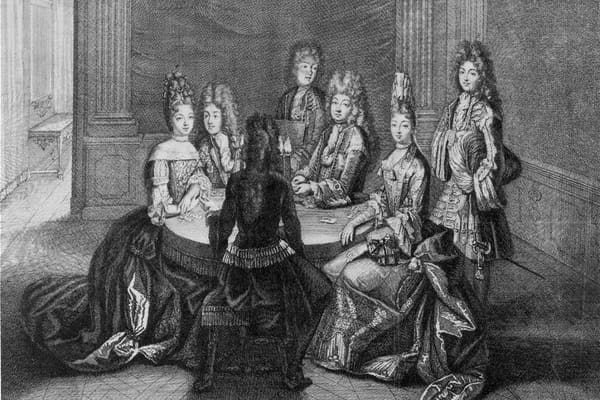
Lansquenet was hugely popular in French and German camps in the 1500s and 1600s, taking its name from the Landsknechte, the pike-and-sword mercenaries of the Holy Roman Empire. It travelled with French aristocrats to the courts of the 17th and 18th centuries and appears in memoirs of the Sun King's circle at Versailles.
Lansquenet is one of the oldest banking games in the European tradition and a direct precursor of modern Faro and Baccarat. It survives today mostly as a historical curiosity at period-themed clubs and reenactment events.
Variations & House Rules
The main modern variants are Multiple Punter cards (each Punter bets on their own card), short-deck play, bank-auction rules, and fixed-rotation banking so the Bank does not leap between players on every loss.
For historical flavour use a 32-card piquet pack (7 through Ace). For a faster family game, cap the bank at a fixed small amount (e.g., 10 chips) and rotate the bank clockwise every two deals regardless of outcome.


