
How to Play
French Tarot is France's national trick-taking card game, played with a unique 78-card deck of four suits, 21 trumps, and the Excuse. One player bids to become the taker and plays alone against the rest, aiming to bank enough card points to beat a target set by how many of the three prized 'bouts' they hold.
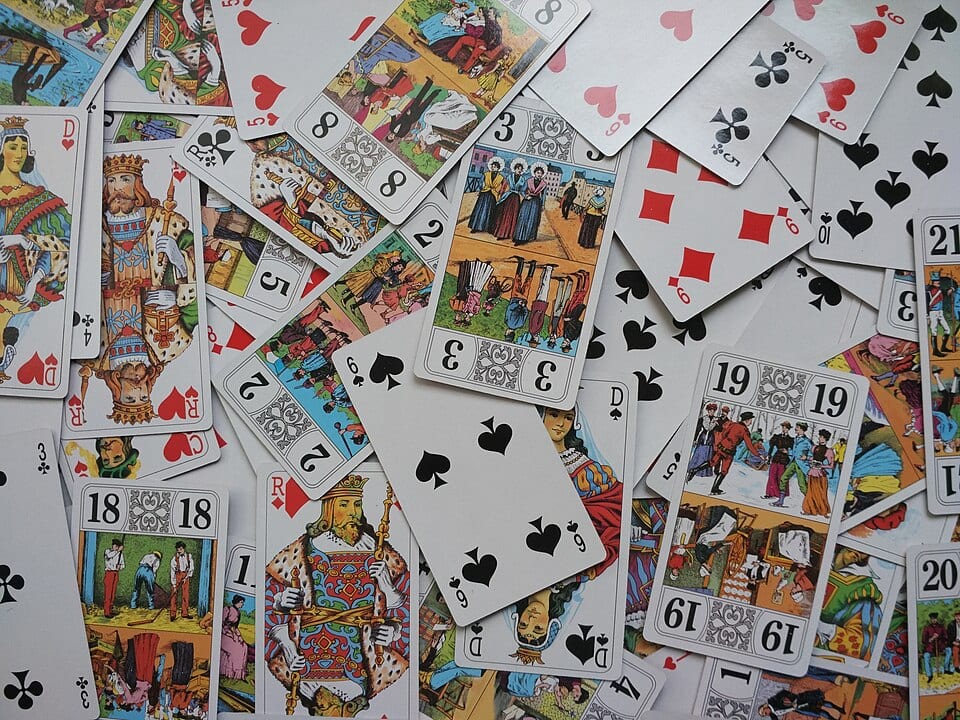
French Tarot (Jeu de Tarot) is France's national trick-taking card game, played with a dedicated 78-card Tarot deck rather than a standard pack. One player bids to become the taker and plays alone, hand against the table, aiming to capture enough card points from the tricks to beat a target set by how many of the three most valuable cards (the bouts) they hold. Beneath its unusual deck lies a rich structure of bidding, a hidden reserve of cards called the chien (the dog), strict follow-suit-or-trump rules, and a scoring formula full of bonuses. It rewards careful counting and long-range planning more than any single flashy trick.
Quick Reference
- Use the full 78-card Tarot deck: 4 suits of 14 cards, 21 numbered trumps, and the Excuse.
- Deal all cards in packets of 3; in a 4-player game each player gets 18 cards and 6 go to the face-down dog.
- Run the auction (Petite, Garde, Garde Sans, Garde Contre); highest bidder becomes the taker.
- On a Petite or Garde bid, the taker takes the dog, then discards 6 cards face-down (no trumps or Kings).
- Eldest hand leads; follow suit if possible, otherwise trump is compulsory, and overtrumping is compulsory when able.
- The Excuse may be played to any trick at any time without following suit or trumping.
- Cards are worth: King 4.5, Queen 3.5, Cavalier 2.5, Jack 1.5, all others 0.5; the 3 bouts are worth 4.5 each; total 91.
- Target: 56 points with 0 bouts, 51 with 1, 41 with 2, 36 with 3.
- Score = (25 + difference from target) × contract multiplier (1/2/4/6); taker collects from or pays each of the 3 defenders.
Players
French Tarot is most commonly played by four players, each for themselves; there are no fixed partnerships, though the auction winner effectively becomes a temporary team of one against the other three. A three-player game uses the same cards with a larger individual hand, and a five-player game adds a partnership twist where the taker calls a King to secretly recruit a partner (see Variations). Turn order is always counter-clockwise ('to the right') in traditional French play, though many home groups play clockwise instead; agree on direction before dealing.
Card Deck
- One 78-card Tarot Nouveau deck: four French suits of 14 cards each (Spades, Hearts, Diamonds, Clubs), plus 21 numbered trump cards, plus 1 special card called the Excuse. 14×4 + 21 + 1 = 78.
- Suit cards, rank order (high to low): King, Queen, Cavalier (Knight), Jack, 10, 9, 8, 7, 6, 5, 4, 3, 2, Ace. Unlike most Western trick games, the Ace is the LOWEST card in each suit, below the 2.
- Trumps (atouts): numbered 1 to 21 and always outrank every suit card. The lowest trump is called 'le Petit' (the little one) and the highest is 'le Vingt-et-un' (the twenty-one, sometimes called 'le Monde'). Trump 1 beats a King of any suit.
- The Excuse ('l'Excuse'): a unique card outside the trump sequence, usually printed with a jester. It can be played to any trick regardless of the suit led, never has to follow suit or trump, and is essentially never capturable in play (see 'The Excuse' section).
- The three bouts: the Excuse, trump 1 (le Petit), and trump 21 together are called the bouts ('the ends'). Holding more bouts at the end of play lowers the point total the taker needs to win.
Objective
One player, the taker, bids for the right to play alone against the other three (the defense), who cooperate freely and share a single result. The taker's goal is to end the deal with enough card points in their won tricks (plus the discarded dog, when applicable) to reach a target that depends on how many of the three bouts they collected: 56 points with zero bouts, 51 with one, 41 with two, or 36 with all three. The defense's goal, collectively, is to deny the taker that target.
Setup and Deal
- Shuffle the full 78-card deck and let the player to the dealer's right cut it.
- Deal all 78 cards clockwise in packets of three, going around the table repeatedly, with one exception: after the first packet to each player, deal a packet of three face-down to the centre of the table to form the chien (the dog). In a 4-player game the dog totals 6 cards this way; each of the four players ends up with 18 cards.
- Nobody looks at the dog until the auction is decided.
- The player to the dealer's right ('the eldest hand') speaks first in the auction; deal and the first bid rotate one seat clockwise each hand.
The Auction (Bidding)
- Four possible bids, from lowest to highest: 'Petite' (Small), 'Garde' (Guard), 'Garde Sans le Chien' (Guard Without the dog), 'Garde Contre le Chien' (Guard Against the dog).
- Starting with the eldest hand and moving clockwise, each player in turn either passes or names a bid higher than any bid already made. A player who passes is out of the bidding for that deal.
- Petite and Garde: the taker will take the dog into their hand after bidding closes, see it, and then discard.
- Garde Sans le Chien: the taker leaves the dog face-down and unseen for the whole deal; its points count for the taker at the end regardless.
- Garde Contre le Chien: the taker never sees the dog either, and its points count for the DEFENSE at the end, working against the taker.
- If everyone passes, the deal is abandoned, the cards are gathered, and the deal moves to the next player without scoring.
- The highest bidder becomes the taker for the deal; everyone else forms the defense.
The Dog and the Discard
- Only in a Petite or Garde contract: the taker turns the 6 dog cards face-up for everyone to see, adds them to their hand (now 24 cards), and then discards exactly 6 cards face-down; these discards count as the taker's own captured cards for scoring at the end.
- Discard restrictions: no trump and no King may ever be discarded into the dog. The Excuse may only be discarded if the taker holds no other legal card left to discard (extremely rare).
- If the taker accidentally reveals a King or trump while dealing the dog, or is forced to include one because their hand is short of pluses, the group typically agrees a local house rule; standard tournament rules apply strict penalties for an illegal discard.
- Garde Sans and Garde Contre skip this step entirely: the dog is never touched, and its 6 cards are simply added, unseen, to the taker's total (Sans) or the defense's total (Contre) when scoring the deal.
Trick Play
- The eldest hand (the player to the dealer's right) leads to the first trick; the winner of each trick leads the next.
- Follow suit if you can. If you cannot follow the suit led, you MUST play a trump if you hold one ('ruffing is compulsory' in French Tarot, unlike Bridge or Whist).
- Overtrumping is compulsory too. If a trump has already been played to the trick and you must trump (because you are void in the suit led), you must play a HIGHER trump than any already in the trick if you are able to.
- Only when you can neither follow suit nor produce any trump may you discard any card freely, including a King.
- The highest trump played wins the trick; if no trump was played, the highest card of the suit led wins. The trick winner gathers all four cards face-down and leads next.
- All 24 tricks (18 after the dog cards leave the deal, adjusted for player count) are played out; there is no stopping early.
The Excuse
The Excuse can be played to any trick at any time, even on the very first trick, and is exempt from following suit and from the compulsory-trump rule; playing it never risks losing the trick to an opponent in the normal sense. Whoever plays the Excuse keeps it for their own side's card-point total at the end of the deal, but as compensation they must hand the winner of that trick one low card (worth 0.5 points, never a bout) from among their own already-won tricks. The only time the Excuse can actually be captured by the other side is if it is played on the very last trick of the deal, when there is no later trick left to make the exchange.
Scoring
- Point values are fixed per card, not per trick: each King = 4.5, Queen = 3.5, Cavalier = 2.5, Jack = 1.5. Every other card, including ordinary trumps and the Ace through 10 of each suit, is worth 0.5. Each of the three bouts (Excuse, Petit, 21) is worth 4.5. The full deck always totals exactly 91 points.
- Target by bouts held: the taker needs 56 points with 0 bouts, 51 with 1 bout, 41 with 2 bouts, or 36 with all 3 bouts, out of the 91 available.
- Base score: compute the difference between the taker's actual point total and their target, then add a fixed base of 25 to that difference.
- Contract multiplier: multiply the result by 1 for Petite, 2 for Garde, 4 for Garde Sans le Chien, or 6 for Garde Contre le Chien.
- Settling up: if the taker met or beat their target, each of the three defenders pays that final score to the taker; if the taker fell short, the taker pays that amount to each of the three defenders instead. The taker's net swing is therefore three times the base score.
- Le Petit au bout: if trump 1 (le Petit) is played on the very last trick of the deal, a bonus of 10 points (before the contract multiplier) is added for whichever side ends up holding it, and subtracted from the other side.
- Poignée (handful) bonus: a player, whether taker or defense, who is dealt an unusually trump-heavy hand may reveal it before playing a card for a bonus: 20 points for 10 trumps (Simple), 30 for 13 (Double), or 40 for 15 (Triple), out of 18 cards in a 4-player game.
- Chelem (slam) bonus: if the taker wins every single trick in the deal, they score a large bonus, 400 points if announced in advance and achieved, only 200 if achieved without having announced it, or a 200-point penalty if announced but not completed.
- Because every card value carries a half-point, the taker's total can never land exactly on a whole-number tie with the defense; the outcome is always decisively won or lost.
Winning
A single deal is settled the moment the last trick is played and points are counted: the taker either clears their target and collects from all three defenders, or falls short and pays all three instead, scaled by the contract multiplier and any bonuses. Across a full session, players keep a running personal score over an agreed number of deals (commonly a fixed number of hands, or one full rotation of the deal through every player several times over); whoever holds the highest cumulative score when the session ends is the overall winner. Because the deal rotates, everyone gets an equal number of turns as dealer and as eldest hand.
Variations
- Three-player Tarot: the dog is still 6 cards, but each player is dealt 24 cards from the 78-card deck; there is no partnership, so play is identical to the 4-player game apart from hand size.
- Five-player Tarot: each player is dealt 15 cards, with a dog of 3 cards. After winning the auction, the taker calls a King of their choice (usually a King they do not hold) by naming it aloud; whichever player holds that King becomes the taker's silent partner for the deal, without revealing themselves until that King is actually played to a trick. The partner still plays their own hand and collects their own cards, but the two point totals are combined at the end.
- Two-player 'Tête-à-tête' Tarot: an unofficial but documented variant using a reduced or adapted deck and simplified dog-and-discard rules; far less standardised than the 3 to 5 player forms.
- Simplified 'Tarot for beginners': many French households drop the Poignée and Chelem bonuses and play only Petite and Garde bids while learning, adding Garde Sans and Garde Contre once the core follow-suit-and-trump discipline feels automatic.
Tips and Strategy
- Count your trumps and bouts before bidding, not after. A hand with 8 or more trumps including at least one bout is usually strong enough for at least a Petite; fewer than 5 trumps and no bouts is almost always a pass.
- Protect le Petit. If you hold trump 1 alone or nearly alone, plan several tricks ahead to avoid being forced to play it too early against a higher trump; losing your only Petit late for no reason gives up 4.5 guaranteed points.
- As taker, lead trumps early. Stripping the defense of trumps before they can ruff your Kings and Queens in the suits protects your biggest point cards.
- As a defender, count who is void in which suit. Because trumping is compulsory when void, an opponent's early discard pattern reveals their shape; use that to plan safe leads for your partners later in the hand.
- Play the Excuse for value, not just to save it. Playing it on a trick your side is already winning wastes its protection; playing it early on a weak trick you were going to lose anyway banks its 4.5 points cheaply.
Glossary
- Taker (le preneur): the auction winner, who plays alone against the other players for the deal.
- Chien (the dog): the 3 or 6 cards set aside from the deal, seen or unseen depending on the bid.
- Bouts (the ends): the Excuse, le Petit (trump 1), and the 21, the three cards whose count determines the taker's target score.
- Le Petit: trump numbered 1, the lowest trump but one of the three bouts.
- L'Excuse: the unnumbered special card that may be played to any trick without following suit or trumping.
- Poignée: a bonus for revealing an unusually trump-heavy hand before the first card is played.
- Chelem: winning every trick of the deal, worth a large bonus if achieved.
- Overtrump (surcoupe): playing a higher trump than one already in the trick when compulsorily trumping.
Tips & Strategy
Bid only when your trump-and-bout count supports it: 8+ trumps with a bout is a safe Petite, while a Garde Sans or Garde Contre demands a genuinely dominant hand since you never see or improve on the dog. Lead trumps early as taker to strip the defense's ability to ruff your Kings and Queens, and track which opponents are void in which suit to time your own discards and overtrumps.
Skilled taker play in French Tarot is built around controlling trumps early, since compulsory trumping and overtrumping mean that whoever runs out of trumps first loses control of the hand. Because the Excuse and the two other bouts alone are worth nearly half the deal's needed points, experienced players track bout location throughout the play almost as closely as they track the trump count, timing their own Excuse and their overtrumps to protect or capture bouts precisely when it matters.
Trivia & Fun Facts
France prints and sells more Tarot Nouveau decks each year for card play than for any esoteric use; the fortune-telling association most English speakers assume for 'Tarot cards' is a comparatively later, non-French development layered onto the same 78-card structure. The Excuse card, showing a jester or fool, is the direct ancestor of the Joker used in modern poker-pattern decks.
-
01Why can the taker's score in French Tarot never end in an exact tie with the defense's target?Answer Every card in the 78-card deck is worth a multiple of 0.5 points, so the 91 total points can never split evenly on a target that would create a dead-even result.
History & Culture
Tarot cards originated in 15th-century Italy as 'tarocchi', a trick-taking game with a suit of 21 numbered trumps and a Fool, well before tarot cards were ever used for fortune-telling. The game spread north into France, where the modern Tarot Nouveau deck design (with its now-familiar corner indices and genre scenes on the trumps) was standardised by the French firm Grimaud in the late 19th century. The French Tarot federation (Fédération Française de Tarot) was founded in 1973 and continues to run national championships under codified rules.
French Tarot is one of the most widely played card games in France, a fixture of family gatherings, café tables, and dedicated clubs affiliated with the Fédération Française de Tarot, which runs a national ranking and championship circuit. Its distinctive 78-card deck and vocabulary, taker, dog, bouts, the Excuse, have become part of everyday French card-playing culture even though most players never use a Tarot deck for anything but this game.
Variations & House Rules
Three-player Tarot simply enlarges every hand with no partnership. Five-player Tarot introduces a hidden partnership formed when the taker calls a King, similar in spirit to the called-ace partnerships of some regional Belote and Euchre variants. Casual groups commonly restrict early games to just Petite and Garde bids and skip the Poignée and Chelem bonuses until players are comfortable with compulsory trumping.
For a first session, play only Petite and Garde contracts, skip Garde Sans and Garde Contre, and ignore Poignée and Chelem bonuses until the follow-suit-and-overtrump discipline is automatic. For a faster evening, agree on a fixed number of deals (such as one full round of dealer rotation) rather than an open-ended session.


