
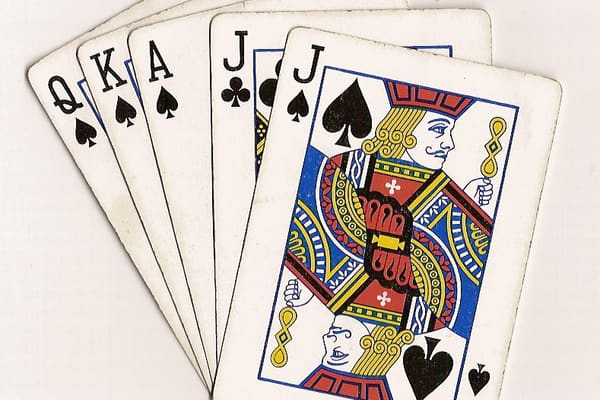
How to Play
Euchre is a trick-taking game played with a subset of a standard 52-card deck. It is popular in English-speaking countries and features a unique trump suit determined by bidding.
Euchre is a fast 4-player partnership trick-taking game played with a 24-card deck (9s up through Aces only). Each hand is just 5 tricks long; after a quick bid to determine trump, the makers (declaring partnership) must take 3 of the 5 tricks or be 'euchred' (beaten). The signature twist is the Bowers: the Jack of the trump suit (Right Bower) is the highest card in the game, and the Jack of the same COLOUR (Left Bower) is the second highest and temporarily becomes part of the trump suit. Games run to 10 points; a partnership that makes their bid scores 1 or 2 points, 4 for a successful solo 'loner', and 2 points go to the defenders on a euchre. Euchre is hugely popular in the American Midwest, Canada, and parts of the UK and Australia.
Quick Reference
- Use a 24-card deck (9 through Ace in each suit).
- 4 players in 2 partnerships; deal 5 cards each.
- Flip top card to propose trump suit.
- Players accept or name a trump suit during bidding.
- Player to dealer's left leads; follow suit if possible.
- Right Bower (Jack of trump) is highest; Left Bower is second.
- Makers win 3-4 tricks: 1 point; all 5 tricks: 2 points.
- Going alone and winning all 5: 4 points.
- Euchre (makers fail to win 3): defenders get 2 points.
Players
Exactly 4 players in 2 fixed partnerships, partners sitting opposite each other. 2-player and 3-player variants (Two-Handed Euchre, Cutthroat Euchre) exist with rule adjustments but the 4-player partnership game is the dominant form. Turn order is clockwise; the first dealer is chosen by cutting for low card (Jack is usually drawn out), and the deal rotates clockwise. A single hand takes 3-5 minutes; a full match to 10 points typically runs 20-30 minutes.
Card Deck
- 24-card deck: remove the 2s through 8s from a standard 52-card pack, leaving 9, 10, J, Q, K, A in each suit.
- Rank order in non-trump suits: A (high), K, Q, J, 10, 9 (low).
- Trump suit order (after trump is named): Right Bower (J of trump, highest card in the deck), Left Bower (J of the SAME COLOUR as trump), A, K, Q, 10, 9 — note the Queen follows the Ace/King and precedes the 10. Example: hearts trump → (Right), (Left, same red colour, now counts as a heart), , , , , .
- Left Bower behaviour: the Left Bower (Jack of same colour as trump) is treated as trump for ALL purposes during the hand: it must be played if you are forced to follow suit to a trump lead, and its 'printed' suit is temporarily ignored.
- A 25th card is sometimes added as a 'benny' joker in Canadian variants (see Variations); standard Euchre does not use a joker.
Objective
Be the first partnership to reach 10 points. Each hand, one partnership 'makes' the trump (by accepting or naming a trump suit) and must win 3 of the 5 tricks. Making 3 or 4 tricks scores 1 point; winning all 5 (a 'march') scores 2. A successful 'loner' (going alone) with 5 tricks scores 4. If the makers fail to take 3 tricks, they are 'euchred' and the defenders score 2 points.
Setup and Deal
- Shuffle the 24-card deck; the player to the dealer's right cuts.
- Deal 5 cards to each player in groups: 3-2 or 2-3 (house choice, consistent throughout the game). Example 3-2: 3 cards to each player clockwise, then 2 cards to each.
- After the deal, 4 cards remain face-down on the table. Place them in front of the dealer and flip the TOP one face-up; this card is 'up for ordering' and its suit is the proposed trump for the first bidding round.
- The player to the dealer's left is the first to decide whether to accept the turn-up suit or pass.
- After each hand, shuffle and deal rotates one seat clockwise.
Bidding (Naming Trump)
- First round: starting with the player to the dealer's left and proceeding clockwise, each player may either PASS or 'order up' the turn-up card's suit as trump. If you order up (or the dealer accepts it on their turn), the dealer PICKS UP the turn-up card into their hand and discards one card face-down. The turn-up's suit becomes trump; the partnership ordering it up is 'the makers'.
- If all 4 players pass in round 1: turn the up-card face-down. The bidding begins again clockwise, and each player may either PASS or NAME any OTHER suit (not the turned-down suit) as trump. The first player to name trump becomes the maker; that suit is trump.
- If all 4 players pass in round 2: the hand is thrown in and the next dealer deals. In 'Stick the Dealer' (a very popular house rule), the dealer MUST name trump in round 2 rather than pass, so no hand is ever thrown in.
- Going Alone (Loner): the player who names trump may declare 'alone' (or 'loner'). Their partner sits out the hand, placing their cards face-down; the lone maker plays all 5 tricks solo. Winning 5 tricks as a loner scores 4 points instead of 2.
- Defending Alone (optional house rule): in some regions, a defender may choose to play alone against a loner; their partner sits out, and if the lone defender euchres, they score 4 points instead of 2.
Gameplay
- Leading: the player to the dealer's LEFT leads the first trick (if someone is a loner, it is the player to the loner's LEFT). Any card may be led.
- Following suit: clockwise, each player must play a card of the suit LED if they hold one. The Left Bower's 'suit' for following-suit purposes is TRUMP, not its printed suit. Example: hearts trump, diamond is led, and you hold (Left Bower) — you do NOT have to play the J♦ because it counts as a heart; instead, play another diamond or renege.
- If you cannot follow suit, you may play any card, including a trump, with no obligation.
- Winning the trick: the highest trump played wins. If no trump is played, the highest card of the suit LED wins. The winner leads the next trick.
- Five tricks per hand: every card is played; count the tricks for each partnership at the end.
Scoring
- Makers win 3 or 4 tricks: 1 point to makers.
- Makers win all 5 tricks (march): 2 points to makers.
- Makers go alone and win all 5 tricks (lone march): 4 points to makers.
- Euchre (makers fail to win 3 tricks, i.e., take only 0, 1, or 2): defenders score 2 points, regardless of how many tricks they won themselves.
- Defending alone (house variant): a lone defender who euchres the makers scores 4 points instead of 2.
- Match target: first partnership to 10 points wins. The classic score-tracking method uses 2s and 3s from the discarded deck stacked on a score card (2 stacked on 3 = 5 points shown; 2 next to 3 = 7 points), but any scorekeeping method works.
Winning
The first partnership to reach 10 points wins the match. Because a single hand is worth 1, 2, or 4 points, matches typically last 5 to 10 hands. If both partnerships reach 10 in the same hand, the makers' score counts first, so the makers win any simultaneous reach. Ties are impossible in a single hand.
Common Variations
- Stick the Dealer: the dealer MUST name trump in round 2 if all players have passed (no throw-ins). Speeds up play.
- Canadian Euchre (25-card deck with Benny): add one joker as the highest trump of any suit (the Benny or Best Bower). Bowers then rank Joker > Right Bower > Left Bower.
- Farmer's Hand / Misdeal: in some Midwestern tables, a player dealt only 9s and 10s may declare a misdeal and reshuffle (prevents hopeless hands).
- Call for Best: a lone maker may replace their weakest card with the dealer's turn-up card's equivalent (some regional rules).
- No-Trump: some groups allow a player to declare 'no trump' as an alternative; the highest card of the suit led wins every trick with no bowers.
- Two-Handed Euchre (2-player): each player receives 10 cards instead of 5; suits below 10 are omitted and play is solo.
- Cutthroat Euchre (3-player): one player makes trump and plays solo; the other 2 partner temporarily for this hand.
- Bid Euchre (5-handed, 24-card): each player bids a number of tricks (2-5); higher bid wins; partner is drafted based on a called card. A richer auction variant.
- Ace-no-face, Farmer's Hand, and Railroad Euchre: regional rule packs used around the US Midwest; most add rules allowing hands without face cards to be redealt.
Tips and Strategy
- Call trump only with a reasonable hand. A safe 'order up' holds at least the Right Bower + 2 other trumps, or both Bowers. Ordering with one trump and off-suit aces is usually a euchre trap.
- Count trumps. 7 trumps exist (including both Bowers); after the first trick with a trump lead, you can usually estimate how many remain in opponents' hands. Lead trump early when you hold Right+Left to clear defenders.
- Remember the Left Bower is TRUMP. New players often forget and play it on a non-trump suit lead; this is a renege and costs the hand.
- Go alone when you have the top 3 trumps + an off-suit Ace. A loner win is 4 points; the reward is usually worth the risk once you hold Right + Left + Ace-of-trump + any high side-suit.
- Lead aces early. Non-trump Aces are the best side-suit winners; lead them before opponents can trump in.
- Watch the dealer's pickup. The dealer discards one card when the turn-up is ordered; the discard is always an off-suit low card, so assume the dealer is short in that suit.
- Dealer's partner benefits most from ordering up. When the turn-up is your partner's to receive, they gain a guaranteed trump; order up aggressively when your partner deals.
- Counter-euchre strategy: if opponents call trump from weak hands, lead trump immediately to force them to waste their Bowers early.
Glossary
- Trick: one round of 4 cards, one per player; 5 tricks per hand.
- Trump: the suit that beats all others; chosen each hand by bidding.
- Right Bower: the Jack of the trump suit; highest card in the deck.
- Left Bower: the Jack of the same colour as trump; second-highest card, counted as a trump.
- Makers: the partnership that named (ordered up or called) trump this hand.
- Defenders: the non-maker partnership, trying to euchre the makers.
- Euchre: when the makers fail to take 3 tricks; defenders score 2 points.
- March: winning all 5 tricks in a hand.
- Loner: a maker playing alone (their partner sits out); pays 4 for all 5 tricks.
- Order up: accepting the turn-up card's suit as trump in the first bidding round.
- Stick the dealer: house rule forcing the dealer to name trump in round 2 rather than throw in.
- Turn-up: the face-up card proposed as trump at the start of bidding.
- Void: holding no cards of a given suit.
- Renege (revoke): failing to follow suit when you hold the suit led; a rules violation with serious penalties.
Tips & Strategy
Coordinate with your partner to win tricks and pay attention to the trump suit. Use strategic bidding to convey information about your hand.
Euchre involves teamwork and strategic play. Effective communication with your partner and careful consideration of the trump suit are crucial.
Trivia & Fun Facts
In Euchre, the Right Bower (Jack of the trump suit) is the highest card, and the Left Bower (Jack of the same color as trump) is the second-highest.
In Euchre, what is the term for not having any cards of the trump suit in your hand?
History & Culture
Euchre has German origins and was brought to the United States by immigrants. It became particularly popular in the Midwest and is commonly played in social settings.
Euchre holds cultural significance, especially in regions where it is widely played. It is often associated with social gatherings and friendly competitions.
Variations & House Rules
Variations include Stick the Dealer, Farmers Hand, and Canadian Euchre. Each variant introduces unique rules and twists.
Experiment with different house rules or try playing with larger decks for added complexity.


