
How to Play
Bridge is a four-player, partnership-based card game that blends strategy and teamwork. Bid to set the contract, win tricks strategically, and score points based on the agreed-upon goals. Renowned for its depth, Bridge is a classic favorite among card game enthusiasts worldwide.
Bridge (Contract Bridge) is the most complex and strategically deep mainstream card game, played by 4 players in fixed partnerships with a standard 52-card deck. Every hand has two phases: AUCTION, a structured bidding dialogue in which partners signal their hand strength to jointly decide the contract (how many tricks they promise to take and in which trump suit, or no-trump); and PLAY, in which the declarer plays 13 tricks against two defenders while their partner's hand is exposed face-up as the 'dummy'. Bridge rewards partnerships who develop a shared bidding 'system' to convey strength, length, and distribution through their bids. Scoring is asymmetric: making a contract scores points at preset rates per trick, with large bonuses for game (100+ points), slam (12 or 13 tricks), and vulnerability; failing the contract awards large penalties to the defenders. Rubber Bridge, Chicago Bridge, and Duplicate Bridge are the three common formats; Duplicate Bridge is the tournament standard.
Quick Reference
- 4 players form 2 partnerships, sitting opposite each other.
- Deal all 52 cards evenly, 13 per player.
- Use a bidding phase to determine trump suit and contract.
- Player to declarer's left leads the first trick.
- Follow suit if possible; otherwise play any card.
- Highest card of led suit or highest trump wins the trick.
- Dummy's hand is played face-up by the declarer.
- Major suits (Hearts/Spades) score 30 per trick; minor suits 20.
- Small Slam (12 tricks) and Grand Slam (13 tricks) earn large bonuses.
- Failing the contract gives defenders 50-100 points per undertrick.
Players
Exactly 4 players in 2 fixed partnerships. Partners sit opposite each other at the table; the 4 seats are traditionally labelled North, South, East, West with North-South one partnership and East-West the other. Bridge does not work for any other player count. A single hand (auction + play + scoring) takes about 7-10 minutes; a rubber or a 3-hand Chicago runs 45-60 minutes; a Duplicate Bridge session is 2-4 hours.
Card Deck
- One standard 52-card pack, no jokers.
- Rank order in every suit (high to low): A, K, Q, J, 10, 9, 8, 7, 6, 5, 4, 3, 2.
- Suit ranking for bidding (lowest to highest): Clubs < Diamonds < Hearts < Spades < No-Trump. Minor suits (♣♦) vs. Major suits (♥♠). NT ranks above all suits in the auction.
- Honour cards: A, K, Q, J, 10 of any suit.
- High Card Points (HCP): a rough hand-evaluation: Ace = 4, King = 3, Queen = 2, Jack = 1. Total in the deck = 40; an average hand is 10 HCP.
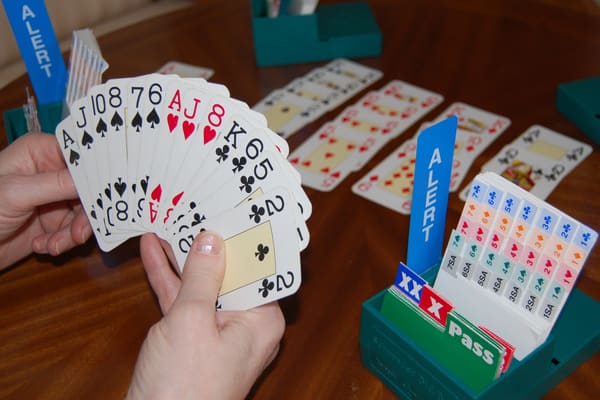
- Serious players use boards and a bidding box with printed bid cards; the home game uses voice bids.
Objective
Each hand, the partnerships bid competitively in an auction; the high bid becomes the CONTRACT, committing that partnership to take a specific number of tricks (6 + the bid level, so 1♣ = 7 tricks, 4♠ = 10 tricks, 7NT = all 13 tricks) with a specific trump suit (or no trump). Making the contract scores points; missing it concedes points to the opponents. Over a session (rubber, Chicago, or Duplicate), the partnership with the higher cumulative score wins.
Setup and Deal
- Shuffle the 52-card deck thoroughly. The player right of the dealer cuts.
- Deal 13 cards to each player, one at a time, clockwise.
- Each player sorts their hand by suit and ranks within suits, without showing cards.
- Agree the scoring format (Rubber, Chicago, or Duplicate) and vulnerability markers before the first hand. Vulnerability ('vul' / 'non-vul') is a state that DOUBLES some bonuses and penalties; in Rubber it is set by winning a game; in Chicago and Duplicate it is preset per deal.
- The dealer opens the auction; bidding then proceeds clockwise.
Bidding (The Auction)
- Bid format: a bid consists of a LEVEL (1-7) + a STRAIN (♣, ♦, ♥, ♠, or NT). The LEVEL implies tricks to take (level + 6, so 1♣ = 7 tricks, 7NT = 13 tricks). The STRAIN declares the trump suit (or no trump).
- Bid hierarchy: each successive bid must be HIGHER than the last, either by level, or at the same level by a higher-ranked strain (♣<♦<♥<♠<NT). Example: after 1♣, legal next bids are 1♦, 1♥, 1♠, 1NT, or any bid at the 2-level or higher.
- Pass: you may pass on any turn; a pass does not end the auction unless three consecutive passes follow a bid (or four passes initially).
- Double: after an opponent's bid, you may 'double' which declares it is unlikely to be made; if the doubled contract is made, the declarers get extra points; if it fails, the defenders get much larger penalties.
- Redouble: after being doubled, the bidding partnership may redouble, further multiplying the penalty/bonus.
- Auction ends: after any bid, if three players PASS in succession, the auction closes. The last bid becomes the CONTRACT. The partnership that won the auction are the DECLARERS; the player on their side who FIRST bid the winning STRAIN becomes the DECLARER; the opponents are the DEFENDERS.
- All pass (no bid): if all four players pass without any bid, the deal is thrown in and the next dealer deals.
- Bidding conventions: most partnerships use a 'bidding system' (Standard American, ACOL, 2/1, Precision) that assigns specific meanings to bids beyond their face value. Examples: 1NT opening = 15-17 HCP balanced; Stayman (2♣ response to 1NT) asks opener for a 4-card major; Blackwood (4NT) asks how many Aces opener holds. Learning a system is a significant part of becoming a competent player.
Play of the Hand
- Opening lead: the defender to the DECLARER'S LEFT leads the first card FACE-UP before dummy's hand is revealed.
- Dummy reveal: the declarer's partner (the DUMMY) then lays their 13 cards face-up on the table, sorted by suit, trump suit on their right. The dummy plays NO independent part in the hand; the DECLARER plays both their own and dummy's cards.
- Trick play: each trick starts with a LEAD; the other three players follow clockwise. You must follow suit if you can; otherwise you may play any card.
- Winning the trick: the highest TRUMP played wins; if no trump, the highest card of the suit led wins. The trick winner leads the next trick. If dummy wins, dummy's next lead comes from dummy.
- Declarer plays both hands: declarer announces dummy's plays verbally; dummy may not participate in any decisions and may not even signal what to play.
- Tracking tricks: each partnership keeps their won tricks visible in front of one partner, typically arranged in a row with trick-winning cards oriented toward their own side.
- All 13 tricks are played. After the last trick, compare tricks won by the declarers vs. their contract; this determines the score.
Scoring
- Contract trick points (per trick at or below the bid): minors (♣♦) = 20 per trick; majors (♥♠) = 30 per trick; NT = 40 first trick, 30 per subsequent trick.
- Game bonus: if contract trick points total 100+, a 'game' is scored. Non-vul game = +300; vul game = +500. Game is made at 3NT, 4♥/♠, or 5♣/♦ (levels producing 100+ trick points).
- Part-score bonus: contracts below game earn a flat +50 bonus.
- Slam bonuses: Small slam (12 tricks contracted and made) = +500 non-vul / +750 vul. Grand slam (13 tricks contracted and made) = +1000 non-vul / +1500 vul.
- Overtricks: each extra trick beyond the contract scores at the contract trick rate (or more if doubled/redoubled).
- Undertricks (contract not made): defenders score 50 per undertrick (non-vul) or 100 per undertrick (vul), with much larger penalties if the contract was doubled or redoubled.
- Honours (Rubber Bridge only, and usually ignored in Duplicate): 100 points for any four top trump honours; 150 for all five. In NT, 150 for all four Aces.
- Doubled / redoubled contracts: trick values and penalties are multiplied (doubled = 2x, redoubled = 4x); adds +50 bonus for 'insult' and extra overtrick value.
Winning
A single HAND is won if the declarers take AT LEAST the contracted number of tricks; otherwise the defenders 'set' the contract. Session-level winning depends on format: in RUBBER Bridge, the first partnership to win 2 games (100+ trick points each) wins the rubber and collects the rubber bonus (500 if the opponents won a game; 700 if not). In CHICAGO (4-deal Bridge), each deal is its own game with preset vulnerability; the higher cumulative score after 4 deals wins. In DUPLICATE (tournament form), the same deals are played at multiple tables; results are compared board by board, and the partnership with the highest cumulative matchpoints or IMPs wins. The game ends at the close of the chosen format; the winning partnership is the one with the higher final score.
Bidding Conventions
Bridge incorporates numerous bidding conventions such as Stayman (asking responder for a 4-card major over a 1NT opening), Blackwood (4NT asking for Aces en route to slam), Jacoby Transfer (responder's major bid shows the NEXT suit up as their 5+ card suit), Gerber (4♣ asking for Aces after an NT opening), and strong-2 systems (2♣ opening = 22+ HCP or game-forcing). Partnerships must agree their system explicitly before play and disclose conventions to opponents on request (the 'alert' procedure).
Etiquette
Bridge is the most tradition-bound card game in the English-speaking world. Players are expected to maintain pace of play, refrain from giving unauthorised information (tempo breaks, body language, table talk), and announce their own bidding conventions on request. Post-mortem discussion of a hand at the table is customary but should not interrupt ongoing play. In Duplicate tournaments, directors enforce a strict protocol including bid-box use, silence during the auction, and procedures for claiming the remaining tricks at the end of a hand.
Variations
- Contract Bridge: the standard modern form described above; umbrella term for all current Bridge.
- Rubber Bridge: the social home-game form; play to 2 games won ('rubber'); vulnerability is earned by winning the first game.
- Chicago Bridge (Four-Deal Bridge): fixed 4 deals with preset vulnerability (none, N-S, E-W, both); faster and more balanced than Rubber; popular in clubs.
- Duplicate Bridge: tournament form in which the same boards are played at multiple tables; compared head-to-head; the dominant competitive format.
- Auction Bridge: 1904 ancestor of Contract Bridge; overtricks counted toward game regardless of the contract.
- Honeymoon Bridge: 2-player adaptation of Bridge; see id=231.
- Whist / Bid Whist / Oh Hell: earlier trick-taking games from which Bridge descended; simpler and faster.
- Goulash: a dramatic re-deal mini-variant where cards are sorted by suit before dealing; produces wild distributions.
- Mini-Bridge: a simplified teaching form for beginners that skips the auction and names declarer/contract directly.
Tips and Strategies
- Learn a bidding system. The most common beginner system is Standard American 5-card major (1♥/1♠ openings promise 5+ cards in that major); 2/1 Game Force is the modern expert default. Without an agreed system, bids carry no reliable meaning and the game collapses into guessing.
- Count your High Card Points (HCP). An average hand is 10 HCP; openings usually need 12+ HCP; game contracts generally need the partnership's combined 25+ HCP; slams need 33+ HCP.
- Support your partner. When partner opens a major, counting combined trumps matters more than HCP; with 3+ cards in partner's major, support at the appropriate level.
- Draw trumps early (usually). As declarer in a suit contract, your first priority after opening lead is often to draw opponents' trumps before they ruff your winners. Exception: hands where you need to ruff in dummy first.
- Plan your play before the first trick. Count winners, count losers, identify the plan (e.g., 'need 2 extra tricks from the club suit; finesse through East').
- Defence: lead partner's suit. If partner bid a suit during the auction, lead it unless you have a compelling reason not to.
- Defence: signal with spot cards. Standard 'attitude' signals: a high spot card = I like this suit; a low spot = I don't. Coordinated defensive signalling is the single biggest difference between beginner and intermediate defence.
- Study expert play. Bridge has the deepest literature of any card game; read a few books (Klinger's Guide to Better Card Play, Kantar's Bridge at a Glance) to jump several levels.
- Duplicate-specific: play for tops, not cards. In matchpoint Duplicate, beating other pairs at the same board matters more than raw points; take mild risks to outscore them.
Glossary
- Auction / bidding: the opening phase; partners agree a contract through coded bids.
- Contract: the final high bid; how many tricks and in what strain.
- Trump / strain: the suit that outranks others, named in the contract; 'no trump' means no trump.
- Declarer: the player who first bid the winning strain in the winning partnership; plays both their own and dummy's hand.
- Dummy: declarer's partner; hand is placed face-up on the table and plays no independent part.
- Defenders: the two opponents of the declaring partnership.
- Vulnerability (vul / non-vul): a game state doubling bonuses and penalties.
- Game / part-score / slam: trick-point thresholds that trigger bonus scoring (100+ game, 12-tricks small slam, 13-tricks grand slam).
- Double / redouble: bids that multiply the contract's stakes.
- HCP (High Card Points): hand strength measure; Ace=4, King=3, Queen=2, Jack=1.
- Honours: the top five trumps (A, K, Q, J, 10) or four Aces in NT.
- Ruff: playing a trump when void in the suit led, winning the trick.
- Finesse: a play technique leveraging position to win a trick with a card lower than an opponent's known holding.
- Rubber / Chicago / Duplicate: the three main scoring formats.
- Convention: any bid with an agreed meaning beyond its face value (e.g., Stayman, Blackwood).
Tips & Strategy
Communication with your partner is crucial in Bridge. Develop a system for bidding and signaling to convey information effectively.
Mastering defensive play is as important as declarer play in Bridge. Anticipate your opponents' strategies and disrupt their communication.
Trivia & Fun Facts
The World Bridge Federation (WBF) is the international governing body of contract bridge. It organizes world championships and promotes the game globally.
In Bridge, what is the term for a bid that specifies the number of tricks a partnership commits to taking?
History & Culture
Bridge has roots in the 19th-century game Whist. It evolved into its modern form in the early 20th century and has since become a competitive and social game.
Bridge is not just a game; it's a social activity that fosters communication, camaraderie, and mental agility. It is often associated with intellectual pursuits.
Variations & House Rules
Popular variations include Rubber Bridge, Chicago Bridge, and Duplicate Bridge. Each variant introduces unique scoring and gameplay elements.
Experiment with different bidding systems and conventions to add complexity and excitement to your Bridge games.


