How to Play
Russia's most popular card game. 2 to 6 players use a 36-card deck; attackers play cards a defender must beat with higher same-suit cards or trumps. The last player left holding cards is the durak (fool) and loses. There is no winner, only a loser.
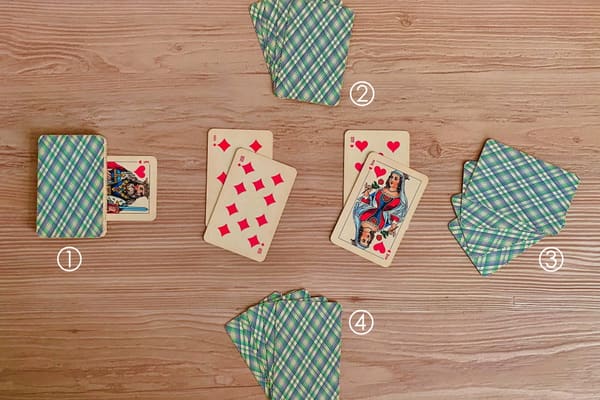
Durak (Russian дурак, meaning 'fool') is the most popular card game in Russia and much of the former Soviet bloc, played by everyone from schoolchildren to grandparents in kitchens, parks, and trains. Two to six players share a 36-card pack (a standard 52-card deck with all 2s through 5s removed; 6 is the lowest card, Ace the highest). Each player is dealt 6 cards, and the top card of the remaining stock is turned face up and tucked partly under the deck to set the trump suit; this suit beats all others for the rest of the hand. The game is not a trick-taker but an attack-defence beating game: the player with the lowest trump opens the first attack by playing any card, and the defender (the next player clockwise) must beat it with a higher card of the same suit OR any trump. Other players may then 'throw in' (podkidnoy) more cards of ranks already seen on the table for the defender to beat, up to 6 cards per round or the defender's hand size (whichever is smaller). If the defender beats every card, the round is won: all played cards go to the discard pile and the defender becomes the new attacker. If they fail, they pick up the whole pile and lose the turn to attack. After each round, every player draws back up to 6 cards (attacker first, defender last) until the stock is exhausted. The game continues until one player has emptied their hand and exited; eventually only one player remains holding cards, and that player is the durak. There is no winner in Durak, only a loser: the durak ritually shuffles and deals the next hand.
Quick Reference
- 2 to 6 players. 36-card deck (standard deck minus 2, 3, 4, 5).
- Deal 6 cards each; flip top of stock to set trump suit.
- Lowest-trump holder opens the first attack.
- Attacker plays a card; defender must beat with higher same-suit or any trump.
- Any player may throw in more cards matching ranks already on the table.
- Successful defender becomes next attacker; failed defender picks up all cards.
- Draw up to 6 cards from stock after each round (attacker first, defender last).
- No point system; last player with cards is the durak and loses.
- Everyone else is simply 'not-the-durak'.
- Traditional: durak deals the next hand.
Players
2 to 6 players, each for themselves; best at 3 to 4 players. Play rotates clockwise. For 6 players, some groups add a second 36-card deck. Partnership variants exist (Pairs Durak) but the classic form is cutthroat. A hand typically takes 5 to 20 minutes; a full session is an open-ended series of hands, and the durak of each hand deals the next.
Card Deck
One standard 36-card Russian pack: A, K, Q, J, 10, 9, 8, 7, 6 of each suit (2s, 3s, 4s, and 5s removed from a 52-card deck). Card rank within a suit (high to low): A, K, Q, J, 10, 9, 8, 7, 6. The trump suit is set by the face-up card left under the stock at deal. Any trump card beats any non-trump card, no matter the rank. For 6+ players, expand to a 52-card pack and adjust ranking to 2-low / A-high.
Objective
Empty your hand before the other players. A player who runs out of cards during or immediately after a round leaves play. The game ends when only one player remains holding cards; that player is the durak (fool) and loses. There is no winning score; successful players simply avoid being the last person left with cards.
Setup and Deal
- Shuffle the 36-card deck thoroughly. The player to the dealer's right cuts.
- Deal 6 cards face down to each player, one at a time, clockwise from the dealer's left.
- Flip the top card of the remaining stock face up and slide it partially under the stock pile so it remains visible. This card's suit is trump for the entire hand, and this card will be the last card drawn from the stock.
- Each player looks at their hand and identifies their lowest trump card.
- The player holding the lowest trump opens the first attack. If nobody holds a trump (rare but possible), deal passes and a new hand is dealt. The defender is always the player immediately clockwise from the attacker.
Attack and Defence
- Attacker's first card: The attacker plays any one card face up on the table.
- Defender's response: The defender must beat that card. A non-trump attack is beaten by a higher card of the same suit OR any trump card. A trump attack is beaten only by a higher trump.
- Throwing in (podkidnoy): Once an attack has been defended, any other player (not just the attacker) may 'throw in' additional attack cards, as long as each new card matches the rank of a card already played during this round (either an attack card or a defence card). Each thrown-in card must also be beaten by the defender.
- Six-card limit: A round may contain at most 6 attack cards, or fewer if the defender began the round with fewer than 6 cards in hand. The defender cannot be forced to beat more cards than they had at the start of the round.
- Successful defence: If the defender beats every card, the round ends. All played cards go face down to the discard pile (not back to the deck). The defender becomes the new attacker for the next round.
- Failed defence: If the defender cannot or will not beat a card, they must pick up the entire pile (both attack and defence cards) and add them to their hand. The defender loses their turn to attack; the attacker remains the attacker for the next round (or, in some house rules, the attack passes to the defender's left).
- End of round draw-up: Starting with the original attacker (or attackers in order), each player draws cards from the stock until they have 6 cards. The defender draws last. Once the stock is exhausted, no more cards are drawn and play continues until the hand ends.
Passing (Perevodnoy Variant)
- Perevodnoy Durak (translation / transferable Durak): the most-played variant in modern Russia. The defender may 'translate' (pass on) the attack INSTEAD of defending if they hold a card of the same rank as the attack.
- Passing the attack: the defender plays a matching-rank card on top of the attack card (without beating it) and announces 'perevod'. The attack then transfers to the next player clockwise, who becomes the new defender. The original attacker does not change.
- Trump perevod: the defender may ALSO pass without playing a card by showing a trump of the same rank as the attack (proyezdnoy / drive-by rule in some variants); the shown card returns to the hand and the attack transfers.
- Limits on passing: the pass requires at least 1 additional card beyond those already on the table; a defender down to their last card cannot pass.
- Without perevodnoy: in classic (podkidnoy) Durak, the defender must either beat every card or pick up the whole pile; passing the attack is not allowed.
Going Out and Ending the Hand
- The moment a player plays their last card (or beats the final attack card that emptied their hand), they are out of the game. They take no further turns and do not draw more cards.
- If the stock is still alive when a player goes out, subsequent players still draw up to 6 from the stock at the end of each round.
- When the stock is empty and players start going out, play continues among remaining players with shrinking hands and no draw-ups. A trump scarcity develops; defence gets harder.
- The durak: when only one player remains holding cards, they are the durak. The hand ends immediately (no final attack is played). The durak deals the next hand.
- Double durak (disgrace): in some house rules, if the durak is holding more than 6 cards when the game ends, they are declared 'double durak' and must deal the next TWO hands or pay a double forfeit.
Scoring
Durak has no point score. Each hand produces one loser (the durak); everyone else is simply 'not-the-durak'. Groups play an open-ended series of hands, often with a running tally of how many times each player has been the durak, or with a drinking or forfeit ritual for the durak after each hand. Typical sessions run 5 to 20 hands; the player who has been the durak the fewest times is the informal session champion.
Winning
Each hand ends the instant the second-to-last player empties their hand; the single player still holding cards is the durak and loses that hand. Every other player has effectively 'won' by not being the durak, but there is no ranking among them; first-out and second-out are equally safe. Across a session, the match winner is whoever has been the durak the fewest times. In gambling or drinking variants, the durak owes a chip or a shot to every other player after each hand; the player with the most chips (or the fewest shots) at the session's end is the overall winner.
Common Variations
- Podkidnoy Durak (classic / throw-in): the most common form. The defender must beat all attack cards or pick up the pile. No passing allowed.
- Perevodnoy Durak (passing / translation): the defender may pass the attack to the next player by playing a matching-rank card. Dominant form in modern Russia.
- Proyezdnoy (drive-by): a variant of perevodnoy where the defender can pass without playing a card, by showing a trump of matching rank.
- Svoi Kozyri (own trumps): each player has their OWN personal trump suit; a beating game rather than a trick-taker. Separate game with similar family roots.
- Perevodnoy Durak with Ladder: after being durak twice, a player is given a higher starting hand count (7 or 8 cards) as a handicap to make catching up harder.
- 52-card Durak: for 5 or 6 players, use a full 52-card deck. Ranking is 2-low, A-high. Deal 6 cards each; rest unchanged.
- Pairs Durak (Durak v parakh): 4 players in fixed partnerships. Partners may defend for each other when adjacent.
- Siberian Durak: attacks are limited to 3 cards per round instead of 6. Faster hands.
- Mini Durak (children's version): 24-card deck (9 through A). Faster, less strategic.
Tips and Strategy
- Save your trumps. A hand with 3 or 4 trumps is nearly unlosable; trumps are the ultimate defensive tool and the best throw-in threats. Leading non-trumps first forces opponents to burn their trumps.
- Open with your lowest non-trump card. Opponents will often burn a mid-rank card to beat it, leaving their higher cards for your next attack.
- Track the trump card at the bottom of the stock. The last card to be drawn is the face-up trump; memorise which trumps have been played, and you can often predict who holds the remaining trumps in the endgame.
- Pick up strategically. Sometimes it is better to pick up an attack (adding to your hand) than to waste 2 trumps beating it; the picked-up cards are often weak and can be discarded easily later.
- Throw in aggressively. The throw-in rule lets any player dog-pile the defender once an attack is under way. Coordinated throw-ins from multiple attackers can break even a trump-heavy defence.
- Track hand sizes. Know how many cards each opponent holds. A defender with 2 cards cannot be attacked with more than 2 cards in the round; this caps the attack size.
- Endgame Ace. In the closing hands (when the stock is gone), holding a single high trump is often decisive. An Ace of trumps is functionally unbeatable unless another Ace of trumps appears, which is impossible in a single-deck game.
- Perevodnoy: translate to the weakest defender. When you can pass, pick the next player if they are trump-light or holding few cards; force the attack onto the opponent least able to defend.
Glossary
- Durak (дурак): 'fool'; the last player left holding cards at hand's end.
- Kozyr (козырь): 'trump'. Kozyri = plural trumps.
- Podkidnoy (подкидной): 'throw-in'; the classic Durak form where other players may add matching-rank attack cards during a round.
- Perevodnoy (переводной): 'translating / transferable'; Durak variant allowing the defender to pass the attack to the next player.
- Proyezdnoy (проездной): 'drive-by'; a perevodnoy sub-variant where a trump is shown (not played) to pass.
- Bit' (бить) / Otbit' (отбить): 'to beat' / 'to beat back'; the defender's action of covering an attack card.
- Bita (бита): 'the beaten'; the discard pile of completed attacks.
- Nabor (набор): 'draw-up'; taking cards from the stock at round's end.
- Shestyorka (шестёрка): 'the six'; the lowest card in the 36-card pack, often a liability to hold.
Tips & Strategy
Save your trumps for defence; a hand with 3 or 4 trumps is almost always safe. Attack with your lowest non-trump first to force opponents to waste mid-rank cards. Track the face-up trump at the bottom of the stock and count which trumps have been played; in the endgame, knowing who holds the remaining trumps is decisive. Throw in matching-rank cards aggressively when someone else attacks; coordinated throw-ins from multiple players can break a trump-heavy defence. Sometimes picking up an attack is cheaper than wasting two trumps to beat it; weigh the cost. If playing perevodnoy, translate attacks onto the weakest defender rather than beating the attack yourself.
Durak rewards memory and resource management over card-power. Skilled players track every trump played and every major non-trump, know approximately how many cards each opponent holds, and balance the short-term cost of picking up against the long-term benefit of keeping trumps in hand. The throw-in rule means you are never safe while defending: even after beating an attack, another opponent may throw in a matching-rank card that forces you to beat again. Endgame tempo matters more than opening tempo; hands lost in Durak are typically lost in the final 3 or 4 rounds when trump scarcity and hand-size inequality compound.
Trivia & Fun Facts
Durak literally means 'fool' or 'idiot' in Russian, and the name refers to the loser rather than the winner: in Durak, the only outcome a player aims for is 'not being the durak'. The game's throw-in rule (podkidnoy) is named from the Russian verb podkidyvat', 'to throw underneath', reflecting the visual action of tossing new attack cards beneath or beside the existing pile. Durak has been played on Soviet spacecraft; cosmonauts are known to have packed a 36-card deck on long missions aboard Mir and the ISS.
-
01What does the word 'Durak' mean in Russian, and what role does it play in the game?Answer 'Durak' means 'fool' or 'idiot' in Russian; it is the title given to the loser of a hand, the single player left holding cards when everyone else has gone out. There is no winner in Durak, only a durak.
-
02In the Perevodnoy variant, how can a defender pass the attack to the next player instead of defending it?Answer The defender plays a card of the same rank as the attack card on top of it (without beating it) and announces 'perevod'; the attack then transfers to the next player clockwise, who becomes the new defender.
History & Culture
Durak's origins date to 18th-century Russia, with the modern 36-card form documented in 19th-century card-game treatises. The game spread across the Russian Empire and into Soviet Central Asia, Eastern Europe, and the Baltic states, and is now the default card game of households, trains, and parks across the former Soviet world. Durak has no winner, only a loser, reflecting a distinctive cultural attitude toward games that prize skill avoidance rather than skill accumulation. The game is mentioned in Dostoevsky, Chekhov, and countless Soviet and post-Soviet films as the archetypal kitchen-table pastime.
Durak is the default card game of the former Soviet world, comparable in cultural weight to Bridge in the English-speaking world or Belote in France. It is played in homes, army barracks, schoolyards, trains, and nearly every other social space across Russia and the CIS. The game's structure (no winner, only a loser) gives it a uniquely melancholy Russian character that appears frequently in Russian and Eastern European literature and film as shorthand for the rhythms of domestic life.
Variations & House Rules
Podkidnoy is the classic throw-in form. Perevodnoy adds the translation rule (defender may pass the attack by matching rank). Proyezdnoy extends perevodnoy with a trump-show pass. Siberian Durak limits attacks to 3 cards. Pairs Durak uses 4 fixed partners. 52-card Durak scales for 5 or 6 players with a full Anglo-American pack. Svoi Kozyri is a beating-game cousin where each player has their own trump suit.
Beginners should start with podkidnoy (no passing) until the attack-defence-throw-in flow is comfortable, then add perevodnoy once the basics are learned. For fast sessions, use a 24-card pack (9 through A) and deal 4 cards each. For drinking games, the durak owes each remaining player a shot. For serious play, track 'durak count' across sessions and award a title to the player with the fewest durak finishes.