
How to Play
Truco is the loud and theatrical national card game of Argentina, Uruguay and southern Brazil. Two teams play three-trick hands with escalating bluff bets (Truco, Retruco, Vale Cuatro) and a separate Envido side bet on same-suit hand totals.
Truco is the loud, theatrical, bluff-driven national card game of Argentina, Uruguay, and southern Brazil (where it is called Truco Paulista or Truco Mineiro). Two, four, or six players in two teams use a 40-card Spanish deck and play hands of three tricks each, with a unique card ranking in which the Ace of Swords is the strongest card in the deck. The game is built around two parallel betting structures: the Truco/Retruco/Vale Cuatro escalation on the trick play, and the Envido (highest two-card same-suit total) and Flor (three same-suit cards) side bets. First team to 30 points wins.
Quick Reference
- 2, 4, or 6 players in two teams use a 40-card Spanish deck.
- Deal 3 cards each. No trump suit; rank list is fixed.
- Mano (right of dealer) leads first and breaks tied tricks.
- Three tricks per hand; team that wins 2 wins the hand.
- Bravas (Aces of Swords/Clubs, Sevens of Swords/Coins) are the four highest cards.
- Call Truco / Retruco / Vale Cuatro to escalate hand stakes (2/3/4).
- Envido is a separate same-suit side bet called before second card of first trick.
- Hand: 1 base, 2 Truco, 3 Retruco, 4 Vale Cuatro.
- Envido: 2 base; Real Envido: +3; Falta Envido: enough to win.
- Flor (where used): 3 points; Contraflor escalates.
- Reject any call: opponents score the previous accepted stake.
Players
Truco is played by 2 (mano a mano), 4 (two pairs sitting opposite), or 6 (two trios) players. Four players in two pairs is the canonical form. This guide describes the 4-player Argentine game and notes the main differences for 2-handed play and the Brazilian Paulista variant.
Card Deck
- Use a 40-card Spanish deck (Espadas/Swords, Bastos/Clubs, Oros/Coins, Copas/Cups; remove the 8s and 9s).
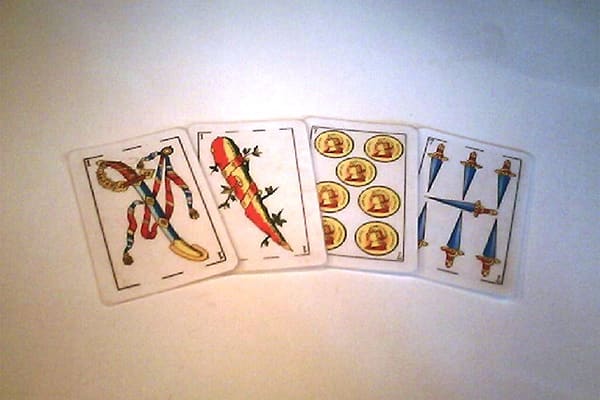
- Card rank in tricks (Argentine Truco), high to low: 1) Ace of Espadas (la Macha), 2) Ace of Bastos, 3) Seven of Espadas, 4) Seven of Oros (los cuatro Bravas, the four 'bravas'), then 5) all 3s, 6) all 2s, 7) Ace of Copas and Ace of Oros (los Anchos Falsos), 8) Kings (Reyes), 9) Knights (Caballos), 10) Jacks (Sotas), 11) Sevens of Copas and Bastos (the 'falsos'), 12) Sixes, 13) Fives, 14) Fours.
- Card values for Envido (different from trick rank): Numerals 1 through 7 count their face value; figures (Sota, Caballo, Rey) count 0; the suit-pair total adds +20 (e.g. King + 5 of the same suit = 0+5+20 = 25; Ace + 6 of same suit = 1+6+20 = 27 for the maximum 'real' Envido of 33 with a 7+6 pair; Wikipedia notes a maximum of 33 from 7+6 of same suit).
- There is no trump suit. The four 'bravas' (Aces of Swords/Clubs and 7s of Swords/Coins) are simply the highest cards in fixed order; everything else loses to them regardless of suit led.
Objective
Be the first partnership to reach 30 points (some regions use 24 or 15). Points come from (a) winning the hand of three tricks at the current stake (1 point at base, escalating with Truco calls) and (b) the side-bet contests of Envido (and Real Envido, Falta Envido) and Flor when applicable.
Setup and Deal
- Choose first dealer; the deal then passes anti-clockwise after each hand.
- Shuffle. The player to the dealer's right cuts. Deal 3 cards face-down to each player one at a time, anti-clockwise.
- The mano (eldest hand, the player to the dealer's right) leads the first trick AND speaks first in any betting.
- No upturned trump or dummy. All bidding happens during the hand.
Gameplay (Trick Play)
- Three tricks per hand. Each player plays one card per trick; the highest-ranked card (per the trick rank list above) wins; the trick winner leads the next trick.
- Hand winner: The team that wins 2 of the 3 tricks wins the hand. A tied trick (parda, both highest cards equal) is decided by the team that won the EARLIER non-tied trick. Special tied scenarios: if the first trick is parda, the team that wins the second wins the hand; if all three tricks are parda, the mano's team wins.
- Truco calls (escalating stake on the hand). At any point on your turn before playing a card, you may call:
- - Truco: Raises the stake from 1 to 2 points.
- - Retruco: Counter-raise after Truco; raises to 3.
- - Vale Cuatro: Counter-raise after Retruco; raises to 4 (the maximum).
- - Quiero (accept): Plays out the hand at the new stake.
- - No quiero (reject): The opposing team immediately wins the previously-set stake (e.g. reject Truco and they score 1 point; reject Retruco and they score 2; reject Vale Cuatro and they score 3).
- Only the team that does NOT currently 'have the hand' (i.e. is being challenged or has not yet escalated) may make the next escalating call.
Gameplay (Envido and Flor Side Bets)
- Envido is called BEFORE the second card of the first trick is played. It is a separate contest about who has the highest 'Envido' value in their hand.
- Calls and stakes:
- - Envido: Worth 2 points if accepted.
- - Envido Envido (or 'Envido de nuevo'): Adds 2 more (total 4).
- - Real Envido: Adds 3 to the current Envido stake.
- - Falta Envido: Final all-in; the winner scores enough points to reach the match target (i.e. 30 minus their current score).
- - Quiero / No quiero: Accept or reject. Reject: opener scores 1 point (or current stake before the rejection).
- Showdown of Envido: After acceptance, each player declares their Envido total. The mano declares first; in turn, each opponent says either a higher number ('Soy mas, X', I have more) or 'Son buenas' (yours are better). The team with the highest Envido scores the stake.
- Flor (only with house rules that include it): Holding three cards of the same suit. Worth 3 points automatically when held; can be matched with 'Contraflor' bets between teams who both have a Flor. In Argentina, Flor is a regional optional rule; in Brazil it is standard.
Scoring
- Hand wins: 1 point at base, 2 with accepted Truco, 3 with accepted Retruco, 4 with accepted Vale Cuatro. Rejecting a Truco-family call concedes the previous stake (e.g. reject Truco = opponents score 1 immediately).
- Envido wins: 2 (Envido), 3 (Real Envido on top), or 'enough to win the match' (Falta Envido). Compounded by repeated Envido calls.
- Flor: 3 points (or higher with Contraflor), where Flor is in play.
- Match target: First team to 30 points wins. Score is traditionally tracked by 'malas' (bad, 0-15) and 'buenas' (good, 15-30) on a piece of wood with notches or with toothpicks.
- No negative scoring for losing hands; you simply do not score that hand.
Winning
The match ends the moment one partnership reaches 30 points. If both teams cross 30 in the same hand (rare but possible with Falta Envido), whoever crossed first by the scoring order (Envido settled before Truco) wins.
Common Variations
- Truco Argentino (described above): Includes Envido but Flor is optional / regional.
- Truco Uruguayo: Very similar to Argentine; Flor is universal and slightly different rank order in some areas.
- Truco Paulista (Brazil): Uses a different rank set in which the four highest cards (manilhas) change every hand based on a face-up 'vira' card; the next-rank card after the vira in each suit becomes the manilha. No Envido; instead, the call escalation is Truco -> Seis (6) -> Nove (9) -> Doze (12). Played to 12 points.
- Truco Mineiro (Brazil): A Paulista variant played to 12 points but with a unique 4-card-per-player deal in some regions.
- Truco Mano a Mano (2-player): No partner. All other rules apply, but the bluff dynamics shift dramatically without a hidden partner.
- 6-handed Truco (two trios): As 4-handed but with three players per team; the table talk becomes even louder.
Tips and Strategy
- Memorise the trick-rank order. The four bravas (1 of Espadas, 1 of Bastos, 7 of Espadas, 7 of Oros) are the only cards that can win a trick against the others. Knowing exactly what cards remain is the heart of competitive Truco.
- Bluff with confidence (mentir bien). Calling Truco with a weak hand can win you 2 points uncontested if the opponents reject. Theatrical posture, taunting and confident table talk are part of the game and legitimate tactics.
- Use Envido to read the opponent. A team that calls Envido aggressively often has 27 or higher; if you accept, plan your trick play assuming they have a strong Envido (which means a same-suit pair with one big card).
- Save your bravas. Playing the Ace of Espadas on the very first trick wins it but tells opponents you have nothing left; sometimes losing the first trick deliberately to win the next two is the right play.
- The mano controls the hand. Tied tricks always default to the mano's team; if you are mano, lead with a moderate card and let opponents commit before showing your hand.
- Falta Envido is a finisher. Use it when you have a near-certain Envido win AND the points it would award would end the match.
Glossary
- Mano: The eldest hand (player to the dealer's right); leads first and breaks tied tricks in their team's favour.
- Bravas: The four highest cards: Ace of Swords, Ace of Clubs, 7 of Swords, 7 of Coins.
- Parda: A tied trick (both highest cards of equal rank); broken by the next non-tied trick.
- Truco / Retruco / Vale Cuatro: The escalating-stake calls on the hand of tricks (2 / 3 / 4 points if accepted).
- Envido: The side-bet contest on the highest two-card same-suit total in hand; called before the second card of the first trick.
- Flor: Holding three cards of the same suit; an automatic 3-point bonus where the rule is in use.
- Falta Envido: The all-in Envido escalation; the winner scores enough to reach the match target.
- Quiero / No quiero: Accept or reject any pending bet.
Tips & Strategy
Truco is two parallel games at once: bluff-driven escalating bets on the hand of three tricks (Truco/Retruco/Vale Cuatro) and a sealed-information side bet on Envido. Knowing exactly which of the four bravas (Aces of Swords/Clubs, Sevens of Swords/Coins) have already been played is the foundation of competitive trick play; bluffing your opponents into rejecting a Truco call when you have a weak hand is the foundation of point gain. Master both layers and table talk becomes your real weapon.
The deepest layer of Truco strategy is positional. The mano's team wins all tied tricks, so if you are mano you can play conservatively (forcing opponents to commit cards first); if you are NOT mano, you must play more aggressively to avoid the parda trap. Envido and Truco calls also interact: a team that has just won Envido has revealed information about its hand strength, which the other team can exploit in the trick play.
Trivia & Fun Facts
Truco players are expected to taunt, boast, and improvise rhyming couplets to accompany their bets, especially when calling Vale Cuatro or Falta Envido. The Argentine version has a folk poetry tradition called 'versos truqueros' that adds verbal performance to the game. The Ace of Swords (Macha) is so iconic that it appears on Argentine playing card backs and in tango lyrics.
-
01What is the maximum number of points a single hand of Truco can be worth from the Truco-family escalation alone (excluding Envido and Flor side bets)?Answer 4 points, won by the team that wins the three-trick hand after 'Vale Cuatro' has been called and accepted.
History & Culture
Truco descends from the medieval Spanish game Truc (cousin of French Triomphe) and arrived in the River Plate region with Spanish and Portuguese colonists. By the 19th century it had become the dominant social card game of gauchos and rural communities in Argentina and Uruguay; in Brazil it diversified into the Paulista and Mineiro variants. Its ritualised table talk, including improvised verses (versos truqueros), is part of national folklore.
Truco is a deeply Argentine, Uruguayan and Brazilian institution, played from rural ranches to urban cafe terraces and famous for its loud, theatrical performance style. It is taught from childhood and remains the dominant social card game across the Rio de la Plata region.
Variations & House Rules
Argentine Truco includes Envido as a core side bet (Flor optional). Uruguayan Truco is similar but Flor is universal. Brazilian Truco Paulista replaces the Envido system with a face-up vira card that changes which cards are the manilhas every hand, and uses Truco/Seis/Nove/Doze escalations played to 12.
Decide before play whether Flor is in use (universal in Brazil and Uruguay; optional in Argentina). Set the match target (15 for a quick game, 24 for medium, 30 for a long evening). Allow or forbid table-talk versifying based on group preference.


