
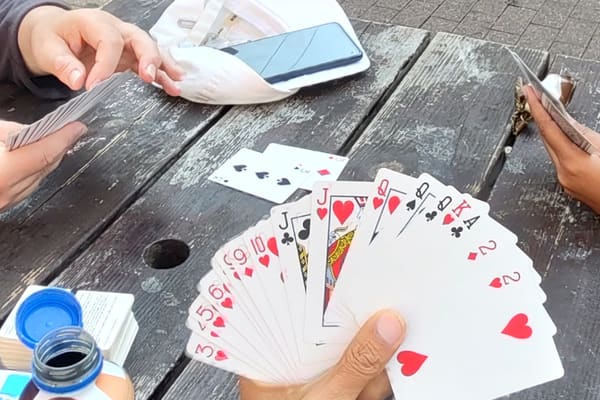
How to Play
Big Two (Deuces, Choi Dai Di) is the dominant East Asian climbing card game. 4 players each get 13 cards; 2 is the highest rank, 3♦ opens the first hand. Players clockwise beat the previous combination with a higher same-type play or pass. Five-card types escalate Straight < Flush < Full House < Bomb < Straight Flush. First to empty their hand wins.
Big Two (also Deuces, Choi Dai Di 鋤大D, Dai Di, Da Lao Er 大老二; the Philippine cousin Pusoy Dos is a separate entry) is a climbing (shedding) card game originating in Hong Kong and Guangdong in the 1980s and now hugely popular across East and Southeast Asia. Four players sit clockwise and the full 52-card pack is dealt evenly, 13 cards each. The defining twists of Big Two are its UNUSUAL RANK ORDER (2 is the HIGHEST card and 3 is the lowest; A-K-Q-J-10-9-8-7-6-5-4-3, with 2 above the Ace) and its SUIT ORDER (Diamonds lowest, Clubs, Hearts, Spades highest). The player holding the 3 of Diamonds (the single lowest card) opens the first trick, leading with the 3♦ either alone or as part of a valid combination. Players then clockwise must BEAT the current play with a higher same-type combination (single beats single, pair beats pair, five-card hand beats five-card hand) or PASS. When three players in a row pass, the last contributor wins the trick and leads a new free-form combination. The first player to empty their hand wins. Five-card hands rank: Straight < Flush < Full House < Four-of-a-Kind-plus-one-kicker (bomb) < Straight Flush. The 2 of Spades (called the 'Big Two') is the single highest card in the pack.
Quick Reference
- 4 players, standard 52-card deck.
- Deal all 52 cards evenly (13 each).
- Rank order HIGH to LOW: 2, A, K, Q, J, 10, 9, 8, 7, 6, 5, 4, 3. Suits HIGH to LOW: ♠, ♥, ♣, ♦.
- Player with 3♦ leads the first trick and must include it in their opening play.
- Leader plays a valid combination (single, pair, triple, or one of the 5-card hand types).
- Each next player plays a higher combination of the same type or passes.
- Three consecutive passes end the trick; last contributor leads the next.
- Five-card hand hierarchy (weak to strong): Straight < Flush < Full House < Bomb (4-of-a-kind + kicker) < Straight Flush.
- First to empty their hand wins the hand.
- Each loser pays 1 point per remaining card (2× if 8+ cards, 3× if 10+, 4× if all 13).
- Holding a 2 at hand end may double the penalty (house rule).
Players
Exactly 4 players in the canonical form, each for themselves (no partnerships in the dominant version; some home rules play 2v2). Occasional 3-player and 5-player variants exist (deck is stripped or padded to keep a uniform deal). A single hand takes 5 to 15 minutes; a session to a point target or fixed hand count runs 30 to 90 minutes. Turn order is clockwise; the 3 of Diamonds holder takes the first turn of the first hand, then the previous hand's winner leads new hands.
Card Deck
- Standard 52-card French-suited pack. No jokers.
- Rank order HIGH to LOW: 2, A, K, Q, J, 10, 9, 8, 7, 6, 5, 4, 3. This is the game's signature: 2 is the HIGHEST rank, 3 is the lowest.
- Suit order HIGH to LOW: Spades (♠), Hearts (♥), Clubs (♣), Diamonds (♦). Suit breaks all rank ties. The 2♠ is the single highest card in the pack.
- The 3♦ is the single lowest card in the pack and holds the opening-play privilege on the first hand.
Objective
Be the first player to empty your hand of all 13 cards. On each trick, contribute a valid combination that beats the current play or pass. Cards still in hand at the end of the hand are penalty points; the scoring system typically charges opponents per card remaining, so the winner of the hand wins the most points and the loser with the most cards pays the most.
Valid Combinations
- Single card: any one card. Beats another single card by rank (and suit if rank ties).
- Pair: two cards of the same rank. Beats another pair by the higher-suit card in the pair (the 'top' card).
- Triple (three of a kind): three cards of the same rank. Rarely played on its own in most Big Two rules; used primarily inside full-house combinations. Some house rules allow it as a standalone.
- Five-card hands (all must be exactly 5 cards, compared only to other 5-card hands of the SAME or HIGHER type):
- Straight: five consecutive ranks, mixed suits. Compared first by highest card rank, then by the highest card's suit. The highest straight is A-2-3-4-5 (wait: ranks wrap only in specific house rules; by default the highest straight is A-K-Q-J-10 of mixed suits, not 2-3-4-5-6).
- Flush: five cards of the same suit, not sequential. Compared by highest card in the flush, then the second, then suit.
- Full house: three of a kind plus a pair. Compared by the rank of the triple (the pair does not matter for comparison).
- Four-of-a-kind plus kicker (bomb): four cards of the same rank plus any fifth card. The rank of the quad determines the order.
- Straight flush: five same-suit consecutive cards. The highest 5-card hand; compared by top rank, then suit.
- Hand-type hierarchy (weakest to strongest five-card type): Straight < Flush < Full House < Four-of-a-Kind+1 (bomb) < Straight Flush. A bomb beats a full house regardless of ranks; a straight flush beats a bomb.
- Within the same combination type, compare by rank; if rank ties, by the highest card's suit.
Setup and Deal
- Shuffle the 52-card pack. The dealer is often chosen as the previous hand's loser, or by a cut for the first deal of a session.
- Deal 13 cards to each of the 4 players, one at a time, clockwise.
- For the FIRST hand of a session, the player holding the 3 of Diamonds leads the first trick and their opening play MUST include the 3♦ (alone as a single or as part of a pair, triple, or five-card combination).
- For SUBSEQUENT hands in the session, the winner of the previous hand leads the first trick and may play any valid combination.
Trick Play
- Free-form lead: the player who leads a trick plays any valid combination (single, pair, triple, or any five-card hand type). That sets the combination type for the trick.
- Must beat or pass: subsequent players (clockwise) may either play a HIGHER combination of the SAME TYPE (same number of cards, same hand type) or PASS.
- Bomb exception: in some rules, a bomb (four of a kind plus kicker) may be played on top of a lower-type 5-card hand. Standard Hong Kong rules only permit bombs over five-card hands, while many home rules allow bombs to beat a single high-card play too. Agree before starting.
- Pass rules: a pass ends only that player's turn; they may play again when the trick loops back to them. Three consecutive passes end the trick; the last player to contribute wins the trick and leads the next.
- No compulsory play: you are never required to play even if you have a beat; passing is always legal.
- Going out: the player who plays their last card in a trick wins the hand (not necessarily the trick), and the hand ends. Any unfinished trick does not continue.
Scoring
- The most common scoring awards the winner and charges the losers based on their remaining cards.
- Basic per-card scoring: each non-winner pays 1 point per card still in hand to the winner. A player with 10 cards still in hand pays 10 points.
- Multipliers (standard Hong Kong rules):
- Player still holding 8 or more cards: pay DOUBLE (2 points per card).
- Player still holding 10 or more cards: pay TRIPLE (3 points per card).
- Player still holding ALL 13 cards (never played any): pay QUADRUPLE (4 points per card = 52 points).
- Holding a 2 (the Big Two) at hand end: some house rules DOUBLE the player's total penalty as an additional punishment for not playing the game's highest cards.
- Other scoring conventions: some tables score 1 per card with no multipliers; others score only the winner's delta (winner scores +total paid, losers do not pay each other directly).
Winning
The hand ends the instant one player plays their last card (either in a pass-pass-pass-lead sequence or in the middle of a trick by playing their final cards). That player scores the winning bonus as above. A multi-hand session plays until an agreed point total (often 30 or 50 points) or a fixed number of hands; the player with the highest cumulative total is the session winner.
Common Variations
- Pusoy Dos (Philippine cousin): nearly identical to Big Two but with SUIT ORDER Clubs < Spades < Hearts < Diamonds (diamonds HIGHEST, not lowest), a different first-play card (3♣), and different five-card hand orderings. Covered in its own entry (id=253).
- 2-player and 3-player Big Two: the deck is reduced or split asymmetrically to keep 13-card hands; 3-player often deals 17 cards each and leaves 1 card face-down.
- Partnership Big Two (2v2): teammates sit across the table; the objective is for one partner to empty their hand. Team scoring replaces individual.
- Bombs-anywhere: bombs may be played on any combination, including a single high-card lead. The standard rule requires bombs to sit on 5-card hands only.
- Wrap-straight: allow 2-3-4-5-6 as the HIGHEST straight (since 2 is the highest rank); in some rules this is the ONLY way to form a straight containing a 2.
- No-pass-until-played: forbid passing in the opening round until a player has had one chance to contribute; speeds the game.
- Doubled 2s penalty: ending the hand with any 2 still in hand doubles (or triples) that player's penalty.
Tips and Strategy
- Hoard 2s for late in the hand. A 2♠ is the game's strongest single card and can reliably regain the lead when an opponent is close to going out.
- Count cards of each type as the hand progresses. Knowing the opponents have no more pairs, or have exhausted their 2s, changes which combinations are safe.
- Break up pairs and triples early if they can chain into five-card hands; a triple is worth much more as a full-house component than on its own.
- Lead your weakest combination type when opening a trick; you do not want to lead a full house if a bomb is likely out.
- When close to going out (3-5 cards left), play aggressively with pairs and singles to force opponents to use their high cards.
- Suit order matters for tiebreakers: two Kings is beaten by two higher Kings in the pair; a pair containing K♠ is stronger than a pair containing only K♥ and K♣.
- Observe which 2s and Aces have been played; tracking them tells you whether opponents still hold table-winners.
Glossary
- Big Two: the 2 of Spades (2♠), the single highest card in the pack; also the name of the game.
- Deuces: an alternative name for the game, emphasising the 2s' special status.
- Climbing game: a card-game category in which each play must out-rank or out-type the previous; Big Two, Pusoy Dos, Tien Len, and President are all climbing games.
- Trick: one round of play opening with a lead and ending after three consecutive passes.
- Lead / free lead: the opening play of a trick; the leader chooses the combination type.
- Pass: declining to play; three consecutive passes end the trick.
- Bomb: four of a kind plus a kicker; the second-highest five-card type, beating any hand type except a straight flush.
- Straight flush: five consecutive same-suit cards; the top five-card hand.
- Deuce: the 2 of any suit; the highest-rank cards in the pack.
Tips & Strategy
Hoard 2s for late-hand control; the 2♠ is the single strongest card and reliably steals the lead when needed. Count cards of each type as the hand progresses; once opponents have exhausted their bombs, your full houses become safe. Break up pairs and triples early when they can chain into five-card hands (a triple is worth more in a full house than on its own). Suit order matters for tiebreakers: a pair containing the K♠ is stronger than a pair of lower Kings without it.
The central strategic tension is balancing aggressive early play (shedding singletons and pairs) against hoarding power cards (2s, aces, bombs) for late-hand leverage. Expert players track opponent hand sizes; when one opponent is down to 3 or 4 cards, the other opponents should cooperate (without explicit signalling) to prevent them from going out by leading combinations that player cannot beat. Five-card hand planning is the third pillar: recognising that a triple is more valuable as a full house component than as a standalone play shapes mid-hand decisions.
Trivia & Fun Facts
The game's name in Cantonese (Choi Dai Di, 鋤大D) literally means 'cultivate / hoe big D', where 'big D' is the 2 of Spades; the hoeing metaphor refers to clearing the hand of cards. The 2♠ is so iconic that online player handles and clan names across Asian Big Two communities frequently use 'BigTwo' or '2S' as a status symbol. Big Two is one of the most-played card games in Asia by raw player count, comparable to Poker in the West.
-
01In Big Two, which single card is the highest in the entire deck, and why?Answer The 2 of Spades (2♠). Big Two uniquely ranks the 2 ABOVE the Ace, making it the top rank. Combined with the game's suit order (spades highest), the 2♠ sits at the absolute top of the pack. It is the game's namesake and a coveted late-hand weapon.
-
02What is the mandatory opening play of the first hand in a Big Two session, and why?Answer The player holding the 3 of Diamonds (3♦, the single lowest card) must lead the first trick of the session, and their lead MUST include the 3♦ (alone as a single or inside a pair, triple, or five-card combination). This fixes the opening turn order and prevents any player from stalling at the start by holding the lowest card.
History & Culture
Big Two emerged in Hong Kong and southern China in the 1970s-1980s and spread rapidly across East Asia and then worldwide, especially in Chinese, Vietnamese, and Filipino diaspora communities. It is part of the broader climbing-game family with Pusoy Dos (Philippines, slight rule differences in suit order), Tien Len (Vietnam), Da Lao Er (Taiwan), and President (Western world). Big Two's precise rank-and-suit ordering is nearly unique: 2 highest and spades-highest-of-suits is characteristic of the Cantonese form. The game is a fixture of Chinese New Year, dim sum afternoons, and family reunions across Hong Kong and Guangdong; it has a thriving online tournament scene today.
Big Two is arguably the most-played competitive card game in East Asia and among Asian diasporas worldwide. Its simple mechanics mask substantial strategic depth, and its 4-player structure fits dim sum tables, family reunions, and online tournament brackets equally well. In Hong Kong, Guangzhou, Taipei, Singapore, and Kuala Lumpur, Big Two is part of everyday social life; in the diaspora (Vancouver, Toronto, Sydney, London) it is a cultural marker and a common family-gathering ritual.
Variations & House Rules
Pusoy Dos is the Philippine cousin with a different suit order (diamonds highest) and starts with the 3♣ instead of 3♦. Partnership Big Two plays 2-vs-2. Bombs-anywhere rules let bombs beat any lead, not just five-card hands. Wrap-straight allows 2-3-4-5-6 as the highest straight. Doubled-2s-penalty punishes players for ending the hand with deuces still in hand. 2- and 3-player variants adjust the deal.
For new players, start with the standard 4-player Hong Kong rules and no partnership; learn the rank and suit ordering first. Add bomb rules after one full hand. For family play with mixed ages, introduce the per-card penalty without multipliers. For competitive play, use the full multiplier scoring with doubled-2s penalty.


