
How to Play
Zheng Shangyou (Struggling Upstream) is a Chinese climbing card game for 3-6 players. Shed your hand first to be Upstream; last-place Downstream pays tribute of two high cards to the Upstream next round.
Zheng Shangyou (争上游, 'Struggling Upstream') is a Chinese climbing card game played primarily in Shanghai, Zhejiang, and Jiangsu. It is the direct ancestor of President and a cousin of Big Two and Dou Dizhu. Three, four, or six players receive the whole deck (one 54-card pack with Jokers, or two packs for larger tables) and race to empty their hand by playing ever-higher combinations of the same type as the current play: singles, pairs, triples, full houses, straights of five or more, and all-matching bombs. The twist is that from the second round onward, the player who finished last (the Downstream) must hand their two highest cards to the player who finished first (the Upstream), who returns two cards of their choice. This rising-and-falling exchange creates a long-running class ladder across a match and gives the game its name.
Quick Reference
- 3-6 players; one 54-card deck with Jokers (use two decks for 5-6 players).
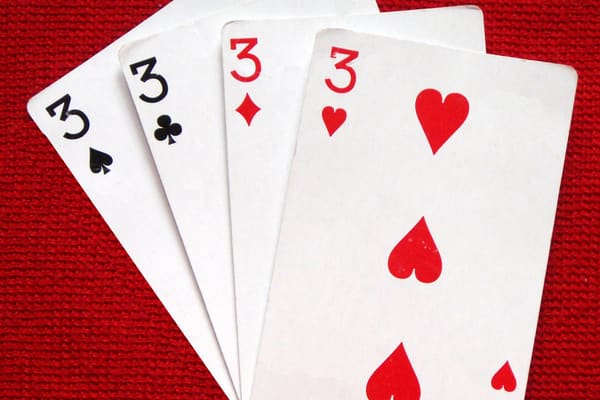
- Deal all cards out evenly; in round 1 the holder of the 3 of Diamonds leads.
- From round 2: Downstream gives top 2 cards to Upstream; Upstream returns any 2.
- Lead any legal combination (single, pair, triple, full house, 5+-straight, bomb).
- Follow with a higher combination of the same type and size, or pass.
- Bombs (4+ of a kind or Joker pair) beat any non-bomb; larger bombs beat smaller.
- When all others pass, you lead the next trick.
- First out = Upstream; last out = Downstream.
- Upstream and Downstream exchange 2 cards at the next round's start.
- Optional point play: 1 point per card, 2 per 2, 3 per Joker left in hand.
Players
Zheng Shangyou is played by 3 to 6 players, best at 4 players with one 54-card deck (two Jokers). With 5 or 6 players use two combined decks (108 cards). With 3 players, remove the two lowest 3s to leave an even 52-card deal. The first dealer is chosen by high-card draw; thereafter the deal rotates to the previous round's Downstream. Play proceeds counter-clockwise, the traditional Chinese direction.
Card Deck
One standard 54-card deck (52 cards plus both Jokers) for 3 or 4 players. Suits are all equal; the game cares only about rank. Rank order, low to high: 3, 4, 5, 6, 7, 8, 9, 10, J, Q, K, A, 2, Black Joker, Red Joker. The 2 is the highest natural rank; the Red Joker is the single highest card in the pack. Two Jokers together form an unbeatable Bomb of Jokers (see Gameplay).
Objective
Be the first player to empty your hand in each round. Over a match, play enough rounds to let the ranking system settle; the overall match goal is usually to be named Upstream (first out) for the most rounds, or to avoid being Downstream (last out) which forces you to surrender cards at the start of the next round.
Setup and Deal
- Shuffle the deck thoroughly. The player to the dealer's right cuts.
- Deal the entire deck out counter-clockwise, one card at a time. With 4 players using 54 cards, each player receives 13 or 14 cards (the dealer adjusts). With 3 players using 52 cards, each player receives 17 or 18.
- Players fan their own cards and sort them into ranks and combinations for planning.
- First round of a match: The player holding the 3 of Diamonds leads. The lead play must include the 3 of Diamonds (as a single, in a pair, in a straight, and so on).
- Subsequent rounds: The previous round's Upstream (first player out) leads, and must first complete the card exchange with the Downstream (see below) before leading.
Card Exchange (Rounds 2+)
From the second round of a match onward, immediately after the deal and before the Upstream leads: the Downstream (last player out last round) hands their two highest natural cards (Jokers excluded) face-up to the Upstream. The Upstream returns any two cards of their choice face-down. In games with a middle rank (Middle, in 4-player play: Second-Upstream gives one highest card to Second-Downstream, who returns one of their choice). This 'pay tribute' step is the signature of Zheng Shangyou and ensures the class ladder shifts slowly rather than cementing.
Gameplay
- The leader plays any legal combination face-up to the centre of the table; subsequent players must either play a higher combination of the same type and same size, or pass. Play passes counter-clockwise.
- Legal combinations: a. Single: one card. b. Pair: two cards of the same rank. c. Triple: three cards of the same rank. d. Full house (triple + pair): five cards, where three share one rank and two share another. e. Straight: five or more consecutive ranks (for example, 7-8-9-10-J); suits are ignored. Straights cannot loop past 2 (for example, K-A-2-3-4 is not legal). Jokers cannot appear in a straight. f. Bomb: four or more cards of the same rank, or the pair of Jokers (Black + Red). Bombs beat any non-bomb play.
- Beating a play: A follow must be the same type and same size with a higher rank. A triple of 7s beats a triple of 5s; a 6-card straight beats another 6-card straight starting one rank higher. You cannot beat a 5-card straight with a 6-card straight.
- Bombs are universal: A bomb (four-of-a-kind or higher, or the Joker pair) may be played on top of any non-bomb play of any type or size. A larger bomb beats a smaller one (five-of-a-kind beats four-of-a-kind; Joker pair beats all other bombs).
- Pass: If you do not wish to (or cannot) beat the current play, say 'pass'. A pass does not prevent you from playing on your next turn.
- Trick resolution: When every other active player has passed consecutively after a play, the most recent player wins the trick, clears the centre, and leads the next trick with any legal combination. Players who have already finished their hand are skipped.
- Finishing: The first player to play their last card becomes the Upstream and is out for the round; subsequent plays continue among the remaining players. The round continues until only one player still holds cards; that player is the Downstream. In 4-player play, the other two are Second-Upstream and Second-Downstream (also called Middle) in finishing order.
- Can't-play restriction after a bomb: In some house rules, a player who is beaten by a bomb cannot themselves bomb over it unless their bomb is strictly larger; in the purer rule, any larger bomb wins, so this is usually left off.
Scoring
- Zheng Shangyou is traditionally played for rank, not points. Finishing position assigns a title for the next round.
- Upstream (first out): Receives the tribute exchange; leads the next round.
- Second-Upstream (Middle, 4+ players): Neutral; no exchange.
- Second-Downstream: In 4-player games, gives one card to the Second-Upstream and receives one back. In 3-player games, does not apply.
- Downstream (last out): Pays two of their best cards to the Upstream at the start of the next round and receives two of the Upstream's choice back.
- Optional point scoring: If tracking points, penalize remaining cards at round end: each card in hand = 1 point, each card of rank 2 = 2 points, each Joker = 3 points. Lowest cumulative score after an agreed number of rounds wins.
Winning
Each round is won by the first player to empty their hand (the Upstream). A match is typically played to an agreed number of rounds (5, 7, or 10) and the match is won by whichever player was Upstream the most times. In point-scored play, the match winner is the player with the lowest cumulative penalty total; in cases of a tie, settle by a deciding round between the tied players.
Common Variations
- Da Lao Er (Big Two): Closest Hong Kong cousin; suit matters for ranking and four-player play is standard.
- Dou Dizhu: Three-player 'Fight the Landlord' derivative where one player plays against two.
- Two-deck large tables: 5 or 6 players use 108 cards; all combinations stay legal, bombs can include five+ of a kind.
- Partnership Zheng Shangyou: 4 or 6 players split into fixed partnerships sitting alternately; partners help each other win by sacrificing tricks.
- Tribute doubled: Downstream gives three cards (not two) to the Upstream for a harsher ladder; only for experienced groups.
- No-tribute casual: Skip the exchange entirely for a one-off round without ladder carryover.
Tips and Strategy
- Count by type, not by card. The moment all four 2s have been played, you know any Ace-topped single play is unbeatable; any A-A pair is unbeatable; any straight of five ending on an Ace is unbeatable. Count aggressively.
- Dump low cards in groups. A 3 is your weakest card but it is invaluable inside a 3-3-3 triple, a 3-4-5-6-7 straight, or a 3-3 pair. Build combinations from your bottom rank first.
- Hoard a bomb. A saved four-of-a-kind or Joker pair is the ultimate lead-control card. Do not burn it on an opponent's casual 5; use it when you are one or two cards from going out and need to break an opponent's lead.
- Track tribute you gave. If you were Downstream and gave up both black Aces, remember: an opponent now holds those Aces. Do not lead with King singles hoping they fall.
- Lead from your strengths. When you win a trick, lead the combination type that nobody can beat. If you hold the last pair of 2s, lead pairs. If you hold a long straight, lead straights to force opponents to follow.
- In tribute, return junk. As Upstream giving back two cards, hand over your lowest unused cards (loose 3s, 4s that do not complete any combination). Never return anything that could be a bomb or a pair for the Downstream.
Glossary
- Upstream (上游, shàngyóu): The first player to empty their hand in a round; the top of the class ladder.
- Downstream (下游, xiàyóu): The last player holding cards in a round; must pay tribute to the Upstream next round.
- Middle / Second-Upstream: In 4+ player play, the second and third finishers; they do not pay tribute.
- Tribute: The mandatory exchange of two high cards from Downstream to Upstream at the start of each round after the first.
- Combination type: Single, pair, triple, full house, straight, or bomb; defines what the next player must match.
- Bomb: Four or more cards of the same rank, or the pair of Jokers; beats any non-bomb play and most smaller bombs.
- Trick: The sequence of plays from a lead until all other players pass consecutively; the trick winner leads the next.
- Pass: Declining to beat the current play; does not disqualify the player from future plays in the round.
Tips & Strategy
Bombs are the pivot. A saved four-of-a-kind or Joker pair gives you one guaranteed chance to break an opponent's streak; the best time to use it is when you are one or two plays from emptying your hand, not when you are still holding eight cards. Count the 2s and Aces obsessively because once they are all played, any remaining high card of that rank is lead-proof.
Expert Zheng Shangyou is a game of type-forcing. When you win a trick, lead the combination type your opponents are least able to match. A hand heavy in 7-8-9-10-J straights leads straights repeatedly; a hand rich in pairs leads pairs. Combined with careful bomb timing and tribute accounting, this turns the game into a positional exercise rather than a card-luck race.
Trivia & Fun Facts
The tribute mechanic (Downstream handing over two cards to the Upstream) is one of the earliest documented examples of an 'inequality ladder' in card game design; it inspired the similar exchange rules found in President variants across Europe and the Americas.
-
01In Zheng Shangyou, what is the single highest-ranking individual card in the deck?Answer The Red Joker (大王, da wang); it beats every other single card and, paired with the Black Joker, forms the strongest bomb in the game.
History & Culture
Zheng Shangyou is the direct ancestor of modern President (Daifugō in Japan, Grosser Presi in Germany) and a sibling to Big Two and Dou Dizhu. It is recorded in eastern Chinese card traditions going back centuries and remains a staple of the Shanghai-Zhejiang-Jiangsu region, particularly played during Lunar New Year gatherings and family holidays.
Zheng Shangyou is one of the three iconic Chinese climbing games (alongside Dou Dizhu and Big Two) and is closely associated with family-centred holiday play in eastern China. Its tribute mechanic is often cited in Chinese popular media as a metaphor for social mobility, and the phrase 'zheng shangyou' is used colloquially to mean 'strive to rise'.
Variations & House Rules
Big Two is the Hong Kong sibling where suits matter. Dou Dizhu is the 3-player landlord derivative. Two-deck large tables support 5-6 players. Partnership Zheng Shangyou pairs up players; tribute-doubled and no-tribute variants tighten or loosen the ladder mechanic.
For a children's game, drop the tribute and ignore bombs; play as a simple climbing game. For competitive play, use the full 54-card deck with tribute, keep a written tally of Upstream wins across the match, and add a three-card tribute penalty for repeat Downstreams.


