
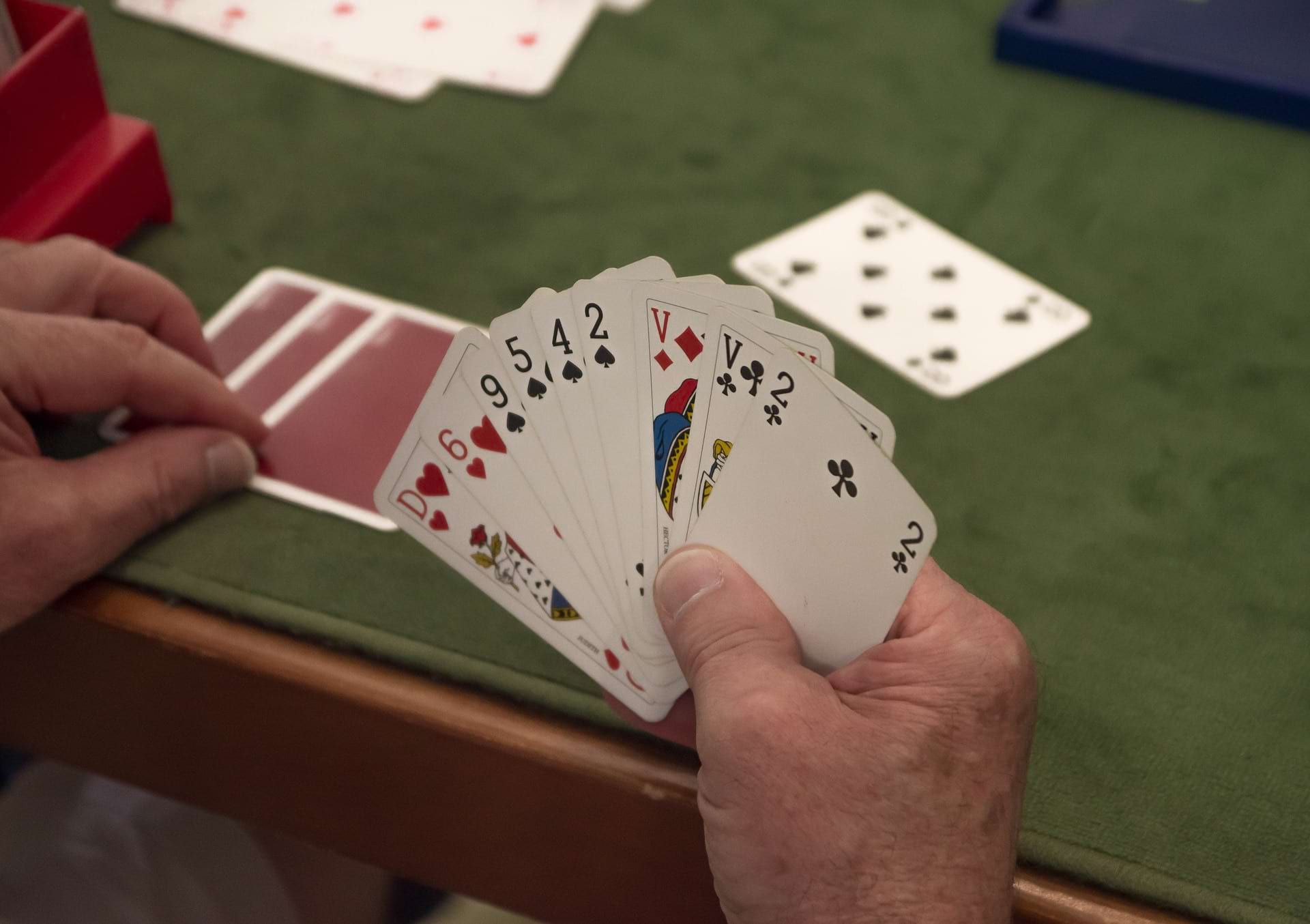
How to Play
Auction Bridge is a 4-player partnership trick-taking game played with a standard 52-card deck, in which the two partnerships bid competitively in an 'auction' for the right to name trump and set a contract. It evolved in England around 1904 from the earlier game simply called Bridge, adding competitive bidding, doubling, and redoubling, and was the dominant form of Bridge worldwide until Harold Vanderbilt's 1925 Contract Bridge scoring reforms gradually displaced it. Its defining rule is that every odd trick a declaring side actually wins counts toward the 30 points needed for game, not merely the tricks it bid, so a partnership only needs to bid enough to win the auction rather than to claim its entire hand. Games are grouped into rubbers, won by the first partnership to complete 2 games, with large bonuses for honour cards, slams, and the rubber itself.
Auction Bridge is a 4-player partnership trick-taking game played with a standard 52-card deck, in which the partnerships compete in a bidding contest, the 'auction', to decide who will name trump and how many tricks that side commits to winning. It emerged in England around 1904 as a direct evolution of the older game simply called Bridge (or Bridge-Whist), which let only the dealer's side name trump with no competitive bidding at all; Auction Bridge's innovation was to let every player at the table bid for the right to declare, with opponents free to outbid or double. For roughly two decades it was the dominant form of Bridge worldwide, played in clubs, ocean liners, and parlors across Britain and America, before Harold Vanderbilt's 1925 scoring reforms launched Contract Bridge and gradually displaced it. The game's defining scoring quirk, and the biggest difference from its successor, is that every trick a declaring side actually wins counts toward game, not merely the tricks it bid for, so a partnership only needs to bid high enough to win the auction rather than to bid out its whole hand.
Quick Reference
- 4 players in 2 fixed partnerships; deal 13 cards to each player from a standard 52-card deck.
- The dealer opens the auction; each following bid must outrank the last in level or denomination, or a player may pass or double.
- The auction ends after 3 consecutive passes; the declarer is whoever first named the winning denomination for their side.
- The player to the declarer's left makes the opening lead, then the dummy's hand is laid face-up and the declarer plays both hands.
- Each player must follow the suit led if possible, or may play any card, including a trump, if void.
- The highest card of the suit led wins the trick, unless a trump was played, in which case the highest trump wins; the winner leads next.
- Trick values per odd trick: Clubs 6, Diamonds 7, Hearts 8, Spades 9, No-Trump 10, all counted below the line toward the 30-point game.
- Doubled contracts double the trick and undertrick values and add a 50-point bonus for making the contract; redoubling doubles those again.
- Honours, slams, and the 250-point rubber bonus for winning 2 games are all scored above the line, separately from the game total.
Players
Exactly 4 players in 2 fixed partnerships, with partners seated opposite each other. A 3-player form exists, dealing a face-down 'dummy' hand for the missing fourth seat that is exposed and played by whichever side wins the auction, but the standard game is always played 4-handed. Play proceeds clockwise from a rotating dealer. A single hand, auction plus play plus scoring, takes roughly 8-12 minutes; a full rubber (first partnership to win 2 games) typically runs 45-75 minutes.
Card Deck
- One standard 52-card pack, no jokers.
- Rank order in every suit (high to low): A, K, Q, J, 10, 9, 8, 7, 6, 5, 4, 3, 2.
- Denomination ranking for bidding (lowest to highest): Clubs, Diamonds, Hearts, Spades, No-Trump. A bid in a higher-ranked denomination outranks an equal-level bid in a lower one; No-Trump outranks every suit.
- Honour cards: the Ace, King, Queen, Jack, and 10 of the trump suit (or the four Aces when the contract is No-Trump).
- The book: the first 6 tricks a side wins in a hand are not scored; only tricks beyond the book, called 'odd tricks', count toward the contract and toward scoring.
Objective
Win the auction by naming the highest bid, then work with your partner to take at least as many odd tricks (tricks beyond the book of 6) as you bid, in the denomination you named. Making the contract scores points toward game for your side; every side's 'odd tricks' actually won, whether bid for or not, count toward the 30 points needed to win a game, which is this game's signature difference from Contract Bridge. The first partnership to win 2 games completes the rubber and adds a large bonus, and the partnership with the higher total score across the rubber is the winner.
Setup
- Shuffle the 52-card deck; the player to the dealer's right cuts.
- Deal 13 cards to each player, one at a time, clockwise, starting with the player to the dealer's left.
- Each player sorts their hand by suit without showing any cards.
- Agree the rubber format (first to 2 games) before the first hand; after each hand the deal passes to the next player clockwise.
- The dealer opens the auction.
Bidding
- The dealer bids first. A bid names a number of odd tricks (1 through 7) and a denomination (Clubs, Diamonds, Hearts, Spades , or No-Trump), for example '1 Heart' commits to 7 total tricks with hearts as trump.
- Each following bid, moving clockwise, must outrank the last one, either by naming a higher level or, at the same level, a higher-ranked denomination (Clubs < Diamonds < Hearts < Spades < No-Trump). A player may also pass or double the last bid instead of bidding higher.
- Doubling. Any player may double the last bid made by an opponent before it is overbid; this multiplies the eventual trick score and any undertrick penalty. The doubled side may redouble in turn, doubling those values again.
- The auction ends when a bid, double, or redouble is followed by 3 consecutive passes. If all 4 players pass on the very first turn with no bid at all, the hand is thrown in and redealt by the same dealer.
- The declarer is whichever player, on the winning side, was first to name the denomination of the final contract during the auction; that player's partner becomes the dummy.
Gameplay
- The player to the declarer's left makes the opening lead, playing any card face-up.
- Immediately after the opening lead, the dummy lays their entire hand face-up on the table, sorted by suit; the dummy takes no further active part beyond following the declarer's instructions on which card to play.
- The declarer plays both their own hand and the dummy's hand for the rest of the deal; each defender continues to play from their own hand.
- Follow suit if possible. Each player must play a card of the suit led if they hold one; if void in that suit, any card may be played, including a trump.
- Winning the trick: the highest card of the suit led wins, unless a trump was played, in which case the highest trump played wins. The trick winner leads the next trick.
- Play continues until all 13 tricks have been played out.
Scoring
- Trick values (below the line), per odd trick made: Clubs 6, Diamonds 7, Hearts 8, Spades 9, No-Trump 10 points.
- Every odd trick the declaring side actually wins counts below the line, not just the tricks it bid. A side that bid '1 Spade' (8 tricks total) but takes 11 tricks scores for all 5 odd tricks won, at 9 points each, 45 points, not just the 1 it contracted for.
- Game is reached the moment a partnership's below-the-line total reaches 30 points, possibly built up over more than one hand; reaching game closes out that game and both partnerships start a fresh below-the-line total for the next one.
- Doubled and redoubled contracts score double, or quadruple, the normal trick value below the line, and making a doubled or redoubled contract adds a bonus of 50 points above the line (100 if redoubled) on top of the trick score.
- Undertricks: if the declaring side fails to make its contract, the defenders score 50 points above the line for each trick short (doubled: 100 per trick; redoubled: 200 per trick).
- Honours (above the line): if one hand holds all 4 trump honours (A, K, Q, J of trump), that hand's side scores 80; if one hand holds all 5 trump honours, or all 4 Aces in a No-Trump contract, that side scores 100. If the honours are split, 3 or more between the two partners, or exactly one honour beyond the fourth held by partner, each honour scores 10.
- Slam bonuses (above the line): winning 12 of the 13 tricks in a hand (a small slam) scores 50 points; winning all 13 tricks (a grand slam) scores 100 points, regardless of the level bid.
- Rubber bonus: the first partnership to win 2 games wins the rubber and scores 250 points above the line.
Winning
The rubber ends the moment a partnership completes its second game. Add up every point both partnerships scored, above and below the line, across every hand of the rubber; the partnership with the higher total wins the rubber by the difference between the two totals. If a session must stop before either side has won 2 games, the partnership with the higher net total at that point is the winner; an exact tie on an unfinished rubber is conventionally settled by playing one further hand.
Doubling and Redoubling
Doubling is a tactical tool as much as a scoring one: a defending side doubles a contract it believes will fail, both to raise the penalty if the declarer is set and to warn the declaring side of danger, and a declaring side that is confident in its contract can redouble to punish an over-optimistic double. Because doubling multiplies every odd trick made below the line as well as the undertrick penalty, a doubled contract that succeeds can reach game in a single hand even at a modest bidding level, while a doubled contract that fails can swing 200 or more points to the defenders in one hand.
Variations
- Royal Auction Bridge: an early revision of the scoring table, popular in the 1910s, that raised the No-Trump trick value relative to the suits to reward No-Trump bidding more heavily than the original 1904 scale.
- Three-hand Auction Bridge: played with a dealt-out dummy hand standing in for a missing fourth player, taken over by whichever side wins the auction.
- Nullo (Misère) bidding: a house variant allowing a bid to declare for losing tricks instead of winning them, scored separately from the standard trick table.
- Chicago-style short rubbers: informal home adaptations that cap a session at a fixed number of hands rather than playing to 2 full games, for a shorter evening.
Tips and Strategy
- Bid only high enough to win the auction, not to claim every trick you think you can make. Because all odd tricks won count toward game regardless of the bid, overbidding only adds risk of being doubled and set without adding to your eventual score.
- Count your honour cards before bidding. A hand holding 3 or more of the top 5 trump honours is usually strong enough to contest the auction confidently, since honours score points independently of how the play goes.
- Double speculatively when you hold strong defense against the named denomination, especially once the bidding level is high; even a modest double that succeeds swings a large undertrick penalty your way.
- As dummy, lay your hand out by suit with trumps to your own right so the declarer can read your holding at a glance and call for cards efficiently.
- Track how many odd tricks below the line each side already has toward game before deciding whether a marginal double is worth the risk; a side already close to 30 points has more to protect than one just starting a new game.
Glossary
- Trick: one round of all 4 players playing a single card; the highest card of the suit led, or the highest trump if any was played, wins it.
- Trump: the denomination named in the winning bid, whose cards outrank every card of any other suit for the rest of the hand.
- Book: the first 6 tricks won by a side in a hand; these are not scored on their own.
- Odd trick: any trick won beyond the book of 6; only odd tricks count toward the contract and toward scoring.
- Declarer: the player who first named the winning denomination for their side during the auction; plays both their own hand and the dummy's.
- Dummy: the declarer's partner, whose hand is exposed face-up on the table after the opening lead and played according to the declarer's calls.
- Contract: the final bid of the auction, committing the declaring side to a number of odd tricks in a stated denomination.
- Double/Redouble: a call that multiplies the trick score and undertrick penalty of the last bid; a redouble doubles those values again.
- Rubber: a match won by the first partnership to complete 2 games.
Tips & Strategy
Bid only high enough to win the auction rather than to claim every trick you think your hand can make, since every odd trick your side wins counts toward game regardless of what you bid, and overbidding only invites a costly double. Count your honour cards, the Ace, King, Queen, Jack, and 10 of the trump suit, before entering the bidding, since a hand with 3 or more of them is usually strong enough to contest confidently and honours score points independently of the play. Look for doubling opportunities when you hold strong defensive strength against the named denomination, especially at higher bidding levels, since even one successful double can swing a large undertrick penalty in your favor. As dummy, lay your hand out clearly by suit so your partner can call for cards efficiently, and as declarer, plan the whole hand from the moment the dummy is exposed rather than playing trick by trick. Keep track of how close each side already is to the 30 points needed for game before risking a marginal double, since a side already partway to game has more to lose from a bad outcome than one starting fresh.
Because every odd trick won counts toward game no matter what was bid, Auction Bridge rewards a conservative bidding style that most Contract Bridge players find counterintuitive: naming the lowest bid that can plausibly win the auction is usually correct, since bidding higher only raises the risk of a costly double without adding anything to the eventual score if the contract succeeds. This shifts much of the game's real skill away from precise hand description in the auction and toward accurate trick-by-trick play and shrewd doubling, since a well-timed double against an overreaching opponent can swing 100 points or more in a single hand through the doubled undertrick penalty. Declarer play also carries more weight than in Contract Bridge, since a declarer who simply plays solidly and racks up extra odd tricks scores for every one of them below the line, making disciplined card counting and suit management genuinely rewarding rather than merely a matter of safely fulfilling a fixed contract.
Trivia & Fun Facts
Auction Bridge's most famous quirk is that a partnership never needed to bid its whole hand to score for it: every odd trick actually won counted toward the 30 points needed for game, so cautious, low bidding was often the safest route to victory, exactly the opposite incentive from Contract Bridge, where a low bid leaves extra tricks scoring only minor bonuses. Because winning tricks mattered more than accurately describing your hand, Auction Bridge bidding conversations were comparatively simple by later standards, and much of the game's real skill lay in play technique and in judging when to double an opponent's contract. The game was popular enough in its heyday that ocean liners, gentlemen's clubs, and society hostesses in both Britain and America organized regular Auction Bridge nights and tournaments throughout the 1910s and early 1920s. Despite being almost entirely eclipsed by Contract Bridge since the late 1920s, Auction Bridge is still occasionally revived by card game historians and heritage clubs as a way to experience Bridge as it was played before the modern contract-scoring era.
-
01What is the single biggest scoring difference between Auction Bridge and the Contract Bridge that replaced it?Answer In Auction Bridge, every odd trick the declaring side actually wins counts below the line toward the 30 points needed for game, not just the tricks it bid for; Contract Bridge changed this so only the tricks named in the contract count toward game, turning any extra tricks into much smaller overtrick bonuses instead.
-
02Who devised the scoring system that created Contract Bridge and eventually displaced Auction Bridge?Answer The American yachtsman Harold Vanderbilt devised the new scoring system in 1925 that became Contract Bridge.
History & Culture
Auction Bridge emerged in England around 1904 as a direct evolution of the earlier game known simply as Bridge or Bridge-Whist, itself descended from the Russian game Biritch, which had let only the dealer's side name trump with no competing bids from the other players. Auction Bridge's central innovation was to open the naming of trump to a genuine competitive auction among all 4 players, adding the double and redouble as tactical tools along the way. It rapidly became the most popular form of Bridge in clubs and homes across Britain and the United States through the 1910s and into the 1920s, with its own dedicated rulebooks, clubs, and championship play. Its reign ended when the American yachtsman Harold Vanderbilt devised a new scoring system in 1925, in which only the tricks actually bid, rather than every trick won, counted toward game; this new game, Contract Bridge, rewarded precise bidding so much more than Auction Bridge that it displaced its predecessor worldwide within about a decade.
Auction Bridge occupies a pivotal place in card game history as the missing link between the dealer's-choice trump-naming of early Bridge and Bridge-Whist and the fully codified bidding systems of modern Contract Bridge, and for roughly two decades it was itself the most fashionable card game in the English-speaking world. Its clubs, dedicated rulebooks, and tournament circuits in Britain and the United States through the 1910s and early 1920s mirror the social prominence Contract Bridge would later inherit and expand upon. Studying Auction Bridge today gives a clear, playable illustration of why Vanderbilt's 1925 scoring reform mattered so much: the switch from 'every trick counts' to 'only the contract counts' fundamentally changed what skillful bidding looked like, reshaping competitive card play for the following century. Though it is rarely played outside historical reenactment and heritage card clubs now, Auction Bridge remains the direct ancestor every Contract Bridge and Duplicate Bridge player's game ultimately descends from.
Variations & House Rules
Royal Auction Bridge was an early-1910s revision of the original 1904 scoring table that raised the value of No-Trump tricks relative to the 4 suits, encouraging players to bid No-Trump more aggressively than the original scale had rewarded. Three-hand Auction Bridge adapts the game for a missing fourth player by dealing out a face-down dummy hand that is claimed and played by whichever side wins that hand's auction. A Nullo, or Misère, house variant lets a player bid to lose tricks instead of winning them, scored on a separate table from the standard trick values. Casual Chicago-style short rubbers cap a session at a fixed number of hands instead of playing out a full 2-game rubber, suiting a shorter social evening.
New groups often play a few practice hands with all 4 hands exposed on the table so everyone can see how the auction, doubling, and the below-the-line scoring toward game actually connect before playing with hidden hands. Lowering the game target from the traditional 30 points speeds up short sessions considerably, since it takes fewer accumulated odd tricks to close out each game. Tables that find the classic honours bonuses fiddly to track can agree in advance to drop honours scoring entirely and focus purely on the trick-taking and doubling contest, which keeps the core auction skill intact while simplifying the scorekeeping. Groups new to the double and redouble can also agree to cap penalties at the undoubled rate for their first few sessions, removing the sharpest swings while everyone learns to read the auction.


