
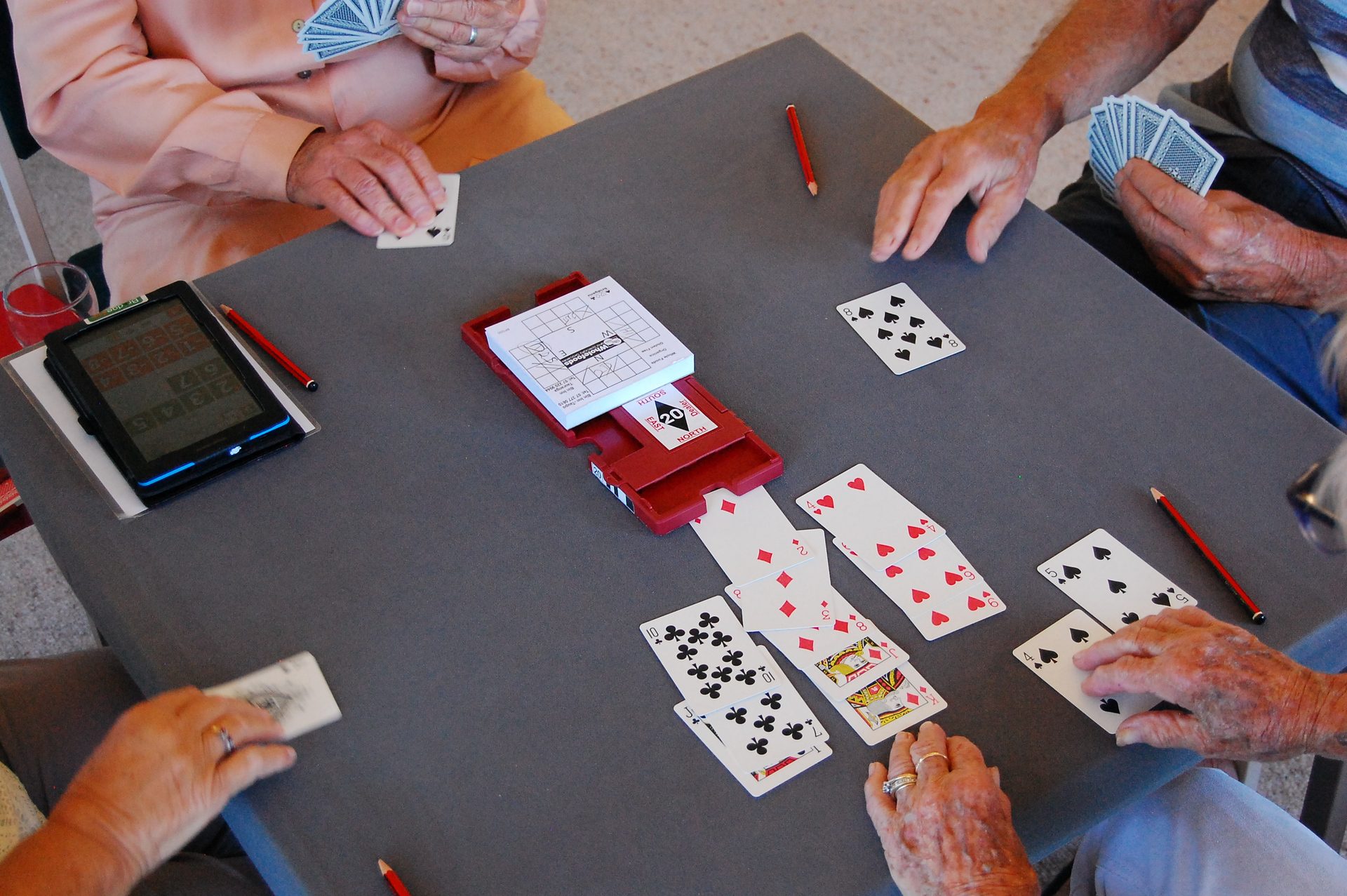
How to Play
Vint is the 19th-century Russian Whist-Bridge ancestor in which four players bid through a contract auction but, crucially, play with NO dummy: all four hands stay hidden. Tricks score for both sides; honors and slam bonuses make the rubber to 1000 points lively.
Vint is the late-19th-century Russian trick-taking partnership game that served as a missing link between Whist and Contract Bridge. Four players, a 52-card deck, and an auction in which each bid promises a number of tricks above 6 along with a suit (or no-trump). Crucially, unlike Bridge there is NO dummy: ALL FOUR players play their hands hidden, including the declarer's partner. Both sides score the tricks they actually take, with bonus 'honors' for top trumps and slam premiums for taking 12-13 tricks. The match is played to a target score, traditionally 1000 game points.
Quick Reference
- 4 players in two fixed partnerships use a 52-card deck.
- Deal 13 cards each one at a time; dealer speaks first in the auction.
- Bids name tricks above 6 plus a suit (or no-trump); bidding ends after 8 consecutive passes.
- NO dummy: all four players keep their hands concealed.
- Player left of declarer leads first; follow suit if able.
- Highest trump or highest card of led suit wins the trick.
- Trick value scales by contract level (10 / 20 / 30 / ... / 70 per trick) plus 10 for no-trump.
- Both sides score the tricks they take.
- Slam bonuses: 100 (12 tricks) or 250 (13 tricks); honors: 4x or 10x trick value.
- Undertricks: defenders score 2x trick value per missing trick.
Players
Vint is played by exactly 4 players in two fixed partnerships sitting opposite each other. The deal rotates clockwise after each hand. There is no 2- or 3-player Vint; this is a strictly 4-handed game.
Card Deck
- Use a standard 52-card pack with no jokers.
- Card rank within a suit, high to low: Ace, King, Queen, Jack, 10, 9, 8, 7, 6, 5, 4, 3, 2.
- The trump suit (or no-trumps) is set by the winning auction bid.
- Honor cards in the trump suit: Ace, King, Queen, Jack, Ten. In a no-trump contract the four Aces are honors. Holding multiple honors as a partnership earns bonus points.
Objective
Win the auction by promising the highest number of tricks at the highest contract level, then take at least that many tricks (in declarations Whist-style for both sides simultaneously). Points are scored for tricks taken (by both sides), for slam bonuses, for honors, and for fulfilling versus failing the contract. The first partnership to 1000 game points wins the match.
Setup and Deal
- Cut for first dealer; the deal then rotates clockwise after each hand.
- Deal all 52 cards face-down, 13 to each player one at a time.
- Auction: The dealer speaks first. Each player in turn bids a contract OR passes. Each contract names a number of tricks above 6 (i.e. 1 = 7 tricks, 2 = 8, ..., 7 = 13 tricks) AND a suit OR No-Trump. The suit hierarchy from low to high is: Spades, Clubs, Diamonds, Hearts, No-Trump (in the most-played order).
- Each subsequent bid must outrank the previous. A higher trick number always outranks a lower trick number; for the same trick number, a higher-ranking suit outranks a lower one. So '1 No-Trump' outranks '1 Hearts', and '2 Spades' outranks '1 No-Trump'.
- Auction ends when 8 consecutive passes occur (effectively two passes per player, including the last bidder). The high bid becomes the contract; the player who first named that level/suit becomes the declarer.
- If all four players pass without bidding, the deal is annulled and the next player deals.
Gameplay
- No dummy. All four players hold their cards concealed; this is the key difference from Bridge.
- The player to the declarer's left leads the first trick.
- Follow suit if possible. If void in the led suit, you may play any card (no obligation to overtrump in the standard rules).
- Winning the trick: The highest trump played wins. If no trump was played, the highest card of the led suit wins. The trick winner leads the next.
- Continue for all 13 tricks. Both partnerships count the tricks they took.
Scoring
- Trick value scales with the contract level. A common value table: contract level 1 (7 tricks) = 10 points per trick; level 2 = 20; level 3 = 30; level 4 = 40; level 5 = 50; level 6 = 60; level 7 = 70. No-trump contracts pay an extra 10 per trick at all levels.
- All tricks taken score, including by the defenders. This is unique to Vint and to the Whist tradition. If the declarer's side bid 4 Hearts (10 tricks contracted at level 4) and took 9 tricks while defenders took 4, the declarer's side scores 9 × 40 = 360 (and is short of contract; see undertricks) and the defenders score 4 × 40 = 160.
- Slam bonuses: Winning 12 tricks (small slam) earns 100 bonus points; winning all 13 (grand slam) earns 250 bonus points; both for the partnership that achieves them, not just the declarer's side.
- Honors: A partnership with 5 trump honors (A-K-Q-J-10 of trumps OR all four Aces in no-trump) scores 10x the trick value as honor bonus. With 4 honors: 4x the trick value. With 3 honors split between partners: small bonus or none.
- Undertricks (failure): The defending side scores penalty points equal to twice the trick value for every trick the contract falls short. Some rule sets simplify this to 50 per undertrick.
- Game and rubber: Vint is traditionally played in 'rubber' format: first to 1000 game points wins the match. Some clubs play to 500 for a shorter session.
Winning
The match is won by the first partnership to reach 1000 game points (or 500 in shorter formats). The winning side claims the rubber bonus (typically 250 points). Multiple rubbers may be played in a session.
Common Variations
- Old Russian Vint (Whist Vint): A simpler historical variant with fewer scoring categories, closer to early Whist.
- Modern Vint with Honors: The standard form with honors bonuses described above.
- Progressive Vint: Each new deal must be opened at a higher minimum contract level than the previous one, forcing escalating risk.
- No-trump-first Vint: No-trump outranks all suited contracts at every level (so 1 No-Trump beats 1 Hearts but loses to 2 Spades). The most common modern ordering.
- Tournament Vint: Played by Russian historical-game societies; standardised scoring tables and strict bidding rules.
Tips and Strategy
- Bidding is information, not just commitment. Even though there is no dummy, your bids tell your partner about suit length and strength. A 1 Spades opening typically promises 4-5 spades and at least one trick honour.
- Without the dummy, defense is harder. You cannot see opposing hands, so leading low cards from long suits to develop length tricks is far more important than in Bridge.
- Honors are huge points. A 5-honor 4-Hearts contract scores 10 × 40 = 400 honor bonus on top of trick scores; bidding to keep honors on your side can swing the rubber.
- Lead trumps as declarer. Drawing 2-3 rounds of trumps strips defenders of ruffing tricks and protects your side-suit Aces and Kings.
- Track the high cards. With 13 tricks of strict play and no exposed hand, knowing exactly which Aces and Kings remain is the foundation of every late-game decision.
- Bid slams cautiously. A 100 or 250 bonus is enticing, but a failed slam contract can hand the defenders thousands of penalty points across all undertricks at the slam level.
Glossary
- Vint: Literally 'screw' in Russian; the name reflects the auction mechanics that 'screw up' the bidding from contract to contract.
- Contract: The bid (number of tricks above 6 plus trump suit or no-trump) that wins the auction.
- Declarer: The player who first named the winning contract level and suit.
- Honors: A, K, Q, J, 10 of trumps (or all four Aces in no-trump); held collectively by a partnership for a bonus.
- Slam: A small slam is 12 of 13 tricks; a grand slam is all 13. Both pay bonus points.
- Rubber: A match to 1000 game points; the winning side claims a rubber bonus.
- Undertrick: A trick the contracting side fell short of its bid; the defenders score penalty points per undertrick.
Tips & Strategy
Vint is a memory game wearing a Bridge auction's clothes. With no dummy hand exposed, all four players must reconstruct opponents' hands purely from the bidding and the played cards. Use your bids to communicate suit length and strength to your hidden partner, and treat the auction as a coded conversation worth almost as much as the play.
Without an exposed dummy, declarer play in Vint requires far more imagination than in Bridge. Skilled declarers picture their partner's likely distribution from the auction, then play the early tricks to confirm or refine that picture. Defenders, lacking a dummy to attack through, rely heavily on long-suit development and on signaling through the cards they discard. The honors bonus often makes a marginal trump suit (4-card with A-K-Q-J) better to bid than a 5-card suit without high honors.
Trivia & Fun Facts
The name 'vint' literally means 'screw' in Russian, referring to the way each bid 'screws up' the contract from the previous level. Tchaikovsky was such a passionate Vint player that letters survive in which he laments losing rubbers to friends. Despite Vint's near-disappearance from modern play (eclipsed entirely by Bridge), Russian historical-game societies still hold occasional Vint tournaments.
-
01What is the most important way Vint differs from Contract Bridge in the play of the hand?Answer Vint has NO dummy; the declarer's partner keeps their hand concealed and plays it themselves, exactly like the other three players.
History & Culture
Vint emerged in Russia in the 1870s and 1880s as a Russian adaptation of English Whist with an explicit auction mechanism. It became the dominant card game of the Russian intelligentsia and aristocracy through the late Imperial period and the early Soviet era. Tchaikovsky was a noted enthusiast; references appear in works by Chekhov, Tolstoy, and Solzhenitsyn. Vint's auction structure directly influenced the development of Auction Bridge (1904) and later Contract Bridge (1925), making it a critical missing link in the Whist family tree.
Vint was the card game of late-Imperial and early-Soviet Russian intellectual life, played in literary salons, military officers' clubs, and dachas. Although replaced by Bridge in the 20th century, it remains a touchstone of historical Russian card-game culture and is studied for its role in Bridge's evolution.
Variations & House Rules
Old Russian Vint is closer to early Whist with simpler scoring. Modern Vint with Honors uses bonuses for top trumps. Progressive Vint forces escalating contracts. No-trump-first Vint orders the suit-level ranking with no-trump outranking suits at the same level.
Play to 500 game points for a shorter introductory rubber, or 1000 for the traditional length. Beginners often skip the honors scoring at first and add it once the auction and trick-play rhythm is comfortable.


