
How to Play
Duplicate Bridge is the tournament form of Contract Bridge for exactly 4 players per table, in which the same pre-dealt boards are replayed unshuffled at every table so results measure skill rather than the luck of the cards. Scores are compared through matchpoints (pairs) or International Match Points (teams) rather than rubber scoring, reshaping strategy around relative rather than raw results.
Duplicate Bridge is the tournament form of Contract Bridge, played by exactly 4 players per table in two fixed partnerships using a standard 52-card deck, in which every pair around the room plays the SAME pre-dealt hands rather than a fresh shuffle each round. Each deal is stored in a plastic board with four labelled pockets (North, South, East, West) so it can be replayed unshuffled at every table; after the auction and play finish, players return their cards to the correct pocket and pass the board to the next table according to a published movement. Because every partnership at every table faces an identical distribution of cards, the luck of the deal is factored out and results are compared directly: how well a pair bid and played a hand is measured against everyone else who held exactly the same 13 cards, not against an abstract average. Scoring converts the raw trick result of each board into either matchpoints (compared board by board against every other pair who played it) or International Match Points, IMPs, (compared team versus team across a fixed set of boards), rather than the cumulative rubber score used in casual Bridge. This single change reshapes strategy throughout a session: a single overtrick, a well-timed sacrifice, or a contract-defeating double can swing a whole result, since only the relative outcome on each board counts, not the raw number of points scored.
Quick Reference
- Exactly 4 players per table (North-South vs East-West); a session runs several tables playing the same preset boards.
- Each board is a fixed, pre-dealt set of 4 hands stored in labelled N/S/E/W pockets, replayed unshuffled at every table.
- Vulnerability is preprinted on each board rather than decided by table history.
- Bid using bidding boxes until 3 passes follow a bid; the highest bidder's side becomes declarer.
- Play 13 tricks exactly as in rubber Bridge, following suit and trumping as needed.
- Record the result on the board's scoreslip or Bridgemate, then pass the board to the next table.
- Matchpoints (pairs): earn credit for beating or tying every other pair's raw score on the same board.
- IMPs (teams): the raw point difference between a team's two results on a board converts to International Match Points via a fixed scale.
Players
Exactly 4 players per table, seated North, South, East, and West in two fixed partnerships (North-South versus East-West), identical to rubber Bridge. A duplicate GAME is not limited to one table, though: clubs typically run 3 to 10 tables (12 to 40 or more players) in a single session, and national or world championships can fill hundreds of tables simultaneously, all comparing results on the same boards. In a Mitchell movement, North-South pairs stay seated while East-West pairs move between tables each round, so North-South and East-West are ranked as two separate fields; in a Howell movement, every pair moves and all pairs are ranked together in one combined field. A round is one or more boards, often 2 or 3, played at a single table before players move; a full session is typically 24 to 27 boards and takes 3 to 4 hours.
Card Deck
- One standard 52-card pack per board, no jokers, with the same rank order as rubber Bridge.
- Rank order (high to low): A, K, Q, J, 10, 9, 8, 7, 6, 5, 4, 3, 2, identical in all 4 suits.
- Duplicate boards: a rigid plastic or cardboard tray with 4 labelled pockets (N, S, E, W) that holds the 13 cards belonging to each seat between tables, so the same deal can be replayed unshuffled dozens or thousands of times.
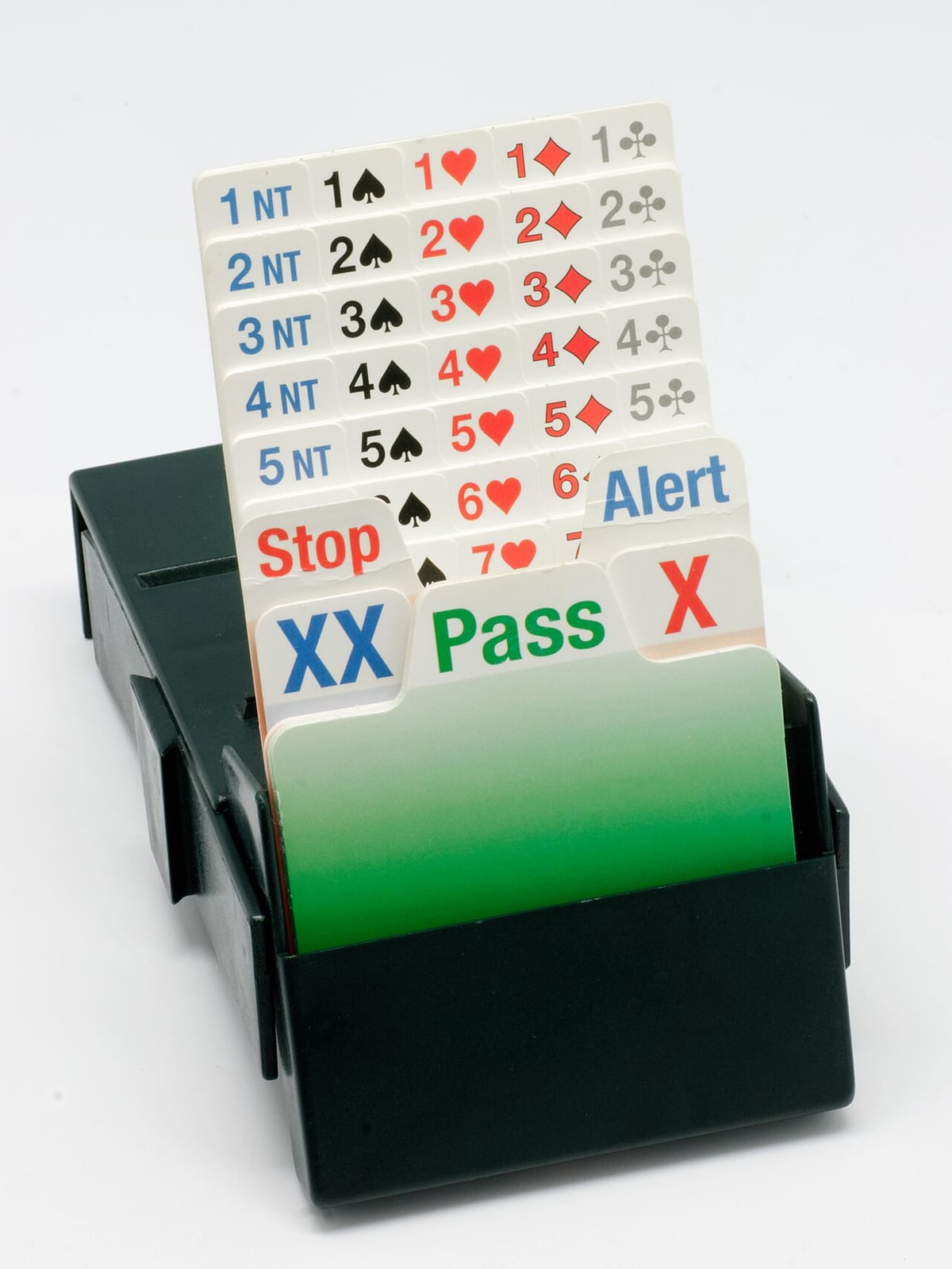
- Bidding boxes: a set of 4 small boxes of pre-printed bid cards (1♣ through 7NT, Pass, Double, Redouble) that players place face-up on the table instead of speaking their bids aloud, keeping the auction silent and removing tone-of-voice tells.
- Traveling scoreslip or electronic scoring device (Bridgemate): attached to or kept with each board to record every pair's contract, result, and score as the board passes from table to table.
Objective
Score better, relative to every other pair who played the identical cards, than as many of them as possible. Within a single board, declarer's side still wins by making at least the number of tricks it contracted for; but the raw number of points scored on that board barely matters on its own. What matters is the comparison: either matchpoints (earning credit for every pair beaten on that specific deal) or IMPs (the raw point difference between a team's two results on the same board, converted through a fixed scale). Across a full session of boards, the pair or team with the best total matchpoint percentage or IMP total wins.
Setup
- Before the session, the director or a dealing machine deals each board's 52 cards once into its 4 labelled pockets (N, S, E, W); the SAME 4 hands travel intact from table to table for the rest of the session.
- Players are assigned a starting table and direction (N, S, E, or W); a posted movement schedule tells each pair which table to sit at each round and which boards to play there.
- At each new table, players take the assigned board and each player removes only the pocket labelled with their own seat, without looking at any other player's cards.
- Vulnerability, which doubles some scoring bonuses and penalties, is preprinted on each board following a fixed 16-board cycle, not decided by table history as in rubber Bridge.
- The board number fixes who deals and who leads the auction: dealer rotates North, East, South, West as the board number increases, so board 1 is dealt by North, board 2 by East, and so on.
Gameplay
- The preassigned dealer opens the auction; bidding proceeds clockwise using bidding boxes, exactly as in rubber Bridge, until 3 consecutive passes follow a bid, or all 4 players pass with no bid, in which case the board is recorded as passed out.
- The player to the LEFT of declarer, the partnership that won the auction, leads to the first trick; declarer's partner's hand is exposed face-up on the table as the dummy, and declarer plays both hands.
- Play continues trick by trick exactly as in rubber Bridge: follow suit if possible, the highest card of the suit led wins the trick unless it is trumped, and the trick winner leads next.
- Beyond the auction and any required alerts, players do not discuss the hand at the table; all information must come only through legal bids and plays, and hesitating meaningfully or signalling by tone of voice is against the rules and can be penalised by the director.
- After the last trick, players verify the result, record the contract and score on the traveling scoreslip or Bridgemate device attached to the board, and return each hand to ITS OWN pocket, not shuffled back together, before passing the board onward.
Scoring
- Raw trick score for each board is computed exactly as in rubber Bridge: a set rate per trick for the contract, bonuses for game and slam, and penalties for undertricks, doubled or redoubled as applicable.
- Matchpoint scoring: a pair's raw score on a board is compared against every other pair's raw score on that SAME board across the field. Each pair earns credit for every other pair it beats and half credit for every tie; results are usually reported as a PERCENTAGE of the maximum possible.
- IMP scoring (team events): two 4-player teams each send one pair to sit North-South and the other to sit East-West at separate tables playing the SAME boards against different opponents; the raw point difference between the two results on each board is converted through a published IMP scale, where, for example, a 750-point swing is worth about 13 IMPs, and IMPs are totalled across all boards.
- Because only the comparison matters, an overtrick or a well-chosen sacrifice that would look costly in isolation can still be the best-scoring action on that board if it beats what other pairs achieved with the same cards.
Common Variations
- Matchpoint pairs: the most common club and weeknight format; every board counts equally regardless of the size of the swing, rewarding aggressive, small-edge decisions.
- Teams of four (IMP scoring): the format used in almost all serious national and international competition; large swings matter far more than small ones, favouring safer, more standard bidding and play.
- Individual movement: a rarer format in which players change partners every round or two instead of keeping one partner all session, isolating individual skill from partnership chemistry.
- Swiss teams: teams play a sequence of matches against opponents with a similar running score rather than a single fixed field of tables, common in weekend tournaments.
- Barometer scoring: running standings are posted and updated after every round so players can follow the field's progress during the session, rather than only at the very end.
Duplicate Procedure and Etiquette
- Alerting: a partnership using an unusual, pre-agreed ('conventional') bid must alert the opponents, typically by tapping an Alert card from the bidding box, and must explain the agreed meaning if asked.
- Claiming: declarer may claim the remaining tricks by laying down their hand and stating how they intend to play it; defenders may dispute the claim, and the director rules on any disagreement.
- Director calls: an appointed director rules on irregularities, such as a lead out of turn, a revoke (failing to follow suit when able), or insufficient disclosure of a convention, and can assign an adjusted score when a violation affected the outcome.
- Slow play and hesitations: unusually long pauses before a bid or play can convey unauthorised information to partner; partners are expected to bid and play as though the pause had not happened, and directors can adjust scores if they judge that it did.
Tips and Strategy
- In matchpoint pairs, bid game and slam on borderline hands more aggressively than at rubber Bridge; making a normal contract that everyone else in the field also makes scores only an average result, so extra-value contracts and overtricks are what separate a pair from the field.
- In IMP team play, favour safety over overtricks: giving up an IMP or two to guarantee a normal contract is usually correct, since one lost game swing costs far more than a missed overtrick gains.
- Read the vulnerability printed on the board itself rather than relying on table history; because it is preset and identical for everyone who plays that board, it is a reliable guide for how aggressively to compete or sacrifice.
- A well-timed sacrifice (deliberately bidding a contract expected to fail) can be the top matchpoint or IMP result on a board if the opponents' making contract would have scored more than the sacrifice's penalty costs; estimate that exchange before bidding it.
- Keep bidding as standard and unambiguous as the partnership allows against unfamiliar opponents; unusual conventions require alerts that hand the opponents extra thinking time and information.
- After a session, review the boards where a pair's result diverged sharply from the field average; that gap, not the raw plus or minus score, is what reveals real bidding or play errors worth fixing.
Winning
A single board is 'won' only in relative terms: the matchpoint or IMP result on that board against the rest of the field, not the trick outcome by itself. Over a full session, typically 24 to 27 boards, the pair or team with the highest total matchpoint percentage, or the highest cumulative IMP total against its direct opponents, is declared the winner of that session. Multi-session events, such as club championships and regional or national tournaments, further total or average results across several sessions, sometimes qualifying the top finishers into elimination knockout teams play. Because comparisons reset with each new board and each new set of opponents, a single disastrous board never eliminates a pair the way losing a rubber can in rubber Bridge; steady, mistake-free play across many boards usually beats occasional brilliance mixed with occasional disaster.
Glossary
- Board: the physical tray holding one fixed, replayable deal, labelled N/S/E/W.
- Movement: the schedule telling pairs which table and boards to play each round; Mitchell and Howell movements are the most common.
- Matchpoint: the unit of comparison in pairs scoring, earned by beating or tying other pairs' results on the same board.
- IMP (International Match Point): the unit of comparison in teams scoring, converted from a raw point difference using a published scale.
- Director: the tournament official who rules on irregularities and assigns adjusted scores.
- Alert: the required notice that a bid carries an unusual, pre-agreed meaning.
- Session: one complete round of boards, commonly 24 to 27, played in a single sitting; the basic scoring unit of an event.
Tips & Strategy
Because only the relative result on a board is scored, matchpoint pairs strategy rewards chasing small edges: bid tight games and slams, and squeeze out overtricks, since a normal result that everyone else also reaches only scores an average. IMP team strategy rewards the opposite instinct, favouring safety and standard actions, because one large minus swing costs far more than several small plus swings gain. Always read the vulnerability printed on the board itself, since it is fixed and identical for every pair who plays it, and use it to judge sacrifices and doubles. After a session, compare results against the field average rather than a simple plus-or-minus tally; that comparison is what actually reveals bidding or play mistakes.
Duplicate Bridge strategy diverges from rubber Bridge because only the relative result on each board is scored. In matchpoint pairs, chasing small edges, such as an extra overtrick or a slightly risky game try, pays off because an average, everyone-makes-it result scores only 50 percent; in IMP team play, the same aggression is often wrong because a single large minus swing costs more than several small plus swings gain, so safety and standard bidding are rewarded instead. Reading the preset vulnerability on the board itself, rather than table history, is essential for judging sacrifice and doubling decisions correctly. Because every pair in the field faces identical cards, comparing a session's results against the field average, rather than a simple plus-or-minus tally, is the most reliable way to find real bidding or play weaknesses.
Trivia & Fun Facts
A single well-known deal can be replayed at dozens of tables in one club session, and at thousands of tables worldwide if it is issued for a simultaneous national pairs event, letting a small local club compare its results directly against a big-city club on another continent. The largest duplicate events, world championship team finals, are watched online through 'Vugraph' broadcasts that reveal all 4 hands to the audience the instant the auction ends, well before either team's own players have seen anything beyond their own 13 cards. Because boards preserve a deal exactly, a single misdeal or damaged card can force the director to rule an entire board 'fouled' and thrown out of the event's scoring.
-
01In duplicate Bridge, why does the same deal get played by many different pairs instead of a single fresh deal per table?Answer So that the luck of the cards is factored out of the result: every pair's performance is compared only against other pairs who held the identical 13-card hands, which measures bidding and play skill rather than which side happened to be dealt stronger cards.
-
02What is the difference between matchpoint scoring and IMP scoring?Answer Matchpoint scoring compares a pair's raw result on a board against every other pair who played that same board, awarding credit for each pair beaten or tied regardless of the size of the difference; IMP scoring instead converts the raw point difference between two results on the same board into International Match Points using a fixed table, so large swings matter far more than small ones.
History & Culture
Duplicate scoring predates Contract Bridge itself: it was devised in the 1880s for Whist so that club and tournament results would reflect skill rather than the deal, and the American Whist League ran early duplicate championships using trays close to today's boards. When Contract Bridge overtook Auction Bridge in popularity following Harold Vanderbilt's 1925 scoring reforms, duplicate methods carried over almost unchanged. The American Contract Bridge League, founded in 1937, and the World Bridge Federation, founded in 1958, built duplicate Bridge into the dominant format of organised play, and it now underpins everything from weekly club games to the Bermuda Bowl world team championship. Portable electronic scoring devices, known as Bridgemates, largely replaced paper travelling scoreslips from the 2000s onward, letting results post to a screen the moment a round finishes.
Duplicate Bridge is the backbone of organised competitive Bridge worldwide: national bodies such as the American Contract Bridge League in North America and the English Bridge Union in the UK run thousands of sanctioned club games and tournaments every week, and the World Bridge Federation crowns world champions in pairs and teams formats at events such as the Bermuda Bowl. Its skill-over-luck design has made it one of the few card games recognised by some national sports bodies and included in the World Mind Sports Games alongside Chess and Go. Bridgemate scoring and Vugraph broadcasts have also made spectating and post-mortem analysis part of the culture, with active club and online communities dissecting the same boards from many different tables' perspectives.
Variations & House Rules
Matchpoint pairs is the most common club and weeknight format, scoring every board equally regardless of swing size. Teams of four, scored in IMPs, dominates serious tournament and international play, where two pairs from the same team play the same boards at different tables against a common opponent team and results are compared as a raw point difference converted to IMPs. Individual movements rotate partners as well as opponents each round, isolating solo skill. Swiss teams pit teams against a sequence of opponents with a similar running score rather than a single fixed field, common in weekend tournaments. Barometer games post live running scores throughout a session rather than revealing results only at the end.
For a casual club night, run matchpoint pairs over a short 12 to 15 board session so newer players see faster turnover and more frequent results. For a serious partnership tune-up, play one set of boards twice, once scored at matchpoints and once at IMPs, to compare how differently the two scoring methods reward the same bidding and play decisions. Clubs without electronic scoring devices can substitute simple paper travelling scoreslips clipped to each board; the comparison mechanics work identically either way.


