
How to Play
Sheepshead is the Wisconsin-American 5-player point-trick partnership game, derived from Bavarian Schafkopf. 32-card deck; all Queens, Jacks, and Diamonds (14 cards) are trump in a fixed order. Each player gets 6 cards; 2 cards form the blind. The picker takes the blind, buries 2 cards, and partners silently with the J♦ holder. Picker's side needs 61+ card points (of 120) to win; 91+ = schneider; 120 = schwarz.
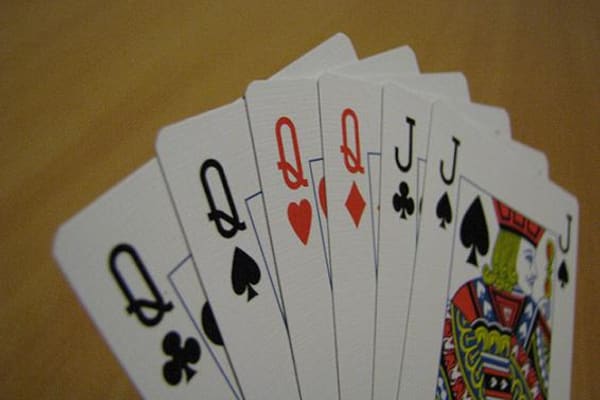
Sheepshead (Schafkopf in its original German) is the classic 5-player point-trick partnership game of Wisconsin and the upper American Midwest, and a direct descendant of 18th-century Bavarian Schafkopf. It uses a 32-card deck (7s through Aces, four suits) and features an extraordinary 14-card trump suit formed by all four Queens, all four Jacks, and all eight Diamonds in a fixed top-down order: Q♣, Q♠, Q♥, Q♦, J♣, J♠, J♥, J♦, A♦, 10♦, K♦, 9♦, 8♦, 7♦. Every Queen, every Jack, and every Diamond in the deck is a trump; the non-Diamond suits (♠, ♥, ♣) are 'fail' suits with just 6 cards each (A, 10, K, 9, 8, 7). Each player receives 6 cards; two go face-down as the blind (widow). Players in turn order may 'pick' the blind: the picker takes those two cards, buries any two cards face-down, and partners with whichever other player holds the Jack of Diamonds (J♦). The partnership is hidden; the J♦ holder does not announce themselves until play reveals them. The picker's side must take 61+ card points (out of 120 in the deck) to win; the 3 defenders together need 60+ to win. Card values: A=11, 10=10, K=4, Q=3, J=2, 9/8/7=0. It is a game of sharp trump control, hidden partner deduction, and aggressive bury-to-score management; Wisconsin clubs call it 'the Badger state's real card game'.
Quick Reference
- 5 players; 32-card deck (7-A, four suits).
- Deal 6 cards each + 2 face-down blind.
- Trump = 14 cards: all Queens, all Jacks, all Diamonds in fixed order.
- In order, pick the blind or pass; picker buries 2 cards.
- Secret partner = holder of the Jack of Diamonds (or called fail-suit Ace).
- Follow suit (or trump if trump is led); highest trump or highest led-suit card wins.
- A=11, 10=10, K=4, Q=3, J=2, 9/8/7=0.
- Picker 61-90: win 1 unit each; 91+: schneider (2x); 120: schwarz (3x).
- Defender win: each collects 1 unit; reverse bonuses for schneider/schwarz.
Players
5 players is the canonical number. 3-handed and 4-handed Sheepshead exist as separate reduced variants (see Variations) but 5-player is the game most Wisconsin players mean by 'Sheepshead'. Each player acts individually; partnerships form only after the pick (and are hidden). The first dealer is chosen by high-card draw; deal rotates clockwise after each hand.
Card Deck
A 32-card Piquet deck: remove all 2s, 3s, 4s, 5s, and 6s from a standard 52-card pack. Four suits [♠][♥][♦][♣]; ranks in each suit, high to low for fail suits: A, 10, K, 9, 8, 7 (only 6 cards per fail suit). Trump suit: 14 cards in strict order from highest to lowest: Q♣, Q♠, Q♥, Q♦, J♣, J♠, J♥, J♦, A♦, 10♦, K♦, 9♦, 8♦, 7♦. Every Queen, Jack, and Diamond in the deck is a trump card; the three 'fail' suits are Spades, Hearts, and Clubs minus their Queens, Jacks (so each fail suit has only A, 10, K, 9, 8, 7 = 6 cards; 3 × 6 = 18 fail cards plus 14 trumps = 32 total). Card point values for scoring: A = 11, 10 = 10, K = 4, Q = 3, J = 2, 9 = 0, 8 = 0, 7 = 0. Total points in the deck: 120; winning threshold 61+ for the picker's side.
Objective
As the picker (declarer) and your secret J♦-partner, take at least 61 card points in tricks. The three defenders win if they collectively take 60+ points. Bonus multipliers apply at point-totals of 91+ (schneider) and 120 (schwarz or no-tricker). The game is scored in hand payments (usually tracked in chips or cents, sometimes in points on a score sheet).
Setup and Deal
- Agree on table stakes (e.g., 1-3-5 or 2-4-8 chip payments for win/schneider/schwarz).
- Shuffle the 32-card deck thoroughly; the player to the dealer's right cuts.
- Deal 6 cards to each of the 5 players in two batches of 3 + 3, clockwise. Between the two batches, deal 2 cards face-down to the centre to form the blind (also called 'the Wisconsin blind' or 'widow'). The blind stays face-down until the pick is decided.
- Starting with the player to the dealer's left, each player in turn may pick the blind (pick up the two cards) or pass. Once a player picks, the pick phase ends.
- If all 5 players pass, the hand is resolved by a pre-agreed no-pick variant, most commonly Leaster (lowest points wins) or Doubler (stakes double and the hand is re-dealt); see Variations.
- The picker takes the 2 blind cards into hand (making 8 cards), then buries 2 cards face-down in front of them. The buried cards are not seen by anyone and are counted as part of the picker's trick-take at the end. The picker thus plays the hand with 6 cards.
- The player to the dealer's left leads the first trick.
Gameplay
- A hand consists of 6 tricks (one per card held by each non-picker and picker).
- The leader plays any one card face-up to the centre. Others follow clockwise.
- Follow suit strictly. If the led suit is a fail suit (Spades, Hearts, Clubs), you must play a fail card of that suit if you hold any. If the led card is a trump (any Queen, Jack, or Diamond), you must play a trump if you hold any; the Queens, Jacks, and Diamonds are all considered the same trump suit. Off-suit or off-trump plays are allowed only when you are void in the led suit.
- Trick resolution: If any trump is played, the highest trump (per the strict Q♣-to-7♦ order above) wins. Otherwise, the highest fail-suit card of the led suit wins. The trick winner collects all 5 cards face-down in their trick pile and leads the next trick.
- Partner reveal: The J♦ holder's identity is hidden until the J♦ is played, at which point the partnership is obvious. Some groups require the J♦ holder to sit quietly even if it is never played (it stays hidden if the J♦ is in the bury).
- Special case: J♦ in the picker's hand. If the picker themselves holds the J♦, they have no partner and play alone (still versus all four defenders). This is called a solo; stakes are typically doubled.
- Called-Ace partner (optional): In many Wisconsin groups the picker may name a fail-suit Ace as the call; whoever holds that Ace is the picker's partner. This replaces the J♦ partner rule. The picker must hold at least one card of the called Ace's suit.
Scoring
- After trick 6, each side totals the card points in its collected tricks plus (for the picker's side) the 2 buried cards. A + 10 + K + Q + J + 9/8/7 = 11 + 10 + 4 + 3 + 2 + 0 = 120 total in the deck.
- Normal win (picker's side 61-90 points): The picker's side wins 1 unit from each defender (2 units total if called-Ace partner, or the J♦ partner collects 1 unit from each defender and pays the picker 1 unit of their winnings as customary; conventions vary).
- Schneider (picker's side 91-119 points): 2 units from each defender (double the normal payment).
- Schwarz / No-tricker (picker's side takes all 6 tricks and 120 points): 3 units from each defender.
- Defender win (picker's side 31-60 points): Defenders each collect 1 unit from the picker.
- Defender schneider (picker's side 0-30 points): Defenders each collect 2 units from the picker.
- Defender schwarz (picker's side takes zero tricks and 0 points): Defenders each collect 3 units.
- Solo bonuses: If the picker plays alone, double all payments.
- Doubler round (optional, see variations): Triggered by 5 passes in some variants; payments double for the next hand.
Winning
Sheepshead is played as a session rather than to a fixed target; the session winner is the player with the highest chip or unit total at the end of the evening. Wisconsin tournament play uses a fixed number of hands (often 50 or 100) and settles by final chip count. Ties are broken by the most picks won as declarer.
Common Variations
- Called-Ace (Called-Ace Sheepshead): The picker calls a fail-suit Ace; whoever holds it is the partner. Replaces the J♦ partner rule and is the dominant form in modern Wisconsin.
- Leaster: If all 5 players pass the pick, play without a picker; whoever takes the fewest points wins the hand and collects a small unit from each other player. Some Leasters require taking at least 1 trick to win.
- Doubler (Duplicate): If all 5 players pass the pick, the hand is re-dealt and payments for the next hand double. Repeats until someone picks.
- Mystery Partner: The called-Ace partnership stays hidden until the called Ace is played.
- 3-Handed Sheepshead: 3 players; 10 cards each plus 2-card blind; picker plays alone against 2 defenders.
- 4-Handed Sheepshead: 4 players; 7 cards each plus 4-card blind; picker plays alone against 3 defenders (Jack of Diamonds partner does not apply).
- Crack (Kontra): A defender may 'crack' to double stakes before the first trick, similar to Skat's Kontra.
- Re-crack (Re-Kontra): The picker may re-crack for 4x stakes.
- Mauer (Stonewall): Both sides may silently agree to 'build a wall' of low fail cards to deny the picker points.
Tips and Strategy
- Pick only with 4+ trumps or 3 trumps plus long Diamonds. The 14-card trump suit means roughly half a random hand is trump; a picker with 5-6 trumps dominates, while 2-3 trumps is a quick loss.
- Bury your losers first. When you pick the blind, bury the two highest-point fail cards you cannot easily trump with. A buried Ace banks 11 points directly to your side; a buried 10 banks 10. Never bury trumps; you need trump length to take tricks.
- Lead trumps when you are long in trump. If you hold 6 trumps as picker, leading trumps strips both the J♦ holder (who might be long too) and defenders in one run. A picker with a 6-trump hand should take 4-5 tricks easily.
- Hide your Jack of Diamonds partnership. If you hold the J♦ as a non-picker, do not play it until forced by a trump lead. Playing it too early reveals the partnership and lets defenders coordinate against you.
- Count the trumps played. 14 trumps means you need to know how many are gone. After 4 tricks of trump play, roughly 10-12 trumps are typically out; plan your endgame accordingly.
- Fail-suit Aces are gold. 11 points each; win them with high trumps if you can, and save your single ruff (trump when void) for defender Aces.
- As a defender, lead your fail-suit Ace early. Forcing the picker to trump a fail-suit Ace uses one of their trumps and banks 11 points for the defenders if they cannot ruff.
- Call the weakest Ace in called-Ace games. Call a fail-suit Ace that you hold nothing else in. If the called-Ace holder is on your left, they must lead it immediately when trump is led; calling the 'unmastered' Ace forces the partner reveal early and lets you plan.
Glossary
- Picker (declarer): The player who takes the blind and plays as the leader of the picking side.
- Blind (widow): The 2 face-down cards dealt separately; the picker takes them into hand and buries 2 cards.
- Bury: The picker's discard of 2 cards face-down after picking; these count as trick points for the picker's side.
- Partner (J♦ partner): The holder of the Jack of Diamonds in base rules; the picker's hidden ally. In called-Ace variants, the holder of the called Ace.
- Trump: Any Queen, Jack, or Diamond; 14 cards total, ranked in a fixed order from Q♣ down to 7♦.
- Fail suit: Spades, Hearts, or Clubs minus Queens and Jacks: A, 10, K, 9, 8, 7 per suit (6 cards each).
- Schneider: 91+ points for one side; 2x stakes.
- Schwarz / No-tricker: All 6 tricks for one side; 3x stakes.
- Solo: Picker plays alone when holding the J♦; double stakes.
- Leaster: No-pick variant where the lowest-point taker wins.
- Doubler: No-pick variant where the next hand's stakes double.
- Called Ace: The fail-suit Ace named by the picker to identify the partner (called-Ace variant).
- Crack (Kontra): A defender's double-stakes declaration before the first trick.
Tips & Strategy
Pick only with 4+ trumps (or 3 trumps plus long Diamonds). Bury your highest-point fail cards (Aces and 10s) to bank them for your side. Lead trumps when you are long in trump to strip defenders. Hide your J♦ partnership until forced. Defenders should lead fail-suit Aces early to force trumps out of the picker's hand. Count the 14 trumps trick by trick.
Sheepshead is a trump-management game at its heart. The 14-card trump suit dominates, but the eight Diamond trumps (A♦ down to 7♦) are weaker than the four Queens and four Jacks and are often discarded or ruffed. Expert play revolves around burying the 21-point Aces and 10s of fail suits (easy points for the picker) and timing the reveal of the J♦ partner. Defenders read the picker's bury by the order and strength of their fail-suit discards; a picker who buries high fail cards signals a hand weak in fail suits but strong in trumps.
Trivia & Fun Facts
The American name 'Sheepshead' is a literal translation of the German 'Schafkopf' ('sheep's head'), which itself has disputed etymology: one theory holds the name came from the chalked-sheep-head scoring tally on pub walls; another holds it from the 'Kopf' (head/round) of sheep (tricks) scored. Wisconsin has more weekly Sheepshead games per capita than anywhere in the world, and Sheepshead is the only card game taught in some Wisconsin middle schools as part of regional heritage studies.
-
01In Wisconsin Sheepshead, how many cards are trump, and what is the full top-down trump order?Answer 14 cards are trump. Top to bottom: Q♣, Q♠, Q♥, Q♦, J♣, J♠, J♥, J♦, A♦, 10♦, K♦, 9♦, 8♦, 7♦. All four Queens rank above all four Jacks; the Jacks rank above the eight non-court Diamonds; every card from the Queen of Clubs down to the 7 of Diamonds is a trump regardless of the nominal suit of the cards.
History & Culture
Sheepshead is the direct American descendant of 18th-century Bavarian Schafkopf, brought to the American Midwest by German immigrants between 1840 and 1890. It took hold especially in Wisconsin and parts of Minnesota, Illinois, Missouri, and Iowa, where German-American communities made it the most-played card game of the region through the 20th century. The Milwaukee-area German-heritage press through the 1890s-1950s regularly covered Sheepshead tournaments, and the Wisconsin legislature has proclaimed it the state card game in informal resolutions. The American called-Ace variant (replacing the Jack-of-Diamonds partner rule) became dominant after World War II.
Sheepshead is the cultural card game of Wisconsin and adjacent German-American Midwest, played in taverns, VFW halls, and family kitchens for generations. The game's deep Bavarian roots make it a living link to 19th-century German immigrant culture; local Schafkopf and Sheepshead clubs operate tournaments, publish newsletters, and run instructional classes. It is one of the few American card games with a strong regional identity and organised competitive scene, comparable to Bridge clubs in social structure but distinctly blue-collar in tone.
Variations & House Rules
Called-Ace is the dominant modern Wisconsin form. Leaster handles all-pass hands by lowest-taker wins. Doubler re-deals with doubled stakes. Crack and Re-crack double and re-double stakes. 3-Handed and 4-Handed are reduced-player variants. Mystery Partner keeps the called-Ace partner hidden. Mauer is a defensive coordination tactic.
For beginners, play Jack-of-Diamonds partner only (no called-Ace); the rule is simpler and hands unfold more predictably. For experienced groups, use called-Ace with Crack/Re-crack to add doubling tension. For 3 or 4 players, use the 3-Handed or 4-Handed variants. Set the initial stakes low (pennies or single chips) for casual play; Wisconsin club stakes are often higher.


