
How to Play
Schafkopf is Bavaria's traditional four-hand trick-taking game for 32 cards in which all Obers/Queens and Unters/Jacks are permanent trumps, and the declarer either hunts a hidden partner by calling an Ace (Rufspiel) or plays alone as a Solo, Wenz, or Geier.
Schafkopf (literally 'sheep's head') is Bavaria's traditional four-hand, trick-taking game and the common ancestor of both Skat and American Sheepshead. It is played with a 32-card deck; each player receives 8 cards and tries to win at least 61 of the 120 card points available. The signature feature is that the four Queens and four Jacks (or Obers and Unters in a Bavarian deck) are always trump, sitting above the nominated trump suit. After the deal, one player declares a contract: the everyday Rufspiel (Sauspiel), in which the declarer calls a suit Ace to identify a hidden partner, or one of several Solo contracts played alone against the other three. Play is clockwise, must follow suit, and the highest trump or highest card of the led suit wins each trick.
Quick Reference
- 4 players; shuffle a 32-card Bavarian or short French deck (7 through Ace).
- Deal 8 cards each in two packets of four; no stock remains.
- Bidding clockwise from forehand: Rufspiel (Hearts trump, called-Ace partner), Farbsolo, Wenz or Geier; highest contract wins. If all pass, play Ramsch.
- Forehand leads; play proceeds clockwise. Must follow suit; Obers/Queens and Unters/Jacks count as trumps.
- Trick won by the highest trump, else the highest card of the led suit; winner leads next.
- Before card 2 of trick 2 a defender may call Kontra, the declaring side may answer Re (and so on), each call doubling the score.
- Card points: Ace 11, 10 10, King 4, Ober/Queen 3, Unter/Jack 2, others 0 (120 in deck).
- Declaring side ≥ 61 wins; losers ≤ 30 = Schneider, 0 tricks = Schwarz, each a bonus unit.
- Laufende (runs of top trumps, min 3 in Rufspiel/Farbsolo, 2 in Wenz/Geier) add one unit each.
Players
Exactly 4 players, seated around a square table. There are no fixed partnerships; in the everyday Rufspiel contract the declarer and the holder of the called Ace form a temporary, initially hidden partnership for that hand. All Solo contracts (Wenz, Farbsolo, Geier) are played one against three. Deal rotates clockwise each hand.
Card Deck
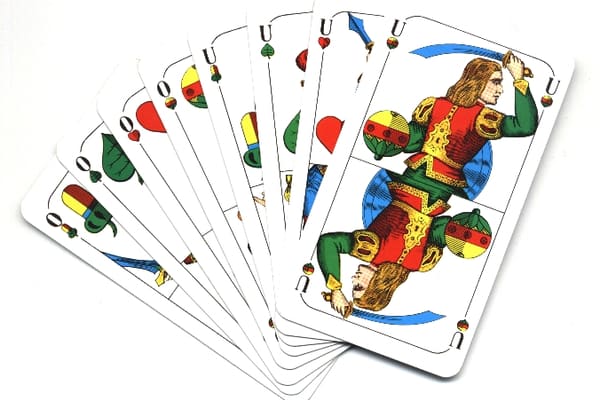
A 32-card German-suited Bavarian deck (suits: Eichel/Acorns, Gras/Leaves, Herz/Hearts, Schellen/Bells; court cards Ober and Unter rather than Queen and Jack) or a standard French 32-card deck with 2s through 6s removed, leaving 7 through Ace in each of ♠ ♥ ♦ ♣. In non-trump suits, cards rank Ace (high), 10, King, Ober/Queen, Unter/Jack, 9, 8, 7; however in every normal contract all Obers/Queens and all Unters/Jacks are promoted into the trump suit, so only six cards of each non-trump suit actually exist as side-suit cards. Point values (120 in the whole deck): Ace = 11, 10 = 10, King = 4, Ober/Queen = 3, Unter/Jack = 2, 9/8/7 = 0.
Objective
The declaring side (declarer plus called partner in Rufspiel, or the soloist alone in a Solo) must win tricks totalling at least 61 of the 120 card points. The defenders win if they capture 60 or more (they only need to tie the other side at 60 to beat the declarer, since the declarer must exceed 60).
Setup and Deal
- Shuffle the 32-card deck. The player to the dealer's right cuts.
- The dealer gives 8 cards to each player, clockwise, in two packets of four (first packet of four to each player, then the second packet of four).
- No cards remain; there is no stock or skat.
- Starting with the player to the dealer's left (forehand), each player in clockwise order may announce a contract or pass. The highest-ranking contract wins; the announcer becomes the declarer. If all four pass, the hand is thrown in or a forced Ramsch is played (see Variations).
- Contracts, in ascending rank, are: Rufspiel (a Hearts-trump partnership game, lowest and most common), then Farbsolo (chosen-suit solo), Wenz (only the four Unters/Jacks are trump), and Geier (only the four Obers/Queens are trump). Many Bavarian circles rank Solo highest; locally defined ordering may vary, but any Solo beats any Rufspiel.
Trump Structure
- Rufspiel (Sauspiel): Trump suit is Hearts. The trump suit contains all four Obers/Queens, all four Unters/Jacks, and the six Heart side cards (A, 10, K, 9, 8, 7 of Hearts), giving 14 trumps in total.
- Farbsolo: The soloist names any suit as trump. That suit's six side cards, plus all four Obers/Queens and all four Unters/Jacks, form the 14 trumps.
- Wenz: Only the four Unters/Jacks are trump (4 trumps). Obers/Queens rank normally inside their side suit, just below the Ace.
- Geier: Only the four Obers/Queens are trump (4 trumps). Unters/Jacks rank normally inside their side suit.
- Trump ranking (inside trumps): Ober/Queen of Eichel/♣ (high), Ober/Queen of Gras/♠, Ober/Queen of Herz/♥, Ober/Queen of Schellen/♦, then Unter/Jack of ♣, ♠, ♥, ♦ in the same order, then (if applicable) the Ace, 10, King, 9, 8, 7 of the nominated trump suit from high to low. Among non-trump suits, cards rank A, 10, K, 9, 8, 7 (no Obers/Queens or Unters/Jacks there, as they are all trumps).
Rufspiel: Calling the Partner
- Only Rufspiel has a called partner. The declarer chooses a non-trump suit Ace (♣, ♠ or ♦; never ♥ because Hearts is trump) that they do not hold themselves and announce, for example, 'I play on the Acorn Ace' (Eichel-Sau). Whoever holds that Ace is the declarer's silent partner for the hand, but does not reveal themselves.
- The declarer must hold at least one side-suit card of the called suit (so the partnership can actually be contacted).
- The called Ace must be played when its suit is led (the holder is obliged to supply it). The holder may not lead its suit themselves while still holding the Ace, except in the rare case of 'running away' by leading three or more cards of the called suit in a row (Davonlaufen).
- If the called Ace has not yet appeared, it must be played on the final (eighth) trick if its suit is not led first.
Gameplay
- Forehand (the player to the dealer's left) leads to the first trick by playing one card face up.
- In clockwise order, each remaining player plays one card, forming a trick of four cards.
- Must follow suit. If the led card is a trump, each player must play a trump if able; if the led card is a side suit, each player must play that suit if able (remember that Obers/Queens and Unters/Jacks are trumps, not side suit cards, in standard contracts). A player with neither may play any card.
- The trick is won by the highest trump played, or (if no trumps are played) by the highest card of the suit led. The winner gathers the four cards face down and leads to the next trick.
- Play continues until all 8 tricks are played and all 32 cards captured. Each side then counts the point values of cards in their won tricks.
Doubling (Kontra / Re)
- Before the first card of the second trick is played, any defender may announce Kontra, doubling the game value.
- The declaring side may then answer Re, doubling it again.
- Further announcements ('Supra', 'Hirsch') may redouble a third and fourth time in some local rules, but the basic game uses only Kontra and Re.
Scoring
- Win condition: Declaring side with ≥ 61 points wins the hand; with ≤ 60 points they lose.
- Schneider: If the losing side takes 30 or fewer points, they are 'Schneider' and the winners score a bonus unit.
- Schwarz: If the losing side takes zero tricks at all, they are 'Schwarz' and the winners score a further bonus unit.
- Laufende (runners): Consecutive highest trumps held by the winning side in the correct ranking order, starting from the Ober/Queen of Eichel/♣. In Rufspiel and Farbsolo the minimum payable runners is 3; in Wenz and Geier it is 2. Each runner adds one unit.
- Base values (typical Bavarian tariff): Rufspiel = 1 unit, Farbsolo / Wenz / Geier = 2 units (sometimes 3). The total unit value is the sum of the base, Schneider (if any), Schwarz (if any), runners (if any), each then doubled if Kontra was played, doubled again if Re, doubled a third time if any further call was agreed.
- Payments: Each defender pays the declarer the computed units (and the silent partner matches their share) in Rufspiel, so the declarer and partner each win or lose the computed amount from each opposing player. In a Solo, the soloist wins from or pays each opponent individually.
Winning
- A single hand is won by reaching the point threshold stated above.
- A session is typically played for an agreed number of deals (often 16, 24, or 'until everyone has dealt the same number of times'); the player with the largest positive unit balance is the session winner.
- There is no in-hand tie possible because the declarer needs strictly more than 60, so a 60-60 split is a defenders' win.
Common Variations
- Tout: An announced Tout (in Solo or Wenz) claims that the declarer will win every trick; lost if even one trick goes to the defenders, won at quadruple the base. Sometimes called 'Durchmarsch'.
- Sie: The rarest call; the declarer is dealt all four Obers/Queens and all four Unters/Jacks, announces Sie, and collects quadruple the basic game without play.
- Ramsch: Played when all four players pass. Everyone plays alone for themselves, and the player who ends up with the most card points loses a fixed amount. Used as a consolation contract.
- Kurze Karte (Short Schafkopf): Uses a 24-card pack (7s and 8s removed); each player is dealt 6 cards. Faster, with a denser trump distribution.
- Three-handed Schafkopf: A 24-card variant with a three-player table, admitting only Solo-style contracts.
Tips and Strategy
- In Rufspiel the first few tricks are about finding your partner. Leading the called suit is the standard 'hello' from the declarer, forcing the Ace out and revealing the partner.
- Count the trump cards as they appear. With 14 trumps in Rufspiel/Farbsolo, whoever outlasts the table in long trumps usually wins the last three tricks and most of the points.
- Think in point values, not trick counts. A 2-trick pile that includes both Aces and the 10 of trumps can easily hold 40+ points, while a 4-trick pile full of 9s and 8s may be worthless.
- Obers/Queens and Unters/Jacks are never usable as side-suit cards; never 'save' them for a long suit, they are trumps and nothing else.
- As defender, think about Schneider: even if you cannot prevent the declarer from reaching 61, denying them Schneider (holding them below 91) saves a unit.
- Kontra is information as well as money. Only call Kontra when you are fairly sure the declaring side is below 61; a bad Kontra doubles your losses.
Glossary
- Ober / Unter: Bavarian-pack equivalents of Queen and Jack; always trump in standard Schafkopf contracts.
- Trump: A privileged card that beats any card of another suit. In Schafkopf the trump 'suit' is the union of all Obers/Queens, all Unters/Jacks, and the six side cards of the nominated trump suit.
- Rufspiel / Sauspiel: The standard partnership contract with Hearts trump; the declarer calls a suit Ace to name a hidden partner.
- Sau: 'Sow', Bavarian nickname for the Ace (used in 'I call the Eichel-Sau', the Acorn Ace).
- Called Ace (Rufsau): The non-trump Ace named by the declarer; its holder is the partner.
- Solo: Any contract in which one player plays alone against the other three.
- Wenz: A Solo in which only the four Unters/Jacks are trump.
- Geier: A Solo in which only the four Obers/Queens are trump.
- Schneider / Schwarz: Bonus conditions for winning side (≤ 30 points / zero tricks for losers).
- Laufende (runners): A run of top trumps held by the winning side, starting with Ober of Eichel/♣.
- Kontra / Re: Doubling and redoubling calls by defenders and declarers before the second card of trick 2.
- Forehand: The player to the dealer's left; leads the first trick.
- Ramsch: Consolation contract played when all four pass; the player with most points loses.
Tips & Strategy
The signature skill is counting trumps (there are 14 in a standard game) and keeping track of where the top Obers and Unters still are. In Rufspiel, leading the called suit early forces the partner into the open and sets up a coordinated mid-game; in a Solo, conserve your highest trumps for the last three tricks where the ten- and eleven-point cards tend to fall.
Rufspiel is an information game: the declarer must reveal the partner eventually, and the defenders must deduce who holds the called Ace before it is played. Watching which player avoids the called suit, who discards high trumps, and who dumps point-carrying Tens tells you almost everything about the hidden partnership.
Trivia & Fun Facts
Bavarian tradition says the game's name refers not to sheep at all but to the chalked tally marks once used to keep score on the wooden table, which resembled a sheep's head when fully filled in. Regional Schafkopf tournaments draw thousands of players and are televised by Bayerischer Rundfunk.
-
01In standard Bavarian Schafkopf, which cards are always trump regardless of the contract?Answer All four Obers/Queens and all four Unters/Jacks, in the ranking Eichel/Clubs, Gras/Spades, Herz/Hearts, Schellen/Diamonds.
History & Culture
Schafkopf has been documented in Bavaria since the late 18th century and is the acknowledged ancestor of Skat (via the 19th-century reformers in Altenburg) and of American Sheepshead (carried to Wisconsin by German immigrants). The Bavarian Ministry of Culture lists Schafkopf among the state's intangible cultural assets.
Schafkopf is inseparable from Bavarian identity. It is played in virtually every village Gasthaus and Biergarten, taught in many Bavarian schools as part of regional heritage classes, and defended fiercely as the 'real' traditional game by players who view Skat as a northern usurper.
Variations & House Rules
The main named contracts beyond basic Rufspiel are Farbsolo (chosen-suit solo), Wenz (Unters/Jacks-only trump) and Geier (Obers/Queens-only trump). High-risk calls include Tout (winning every trick) and Sie (all eight top trumps dealt to one player, an automatic quadruple-value win). If all four players pass a deal, many circles switch to Ramsch, where the player with the most points loses.
Newcomers should begin with Rufspiel only and add Wenz after a few sessions. Playing with an exposed dummy hand for the first few rounds helps new players see which cards are trump. A shorter 24-card pack (7s and 8s removed) speeds the game up and reduces the amount of counting needed.


