
How to Play
Swabia's iconic partnership card game: a 48-card double deck, a bidding auction for a trump contract, an elaborate meld-declaration phase, and 10 or 15 trick-taking rounds played to a 500 or 1000 point match target.
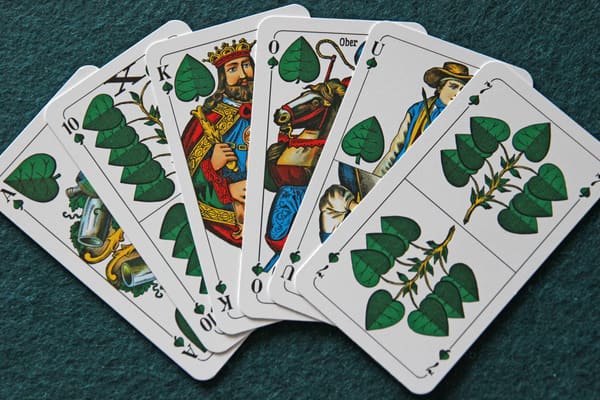
Binokel (Swabian: Benoggl) is the signature card game of Württemberg and Swabia in southwestern Germany, a close cousin of French Bézique and American Pinochle. It is played with a 48-card double deck containing two copies each of Ace, 10, King, Ober (Queen), Unter (Jack), and 7 in each of four suits. It combines two distinct phases: a melding phase where players score points for specific card combinations held in hand (pairs, families, four-of-a-kind, and the namesake Binokel of Ober of Leaves with Unter of Bells), and a trick-taking phase where players capture high-value cards on tricks. The bidder who wins the auction picks up the 3-card Dapp (talon), declares a trump suit, and tries to reach the bid total through melds plus captured trick points. Trick-play uses the Eichel-heavy German card ranking with Aces on top at 11 points, Tens second at 10 points, then Kings, Obers, Unters at 4, 3, 2 points respectively; the winner of the last trick adds 10 points for a round total of 240 points. Reaching a score of 1000 (three-player) or 500 (four-player) in cumulative rounds wins the match.
Quick Reference
- Use a 48-card double deck: two copies each of A, 10, K, Ober, Unter, 7 in four suits.
- Deal 15 cards (3-player, 3-card Dapp) or 10 cards (4-player partnership, 8-card Dapp).
- Auction starts at 150 and rises in 10s; highest bidder picks up the Dapp and names trump.
- Declare melds face-up (Family 100/150, four-of-a-kind 40-100, Binokel 40, pairs 20/40).
- Play tricks: must follow suit, must trump if void, must overtake if able.
- Winner of last trick gains 10 points.
- Card points: A=11, 10=10, K=4, Ober=3, Unter=2; 240 per deck plus 10 for last trick.
- Declarer succeeds if melds + trick points >= bid; else loses double the bid.
- First to 1000 (3-player) or 500 (4-player) wins the match.
Players
Three players each for themselves, or four players in fixed partnerships (partners sit opposite). Three-player Binokel is the traditional form; four-player Cross Binokel is the most popular in modern Swabia. Deal rotates anticlockwise. The dealer deals last and speaks last in the auction.
Card Deck
A 48-card double deck. Two copies each of the following ranks in each of the four suits: Ace, 10, King, Ober (Queen), Unter (Jack), 7. German-suited packs use Acorns (Eichel), Leaves (Grün/Laub), Hearts (Herz), and Bells (Schellen); French-suited packs use Clubs, Spades, Hearts, Diamonds. Rank order for trick-taking and card points (high to low): Ace (11 points), 10 (10), King (4), Ober/Queen (3), Unter/Jack (2), 7 (0). The 7 of trumps carries its own name, the Dix or Diss, and is worth 10 points as a meld when exchanged or played.
Objective
Win the auction by bidding the highest total you can make from melds plus tricks; then declare a trump, pick up the Dapp, set aside any discards, declare your melds, and play out 15 tricks (3-player) or 10 tricks (4-player) to reach or exceed your bid. Defenders (the non-declarers) aim to score enough trick points to deny the bidder their contract and to accumulate their own meld points. First to reach the match target wins.
Setup and Deal
- Shuffle the 48-card pack. Deal anticlockwise in packets.
- 3-player deal: 15 cards to each player, dealt in packets of 4-4-3-4 or 5-5-5, with 3 cards placed face-down as the Dapp after the first round of dealing.
- 4-player deal: 10 cards to each player in packets of 4-3-3, with 8 cards forming the Dapp (split as 4+4 or 4 face-down); or 12-card hands with a 0-card Dapp in Cross Binokel variants. The 10-card / 8-card Dapp format is the modern standard.
- Nobody touches the Dapp during the auction. Players sort their hands by suit and mentally value their melds before bidding.
Bidding (Auction)
- Starting with the player to the dealer's right, each player may pass or bid a minimum meld-plus-trick total starting at 150 and rising in multiples of 10.
- Once you pass you are out of the auction. The auction ends when two consecutive passes occur.
- The highest bidder wins the contract, turns the Dapp face-up for all to see, and takes it into their hand.
- The declarer then discards any number of cards equal to the size of the Dapp back to the table face-down; those discards count as tricks captured by the declarer at the end of play (their card points count toward the declarer's total).
- The declarer now names the trump suit by showing the Diss (7 of trumps) or by declaring verbally.
- If no one bids above the minimum and everyone passes, some house rules force the dealer to take the contract at 150 (Zwangsspiel, 'forced game') or redeal.
Meld Declaration
- After the discard, every player places their melds face-up on the table in front of them for scoring; only after scoring do the melds return to hand for play.
- Family (Familie): A-10-K-Ober-Unter of the same suit. 100 points in non-trump; 150 points in trump.
- Four of a kind (Rundfier): Four Aces = 100; four Kings = 80; four Obers = 60; four Unters = 40. Must be one of each suit (not duplicates of a single card).
- Binokel: Ober of Leaves/Spades + Unter of Bells/Diamonds = 40 points. Two Obers and two Unters (double Binokel) = 300 points.
- Pair (Paar): King + Ober of the same suit = 20 points in non-trump; 40 points in trump.
- Diss (7 of trumps): 10 points if declared. The lower Diss exchanges with the turned trump card in some variants.
- A card used in one meld may also be used in another meld of a different type (e.g. a King of trumps can count both in a trump Family and in a trump Pair), provided both melds are actually shown; this is called cumulative melding.
- After meld scoring, players gather melds back into hand. The declarer's trick phase begins.
Trick-Taking Phase
- The declarer leads the first trick.
- Must follow suit. If unable, must trump. If unable to follow suit and out of trumps, play any card.
- Must overtake if possible. If you follow suit or trump, you must play a card higher than any already played to the trick, if you hold one.
- Highest trump wins the trick; otherwise highest card of the suit led wins. When two cards of identical rank are played, the first one played wins (this matters because the double deck means two Aces of trumps may both appear in the same trick).
- Play continues anticlockwise. The winner of each trick leads the next.
- Play all 15 tricks (3-player) or 10 tricks (4-player). Count captured card points plus a 10-point bonus to the winner of the last trick.
Scoring
- Card point totals per deck: Aces 11×8 = 88, Tens 10×8 = 80, Kings 4×8 = 32, Obers 3×8 = 24, Unters 2×8 = 16. Total = 240 points; last trick adds 10, so 250 points are available from tricks each deal.
- Declarer succeeds if melds + captured trick points >= the bid. The declarer scores the total they actually made.
- Declarer fails: loses double the bid as a negative round score; defenders score their own melds plus a standard 30-point bonus (in some Swabian rules).
- Defenders (non-declarers): always score their own melds plus the card points they capture in tricks, regardless of whether the declarer made the contract. In partnerships, the defending team's scores combine.
- Round totals are rounded to the nearest 10 (rounding halves up) and added to the running match score. First to 1000 points (3-player) or 500 points (4-player) wins the match.
Winning
The match ends when any player or partnership reaches the match target (traditionally 1000 in 3-player Binokel, 500 in 4-player Cross Binokel). If several players pass the target in the same deal, the one with the highest total wins. A complete Binokel match typically runs 30-60 minutes and involves 6 to 12 deals depending on how often the bidder makes the contract.
Common Variations
- Kreuz-Binokel (Cross Binokel): 4-player partnership version with partners sitting opposite; the most popular modern form in Swabia. Match target 500.
- Gaigel: A shorter two-player cousin also played in Swabia with a 48-card pack (or 40) and similar card ranking but no Dapp.
- Sechser-Binokel (6-player): Two teams of three on each side, double deck shared. Rare outside dedicated clubs.
- Bettel/Durchmarsch announcements: Some houses add a 'Bettel' (declarer takes no tricks) and 'Durchmarsch' (declarer takes all tricks) for bonus scoring.
- 40-card stripped deck: Some localities play Binokel with a 40-card deck (2 copies of A, 10, K, Ober, Unter) instead of 48; scoring adjusts proportionally.
Tips and Strategy
- Evaluate conservatively before bidding: A hand with one Family, one Four-of-a-Kind Aces, and a Binokel guarantees 240 meld points. Combine with an estimate of trick points (never bid more than 60% of 250 from tricks unless you have at least two aces of trumps).
- Keep Binokel cards late: The Ober of Leaves and Unter of Bells are low in trick value; holding them into the late game to capture as a pair pays 40 meld points and disguises your strategy.
- Lead trumps early as declarer: Exhaust opponents' trump holdings before leading your Aces and 10s. Trump management is the single most important tactical decision.
- Defender's goal: 60 trick points: If defenders collect 60+ card points in tricks against a 150 contract, the declarer likely fails by 30-plus. Coordinate to let the partner with more trumps capture.
- Do not overbid for the Dapp: The Dapp sometimes adds big melds but often gives you little. Bid based on your hand; treat Dapp finds as upside.
Glossary
- Dapp: The 3- or 8-card face-down talon picked up by the highest bidder. Sometimes spelled Tapp.
- Ober: The Queen equivalent in German-suited Binokel; ranks between King and Unter.
- Unter: The Jack equivalent; ranks between Ober and 10.
- Diss / Dix: The 7 of trumps. Worth 10 melded; in some rules can be exchanged with the turned trump card.
- Family (Familie): The A-10-K-Ober-Unter sequence in one suit; 100 melded (150 in trumps).
- Binokel: The Ober of Leaves + Unter of Bells meld worth 40 points; namesake of the game.
- Rundfier: Four of a kind, one from each suit.
- Zwangsspiel: Forced game, where a player (often the dealer) must take a 150-point contract rather than pass out the deal.
- Anticlockwise: Direction of dealing and play in Binokel.
Tips & Strategy
Learn the standard meld values so you can valuate a hand within a few seconds. Bid only what your visible melds and a realistic trick estimate support, and do not chase the Dapp: treat its gifts as upside, not the basis of a bid. As declarer, lead trumps early to strip opponents before running your Aces.
Picking up the Dapp is the pivotal moment. Top players evaluate whether the Dapp cards strengthen an existing Family or Binokel before deciding which hand cards to bury; they also weigh whether the trump declared gives their Aces protection from being trumped. The best Binokel players play tricks with a running count of both sides' card points.
Trivia & Fun Facts
The namesake 40-point Binokel meld is the Ober of Leaves + Unter of Bells, a pairing some say represents a mismatched courtly couple; doubled in both copies, it becomes a 300-point Doppelbinokel, one of the rarest and most game-swinging melds in any card game.
-
01Which two specific cards make up the Binokel meld that gives the game its name?Answer The Ober of Leaves (Queen of Spades in French-suited decks) paired with the Unter of Bells (Jack of Diamonds), worth 40 points melded.
History & Culture
Binokel developed in Württemberg during the 19th century and is closely related to French Bézique and American Pinochle (which Germans of Swabian descent may have carried to the United States). It remains the most played social card game in Baden-Württemberg and southern Bavaria and is the subject of dedicated Binokel-Stammtisch (regulars' table) gatherings in Swabian villages and towns.
Binokel is a cornerstone of Swabian regional identity. Villages host Binokel tournaments at their Kirchweih festivals, Swabian cultural clubs abroad use the game as a social anchor, and countless local Vereine (associations) organise weekly Binokel-Abende. The game sits alongside Spätzle and the Schwäbische Alb as emblems of Swabian life.
Variations & House Rules
Cross Binokel (4-player partnerships) dominates modern Swabia. Traditional 3-player Binokel plays for oneself. Gaigel is a shorter 2-player cousin. 40-card stripped variants use reduced decks. Some rules add Bettel (no tricks) and Durchmarsch (all tricks) bonus announcements.
Beginners should play open-meld rounds where all melds are shown face-up throughout the deal to practice valuation. Set the match target to 300 points for a short introductory game, or the classic 500/1000 for a full session.


