
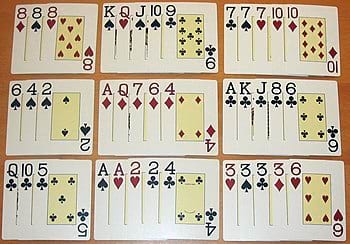
How to Play
The Philippines' most popular climbing card game, a Big Two derivative: four players race to empty a 13-card hand by playing singles, pairs, triples, and five-card poker hands that each beat the previous play.
Pusoy Dos (Tagalog: 'poker two') is the Philippines' most popular climbing card game, adapted from Chinese Big Two (Dai Di). Four players receive 13 cards each from a full 52-card deck and race to be the first to empty their hand by playing singles, pairs, triples, or five-card poker-style combinations that each beat the previous play of the same type. The weakest card is the 3 of Clubs; the strongest is the 2 of Hearts. The first play of every round must include the 3 of Clubs (the lowest card in the deck). When a player cannot or will not beat the current play, they pass. When all other players pass, the last player to play regains the lead and may play any new combination. The game rewards hand planning, timing, and reading opponents' remaining-card counts. A standard Pusoy Dos session is played as a series of rounds for money or tokens, with the round winner collecting per-card penalties from each loser; extra multipliers apply when a loser is left with many cards (called 'chicken' or 'double-loss').
Quick Reference
- 4 players, standard 52-card deck, deal 13 each anticlockwise.
- Rank low to high: 3, 4, ..., A, 2. Suit order (Philippine): Clubs < Spades < Hearts < Diamonds.
- Player with 3♣ leads first; their first play must include 3♣.
- Play a single, pair, triple, or five-card poker hand.
- Followers must play a higher combination of the same type, or pass.
- When all others pass, last player leads any new combination.
- First out wins. Losers penalised 1 point per card left.
- 10-12 cards left: doubled penalty; 13 cards left: tripled penalty.
- Extra -1 for holding the 2 of Diamonds at round's end.
Players
Exactly four players, each playing for themselves. No partnerships. Seat order does not matter for the rules, but play always proceeds anticlockwise. A short four-player Pusoy Dos game takes 10-15 minutes; a full match for money runs as many rounds as the players agree on.
Card Deck
A standard 52-card deck; no Jokers. Card ranking low-to-high: 3, 4, 5, 6, 7, 8, 9, 10, J, Q, K, A, 2. Within any rank the suit order low-to-high is Clubs, Spades, Hearts, Diamonds in the most common Philippine rules. (The international Big Two order of Diamonds < Clubs < Hearts < Spades is occasionally used; confirm before starting.) The absolute lowest card is therefore the 3 of Clubs and the absolute highest is the 2 of Diamonds , with the 2 of Hearts and 2 of Spades below it in most Philippine houses.
Objective
Be the first of the four players to play every card in your hand. Remaining players score negative (penalty) points based on cards left in hand; repeat for the agreed number of rounds, and the player with the highest cumulative score (or fewest losses) wins the match.
Setup and Deal
- Shuffle the 52-card deck and deal all 52 cards anticlockwise, one at a time, starting to the dealer's right. Each player ends with 13 cards.
- First hand of the match: The player holding the 3 of Clubs leads the first trick, and their first play must include the 3 of Clubs (either as a single card, or as part of a valid pair/triple/poker hand).
- Subsequent hands: The winner of the previous round leads first, and may play any legal combination without the 3-of-Clubs constraint.
- Each player arranges their 13 cards in hand, ideally grouping planned combinations into a play order.
Legal Plays
- Single: Any one card. Beaten by a higher single; rank then suit.
- Pair: Two cards of the same rank. Beaten by a higher pair; rank first, then the higher of the two suits.
- Triple (three-of-a-kind): Three cards of the same rank. Beaten by a higher triple.
- Five-card poker hand: One of the following combinations, ranked low to high: - Straight: Five cards in rank sequence (any suits). Beaten by a higher straight; tie broken by the top-card rank, then top-card suit. - Flush: Five cards of the same suit (not in sequence). Beaten by a higher-suit flush, then by highest card. - Full House: Three of a kind plus a pair. Beaten by a higher triple rank. - Four of a Kind + kicker: Four cards of the same rank plus any fifth card. Beaten by a higher four-of-a-kind. - Straight Flush: Five cards of the same suit in rank sequence. Beaten by a higher straight flush. - Royal Flush (A-K-Q-J-10 suited): Highest straight flush; not beatable by any other five-card hand.
- Combination categories do not mix: A pair can only be beaten by a higher pair; a straight can only be beaten by a higher straight (not by a flush or full house), etc. If someone leads a pair, every follower must play a higher pair or pass.
- Special hands: Some house rules treat the lowest straight (3-4-5-6-7) as beating any non-flush straight; confirm before starting.
Gameplay
- The leader plays any legal combination (subject to the 3♣ rule on the very first trick of the match).
- In anticlockwise order, each other player may either play a higher combination of the same type or pass.
- A player who passes is out of this round of play until a new lead begins.
- New lead trigger: When every other player passes in turn, the last player to play regains the lead. They collect the played pile (discard to one side) and may lead any new legal combination.
- Play continues until one player empties their hand.
- Forbidden final play (optional house rule): Many houses forbid ending the game on a single 2 led from an empty lead (because it is too easy); the winning card must instead form a combination or be led from a trick won on merit. Clarify before play.
Scoring
- The player who empties their hand wins the round.
- Each other player scores -1 point per card remaining in hand (or -1 chip per card if playing for tokens).
- Penalty multipliers: - 8 or 9 cards remaining: losses stay at face value (some houses start the multiplier earlier). - 10-12 cards remaining: penalty doubled (often called 'sunog' or 'burned'). - All 13 cards remaining (the loser never played a card): penalty tripled ('hindi nakatira' or 'shutout').
- Special extra penalties: - Holding the 2 of Diamonds (the highest card) at round's end: extra -1. - Holding all four 2s at round's end: extra -4 (nobody ever caught the high pair).
- The winner collects the total of all opponents' penalties; losers pay this into the winner's stack.
- Match end: after an agreed number of rounds or when a player reaches a lost-chip limit, the highest cumulative score wins.
Winning
A single round is won by the first player to empty their hand. A match is won by the player with the highest cumulative score (or least money lost) after the agreed number of rounds, usually 5, 10, or 20. In casino-style digital play (such as Tongits-Go's Pusoy Dos tables), play continues until a player's chip pile is exhausted or a leaderboard cut-off is reached.
Common Variations
- Big Two international rules: Suit order Diamonds < Clubs < Hearts < Spades (opposite to Philippine), and the first play must include the 3 of Diamonds. The game is otherwise identical.
- No five-card hands (casual): Drop all five-card combinations and play only singles, pairs, and triples. Much faster and often used for teaching.
- Revolution: When someone plays a four-of-a-kind, the rank order inverts for that round (2 becomes lowest). Resets at the next new round.
- Pusoy Dos for money: Each point equals an agreed peso amount; losers settle with the winner immediately, then the deal rotates.
- Team variant (2v2): Partners sit opposite and combine scores. The first partner out wins for the team; the other partner's remaining cards still count for the opponents.
Tips and Strategy
- Plan your hand at the start: Before the first play, sort your cards into combinations. Identify your strongest lead combination, your endgame shedding plan, and any 'dead' cards you need to dump early.
- Control the lead: Winning the lead lets you dictate the combination type. Lead combinations your opponents are unlikely to match (e.g. a pair of 9s if you've seen none of the other 9s played).
- Save 2s for last: A 2 is unbeatable as a single. Hold your 2s for the final play of the match, especially the 2 of Diamonds.
- Count the key cards: Keep a mental list of where the four 2s, the four Aces, and any bomb-pair ranks (four of a kind) sit. If all four 2s are out, a pair of Aces is the new unbeatable pair.
- Read the deals: If an opponent is down to 3-4 cards and keeps passing small pairs, they are likely holding a bomb or a five-card hand; play to force them into leading (pass everything) so the bomb gets wasted on small combinations.
- Bomb timing: A four-of-a-kind can be played at any time (some rules allow it to interrupt any combination, including pairs and straights). Save your bomb for a moment when it swings the lead decisively.
Glossary
- Bomb: A four-of-a-kind with kicker, one of the highest-value combinations; beats any other combination in some house rules.
- Lead: The first play in a trick; the leader chooses the combination type.
- Pass: Decline to play this trick; you are locked out until a new lead begins.
- New lead / 'bagong pasok': A fresh lead when all other players have passed; the last player to play leads any new combination.
- Shutout: A loss where the player never played a card (13 cards remaining), triggering the triple-penalty multiplier.
- Revolution: House rule inversion of rank order when a four-of-a-kind is played.
- Anticlockwise: The standard Philippine direction of play.
- Tres de Clubs (3♣): The lowest card in the deck. Opens the first trick of the match.
Tips & Strategy
Plan your entire 13-card hand into combinations before playing. Save 2s as final unbeatable singles, especially the 2 of Diamonds. Count the high cards (four 2s, four Aces) and use the lead to dictate combination types that opponents cannot beat.
Hand planning at the deal is everything. Top players mentally allocate their 13 cards into a sequence: opening tricks that win cheaply, middle tricks that shed bulk, and a closing combination that cannot be beaten. Bomb timing (when to play four-of-a-kind) and lead-control are the two skill levers that separate winners from losers.
Trivia & Fun Facts
'Pusoy Dos' literally means 'poker two' in Tagalog, referring to the poker-hand combinations and the supremacy of the 2. Despite the shared name 'Pusoy', classic Pusoy (without the 'Dos') is actually Chinese Poker, a completely different 13-card arrangement game; confusing the two is a common beginners' mistake in Manila gaming circles.
-
01In Philippine Pusoy Dos, which single card is the most powerful, and which card must be included in the first play of a new match?Answer The 2 of Diamonds [2♦] is the highest single card, and the first play must include the 3 of Clubs [3♣], the deck's lowest card.
History & Culture
Pusoy Dos is the Philippine adaptation of Chinese Big Two (Dai Di, from Guangdong in the mid-20th century). It spread through the Philippines in the late 1970s and 1980s and became one of the country's most played card games; the digital adaptation Tongits-Go has driven new growth since the 2010s.
Pusoy Dos is a pillar of Filipino card game culture, played at family gatherings, wakes, school breaks, neighbourhood sari-sari stores, and online on Tongits-Go. It is one of the first competitive games Filipino children learn and remains a rite of passage into adult social gambling in most Philippine communities.
Variations & House Rules
Big Two international rules use Diamonds/Clubs/Hearts/Spades suit order and open on 3♦. Casual no-five-card-hands variants drop poker combinations. Revolution rules invert rank order when a bomb is played. Partnership 2v2 combines opposing players' scores. Tongits-Go implements the standard Philippine rules online.
For 3 players, remove one suit (usually diamonds) so 39 cards deal 13 each. For fast beginner games, disallow five-card hands. For money play, fix a peso value per card penalty and settle after each round. Revolution and bomb-any rules add excitement for experienced groups.


