
How to Play
Bid Whist is a 4-player partnership trick-taking game that became a cornerstone of African-American social card playing in the 20th century. A 54-card deck (52 + 2 jokers) is dealt with a 6-card kitty; partnerships bid for the right to name trump, choosing between uptown (Ace high), downtown (Ace still high but 2-3-4... K low), or no-trump.
Bid Whist is a partnership trick-taking game that became a cornerstone of African-American social card playing in the 20th century. Four players in two fixed partnerships use a 54-card deck (standard 52 plus two jokers) to bid for the right to name trump and take at least a declared number of tricks over six. A unique feature of Bid Whist is the uptown / downtown direction choice: the bid winner may declare that high cards win (uptown, Ace high) or that low cards win (downtown, Ace low). A match to 7 points lasts roughly 30 to 45 minutes.
Quick Reference
- 4 players in fixed partnerships; shuffle 54 cards (52 + 2 jokers) and deal 12 each with a 6-card kitty.
- Bidding clockwise from eldest, each player bids 3 to 7 books with uptown, downtown, or no-trump (no-trump beats suit at equal book count).
- The winning bidder picks up the kitty, discards 6 cards face-down as the team's first trick, and names the trump suit (or no-trump).
- Bidder leads the first trick; play clockwise and follow suit if able.
- Uptown: Ace high; Downtown: Ace high but 2, 3, ..., K low (suit order inverts).
- In suit rounds: jokers are the two highest trumps (Big above Little). In no-trump: jokers are worthless.
- Highest trump (or highest led-suit card if no trump) wins the trick.
- Make the bid: +1 point per book captured. Set bid: -bid points.
- No-trump: commonly double in both directions. Boston (all 13 tricks): instant-win variant in many houses.
Players
Exactly 4 players in two fixed partnerships. Partners sit across from each other and share a score. The first dealer is chosen by cutting the deck (low card deals); the deal rotates clockwise each hand. Three- and five-player cut-throat variants exist and are described under Variations.
Card Deck
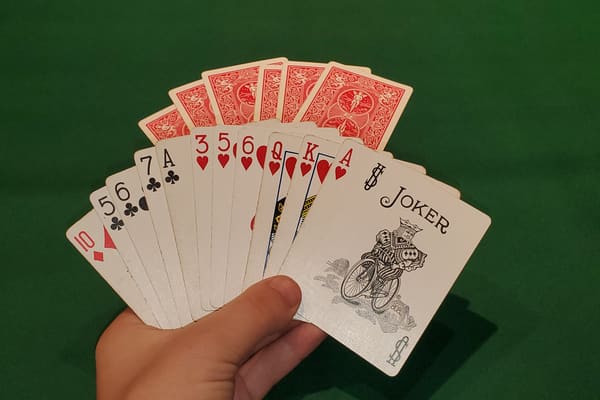
54 cards: a standard 52-card deck plus two jokers (a Big Joker and a Little Joker; if the jokers are not visibly different, mark them so everyone agrees which is which). In suit rounds (uptown and downtown), jokers act as the two highest trumps; in no-trump rounds, jokers are worthless and cannot win a trick. Card ordering in trump depends on the direction: uptown suit ranking from high to low is Big Joker, Little Joker, Ace, King, Queen, Jack, 10, 9, 8, 7, 6, 5, 4, 3, 2; downtown ranking from high to low is Big Joker, Little Joker, Ace, 2, 3, 4, 5, 6, 7, 8, 9, 10, Jack, Queen, King. Non-trump side suits follow the same direction but contain no jokers.
Objective
The bidding team tries to win at least the number of books (tricks above six) they bid. Each hand contains 13 tricks; six of them are 'free' for the bidding team, and only tricks above six count toward the bid. The first team to reach 7 points wins the match; a team that drops to minus 7 loses the match.
Setup and Deal
- Shuffle the 54-card deck thoroughly; offer a cut to the player on the dealer's right.
- Deal the whole deck counter-clockwise in batches (commonly three at a time, then four, then three, then two: 3-3-3-3 to each player plus a 4-card kitty, or 4-4-4 plus a 6-card kitty with two jokers; houses vary). The most common layout is 12 cards per player plus a 6-card kitty face-down on the table.
- Kitty: A 6-card pile dealt face-down during the deal and reserved for the winning bidder. Some houses 'sport' the kitty by flipping it face-up so all players see it before bidding; most play it face-down until the bid is won.
- Misdeal: A void deal if any player has the wrong number of cards, or if a card is exposed during the deal; same dealer re-deals.
Bidding
- Bid format: Each bid specifies two things: a number of books (tricks above six, minimum 3 and maximum 7) and a direction (uptown, downtown, or no-trump). Bids are announced out loud once, starting with the player to the dealer's left and proceeding clockwise; the dealer bids last.
- Beating a bid: A later bid must be higher than all previous bids. A higher number beats a lower number. At the same number, no-trump beats uptown and downtown in the most common ruling (no-trump is harder so it is ranked highest at the same book count).
- Passing: A player may pass. A player who passes cannot bid again for that hand.
- Minimum three: The lowest legal bid is 3 books (winning 9 of 13 tricks).
- No bid at all: If every player passes, the cards are thrown in and the next dealer deals a fresh hand; alternatively, the dealer is sometimes forced to take a minimum bid.
- Winner takes the kitty: The highest bidder's team becomes the bidding team. The winning bidder picks up the 6-card kitty, adds it to their 12-card hand (now 18 cards), and discards exactly 6 cards face-down from the combined hand. The 6 discarded cards count as the bidding team's first trick.
- Declaring direction: The bidder announces uptown, downtown, or no-trump and, if uptown or downtown, also names the trump suit. All players are now informed of the direction and, if applicable, the trump suit.
Gameplay
- Leading the first trick: The highest bidder leads any card to the first trick after naming trump and direction.
- Trick structure: Play proceeds clockwise. Each player in turn plays one card face-up to the centre. Players must follow suit if they hold any card of the led suit; if void, they may play any card (trump, another side suit, or, in suit rounds only, a joker).
- Winning a trick: In suit rounds (uptown or downtown), the highest trump card played wins the trick; if no trump is played, the highest card of the led suit by the current direction wins. In no-trump rounds, there is no trump suit; the highest card of the led suit by the chosen direction wins and jokers always lose (they are worthless).
- Leading jokers: In suit rounds, a led joker functions as the highest card of the trump suit. In downtown, the leader of a joker names which suit was 'led' if there is ambiguity, but as the highest trump the joker simply wins if no higher joker is played.
- Reneging (revoking): Failing to follow suit when able is a renege. The penalty is three tricks transferred to the opposing team, provided the non-offending team identifies the specific trick in which the renege occurred. If the trick cannot be identified, no penalty is imposed.
- End of hand: All 13 tricks are played; the bidding team counts the tricks it captured.
Scoring
- Books above six: Only tricks won beyond six count. A team that took 9 of the 13 tricks took '3 books'.
- Bid made (bidding team took at least the bid): The bidding team scores 1 point per book taken. A successful bid of 4 that captures 4 books scores 4. Overtakes (captures above the bid) count the same points, no bonus.
- Bid set (bidding team fell short): The bidding team loses points equal to their bid. A set 4-bid scores the bidding team minus 4; their opponents score nothing.
- Non-bidding team: In the standard scoring, the non-bidding team scores zero for making tricks; their advantage comes from setting the bidder. Some houses award the non-bidding team 1 point per book they took above six (rare).
- No-trump scoring (optional double): Many groups double no-trump outcomes: a made 4 no-trump scores 8, a set 4 no-trump scores minus 8. Agree before the first hand.
- Boston (sweep): Taking all 13 tricks is a Boston (or 'rise and fly'). The successful team scores points equal to their tricks minus 6 (so 7 points) and in many houses wins the match outright; the set opposite scores minus their bid.
Winning
- Match winner: The first team to reach +7 points wins.
- Match loser: A team that drops to -7 points loses; the opposite team wins immediately.
- Boston win: Some groups rule a Boston is an outright match win regardless of current score.
- Tie-breakers: Because both +7 and -7 are decisive endpoints, ties are impossible at match end; if both conditions trigger on the same hand (vanishingly rare), the set condition resolves first, i.e. the -7 team loses.
Common Variations
- Rise and fly: A full 13-trick sweep by the bidding team counts double or ends the match immediately.
- Cutthroat Bid Whist: 3-player individual variant; hands are 17 cards each with a 3-card kitty; bids specify exact trick counts (not 'bid plus six'). First to 30 individual points wins.
- Double no-trump: Any no-trump bid scores or sets for double points.
- Kitty sported: Flip the kitty face-up during the auction so all players can see it, increasing bid pressure. Changes the strategic landscape substantially.
- No kitty: Deal all 54 cards out (13 or 14 per player depending on player count) and skip the kitty exchange. Faster and simpler but removes the bidding team's signature advantage.
- Minimum 4 bid: Raise the minimum legal bid to 4 books to force more aggressive auctions.
Tips and Strategy
- Bid based on trump length and high cards. A hand with five trumps and two Aces is usually a safe 4 bid; a hand with three trumps and no Aces is a pass.
- The kitty is a weapon: discard singletons you cannot follow suit with (to create voids for trumping) and discard weak middle cards rather than your top trumps.
- Downtown often looks tempting with a low-card-heavy hand but beware: Aces are still high in downtown trump order, so you still need power cards to control tricks.
- No-trump bids are risky because jokers are worthless. Only bid no-trump with multiple Aces and long solid suits that cannot be interrupted.
- Communicate with your partner through lead signals: leading your long side suit tells your partner to trump or ruff in; leading a low card tells them you want a specific suit continued.
- The 'set' is as valuable as the 'make'. A non-bidding team should play aggressively to force the bidder short one trick; holding the bidder to bid-minus-one is worth the same as making your own bid of that size (points stay on your side relatively).
Glossary
- Book: A trick won beyond the first six; only books count toward the bid. A bid of 'four' means 'ten tricks out of thirteen'.
- Kitty: The 6-card face-down reserve dealt separately; the winning bidder takes it and discards six to re-form their hand.
- Uptown: A bid direction in which cards rank Ace high down to 2 low in every suit and in trump; standard Whist ordering.
- Downtown: A bid direction in which cards rank Ace high (yes, still high) down through 2, 3, 4, ..., Jack, Queen, King low; unusual inversion that punishes big face-card hands.
- No-trump: A bid that plays without a trump suit; jokers are worthless in no-trump rounds.
- Joker (Big / Little): The two wild cards added to the deck; they are the two highest trumps in suit rounds and worthless in no-trump.
- Boston: A sweep of all 13 tricks by one team.
- Renege (revoke): Failing to follow suit when able; penalised by transferring three tricks to the other team if caught.
- Set: To defeat the bidding team by holding them under their bid; the bidders lose points equal to their bid.
Tips & Strategy
Use the kitty to void a weak side suit so you can trump it later; only bid no-trump with multiple Aces and solid long suits. Watch the jokers; in no-trump they are worthless, so a no-trump bid must survive without them.
The 'set' is as valuable as the 'make'. Non-bidding teams should play aggressively to keep the bidders one trick short; holding the bidder under by exactly one is worth the same as making your own bid of the same size.
Trivia & Fun Facts
Bid Whist tournaments at African-American social events and college homecomings can involve hundreds of players and strict enforcement of traditional rules; the game features prominently in African-American literature and film.
-
01What is the difference between an 'uptown' and a 'downtown' bid in Bid Whist?Answer Uptown plays with standard rank (Ace high, down to 2); Downtown inverts the rank so the Ace is followed by 2, 3, 4, ... Kings are low. Jokers are the two highest trumps in either direction.
History & Culture
Bid Whist evolved from traditional Whist with the addition of a bidding phase; it grew into a cornerstone of African-American card culture from the mid-20th century, particularly at family reunions, community events, and historically black college homecomings.
A cornerstone of African-American card game culture, deeply tied to community gatherings and social traditions from HBCU homecomings to family reunions; featured in Ebony, Jet, and African-American popular media.
Variations & House Rules
Rise and Fly rotates sitting partnerships out after being set. Cutthroat Bid Whist uses 3-5 individual players. Double-no-trump doubles scoring for no-trump bids. No-kitty plays without the kitty exchange.
Use double-no-trump to encourage risk-taking. For casual play deal all cards out with no kitty. For tournaments enforce the renege 3-trick penalty strictly.


