
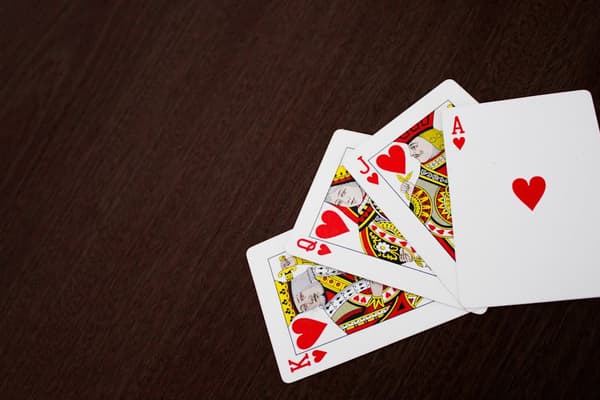
How to Play
Polignac is a classic French no-trump trick-avoidance game for 3 to 6 players using a 32-card Piquet pack. The aim is to avoid capturing Jacks in tricks, above all the [J♠] (the 'Polignac') which is worth double the penalty of the other three Jacks.
Polignac is a classic French no-trump trick-avoidance game for 3 to 6 players (best with 4) using a 32-card Piquet pack. The aim is simple: avoid capturing Jacks in tricks, and above all avoid capturing the , the nicknamed 'Polignac' worth double the penalty of the other three Jacks. A match is commonly played to an agreed penalty threshold (10 or 20 points); the first player to reach it loses, and the overall winner is the player with the fewest penalty points at that moment. Each deal takes 5 to 10 minutes.
Quick Reference
- Remove the black 7s if not exactly 4 players; shuffle the remaining Piquet pack.
- Deal the whole deck counter-clockwise (8 cards each for 4 players); no trump suit and no stock.
- Eldest hand leads any card; play proceeds counter-clockwise.
- Follow suit if able; otherwise discard any card (including a Jack you want to offload).
- Highest card of the led suit wins the trick and leads the next.
- (Polignac) = 2 penalty points; other Jacks = 1 each.
- Optional capot: win all tricks for +5 to each opponent, zero to bidder; fail capot = +5 to bidder.
- Match ends when any player hits 10 or 20 (agreed); lowest total wins.
Players
3 to 6 players, every player for themselves (no partnerships). Four is the canonical count. With 4 players all 32 cards are dealt evenly; with other counts, remove the black 7s to balance (3 players: remove and so 30 cards deal 10 each; 5 or 6 players: similar removals or deal slightly uneven). The first dealer is chosen by any agreed method; deal rotates to the left (counter-clockwise) each hand.
Card Deck
One 32-card Piquet pack: the standard 52-card deck with 2s through 6s removed, leaving King (high), Queen, Jack, 10, 9, 8, 7 (low) in each suit. Rank order within a suit: K > Q > J > 10 > 9 > 8 > 7 (low) for winning tricks, though the original French ranking is sometimes written K Q J A T 9 8 7. There is no trump suit. There are exactly four Jacks in the pack; they are the sole penalty cards.
Objective
Over the series of deals, finish with the lowest cumulative penalty total. Each Jack captured scores against you, and the (Polignac) scores double. The match ends when any player reaches the agreed loss threshold (10 or 20 points); at that moment the player with the fewest cumulative penalties wins the match.
Setup and Deal
- Remove the black 7s if the player count requires it (see Players). Shuffle the remaining pack thoroughly; the dealer offers a cut to the player on the right.
- Deal the entire pack counter-clockwise (the French convention), in small batches (most commonly 3, then 2, then 3 for 4 players, summing to 8 cards each; with other player counts, adjust to deliver equal hands).
- Leave no stock, no widow, no talon; the deal is complete when every card is in someone's hand.
- Misdeal: A deal is void if any player has the wrong number of cards or if a card is exposed; the same dealer re-deals.
Optional Bidding (Capot and General)
- Capot (slam): Before leading the first trick, a player may announce Capot: an undertaking to win every trick in the deal. If they succeed, each opponent scores 5 penalty points and the bidder scores zero. If they fail (drop even a single trick), the bidder instead scores 5 penalty points and opponents score normally for any Jacks they captured.
- General (take-all): In some houses, a player may announce General before the first card is led, undertaking to win every trick; success scores -5 penalty (a bonus) to the bidder and 5 to each opponent; failure is 5 penalty points to the bidder.
- No bid: Most casual games skip the capot / general option and simply play for the low score.
Gameplay
- Leading the first trick: The player to the dealer's left (eldest hand) leads any card to the first trick.
- Trick structure: Play proceeds counter-clockwise (to the left of the current leader). Each player plays one card to the centre. You must follow suit if you hold any card of the led suit; if you are void, you may play any card (including a Jack you would rather dump).
- Winning the trick: The highest card of the led suit wins; there is no trump suit, so off-suit cards cannot win. The trick winner collects the cards face-down in front of them and leads the next trick.
- End of hand: The hand ends when every card has been played. Count Jacks captured: counts as 2 penalty points; each other Jack (J♣, J♦, J♥) counts as 1; total 5 penalty points per deal are available for distribution.
- Renege (revoke): Failing to follow suit when you could have is a renege. If spotted before the next trick is led, the offender corrects the card. If spotted later, the usual penalty is 5 extra penalty points to the offender, or in some houses the offender immediately 'reaches the threshold' and loses the match.
Scoring
- Per deal: Each Jack captured scores against the capturer: = 2, other Jacks = 1 each. A clean round (no Jacks captured at all) scores zero.
- Capot bonuses (if bid): Successful capot gives each opponent 5 penalty points and the bidder zero. Failed capot gives the bidder 5 penalty points; Jacks captured during the attempt also score normally against whoever took them.
- Running total: Add each deal's penalties to each player's cumulative score. The first player to reach or pass the agreed threshold (typically 10 or 20 penalty points) triggers match end.
- Match winner: At the moment any player reaches the threshold, the player with the fewest accumulated penalty points at the table wins. The threshold-hitter is not automatically the loser; rank is by score.
Winning
- Match winner: The player with the lowest cumulative score when any player first reaches the agreed threshold. The threshold value (10 or 20) is agreed before play starts.
- Tie-breakers: If two players are tied on the lowest score at match end, play one additional deal between only the tied players; the one with the fewest penalties in that deal wins. If still tied, repeat.
- Quick-end option: Some groups end the match the instant a player hits exactly the threshold (not only 'reaches or passes'); negligible difference in practice.
Common Variations
- Quatre Valets (Four Knaves): All four Jacks count 1 penalty point each; no double for . Removes Polignac's signature card-specific penalty and makes the game more symmetric.
- Slobberhannes: A related game using the same 32-card deck in which penalty points are assigned for taking the first trick, the last trick, and the , rather than Jacks. Often taught alongside Polignac because of the shared base.
- Knaves (English equivalent): Three- or four-player version with only the Jack of Spades (2) and the Jack of Diamonds (1) as penalties.
- Eichel-Obern (German): Similar trick-avoidance framework, with Obers (the German equivalent of Queens) replacing Jacks as penalty cards.
- Bassadewitz: Related German variant; penalty cards are the Aces of each suit plus the .
- No capot option: Many groups drop the capot / general bidding entirely for simpler play.
Tips and Strategy
- Avoid leading high cards in suits where you hold Jacks; the moment the lead comes back to you with a winning card, you might capture your own Jack.
- Void a suit early. Once you are out of a suit, you can discard a Jack (especially the ) when that suit is led; discarded cards cannot win the trick, so the Jack is safely transferred out of your hand.
- If you hold and have no way to dump it, play it under a high card from another player as soon as a strong card of its suit is led; never save it for later, because you may run out of opportunities.
- Track which Jacks have been captured. Once three Jacks are down, the fourth is the only remaining penalty; if you are sure it is in a particular opponent's hand, leading suits you know they cannot follow will force it onto their trick.
- Capot bids are almost always losing propositions unless you have been dealt something near a perfect hand (all the top cards plus a void in one suit so you cannot be forced to discard a Jack). Use sparingly.
Glossary
- Jack (Valet in French): The face card between 10 and Queen; the sole penalty card in Polignac.
- Polignac: The , worth 2 penalty points (double the other Jacks); named after a historically unpopular French prince.
- Piquet pack: A 32-card deck formed by removing 2s through 6s from the standard 52, leaving A, K, Q, J, 10, 9, 8, 7 in each suit. Used in Polignac, Piquet, Skat, and many European games.
- Capot: A declared attempt to win every trick in a deal; success gives opponents 5 penalty points each, failure gives the bidder 5.
- General: An alternative name for capot in some groups, with a slightly different scoring (bidder gains a bonus instead of zeroing).
- Renege / revoke: Failure to follow suit when able; penalised.
- Eldest hand: The player to the dealer's left; leads the first trick.
- Threshold: The agreed penalty total (10 or 20) that ends the match when any player reaches it.
Tips & Strategy
Void a suit early so you can discard the [J♠] on a led suit you no longer hold; off-suit Jacks cannot win a trick, and the moment you are void in a suit your Jacks can safely leave via that suit's leads.
The capot (win every trick) is a bold but usually losing bid; only attempt it with a hand dominated by high cards (Kings and Queens) across all four suits and a plan for every trick.
Trivia & Fun Facts
The game is named after Prince Jules de Polignac, an unpopular early-19th-century French politician whose memory became folk-synonymous with something to be avoided; capturing the [J♠] is therefore 'capturing Polignac'.
-
01Which Jack is worth the most penalty points in Polignac, and what is it named after?Answer The Jack of Spades (the 'Polignac'), worth 2 points; it is named after Prince Jules de Polignac, a 19th-century French politician.
History & Culture
Polignac has been played in France since at least the 19th century and is a direct ancestor of the broader trick-avoidance family (Knaves, Slobberhannes, Barbu, and others).
A classic French card game that contributed significantly to the evolution of trick-avoidance games across Europe and remains a reference point in French card-game literature.
Variations & House Rules
Quatre Valets equalises all Jacks at 1 point each. Slobberhannes adds first-trick, last-trick, and [Q♣] penalties. Knaves is the English equivalent. Eichel-Obern is the German cousin using Obers (Queens).
For a quicker game drop the capot bid. For more complexity combine Polignac and Slobberhannes penalties. Play to 10 penalty points for a short match or 20 for a full one.


