
How to Play
Brisca is Spain's beloved point-trick game: small three-card hands, a single trump suit, and the freedom to play any card at any time. First to 61 points wins the hand.
Brisca is the Spanish cousin of the Italian game Briscola, a fast trick-taking game with a tiny three-card hand, a single trump suit, and a classic point-card scoring system. It sits at the centre of Iberian card culture and is the game people first teach their grandchildren on a Sunday afternoon. The rules are small but the strategy is surprisingly dense: because you only see three of your own cards at a time and you are not required to follow suit, every single card decision is a live choice between winning a trick for its points, ducking a trick to bait your opponent, or trumping to poach a fat Ace. Partnership play adds a second layer where your hand value multiplies through communication and card memory.
Quick Reference
- 2-6 players using a 40-card Spanish deck (or French deck with 8s, 9s, 10s removed).
- Deal 3 cards each counter-clockwise.
- Turn the next card as pinta; its suit is trump. Remaining cards form the stock.
- Lead any card; no obligation to follow suit. Trumps may be played at any time.
- Highest trump wins; if no trump, highest card of the led suit wins.
- Winner draws first; everyone refills to 3 cards until the stock is exhausted.
- Ace 11, 3 = 10, King 4, Knight 3, Jack 2; others 0 points.
- Team or player over 60 of the 120 total points wins the hand.
- 60-60 ties are replayed with a doubled stake.
Players
Brisca is played by 2 to 6 players. The classic forms are 2 players head-to-head, 3 players in a free-for-all, or 4 players in two partnerships of two sitting opposite each other. Six players split into two teams of three with every seat alternating between teams. With five players, one player sits out each hand in rotation or the group switches to six with two partial teams.
Card Deck
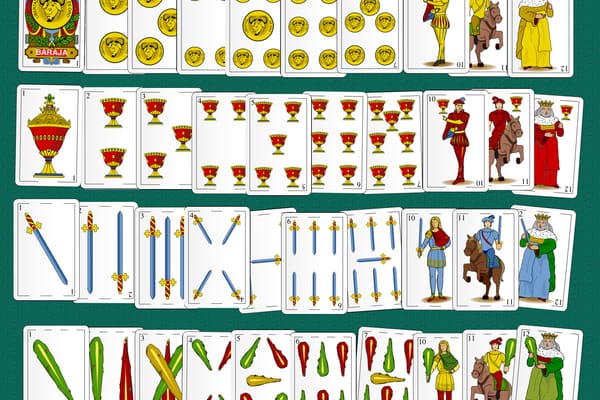
Use a 40-card Spanish deck (baraja española) with the suits Oros (coins), Copas (cups), Espadas (swords) and Bastos (clubs). The ranks, high to low, are: As (1), Tres (3), Rey (King, 12), Caballo (Knight, 11), Sota (Jack, 10), 7, 6, 5, 4, 2. If you only have a French-suited deck, remove the 8s, 9s and 10s (and treat Jack as Sota, Queen as Caballo, King as Rey) to form the 40-card equivalent. In all cases, the trick-winning rank order is: Ace (highest), 3, King, Knight, Jack, 7, 6, 5, 4, 2.
Objective
Capture as many card-point values as possible by winning tricks that contain high-value cards. The player or team ending the hand with more than 60 of the 120 available points wins the hand.
Setup and Deal
- Choose a first dealer by cutting for low card (in Spanish tradition, the player who cuts the lowest card deals; the Ace is low for this purpose only). Deal rotates counter-clockwise thereafter.
- Shuffle the 40-card Spanish deck. Deal 3 cards to each player, one at a time counter-clockwise.
- Turn the next card of the deck face-up and place it crosswise under the remaining stock. This card is the 'pinta' and its suit becomes trump (brisca) for the hand. Everyone can see it.
- Set the remaining 27 (2-player), 30 (3-player), 28 (4-player) cards face-down beside the pinta as the stock. The pinta is the last card that will be drawn from the stock.
- The player to the dealer's right (counter-clockwise order is used) leads the first trick.
Gameplay
- On your turn, play exactly one card face-up to the trick.
- No obligation to follow suit: Unlike most trick-taking games, Brisca players may play any card they like, including a trump, at any time. Sloughing off-suit low cards to dump risk is legitimate and central to strategy.
- Winning the trick: If any trump (brisca) card was played, the highest trump wins. If no trump was played, the highest card of the led suit wins. Off-suit non-trump cards can never win.
- Drawing after the trick: The winner of the trick takes the cards and places them face-down in their own or their team's captured pile. The winner draws one card from the stock first, then each other player draws in counter-clockwise order. All hands return to three cards until the stock runs out.
- Claiming the pinta: When the stock is reduced to just the face-up pinta, the player whose turn it is to draw takes the pinta itself as the final draw. From then on, players play out their three remaining cards without drawing.
- Leading the next trick: The winner of a trick leads the next trick.
- End of hand: The hand ends once all cards have been played. Each team now counts the points in its captured pile.
- Partnership communication: In 4- and 6-player partnership games, table talk beyond conventional signals is forbidden. Allowed signals include a lip-bite (I hold the trump Ace), a shoulder raise (I hold the trump 3), a wink (I hold both Ace and 3), and a head-shake (I have no trumps). These are declared before the hand begins and must be used honestly.
Scoring
- Point values per card: Ace = 11, 3 = 10, King = 4, Knight = 3, Jack = 2. All other cards (7, 6, 5, 4, 2) are worth 0 points.
- Total points in the deck: 4 x (11 + 10 + 4 + 3 + 2) = 120 points.
- Hand result: The team or player capturing more than 60 points wins the hand. 60-60 is a draw and the hand is replayed with a doubled stake.
- Partnership count: Partners pool their captured cards and count points together.
- Winning margins (optional match scoring): +1 game point for taking 61-90 points, +2 for taking 91-119 points, +3 for taking all 120 points (a capote). Match is typically first to 3 or 5 game points.
Winning
A single hand is won by scoring more than 60 points; a tie at 60-60 is replayed. A match is won by the first player or team to reach an agreed number of hand wins (commonly 3) or game points. In single-round casual play, the winner of one hand is simply the highest scorer.
Common Variations
- Brisca Subastada (Auction Brisca): Players bid for the right to choose the trump suit. The highest bid becomes the contract; the bidder must meet or beat their bid in captured points or pay a penalty.
- Five-player Brisca: One player sits out each hand in rotation; the sitter receives a share of the winnings if their team wins.
- Brisca Cubierta (Covered Brisca): The pinta is placed face-down rather than face-up so players do not know the trump suit until the first trump is played.
- Brisca con Rematada (Chilean variant): The winning threshold is 101 points rather than 60, achieved by playing multiple hands and accumulating points.
- Briscola-Chiamata (called-trump variant from Italy but played in Spanish border regions): A five-player bidding version where the highest bidder calls for a specific card; the holder of that card becomes the bidder's partner.
Tips and Strategy
- The non-follow-suit rule is the heart of Brisca. Use it to duck tricks that contain 0-point cards and to pounce on tricks that contain Aces or 3s with a small trump.
- Count the three big cards of each suit: Ace, 3, and King. When the Ace of trumps has been played, the 3 of trumps becomes the top trump.
- Save your high trumps for stealing opponent Aces. A trump 2 or 4 is usually enough to capture an enemy Ace led into an off-suit card.
- In partnership play, lead a low card of a non-trump suit to let your partner capture an opponent's Ace with a small trump; a good Brisca pair robs the opponents of their Aces before the stock runs out.
- Watch the pinta. Knowing what the last stock card will be tells you which card your opponent is guaranteed to take into their endgame hand.
- Do not waste Aces early by leading them into trumps. Only lead an Ace when you suspect no one can trump, or when your partner has signaled trump-void.
Glossary
- Brisca: The trump suit, and also the informal name of the game itself.
- Pinta: The face-up card placed under the stock that shows the trump suit.
- Capote: Winning all 120 points in a hand, a rare and celebrated achievement.
- Sota: The Jack of the Spanish deck (worth 2 points).
- Caballo: The Knight of the Spanish deck (worth 3 points), the equivalent of the French-deck Queen.
- Rey: The King of the Spanish deck (worth 4 points).
- As: The Ace, worth 11 points and the highest-ranking card.
- Baza: A trick; one round of play where every active player contributes one card.
- Señas: The conventional table signals partners may use to communicate their trump holdings.
- Cantar las 40 / las 20: Declaring a marriage (King + Knight of trumps or non-trumps) in the Brisca Subastada variant only; not used in the classic game.
Tips & Strategy
Use the free-play rule to dump worthless cards on opponent-led tricks and save your trumps for capturing their Aces and 3s. In partnership play, the señas signals and careful counting of the big cards in each suit make the difference between amateur and expert.
The deeper art of Brisca is memory. A player who tracks the Ace and 3 of each suit, along with the opponent's already-drawn cards, can predict the last three cards each opponent will hold with high confidence once the stock is exhausted. This knowledge turns the endgame into a solvable puzzle.
Trivia & Fun Facts
Because Brisca uses no fewer than 120 total points distributed among only 20 cards (the four Aces, 3s, Kings, Knights and Jacks), each of these 'point cards' is worth much more than the 20 'blank' cards combined. A hand can swing on a single Ace captured at the right moment.
-
01How many points are in the 40-card Spanish deck used for Brisca?Answer 120 points.
-
02In Brisca, is a player required to follow the suit of the led card?Answer No; any card may be played at any time, including a trump.
History & Culture
Brisca reached Spain from Italy in the late 18th or early 19th century, brought by traveling soldiers and merchants who had learned Briscola in Naples. The Spanish version settled on the native 40-card baraja española and the counter-clockwise turn order characteristic of Spanish games, and it became the default household trick-taker by the mid-19th century.
Brisca is one of the defining card games of Spain, played in every region from Galicia to Andalucía and exported across Latin America by Spanish emigrants. Regional variations (Brisca Cubierta in Valencia, Brisca Subastada in the north) exist, but the core free-play-with-trump mechanic is a constant fixture of Spanish social life.
Variations & House Rules
Brisca Subastada adds an auction phase where players bid for the right to choose trump. Brisca Cubierta keeps the pinta face-down for a more uncertain game. The Chilean Brisca Rematada raises the winning threshold to 101 points across multiple hands.
Play the señas signals openly for teaching games with children, then switch to proper hidden signals once the pattern is understood. For longer sessions, combine three or five hands into a rubber and track cumulative margin as game points.


