
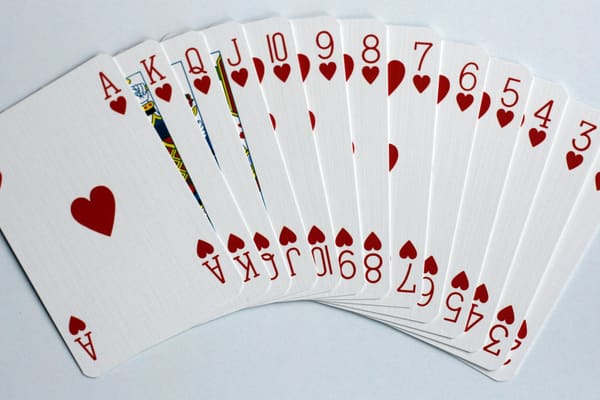
How to Play
Hearts is a 4-player 'avoidance' trick-taking game. Every heart taken in a trick costs 1 point, the Queen of Spades costs 13, so 26 penalty points are at stake each hand. Games run to 100 points and the LOWEST total wins. The opening 3-card pass, disciplined void management, and the rare 'shoot the moon' coup (invert the score by taking every penalty card) are the game's defining decisions.
Hearts is a classic 'avoidance' trick-taking game for 4 players, each playing for themselves. The goal is reversed from most trick games: you want to take as FEW penalty cards as possible. Every heart taken in a trick is worth 1 penalty point and the Queen of Spades is worth 13, so the hand holds 26 total penalty points. Games run over many hands, usually to 100 points, and the player with the LOWEST total wins. Expert play hinges on the opening card-pass, disciplined suit management, and spotting the rare moment when grabbing every penalty card (shooting the moon) flips the score for everyone else.
Quick Reference
- 4 players; deal all 52 cards evenly (13 each).
- Pass 3 cards face-down (hand 1 left, 2 right, 3 across, 4 no-pass; repeat).
- The player holding leads the first trick.
- Follow suit if possible; otherwise sluff any card.
- Highest card of the suit LED wins (no trump).
- Hearts may not be LED until a heart has been played (broken); no penalty cards on trick 1.
- Each heart: 1 point. Q♠: 13 points. Other cards: 0.
- Shooting the moon (all hearts + Q♠): shooter scores 0, others score 26.
- Game ends when a player reaches 100; lowest total wins the match.
Players
Hearts is a 4-player game, each player for themselves (no partnerships). It also adapts to 3 players (remove the 2♣; each player gets 17 cards) or 5-6 players (remove the 2♣, 2♦, and for 6 players the 2♠ too; deal evenly). Play proceeds clockwise. The first dealer is chosen by drawing high card; the deal then rotates clockwise. A single hand takes about 10 minutes; a full game to 100 typically runs 45-60 minutes.
Card Deck
- Standard 52-card pack; no jokers.
- Rank order: A (high), K, Q, J, 10, 9, 8, 7, 6, 5, 4, 3, 2 (low).
- There is no trump suit. The highest card of the suit LED wins each trick.
- Penalty cards: every heart (13 cards, 1 point each) and the (13 points). Everything else is scoreless.
- In the common Omnibus Hearts variation, the is a bonus card worth -10 points; see Variations.
Objective
Finish the match with the FEWEST penalty points. Every heart taken in a trick costs 1 point; the Queen of Spades costs 13; a standard hand therefore has 26 penalty points in play. The game ends the instant any player reaches or passes the target (normally 100 points); the player with the LOWEST score at that moment wins the match. A single heart is nothing; holding on to the Q♠ without a safe bail-out is a disaster.
Setup and Deal
- Shuffle thoroughly. The dealer deals the entire 52-card deck clockwise, one card at a time, so that each of the 4 players receives exactly 13 cards.
- The pass: before any card is played, each player chooses 3 cards from their hand and passes them face-down to another player. The direction of the pass rotates hand by hand: hand 1 = pass LEFT, hand 2 = RIGHT, hand 3 = ACROSS (to the player opposite), hand 4 = NO PASS (also called a 'keeper' hand), then the cycle repeats starting with LEFT.
- Passing order: all players select and stack their 3-card pass face-down FIRST; only after every pass is ready does anyone receive or look at their incoming 3 cards. This prevents reading the pass in real time.
- Add the received cards to your hand once all passes are complete; now re-examine your 13-card hand before the first lead.
- First lead: the player holding the must lead it to the very first trick. There is no choice.
Gameplay
- Follow suit if you can. Each trick: the leader plays a card, and every other player clockwise must play a card of the same suit if they hold one. If not, they may 'sluff' any card from another suit (including penalty cards).
- Winning a trick: the highest card of the suit LED wins the trick. Hearts is a no-trump game, so even the Q♠ does not beat another suit unless spades was led. The winner gathers the trick face-down in front of them (penalty cards still count even though hidden) and leads the next trick.
- First-trick restriction: no penalty cards (no hearts, no Q♠) may be played on the first trick. If a player is void in clubs on the first trick they must sluff a non-penalty card. (Exception: a hand with ONLY hearts and the Q♠ is extremely rare but forces the restriction to relax.)
- Breaking hearts: hearts may NOT be led until hearts have been 'broken', i.e. played on an earlier trick as a sluff when someone was void in the led suit. Once a heart has been captured (or shown as a sluff), hearts is 'broken' and anyone may lead a heart from then on.
- The Q♠ may be played any time you are void in the led suit except the first trick. Dropping the Q♠ on an opponent who is forced to win the trick is a classic tactic.
- Thirteen tricks are played out in full; every card must be played.
Scoring
- After each hand, count the penalty cards each player has taken.
- Each heart: 1 point. 13 hearts exist, so the hearts total 13 points per hand.
- Queen of Spades: 13 points. A single card half the hand's penalty weight.
- Hand total: 26 penalty points distributed across the 4 players.
- Shooting the moon: if one player collects ALL 13 hearts AND the Q♠ in a single hand (26 penalty points), they INVERT the score: they personally score 0 and each of the three other players scores 26. A good shooter must take every heart and the Q♠ without slipping; missing even one heart means you take 25 penalty points yourself.
- Shooter's choice (house variant): at some tables, the shooter may elect instead to subtract 26 from their own score. Fixed at table start.
- Tie-break: if two or more players are tied at the lowest score when someone reaches 100, play one more hand as sudden death; lowest total wins.
Winning
The game ends at the end of any hand in which at least one player's cumulative score reaches or passes the target (typically 100; sometimes 50 for a short game or 200 for a long one). The player with the LOWEST cumulative score at that moment wins. Ties are broken by sudden-death hands. Because Hearts is an avoidance game, 'winning' means you accumulated fewer penalties than everyone else; a winning score of 67 after 5-6 hands is typical.
Shooting the Moon
Shooting the moon is Hearts' signature twist: if one player manages to capture every heart (13) AND the Q♠ (13) in a single hand, that player scores 0 and each opponent scores 26. It is a defensive strategy as much as an offensive one, because a player who is losing can sometimes win a hand by risking a moon attempt. A shot is only viable with very long strong side suits (to trap opponents into winning tricks they cannot take back), guaranteed control of spades, and often a carefully planned pass. Defenders may break up a moon attempt by holding on to a single heart and playing it AFTER the shooter has taken most of them; that heart comes back to cost the defender 1 point, but saves 25.
Common Variations
- Omnibus Hearts: adds the as a bonus card worth -10 points. Winning the J♦ reduces your score. Popular online; changes the pass calculus significantly.
- Black Lady: the most common American form; identical to the rules above. 'Hearts' and 'Black Lady' are used interchangeably.
- Cancellation Hearts: played with two decks for 6-11 players. Duplicate cards in the same trick cancel each other; if all top-ranking cards cancel, the trick goes to the next highest.
- Spot Hearts: hearts score their face value (2♥=2, J♥=11, Q♥=12, K♥=13, A♥=14); Q♠ = 13. Much harsher than the 1-per-heart form.
- Cutthroat Hearts: no passing; fast but more luck-driven.
- Hearts (British form): 3-player game, Q♠ not a penalty; simply avoid hearts. Short and lighter.
- Breaking-pass variant: allow the Q♠ and/or hearts to be led at any time (no 'breaking' requirement). Speeds up the game but weakens strategy.
- No-first-trick restriction: some casual tables allow the Q♠ to be played on the first trick; not recommended, as it rewards chance.
Tips and Strategy
- Pass the Q♠ if you can when passing left or right; it is almost impossible to manage if you hold it and one opponent has a long spade suit. Never pass it across (it comes right back into play against you).
- Pass your long spades OR your short spades, not middle. If you hold 4+ spades BELOW the Queen (say, K♠-J♠-9♠-5♠-3♠) you can safely swallow the Q♠ with the K♠. A 3-spade hand with just the A or K is the most dangerous: the A/K may be forced to eat the Q♠.
- Void a suit on the pass. If you hold only two diamonds, pass both + a third card; in trick 3 or 4 when diamonds is led you can sluff a heart or the Q♠.
- The 2♣ lead is known. When you are the opener, lead the 2♣ as required; you CAN drop the Q♠ on a later club trick when you void clubs, which is the classic Q♠ 'smother'.
- Do not grab unnecessary tricks. Taking tricks in non-penalty suits is fine; taking tricks when hearts are still flying is how you end up with all of them.
- Track who is void. After round 2 or 3, the voided suits are the pass-planning secret; when they sluff, they dump either the Q♠ or a heart.
- Moon awareness: if you have taken 4+ hearts and no one else has any, someone is shooting. Drop a single low heart on the next off-suit trick to block the shot; taking 1-2 hearts is almost always better than conceding 26.
Glossary
- Trick: a single round of one card from every player; 13 tricks per hand.
- Follow suit: play a card of the suit LED if you hold one.
- Sluff / discard: to play a card from a different suit than the led suit, because you are void.
- Void: holding no cards of a given suit.
- Breaking hearts: the first moment a heart is played (as a sluff) during the hand; until then, hearts cannot be LED.
- The Black Lady: the Queen of Spades; 13 penalty points on her own.
- Shooting the moon (hitting the moon): collecting all 13 hearts + Q♠ in one hand; invert scoring.
- Smother: dropping the Q♠ on a spade trick won by an opponent.
- Pass / passing phase: the 3-card exchange before play starts; direction rotates.
- Keeper hand: the no-pass hand, every fourth deal.
- Omnibus: a variant in which the J♦ is worth -10 (a bonus card).
Tips & Strategy
Manage your hand carefully to avoid penalty cards. Pass the Q♠ left or right (never across) unless you hold four or more low spades to swallow it safely. Void a short suit on the pass so you can sluff penalty cards later. Do not take tricks you do not need; winning a trick in a non-penalty suit is fine, but winning one while hearts are flying is how you accidentally shoot yourself. Moon awareness matters: if an opponent has taken 4+ hearts and no one else any, drop a single heart on the next sluff to block the shot.
Expert Hearts is 60% pass, 30% suit management, 10% endgame counting. The pass determines whether you can afford to sluff at will later; voiding a suit on pass is worth more than dropping high penalty cards. Suit management is about being able to duck (play a low card you will not win with) when opponents fire off high cards in a penalty suit. The endgame matters because the last 3-4 tricks are when moons are decided and Q♠-trapping occurs.
Trivia & Fun Facts
In the Omnibus Hearts variation, the Jack of Diamonds is a bonus card worth -10 points, reducing your score. Microsoft Hearts (bundled with Windows 3.1 onward) was one of the first internet card games; its ' '3 of Clubs opening' variant appears in some regional tables because early versions forced the 3♣ lead instead of the 2♣. Hearts is the only 4-player game on the Windows default game roster where the lowest score wins.
-
01In Hearts, what is the term for collecting all 13 hearts AND the Queen of Spades in a single hand, and what does it do to the score?Answer Shooting the moon. The shooter scores 0 that hand and each of the three opponents scores 26 penalty points. A missed shot (catching 12 hearts and the Q♠ but missing one heart) is brutal: the player scores 25 instead of 0.
-
02Which card MUST be led to the very first trick of every hand, and what penalty cards are forbidden on trick 1?Answer The [2♣] must be led; no hearts and no Q♠ may be played on the first trick (except when a hand holds only penalty cards, a near-impossible scenario).
History & Culture
Hearts descends from the 17th-century French game Reversis, in which the same idea of avoiding specific cards first appeared. The modern form (with the Q♠ as the big penalty) developed in the United States in the late 19th century and was standardised in Hoyle editions from the 1920s onward. It is one of the four default games bundled with Microsoft Windows from 1992 to 2012, which introduced Hearts to hundreds of millions of casual players.
Hearts is one of the most-played family card games in the English-speaking world and was the default 'cards-with-people' game on Microsoft Windows for two decades. It is a common first 'real' trick-taking game taught to teenagers and adults, because the no-trump format keeps rules simple while the avoidance flavour rewards observation and planning.
Variations & House Rules
Omnibus Hearts adds the J♦ as a -10 bonus card. Spot Hearts scores each heart at its face value, drastically raising stakes. Black Lady is the standard American form (identical to the rules above). Cancellation Hearts uses two decks for 6+ players, with matched cards cancelling. Cutthroat Hearts skips the passing phase.
For a short casual game, play to 50 points instead of 100. For a longer, strategy-rewarding evening, add the Omnibus J♦ rule and the shooter's-choice moon (subtract 26 from yourself rather than adding 26 to others). For very new players, disable the 'breaking hearts' restriction until they get comfortable.


