
How to Play
A fast party card game for 3 to 13 players in which everyone passes cards simultaneously until someone collects four of a kind and silently touches their nose; the last player to notice is dubbed the Pig.
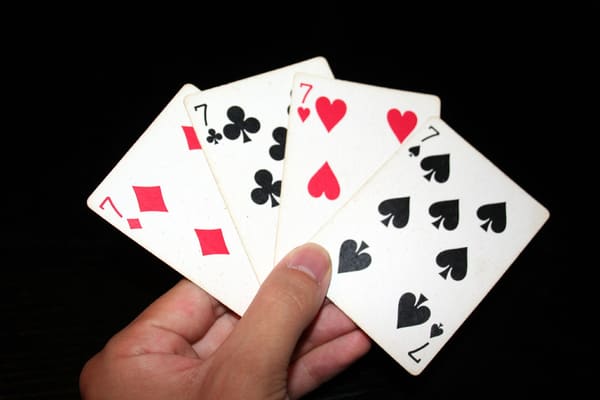
Pig is a raucous party game for 3 to 13 players in which everyone passes cards simultaneously around the circle, racing to collect four cards of the same rank. The moment you complete your quartet you quietly touch your nose; every other player must do the same the instant they notice, and the last player still passing cards is the Pig for that round. Simple, fast, and almost entirely about watching faces rather than cards, Pig is first recorded in 1911 (described then as 'a rather noisy game') and remains one of the easiest card games for mixed-age groups to pick up.
Quick Reference
- 3 to 13 players. Pull one complete rank per player from a 52-card deck.
- Shuffle and deal 4 cards to each player.
- Everyone passes one card left and picks up one from the right, continuously.
- When you hold four of a kind, silently touch your nose.
- Every other player must copy the nose-touch the moment they see it.
- The last player still passing is the Pig.
- Classic: the Pig is eliminated; remove one rank and redeal.
- Letter format: each Pig round earns one letter (P, I, G); spelling PIG eliminates you.
- Tally format: play a set number of rounds; fewest Pig rounds wins.
Players
3 to 13 players, best with 4 to 7. All players play simultaneously; there is no dealer turn order because cards move in continuous rotation. Play lasts about 2 to 5 minutes per round.
Card Deck
One standard 52-card French-suited pack with jokers removed. Before dealing, pull exactly one complete rank (all four cards of one value) per player: 3 players use 3 ranks (12 cards), 4 players use 4 ranks (16 cards), and so on up to 13 players using the full pack. Any ranks may be chosen; Aces, Kings, Queens, Jacks are traditional.
Objective
Be the first player to collect four cards of the same rank (a 'book') and touch your nose without being the last person to do so. Across multiple rounds, avoid becoming the Pig until only one player remains.
Setup and Deal
- Select one complete rank per player from the deck (for 5 players, take all four Aces, all four Kings, all four Queens, all four Jacks, and all four 10s for a 20-card pack).
- Shuffle these cards thoroughly together.
- Deal 4 cards face down to each player. No draw pile or discard pile is used in the classic version.
- Players arrange their 4 cards as a concealed hand.
Gameplay
- Simultaneous passing. On a shared count (or continuously), every player picks one unwanted card from their hand and places it face down in front of the player on their left, at the same time picking up whatever card has been placed in front of them by the player on their right. Your hand always contains exactly 4 cards.
- Keep passing steadily. There are no turns; the whole circle moves at roughly the same speed. Aim to pass and pick up about once every two or three seconds.
- Completing a book. The instant you hold four cards of the same rank, stop passing and silently touch your nose with one finger.
- The nose-touch chain. As soon as any other player notices someone touching their nose, they must stop passing and touch their own nose too, without comment.
- The Pig. The last player still passing cards (the one who was last to notice the nose-touch chain) is the Pig for this round. Some groups require every other player to announce 'Pig!' in unison when the loser is identified.
- Round end. Gather all cards. For the next round remove one complete rank from the deck (so the pack shrinks in step with player count) and redeal; otherwise shuffle and redeal with the same cards if you are scoring across multiple rounds instead of eliminating.
Scoring
- Elimination format (classic). The player who becomes the Pig sits out the next round. Remove one set of four cards from the deck so the remaining players each still start with 4 cards. Continue until only one player has not been eliminated; that player wins.
- Letter format (P-I-G). Play without elimination. Each time you become the Pig you earn one letter: first P, then I, then G. Once you have spelled PIG, you are out. Last player still in (or first to three letters in reverse for survivor scoring) wins.
- Round-tally format. Play a fixed number of rounds (5, 7, or 10). The player who was Pig the fewest times wins; ties share the win.
Winning
In the elimination format, the last player who has not been dubbed Pig is the winner. In the P-I-G letter format, the last player who has not spelled out PIG wins. In a fixed-round tally, the player with the fewest Pig rounds across the session wins.
Common Variations
- Spoons: Place one fewer spoon in the centre of the table than there are players. When someone completes a book they grab a spoon; everyone else must then also grab a spoon. The player left without one is the round loser (same letter format, typically S-P-O-O-N-S).
- Donkey: Identical to Spoons but uses the letters D-O-N-K-E-Y and spoons can be any shared object (coins, sugar packets, ice cubes).
- Silent P-I-G: Forbid any speech at all. Players must rely purely on peripheral vision; making noise earns an extra letter.
- Bluff nose-touch: A player may feint a nose touch to trick others into touching early; wrongly accusing earns the accuser a letter. Adds bluffing layer.
- Full Deck Stockpile: Use the complete 52-card deck. Deal 4 cards to each player; the dealer holds the rest as a stockpile, passes one card left and draws a replacement from the top of the stock instead of receiving from the right. When the stock is exhausted, the discard pile (cards dropped by the player to the dealer's right) is shuffled to refresh it. Introduces more rank variety and slows down repeated draws.
Tips and Strategy
- Decide fast which rank to collect and commit to it early; constantly switching targets costs you tempo against decisive players.
- Pass cards smoothly and rhythmically even when you have a completed book, for a half-second, so your pause is not instantly telegraphed. Many players betray themselves by freezing the moment they lock the quartet.
- Watch peripheral vision of hands, not faces. Players signal with shoulders and elbows before they signal with noses.
- Against very large groups (8 or more), consider collecting a middle rank rather than a showpiece like Aces; others are more likely to pass away their middling cards quickly.
- In Spoons or Donkey, reach for a spoon decisively the moment you see any tension; hesitation is the main cause of losing.
Glossary
- Book (or Set, or Quartet): Four cards of the same rank held by one player. Completing a book is the trigger to touch your nose.
- Nose-touch: The silent signal that you have completed a book; others must copy it as soon as they notice.
- Pig: The player who is last to notice a nose-touch and the round's loser.
- P-I-G: The letter-scoring variant in which each lost round earns you one letter of the word PIG; spelling it out eliminates you.
- Passing rotation: The continuous simultaneous pass of one card to the left (and pickup from the right) that every player performs throughout the round.
- Spoons / Donkey: Object-grabbing variants in which the physical scramble for a central object replaces the silent nose-touch.
Tips & Strategy
Decide which rank you are chasing the instant you see your hand; do not switch targets once cards are moving. Keep your passing motion steady even after completing a book so you do not broadcast the win with a sudden freeze. Watch peripheral shoulders and hands rather than faces to catch the nose-touch a fraction of a second earlier.
Pig rewards rhythmic passing and peripheral awareness more than card choice. Your only meaningful decisions are which rank to chase and how convincingly you can maintain normal body language after completing a book. Experienced players will pass steadily even after winning, keeping their off-hand casual, and watch the shoulders of neighbours for tell-tale slowing rather than fixating on faces.
Trivia & Fun Facts
The Spoons variant is structurally identical to Pig but replaces the nose-touch with a physical grab for an object, which is why the two games are often thought of as the same game under two names. In family play the bluff nose-touch is particularly disruptive with children: the player who pretends to touch their nose and watches everyone else follow is usually celebrated for a round even though it technically earns them a letter.
-
01What is the traditional silent signal for completing four of a kind in Pig?Answer Touching your nose with one finger, whereupon all other players must do the same.
-
02From what older card game is Pig thought to descend?Answer Vive l'Amour, an 18th-century game in which players collected a full 13-card suit rather than a quartet.
History & Culture
Pig is first recorded in 1911 under that name, described in contemporary sources as 'a rather noisy game' played at family parties. It is thought to have evolved from the older 18th-century game Vive l'Amour, in which the target was collecting all 13 cards of a single suit rather than four of one rank. The nose-touch mechanic appears to be an American 19th-century folk-game addition that migrated into the Pig ruleset.
Pig is a staple of American family card evenings and scout-camp game nights, often the first card game children are taught after Go Fish and War. Its Spoons and Donkey variants are used worldwide in schools, summer camps, and party settings because they need no scoring apparatus and remain fun for groups of more than 10 players, a range most card games cannot comfortably support.
Variations & House Rules
Spoons and Donkey replace the nose-touch with a scramble for a physical object, producing noisier and more chaotic play. The P-I-G letter format draws out a session over many rounds without eliminating anyone. Full Deck Stockpile adds a dealer-style draw-and-pass mechanic using the complete 52-card pack for more variety. Silent P-I-G forbids any speech, forcing players to rely purely on peripheral vision.
For children add penalty tasks for the Pig (a silly sound or a small forfeit) rather than elimination, so no one sits out long. For more tension, shorten the count to 7 rounds and award a prize to whoever was Pig fewest times. Use themed decks (animals, movie characters) with four matching cards per theme to play with younger children who cannot yet read ranks.


