
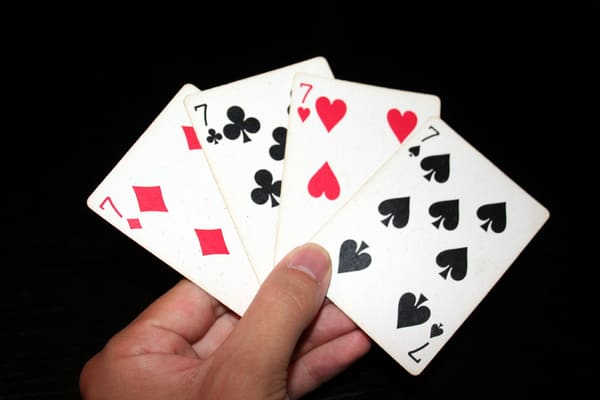
How to Play
Donkey is a family card game of fast reactions where 3-13 players pass cards around, and the first to collect 4 of a kind performs a secret signal; the last player to copy the signal gains a letter of D-O-N-K-E-Y and spelling the word eliminates them.
Donkey is a classic family card game of fast reactions and furtive gestures, closely related to Spoons and Pig. Played with a deck containing exactly as many ranks as there are players (each rank represented by all 4 cards), every player holds 4 cards and passes one card around the circle continuously. The first player to collect 4 of a kind secretly performs an agreed signal (most commonly touching their nose, placing a finger to their lip, or reaching for a spoon in the centre); all other players must then immediately copy the gesture. The last to react earns the next letter of D-O-N-K-E-Y. A player who collects all six letters becomes 'the donkey' and is eliminated. The game ends with one player remaining as the winner, and it is particularly popular at children's parties and family gatherings for its mixture of card strategy and reflex comedy.
Quick Reference
- 3-13 players. Use as many ranks as players (4 cards per rank).
- Deal 4 cards to each; agree on a secret signal before starting.
- Everyone passes 1 card left simultaneously on the dealer's cue.
- Pick up the received card; repeat rapidly.
- When you have 4 of a kind, discreetly perform the signal.
- All others must copy; the last to copy earns a letter.
- Six losses = spelling DONKEY = elimination.
- False signal = automatic letter penalty.
- Last player un-eliminated wins the session.
Players
3 to 13 players, best at 4 to 7. Each player plays for themselves. A dealer deals the first hand; after each letter assignment, the round starts fresh and the next player clockwise deals. All players must be able to see every other player at the table (for watching the signal), so seat around a round or square table with clear sight lines.
Card Deck
One standard 52-card deck, from which exactly as many ranks as there are players are selected (each rank contributes all 4 suited cards). For 4 players, use 4 ranks = 16 cards; for 5 players, 5 ranks = 20 cards; for 7 players, 7 ranks = 28 cards; for 13 players, the full deck = 52 cards. Ranks chosen do not matter (by convention use Aces, Kings, Queens, Jacks, Tens, ... downward through 2s as needed). Suits are irrelevant: the game cares only about matching ranks. Cards have no point value; four of a kind is the only combination that matters.
Objective
Over a series of rounds, avoid collecting all six letters of D-O-N-K-E-Y. Each round is won by whichever player collects 4 of a kind first and performs the secret signal; the last player to copy the signal gains one letter. The last player remaining who has not spelled DONKEY is the overall winner.
Setup and Deal
- Count the players, then select the appropriate number of ranks (4 cards per rank). For 5 players, pull out 5 ranks (e.g., Aces through 9s), set the remaining cards aside.
- Agree on the secret signal before dealing. Common choices: touching your nose with one finger, sticking out your tongue, tapping a finger to your chin, or placing a spoon (in the Spoons variant). Do not change the signal mid-game.
- Shuffle the 4-ranks-per-player deck thoroughly. Deal 4 cards face down to each player.
- Each player privately sorts their 4 cards. Players should not reveal their hands or react visibly if they are dealt four of a kind on the initial deal.
- The dealer calls 'ready, set, pass' to begin.
Gameplay
- Simultaneous pass: On the dealer's signal, every player simultaneously selects one card from their hand and passes it face down to the player on their left. At the same moment, each player receives the card passed by the player on their right.
- Pick up and evaluate: Each player immediately picks up the received card and evaluates their new 4-card hand. If still not holding 4 of a kind, they prepare another card to pass.
- Rapid-fire passing: The dealer continues calling 'pass' (or after the first round, players pass at will without waiting) so cards flow continuously around the circle. The faster the pace, the more exciting.
- Four of a kind: A player who achieves 4 of a kind must not react visibly. Instead they calmly continue playing along, then discreetly perform the agreed signal (touch your nose, tap your chin, grab a spoon).
- Chain reaction: As soon as any other player notices the signal, they must copy it. As each player copies, the chain spreads around the table. The last player to copy has earned the next letter.
- False signals: A player who performs the signal without holding 4 of a kind (deliberately or accidentally) is the automatic loser of that round regardless of who else copied.
- Round end: The round ends once everyone has copied the signal. Letters are assigned, cards are collected, and the next player clockwise becomes the new dealer for the next round.
Scoring
- Letter assignment: The last player to copy the signal receives the next letter of D-O-N-K-E-Y. First loss = D, second = O, third = N, fourth = K, fifth = E, sixth = Y.
- Spelling DONKEY = elimination: A player who has collected all six letters is out of the game. They continue as spectators but do not deal or play.
- False signal penalty: Performing the signal without 4 of a kind earns an immediate letter.
- Winner: The last player remaining (who has not spelled DONKEY) wins the session.
- Short version: Play to D-O-N-K-E-Y (6 letters) for a full session, P-I-G (3 letters) for a quick version, or any agreed shorter word for intermediate length.
Winning
The player who has acquired the fewest letters by the end of the session wins. In the elimination version, the session runs until only one player remains un-eliminated; that player is the session winner. For no-elimination play, run a fixed number of rounds (often 6 or 12) and declare the player with fewest letters the winner.
Common Variations
- Spoons: The most widespread variant. Place spoons (or coins, keys, any tokens) in the centre, one fewer than the number of players. When the four-of-a-kind player grabs a spoon, all others race to grab one too; the player left without a spoon gains a letter. The physical grabbing replaces the copy-the-signal element and makes the game even more dramatic.
- Pig: 3-letter P-I-G word for a quick game. Signal is silently placing a finger to the nose.
- Eliminated players deal: An eliminated player becomes the dealer for the remaining rounds; useful for large-group parties to stop a knocked-out player from wandering off.
- No-elimination (letter-keeper): Play a fixed number of rounds (e.g., 12), and whoever has the fewest letters wins regardless of how far any player progressed through DONKEY.
- Pass-right variant: Some groups pass cards to the right instead of left; the mechanics are identical.
- Double-signal: The four-of-a-kind player must perform two signals in sequence (nose + thumbs-up) to reduce false-signal panic.
- Spoons with a twist: Put valuable prize items (chocolate coins, small toys) in the centre; the fastest grabber keeps the item in addition to the normal scoring. Popular at children's birthday parties.
Tips and Strategy
- Split your attention 30-70 between hand and table. Experienced Donkey players keep 70 percent of their attention on opponents and only 30 percent on their own cards. The first player to notice the signal always copies it first and is safest.
- Pass your odd cards first. If you have pairs of two different ranks, keep the pairs and pass the singletons; convergence on 4 of a kind happens faster.
- Read the passing patterns. If the player to your right is passing very slowly, they are probably close to 4 of a kind and evaluating carefully; watch them especially.
- Perform the signal naturally. A player who drops the signal too dramatically (big nose-touch, eyes scanning) tips everyone off. A subtle, casual touch wins; opponents take several seconds to notice.
- Sit where you can see everyone. In a round table, the seat opposite the dealer gives the best sight lines to all players; claim it if possible.
- In Spoons, position your free hand inches above the table. The physical distance to the nearest spoon is the single biggest determinant of grabbing first.
- With 7+ players, hands become one-suit heavy. If you are dealt 4 cards of one rank, do not pass any; stay pat and perform the signal immediately (you were dealt the winning hand).
Glossary
- Four of a kind: The winning combination of 4 cards of the same rank.
- The signal: The agreed gesture (nose-touch, chin-tap, or spoon-grab) performed by whoever first collects 4 of a kind.
- Letter: D-O-N-K-E-Y progresses one letter per round loss; six letters eliminates the player.
- Chain reaction: The sequence of players copying the signal; the last to copy earns the letter.
- False signal: Performing the signal without holding 4 of a kind; earns an automatic letter.
- Spoons (variant): The physical-grab version where tokens replace the copy-the-signal rule.
- Pat hand: A 4-of-a-kind hand dealt on the opening deal; immediate signal.
Tips & Strategy
Keep 70% of your attention on opponents and 30% on your cards; spotting the signal first is more important than speed of passing. Pass singletons before pairs to converge faster, and when you signal, do so as subtly as possible to buy time.
Donkey is a game of attention management far more than card skill. The fastest signal-spotter wins the most rounds; passing patterns and subtle body language reveal who is close to 4 of a kind. In Spoons, physical positioning near the centre of the table (the common token pool) is the single biggest predictor of survival.
Trivia & Fun Facts
The full D-O-N-K-E-Y spelling is the longest commonly-used letter word for scoring in reaction card games; shorter versions (P-I-G, C-A-T) are used for quicker games with younger children. Competitive Spoons tournaments have been held at children's summer camps and church retreats since the 1950s, with a recognised 'silent grab' technique ranked above the 'loud slap' style.
-
01How is the deck prepared for a 5-player game of Donkey?Answer Select 5 ranks from a standard deck, keeping all 4 cards of each; 20 cards total are dealt, 4 per player.
-
02What does a player who signals without holding 4 of a kind suffer as a penalty?Answer They automatically receive the next letter in D-O-N-K-E-Y regardless of which other players copied the signal.
History & Culture
Donkey and its close relative Spoons have been played in English and American households since the late 19th century. The shared core mechanic (simultaneous passing, reaction-trigger, letter-scoring elimination) appears in children's card-game books from the 1880s onward. It likely descends from earlier European pass-and-match games; similar signal games exist in Germany (Esel) and France (Pige).
Donkey and Spoons are among the most universally played family card games in the English-speaking world, particularly at children's birthday parties, church retreats, summer camps, and holiday gatherings. The dual requirements of card attention and physical reactivity make it one of the few card games that works equally well for 6-year-olds and adults.
Variations & House Rules
Spoons uses physical token-grabbing (one fewer than players) instead of the copy-the-signal element, and is the most widespread version in North America. Pig uses a 3-letter word for shorter games. No-elimination variants run a fixed number of rounds with the lowest letter-total winning.
For very young children, use Pig (3 letters) or even Cat (3 letters) for shorter games. For large parties (9+ players) use Spoons with a physical token grab; the extra physicality increases the drama. Agree on the signal clearly before the first deal; chopping and changing mid-game causes disputes.


