How to Play
A party drinking and bluffing game for 3 to 8 players. A 5-4-3-2-1 face-down pyramid is flipped card by card; each player has 4 secret cards and can claim (or bluff) a match to assign drinks, with row values rising from 1 at the base to 5 at the apex. Caught bluffers drink double; wrong bluff-callers do too. Play responsibly with a non-alcoholic substitute when appropriate.
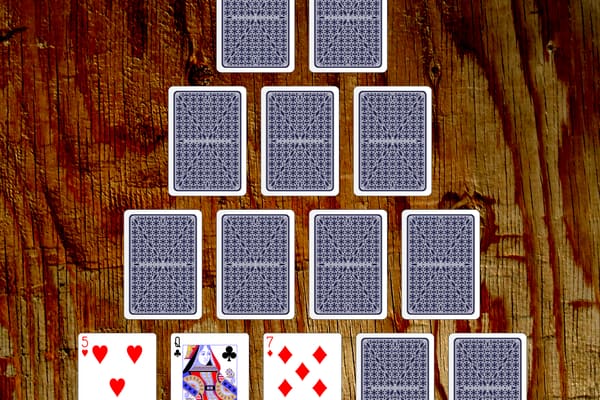
Pyramid is a party bluffing-and-memory drinking game for 3 to 8 players. A pyramid of 15 face-down cards (5-4-3-2-1) sits at the centre of the table; each player has 4 hidden cards they peek at once and must then remember. The dealer flips pyramid cards one at a time from the bottom up, and any player may claim a rank match to assign drinks to an opponent, with each row worth more drinks than the one below (1 at the base, 5 at the apex). Claims may be real or bluffed, and the target may call the bluff at the cost of doubling the drinks for whoever turns out to be lying. Pyramid is almost always played casually with alcohol but works equally well with water, soft drinks, or forfeit tokens. Always agree that drinks are optional and drink responsibly.
Quick Reference
- 3-8 players, standard 52-card deck.
- Deal 15 cards face-down as a 5-4-3-2-1 pyramid at centre.
- Deal 4 cards to each player; each peeks once and memorises.
- Dealer flips pyramid cards bottom row first, left to right.
- Any player may claim a rank match (truth or bluff) to assign drinks to another.
- Target may call; caught bluffer OR wrong caller drinks 2x.
- Row values rising from 1 (bottom) to 5 (apex).
- Real match: assigner gives row-value drinks to target.
- Failed call or caught bluff: 2x row value drinks.
Players
3 to 8 players; best at 5 to 6 where every player has a good chance of matching upper-row cards. Smaller groups (3) make bluffs easier to catch but rounds thinner; larger groups (8) create abundant matches but slow the pace. Each player plays for themselves. A full game takes 15 to 25 minutes. Always play responsibly: agree drink strength up front, keep water alongside drinks, the game works identically with non-alcoholic substitutes or forfeit tokens, and never pressure anyone to keep drinking.
Card Deck
- One standard 52-card French-suited pack, jokers removed.
- Only RANK matters for matching ( matches regardless of suit).
- 15 cards form the pyramid (5-4-3-2-1 rows face-down), and 4 cards are dealt to each player as their hidden hand.
- With 3 players, 15+12 = 27 cards are in play; with 8 players, 15+32 = 47 cards are in play. The rest of the deck is unused.
- Use larger or smaller pyramids (6-row = 21 cards or 4-row = 10 cards) to scale game length.
Objective
Assign as many drinks as possible to other players by correctly matching (or convincingly bluffing) the ranks of revealed pyramid cards, while avoiding being caught in a bluff (which costs you double the row value in drinks). Upper rows are worth more drinks than lower rows, so the top card of the pyramid is by far the highest-stakes moment of the game.
Setup and Deal
- Shuffle the 52-card deck thoroughly.
- Deal 15 cards face-down into a pyramid at the centre of the table: 5 cards as the bottom row, 4 directly above, 3 above that, then 2, then 1 at the apex.
- Deal 4 cards face-down to each player. Each player PRIVATELY peeks at their own 4 cards once, then returns them face-down. Players may not peek again during play.
- Set the remaining cards aside; they are not used this game.
- Agree drink size (one sip = 'drink', one gulp = 'chug', or use tokens) before starting. Confirm the row values: row 1 (bottom) = 1, row 2 = 2, row 3 = 3, row 4 = 4, row 5 (apex) = 5.
- The player to the dealer's left starts the bluffing once the dealer flips the first pyramid card.
Gameplay
- Flip a card: starting with the leftmost card on the bottom row, the dealer flips one pyramid card face-up. Move along the row left to right, then up to the next row, and continue until the apex card is flipped last.
- Claim a match (real or bluff): any player may announce 'I have a [rank]' that matches the flipped card and assign the row's drink value to any other player. Assignments can be split (e.g., 2 drinks to one player and 2 to another on a row-4 flip).
- Multiple claimants: if more than one player claims a match, each one separately assigns the full row value; a rank-7 flip with three claimants results in three independent drink assignments.
- Call the bluff: the player being assigned drinks may say 'show it' or 'bluff!' before drinking. The claimant must then reveal the claimed card. If the claimant actually holds a match, they show it openly; the caller drinks DOUBLE the row value. If the claimant was bluffing (does not hold that rank), the claimant drinks DOUBLE.
- Discarding a revealed match: a revealed match card is placed face-up in front of the claimant and removed from their hand; they now have 3 cards (or fewer) for the rest of the game. Bluff-caught claimants do NOT discard anything since they had no match to show.
- Unmatched flip: if no player claims a match, the card is discarded face-up and play continues with the next flip.
- Progression up the pyramid: the dealer flips every card, row by row, until the apex card is flipped and resolved. The apex card is worth 5 drinks per successful claim (or 10 drinks on a failed call) and is typically the decisive moment of the game.
Winning
Pyramid is a party game with no formal winner. The game ends when all 15 pyramid cards have been flipped and all assignments resolved. Socially, the 'winner' is whoever assigned the most drinks without getting caught bluffing, and the losers are whoever drank the most. In the 'Ride the Bus' variant (see below), the player left with the most unused hand cards at the end plays a gauntlet penalty round.
Scoring (Drink Accounting)
- Row values: Bottom (row 1) = 1 drink, row 2 = 2, row 3 = 3, row 4 = 4, apex (row 5) = 5.
- Successful claim: assigner gives the row value in drinks to another player.
- Failed call: caller drinks 2x the row value (so a failed call on the apex is 10 drinks).
- Failed bluff: the caught bluffer drinks 2x the row value.
- Split assignments: the row value may be split among multiple targets as the claimant chooses (e.g., 4 drinks on a row-4 match can be 2+2 or 3+1 or 4+0).
- Drink == sip, gulp, or token: agree at the start so the math is clear.
Common Variations
- No bluffing (Pure Memory): only players with an actual matching card may claim; no bluffing or calling. Fastest and friendliest version.
- 6-row Pyramid (extended): use 21 pyramid cards with a top card worth 6 drinks. Longer and more dramatic.
- Ride the Bus: after the pyramid is exhausted, the player with the most cards remaining in hand plays a four-step 'ride the bus' penalty: guess red/black, higher/lower, inside/outside, suit. Each wrong guess restarts the chain. Popular follow-up mini-game.
- Memory enforcement: after the initial peek, players must keep their cards in a fixed place and may not re-inspect them. A house rule that raises bluff risk because you are guessing your own cards late in the game.
- Token edition: replace drinks with chips, poker tokens, or IOU sips. Last player with the most tokens wins; an option for groups playing without alcohol.
- Double Pyramid: build two pyramids side by side for a longer night; alternate flips between pyramids to keep momentum.
- Bluff-once-and-out: each player may only bluff ONCE per game; after a bluff (successful or caught) they cannot bluff again. Tones down the bluffing spam at the apex.
Tips and Strategy
- Memorise your cards accurately during the initial peek. Group them mentally by rank ('two Jacks, a 5, and a 9') rather than by suit; ranks are what the pyramid reveals.
- Save bluffs for upper rows. A caught bluff on row 1 costs 2 drinks; on the apex it costs 10. But a successful bluff on the apex assigns 5 drinks with no proof needed; the expected value rises sharply with row height.
- Never bluff the same rank twice. If the pyramid reveals two Jacks and you claim both with just one real Jack in hand, your second claim is a known bluff because the first was discarded.
- Call bluffs selectively. A player who claims 5+ matches in one game statistically cannot hold them all; start calling after their third or fourth claim.
- Assign drinks strategically. Spread small assignments across the table early; save large penalties for the player who has bluffed successfully too many times.
- Watch the discard pile. Any matched card is publicly shown; if all four of a rank have been discarded, nobody can legitimately claim that rank again, so any further claim is a guaranteed bluff.
- Keep water nearby. Pyramid nights with strong drinks go wrong quickly; pacing keeps the bluffing sharp.
Glossary
- Pyramid: the 15-card face-down arrangement (5-4-3-2-1) at the centre of the table.
- Row value: the drink count assigned on a successful match at that row (1 at the base up to 5 at the apex).
- Claim / bluff: announcement that you hold a matching rank, whether true or false.
- Call / show it: the target's challenge demanding the claimant reveal the card.
- Discard: a revealed match card, placed face-up out of play; the claimant's hand shrinks.
- Ride the Bus: a popular post-game penalty mini-game played by the player with the most remaining cards.
- Apex: the topmost pyramid card, worth 5 drinks per match and the climax of the game.
Tips & Strategy
Memorise your four cards thoroughly before the game starts. Bluff sparingly on lower rows (the upside is small) and save bold bluffs for the upper rows where a successful assignment is worth 4 or 5 drinks. Track the discard pile: once all four cards of a rank have been revealed, any further claim on that rank is a guaranteed bluff and automatically callable.
The bluffing element is what makes Pyramid interesting. A well-timed bluff on the top card can swing the whole game, but the risk of drinking double keeps everyone honest. Expert play requires memorising which ranks have already been discarded: a rank whose four cards have all been publicly revealed can no longer legitimately be claimed, so any later claim on that rank is a guaranteed bluff.
Trivia & Fun Facts
The top card of the pyramid is worth 5 drinks, making a successful bluff on it one of the most rewarding (and riskiest) moves in the game; a failed call on the apex is 10 drinks. Pyramid is one of the few drinking games with a clear skill component (memory and bluff-calling), which is why it often features in college tournament-style party nights alongside Beer Pong.
-
01How many cards form the bottom row of a standard Pyramid drinking game, and how many cards total make up the pyramid?Answer 5 cards on the bottom row, with rows of 5-4-3-2-1 for 15 cards total in a standard pyramid. Row values rise from 1 at the base to 5 at the apex card.
History & Culture
Pyramid (sometimes called Pyramid Scheme) is a North American party drinking game that emerged on college campuses in the 1980s and 1990s as a structured alternative to the looser Kings / Ring of Fire format. Its core loop (shared reveal, matching on rank, bluff-and-call risk) is borrowed from card-counting casino games and from the children's bluffing game Cheat. Social drinking games themselves are far older; the Oxford English Dictionary has citations for 'drinking game' going back to the 17th century.
Pyramid combines memory and social deception in a drinking-game format, making it one of the more engaging and skill-based party card games. It is a staple of North American university life and has found steady popularity on overseas campuses through international student exchange. Its simple setup (one deck, one flat surface, one minute to learn) has kept it circulating for decades.
Variations & House Rules
A pure-memory variant removes bluffing entirely. Ride the Bus is a popular post-pyramid penalty mini-game. Larger 6-row or smaller 4-row pyramids adjust game length. Token editions replace drinks with chips for alcohol-free play. Bluff-once-and-out caps bluffing at a single attempt per player.
Adjust the pyramid size and drink values to match your group's pace: a 4-row pyramid (10 cards) is a 10-minute game; a 6-row pyramid (21 cards) lasts 30 minutes. For a family-friendly version, replace alcohol with forfeit tokens and let the game's memory and bluffing drive the fun without drinking stakes.