
How to Play
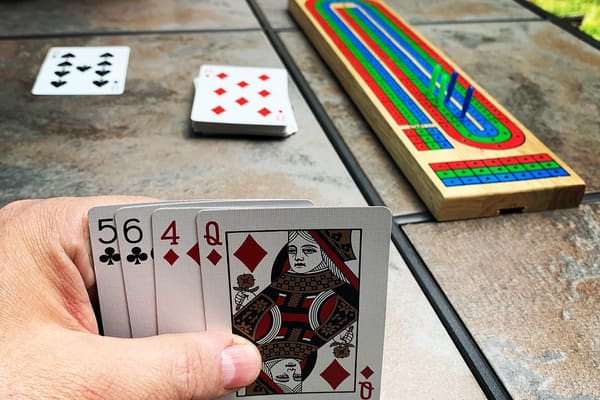
Cribbage is a classic 17th-century English card game for 2 to 4 players, invented by the poet Sir John Suckling around 1630. The defining feature is the pegged scoring board (121 holes) and the dual scoring phase per hand: players score once during play ('pegging'), again when they count their 5-card hands ('the show'), plus the dealer scores a bonus 'crib' hand built from everyone's discards. First to 121 wins; losers skunked at under 91 or double-skunked at under 61.
Cribbage is a classic 17th-century English card game, usually for two players, where you score points by making card combinations (like pairs and totals of fifteen). Scores are tracked on a wooden board by moving pegs hole-by-hole, which is why the playing phase is nicknamed 'pegging'. First to 121 points wins.
Quick Reference
- Cut for first dealer; LOW card deals. Starting score is 0 for everyone.
- 2 players: deal 6 each, discard 2 to crib. 3 players: deal 5 each + 1 to crib, discard 1 each. 4 players (partners): deal 5 each, discard 1 each.
- Non-dealer cuts; dealer turns the top card of the lower half as the starter. Starter = Jack → dealer pegs 2 (His Heels).
- Non-dealer plays first. Running total starts at 0 and may not exceed 31. Cards: A=1, 2-10=face, J/Q/K=10.
- You MUST play if a card in your hand keeps the total ≤ 31; only say 'Go' when no card fits.
- Pairs only match by RANK; a 10 and a Jack do NOT pair. Can't play? Say 'Go'; last player pegs 1 (or 2 for exactly 31). Count resets to 0 after a Go or 31.
- Play: fifteen=2, thirty-one=2, pair=2, pair royal=6, double pair royal=12, run=1/card (order-free), go=1, last card=1.
- Show (hand + starter): fifteens=2 each, pair=2, triple=6, quad=12, run=1/card.
- Hand flush: 4 same suit=4 pts (+1 if starter matches=5). Crib flush: only scores if all 5 share a suit (5 pts).
- His Nobs: Jack in hand matching starter's suit = 1 point.
- Count order: non-dealer → dealer's hand → dealer's crib. Game ends the moment someone hits 121 (even mid-count). Impossible scores: 19, 25, 26, 27.
Players
Cribbage is usually played by 2 players, but also works for 3 (each for themselves) or 4 (two partnerships sitting opposite each other). A single hand takes 5 to 10 minutes; a full game to 121 typically runs 20 to 45 minutes. Turn order is clockwise; the first dealer is chosen by cutting for low card, then deal rotates (or alternates, with 2 players) each hand.
Card Deck
- Standard 52-card pack. No jokers.
- Card values during the play and for making fifteens: Ace = 1, numbered cards = face value, and Jack, Queen, King each count as 10.
- Rank order for runs: A, 2, 3, 4, 5, 6, 7, 8, 9, 10, J, Q, K. Aces are LOW and runs do NOT wrap (Q-K-A is not a run).
- Equipment: a Cribbage board with 121 holes (or 61 for short games) and two pegs per player / team, or paper and pencil as a substitute.
Objective
Be the first player (or partnership) to peg 121 points on the board. Points are scored twice per hand (once during the play, once at the show), plus a bonus crib hand for the dealer. The moment anyone reaches 121 the game ends, even mid-count, so the counting order (non-dealer first) can decide close games.
The Big Picture
What makes Cribbage unusual is that you score twice in every hand. First, players take turns laying cards down one at a time, scoring combinations as they go; this is called the play (or pegging). Then everyone picks their cards back up and scores them again as a five-card hand (their four cards plus a shared 'starter' card); this is called the show. On top of that, the dealer gets a bonus fifth hand called the crib, made up of cards everyone discarded at the start. Every hand: deal, then discard to crib, flip the starter, play (peg), count hands (show). Repeat until someone reaches 121. Important: during the play, each player plays cards face-up IN FRONT OF THEMSELVES (not into a central pile), so that at the end everyone can pick up their own four cards to count in the show.
Setup and Deal
- First dealer: cut the deck, and the player drawing the LOWER card deals first. The deal then alternates each hand (with 2 players) or rotates clockwise (with 3 or 4).
- Starting score: both players (or teams) start at 0 and track scores with pegs on a Cribbage board.
- Shuffle and cut: dealer shuffles, non-dealer cuts.
- 2 players: deal 6 cards face-down to each player, one at a time. Each player looks at their hand and selects 2 cards to discard face-down as the crib (the crib belongs to the dealer and scores for the dealer at the end of the hand).
- 3 players: deal 5 cards to each player and 1 card face-down to start the crib. Each player then discards 1 card face-down to the crib (making 4 cards in the crib).
- 4 players (partnerships, sitting opposite): deal 5 cards to each player. Each player discards 1 card face-down to the crib (again 4 cards). The crib belongs to the dealer, and partnership scores are tracked jointly.
- Misdeal: if the dealer accidentally flashes a card, deals the wrong number, or deals to the wrong player, reshuffle and redeal; no penalty.
The Starter Card
After discards, the non-dealer cuts the remaining undealt deck (lifting the top half without revealing its bottom card). The dealer turns up the TOP card of the LOWER half and places it face-up on top of the pack. This card is the starter (or 'cut card'). It is never played; it simply acts as a shared fifth card that every hand AND the crib use when counting at the end. His Heels (also 'Nibs'): if the starter is a Jack, the dealer immediately pegs 2 points, shouting 'Two for his heels!' This is separate from His Nobs (below), which is 1 point scored during the show.
The Play (Pegging)
- Non-dealer plays first. Play a card face-up in front of YOURSELF (not into a central pile) and announce the card's value aloud. Example: play a 7 and say 'seven'.
- The opponent then plays a card in front of themselves and announces the NEW running total. Example: play a 6 and say 'thirteen'.
- Play alternates. The running total must never exceed 31.
- Compulsion to play: on your turn, if ANY card in your hand keeps the total at 31 or under, you MUST play one. You cannot voluntarily skip a turn when a legal play exists.
- Go: if NO card in your hand can be played without exceeding 31, you say 'Go'. The opponent then keeps playing any cards they can fit, one at a time, scoring any combinations as normal. When neither player can play, the last player to play a card pegs 1 for the Go (or 2 instead if their card brought the total to exactly 31).
- Resetting the count: once neither player can play, the count resets to 0 and whoever did NOT just peg for the Go starts the next series (if it was your opponent who hit 31 or the Go, you lead the next series).
- Repeat until EVERY card from every hand has been played (8 cards total in a 2-player game).
- Card values for the running total: Ace = 1, 2 through 10 = face value, Jack = 10, Queen = 10, King = 10.
- Critical pair rule: face cards are each worth 10 for the running total, but they only form PAIRS with cards of the SAME RANK. A 10 and a Jack do NOT make a pair. A Queen and a King do NOT make a pair. Only two Jacks (or two Queens, two Kings, or two 10s) pair.
Scoring During the Play
Every time you play a card, check if you just triggered any of these, and score immediately by pegging. The traditional patter 'fifteen two, fifteen four, and a pair makes six' tells everyone what you are claiming.
- Fifteen (2 points): your card brings the running total to exactly 15.
- Thirty-one (2 points): your card brings the running total to exactly 31.
- Pair (2 points): you play a card of the same RANK as the one just played (a 10 on a 10, NOT a 10 on a Jack).
- Pair royal / three of a kind (6 points): three of the same rank played in immediate succession.
- Double pair royal / four of a kind (12 points): four of the same rank in immediate succession.
- Run (1 point per card): the LAST 3 or more cards played form a run of consecutive ranks, even if played out of order. Example: playing 5, then 3, then 4 scores a run of 3 (3 points) because the last three cards in order are 3-4-5. If the next card is a 2 or a 6, that scores a run of 4 (4 points). Suits do not matter. A break (a repeated rank or non-consecutive card) ends the run; new runs must build again from 3+ consecutive.
- Go (1 point): you score 1 when your opponent says Go and you cannot play any more either.
- Last card (1 point): whoever plays the final card of a series pegs 1 point if the total ends below 31 (if it lands exactly on 31, they peg 2 for thirty-one instead).
- Pegging sequence legality: to score for pair, pair royal, or run, the cards must have been played CONSECUTIVELY within a single series (no resets in between).
The Show (Counting Hands)
After every card has been played, each player picks their own four played cards back up. Each player counts their 4-card hand TOGETHER with the starter, treating it as a 5-card hand. The dealer then additionally counts the crib (also with the starter) as an extra 5-card hand.
- Counting order (critical): non-dealer first, then the dealer's hand, then the dealer's crib. With more than 2 players, counting goes clockwise from the dealer's left and finishes with the crib.
- Why the order matters: the instant anyone reaches 121, the game ends. A non-dealer who would otherwise lose can still win if their count reaches 121 first, because the dealer never gets to count.
- Counting patter: say your score aloud as you find each combination ('15-2, 15-4, and a run of three is 7, and a pair is 9, and His Nobs is 10'). This lets opponents verify and, under Muggins, claim anything you miss.
Scoring During the Show
Look at your 4 hand cards plus the starter (5 cards total) and score every combination you can find. ONE card may belong to MANY combinations at the same time (that is why high scores are achievable).
- Fifteen (2 points each): every distinct group of cards that sums to 15. A hand of 5-5-5-J with a 5 starter contains many fifteens (each 5+J pair = four fifteens, plus combinations of three 5s = four fifteens), totalling 16 points just from fifteens.
- Pair (2 points each): two cards of the same rank. Three of a kind = 6 (three pairs); four of a kind = 12 (six pairs).
- Run (1 point per card): three or more consecutive ranks. Duplicates create multiple runs: 4-5-5-6 is two runs of three (6 points) plus a pair (2) = 8 total. A pattern like 5-6-6-7-7 is four runs of three (12 points) plus two pairs (4) = 16.
- Flush in your hand: 4 points if all 4 HAND cards are the same suit; 5 points if the starter is that same suit too.
- Flush in the crib: only scores if ALL 5 cards (the 4 crib cards AND the starter) share a suit, worth 5 points. A 4-card crib flush scores 0. This is a common rule to get wrong.
- His Nobs (1 point): if your hand contains the Jack of the SAME SUIT as the starter, score 1 point for His Nobs. This is separate from His Heels (which scored 2 for the dealer if the starter itself was a Jack).
- Impossible scores: every total from 0 through 29 is possible for a single hand EXCEPT 19, 25, 26, and 27. 'Nineteen' is Cribbage slang for a hand worth zero (since that total cannot occur).
Winning
The first player (or partnership) to reach or pass 121 points wins instantly. Scoring stops the moment someone hits 121, even mid-count during the show, which is why the count order (non-dealer first) can be the deciding factor in close games. You do NOT need to hit 121 exactly.
- Skunk line (lurch): if the losing player's final score is 90 or less (failed to reach 91), they are 'skunked' and the winner earns a double game (2 games in match play).
- Double skunk: if the loser's final score is 60 or less (failed to reach 61), they are 'double-skunked' and the winner earns a quadruple game (4 games in match play).
- Triple skunk (house rule): failing to reach 31 is sometimes called a triple skunk; rarely used in tournament play.
- Match play: a typical Cribbage match runs best-of-3 or best-of-5 games, with skunks counting as extra games won.
Muggins (the Optional Points-Claiming Rule)
Muggins is an optional rule that many clubs and tournaments use. If a player, while counting their hand or crib, overlooks any scoring combination, the OPPONENT may call 'Muggins!' after the count is announced, name the missed combination, and peg those points for themselves. Muggins trains players to count carefully and announce every combination aloud. Beginners usually play WITHOUT Muggins until they feel comfortable counting; experienced clubs play WITH it as the default.
Common Variations
- Five-Card Cribbage: the original 17th-century form, 2 players only; deal 5 cards each, discard 2 to the crib (only 3 cards left to play each). Game is to 61 points (once around a single-pegging board). Non-dealer also scores 3 points at the start of the first hand ('three for last') to compensate for the dealer's crib advantage.
- Seven-Card Cribbage: variant with larger hands for 2 players; deal 7 cards each, discard 2 to the crib (5 cards played). Slower but with richer hands.
- Three-Player Cribbage: each of 3 players plays their own hand; the dealer's crib rotates clockwise; no partnerships; game to 121.
- Four-Player Partnership Cribbage: 2 teams of 2 sitting opposite. Partners share a combined score. Play proceeds clockwise; counting order is clockwise from the dealer's left, with the crib scored last.
- Losing Cribbage (Hazard): low score wins; all scoring is inverted. A novelty form.
- Muggins: see above; many tournaments enforce it.
- Shotgun Cribbage: each player keeps ALL 6 cards for the show (no crib); fast and hand-heavy.
- Five-Card Stud-style crib variants: various modern inventions; uncommon.
Tips and Strategy
- Your crib advantage is huge: the dealer's crib averages 4 to 5 points per hand. When dealing, feed your own crib cards that combine well (5s, pairs, cards one rank apart).
- Poison an opponent's crib with low disconnected cards (9-K, 2-9, A-10) that rarely form combinations.
- Fives are gold. Every 10-card (10/J/Q/K) combined with a 5 makes fifteen; there are 16 ten-cards in the deck. Never give your opponent a 5 for their crib unless you have no safer option.
- Pegging leads: leading a 4 or lower is safer than leading a 5, because any 10-card your opponent plays on a 5 makes fifteen.
- Runs in pegging do not have to be in order. If you play a 4 and opponent plays a 5, any 3 or 6 next scores a run.
- Never peg 11 to reach exactly 21: many opponents hold a 10 to peg 31 for 2. Reaching 21 or less invites the 10-card trap.
- Hold pairs for pegging when you can; pairing an opponent's card pegs 2.
- Count aloud with the traditional patter: '15-2, 15-4, and a run of three is 7, and a pair makes 9.' This catches your own errors and Muggins-proofs your counting.
- Memorise impossible scores (19, 25, 26, 27) as a sanity check; if your count lands there, you miscounted.
Glossary
- Crib (box): the 4-card extra hand built from all players' discards; scored by the dealer at the end of the hand.
- Starter (cut card): the face-up card turned up after discards; acts as a shared 5th card for every hand and the crib.
- His Heels (His Nibs): 2 points pegged by the dealer immediately if the starter is a Jack.
- His Nobs: 1 point scored during the show if your hand contains the Jack of the same suit as the starter.
- Pegging: scoring during the play phase by moving your pegs along the board.
- The play: the phase where players alternately lay cards to a running total capped at 31.
- The show: the phase where players pick up and count their hands (plus starter, plus crib for dealer).
- Go: called when you cannot play without exceeding 31; opponent keeps playing and eventually pegs 1 for the Go.
- Fifteen: a combination of cards totalling 15; worth 2 points each.
- Pair royal: three of a kind; worth 6 points. Double pair royal: four of a kind; 12 points.
- Run (sequence): three or more consecutive-rank cards; 1 point per card.
- Flush: 4 same-suit cards in a hand (4 points; 5 with matching starter); crib requires all 5 same suit.
- Muggins: optional rule letting an opponent claim any points a counter overlooks.
- Skunk (lurch): loser fails to reach 91; double game. Double skunk: loser fails to reach 61; quadruple game.
- Pone: archaic term for the non-dealer.
- Nineteen: slang for a zero-point hand (since 19 is an impossible score).
Tips & Strategy
Dealer has the advantage because the crib is theirs, so feed your own crib with fives, pairs, and near-runs. When it is not your crib, poison it with low disconnected cards (like 9-K or 2-9) that rarely combine. Fives are the most powerful cards in the game because every 10-valued card (10, J, Q, K) combined with a 5 makes fifteen; guard them jealously. During the play, runs do not have to be in order, so leading a 4 invites your opponent to build a run on either side. Count your hand aloud the first few games; missing points is common, and in strict Muggins rules an opponent can claim any points you miss.
The hidden skill is discard management, not play. What you send to the crib determines almost half your hand's potential points; expert players calculate expected crib value for each discard option before committing. Pegging discipline is the second skill: refusing to play a 5 that brings the running count to 15 is common for beginners, but holding a 5 for the show often costs more pegging points than it saves. Counting runs during pegging (remembering that runs do not have to be in order) adds a surprisingly large expected value once learned.
Trivia & Fun Facts
The Cribbage board has 121 holes and players score by jumping two pegs hole-by-hole; using two pegs lets onlookers verify the last move because the trailing peg shows where you were and the leading peg shows where you are. The highest possible hand score is 29 (a 5 in any suit plus the three other 5s, with a Jack matching the starter's suit as 'His Nobs'). A 29 hand is so rare it is often documented by clubs and newspapers. Sir John Suckling reportedly fleeced English nobles at Cribbage and invested the winnings in a disastrous military campaign, contributing to his ruin.
-
01In Cribbage, what is the term for the bonus 2 points the dealer scores immediately if the starter card is a Jack?Answer His Heels (also called 'His Nibs'). The dealer scores 2 points the instant the starter is revealed as a Jack, before any play begins. It is distinct from His Nobs (1 point for holding the Jack of the same suit as the starter in your own hand during the show).
-
02What is the highest possible score a single Cribbage hand can reach, and what cards form it?Answer 29 points. The hand is three 5s plus the Jack matching the starter's suit, with the starter being the fourth 5. The fifteens (eight distinct pairings of 5s with the Jack or between the 5s), the four-of-a-kind (12), and His Nobs (1) sum to 29. A 29 hand is astronomically rare and is often framed and logged by the player who gets it.
-
03Which four single-hand scores between 0 and 29 are impossible to produce in Cribbage?Answer 19, 25, 26, and 27. Every other total from 0 to 29 is achievable with some combination of 4 hand cards plus the starter, but these four cannot be produced by any valid arrangement. 'Nineteen' is Cribbage slang for a zero-point hand, since no hand can actually score 19.
History & Culture
Cribbage was invented in the 17th century by the English Cavalier poet Sir John Suckling (1609-1641), who adapted it from the older game of Noddy. Its unique pegged scoring board made it a mainstay of English pubs and sailors' messes, and it remains the official card game of the Royal Navy. Cribbage travelled to North America with colonists and became a fixture of New England taverns and US submarine wardrooms in the 20th century; the oldest commissioned US Navy submarine traditionally carries a Cribbage board belonging to the 'oldest boat' in the fleet.
Cribbage is the official card game of the Royal Navy and a fixture of British pub culture. It is a generational ritual in many North American families, often learned at kitchen tables from grandparents alongside chess and crossword puzzles. The game's 17th-century origins and unchanged rules make it one of the longest-surviving card games in the English-speaking world; modern Cribbage is played to essentially the same rules that Sir John Suckling knew.
Variations & House Rules
Muggins (strict rules): an opponent may claim any points you miss at your show. Three-player Cribbage deals 5 cards each plus 1 to the crib; 4-player is played in partnerships. Six-Card Cribbage is the standard 2-player form (6 cards each, discard 2 to the crib). Five-Card Cribbage is an older, shorter form (6 cards dealt, 5 kept, 1 to crib, game to 61). Captain's Cribbage and Lose-Score variants add novelty tweaks.
Start new players with 2-Player Six-Card Cribbage (the dominant modern form) and skip Muggins until they have internalised the counting. Use a 121-hole board with two pegs per player; the trailing peg helps catch scoring errors. For a longer match, play best-of-3 games or switch to the 181-hole 'skunk line' board.


