
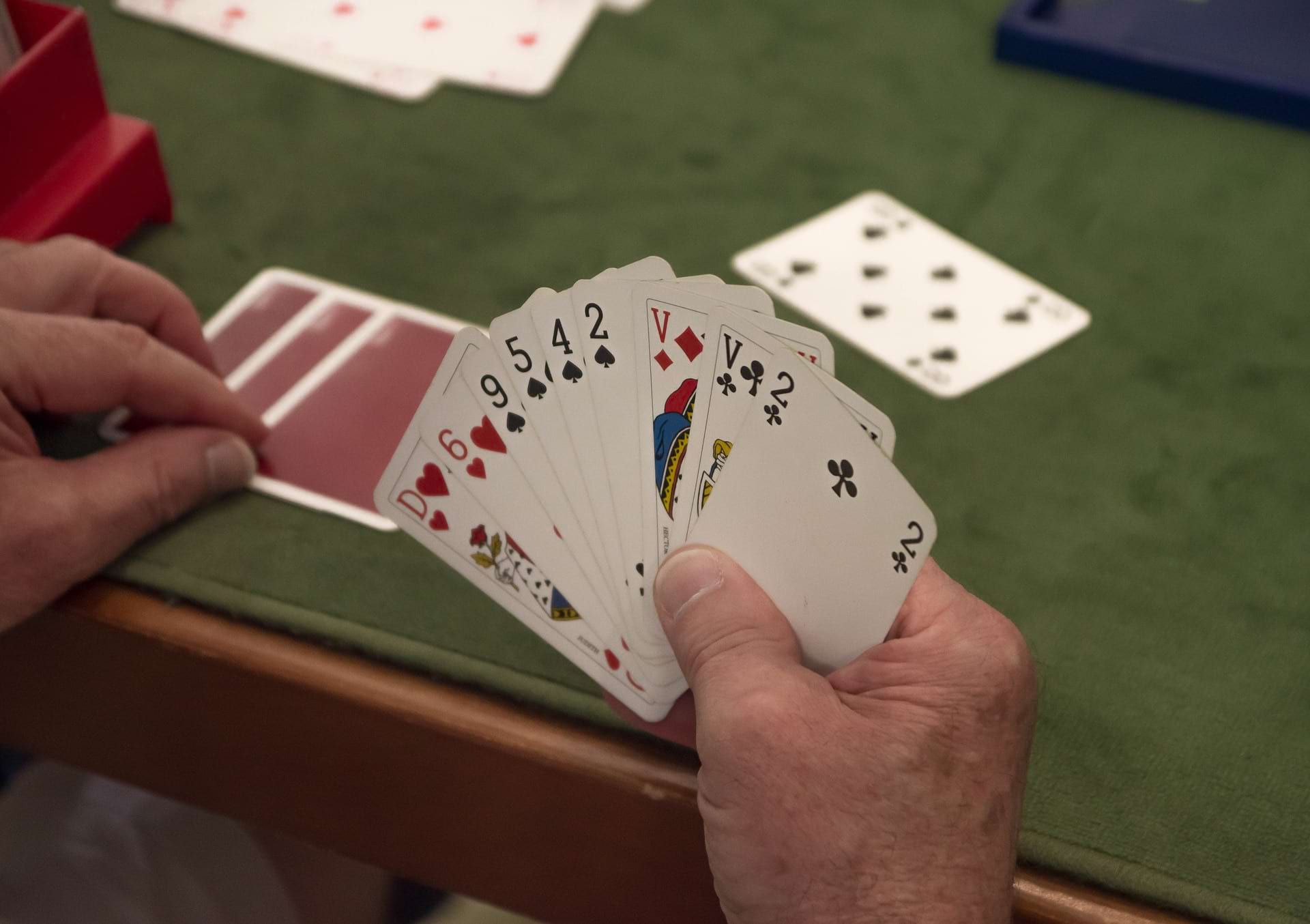
How to Play
Mau Mau is a 2 to 6 player shedding game, one of the most popular family card games in Germany and neighboring countries, played with a standard 52-card deck (traditionally a 32-card Skat pack). Players match the rank or suit of the top discard, with [7♠] forcing the next player to draw 2, [J♦] acting as a wild suit-changer, and [8♣] skipping a turn. The first player to empty their hand wins, but must call out 'Mau' and 'Mau Mau' at the right moments or face a penalty draw.
Mau Mau is a fast-paced shedding game for 2 to 6 players that is one of the most widely played family card games in Germany, Austria, and Switzerland, closely related to international cousins like Crazy Eights and Switch but distinguished by its own set of special cards and its famous 'Mau' call. Each player starts with a small hand and takes turns playing a card that matches either the rank or the suit of the top card on the discard pile; 4 ranks carry special powers that can force opponents to draw cards, skip a turn, or let the player switch the suit in play. The first player to empty their hand wins the round, but they must announce 'Mau' the moment they are down to a single card and 'Mau Mau' the instant they play their last one, or risk a penalty draw if an opponent catches the slip first. Traditionally played with a 32-card Skat-style pack, Mau Mau is just as commonly played worldwide with a full standard 52-card deck, making it an easy game to pick up wherever a deck of playing cards is on hand.
Quick Reference
- 2 to 6 players. Shuffle a standard 52-card deck.
- Deal 5 cards to each player; place the rest face down as the stock.
- Flip the top stock card face up to start the discard pile.
- Play 1 card matching the rank or suit of the top discard, or draw from the stock if you cannot.
- forces the next player to draw 2 (stackable); lets you name the next suit; skips the next player.
- Say 'Mau' the instant you have 1 card left, and 'Mau Mau' as you play your last card.
- The player who goes out scores 0 for the round.
- Everyone else totals their remaining cards: Ace/King/Queen/Jack = 10, numeral cards = face value.
- Scores accumulate across a match; first to a target such as 100 stops the match.
- The player with the LOWEST total when the match ends wins.
Players
2 to 6 players with a single 52-card deck; beyond 6, most groups shuffle 2 decks together (104 cards) so that everyone still gets a workable hand and the stock does not run dry too quickly. Every player competes individually; there are no partnerships. Play proceeds clockwise, and the deal rotates clockwise after every round. A single round takes 5 to 15 minutes depending on how the special cards fall; a casual evening session of several rounds runs 30 to 60 minutes.
Card Deck
- Standard 52-card pack: one deck of French-suited cards, no jokers, for up to 6 players.
- Traditional alternative: in Germany, Mau Mau is traditionally played with a 32-card Skat pack (7 through Ace in each suit); this entry describes the widely used full 52-card version, which simply adds the 2 through 6 ranks as ordinary cards with no special power.
- Four special ranks: forces the next player to draw 2 cards; is wild and lets the player who plays it name the suit that must be matched next; skips the next player's turn; all other ranks, including Aces, Kings, Queens, and the 2 through 6 numeral cards, have no special effect and are played purely for their rank or suit match.
- Card values for optional scoring: Ace, King, Queen, Jack = 10 each, numeral cards 2 through 10 = face value.
Objective
Be the first player to get rid of every card in your hand by playing them, one per turn, onto the discard pile, while correctly announcing 'Mau' when you reach your last card and 'Mau Mau' the moment you play it.
Setup
- Shuffle the 52-card pack thoroughly.
- Deal 5 cards face down to each player, one at a time clockwise starting with the player to the dealer's left.
- Place the remaining cards face down in the center as the stock.
- Turn the top card of the stock face up beside it to start the discard pile; if that first card is , the dealer names the suit that the first player must match.
- The player to the dealer's left takes the first turn.
Gameplay
- Match to play: on your turn, play one card from your hand that matches either the rank or the suit of the top card on the discard pile, for example a on a (matching rank) or a on a (matching suit).
- Draw when stuck: if you have no legal card to play, draw one card from the stock. If it can be played, you may play it immediately or hold it for later; if not, your turn ends.
- Play a : the next player must draw 2 cards from the stock and lose their turn, unless they hold a 7 of their own to play, which passes the draw-2 penalty, now increased to 4, on to the following player; this can chain around the table until someone cannot continue it.
- Play a : the player names any suit, including the one already showing, that the next player must match; a Jack can be played regardless of the top card's rank or suit.
- Play an : the next player's turn is skipped entirely, and play continues with the player after them.
- Announce 'Mau': the moment you play a card that leaves you with exactly 1 card in hand, you must say 'Mau' out loud before the next player acts.
- Announce 'Mau Mau': when you play your final card to empty your hand, you must say 'Mau Mau' as you play it to end the round immediately.
- Missed announcement penalty: if you forget to say 'Mau' or 'Mau Mau' and another player calls out the mistake before the next player's turn ends, you must draw 2 penalty cards before play continues.
- Restocking: if the stock runs out before the round ends, turn the discard pile face down except for its top card and reshuffle it to form a new stock.
Scoring
- Round winner: scores 0 points for that round; every other player totals the point value of the cards remaining in hand: Ace, King, Queen, Jack = 10 each, numeral cards 2 through 10 = face value.
- Running total: many groups play a match of several rounds, adding each round's totals to a running score for every player who did not go out.
- Match target: the match ends once an agreed target is reached, commonly 100 points; the player with the LOWEST total when the match ends is the overall winner.
- Casual play: many households skip scoring entirely and simply play round after round for fun, with whoever goes out first in each round declared that round's winner.
Winning
A round ends the instant a player plays their last card while correctly announcing 'Mau Mau'; that player wins the round outright. For a scored match, play continues across multiple rounds until a player's cumulative penalty total reaches the agreed target, at which point the player with the lowest total overall wins the match; if 2 or more players tie for the lowest total, an extra tie-breaking round is played among just the tied players. In casual, unscored play, players often simply reset and deal a fresh round immediately, with bragging rights for the round going to whoever went out first.
Common Variations
- 32-card Skat pack: the traditional German version removes the 2 through 6 of each suit, using only 7 through Ace (32 cards); the draw-2, wild, and skip powers still apply.
- Ace power: many regional house rules give the Ace a special power of its own, most commonly forcing every other player to draw 1 card or skipping every other player's turn once around the table; this entry describes the base version, where Aces have no special power, so confirm before dealing.
- Seven stacking limit: some groups cap the chain at a single additional player rather than letting the draw penalty escalate indefinitely around the table.
- Two-deck Mau Mau: for 7 or more players, 2 standard 52-card decks are shuffled together so every seat still receives a workable hand and the stock does not run dry partway through a round.
- Bavarian Rummy: a commercially published American adaptation of Mau Mau, sold with its own branded deck, follows the same core matching and special-card structure under a different name.
Tips and Strategy
- Hold your s in reserve. Since a Jack can be played on any top card regardless of rank or suit, saving one for a moment when you are otherwise stuck is more valuable than playing it the instant you draw it.
- Watch for stacked sevens. If you are holding a and the player before you plays one, playing your own immediately passes on an even larger draw penalty rather than absorbing it yourself.
- Time your eights against threats. Playing an to skip the player sitting right before someone who is down to 1 or 2 cards can buy the rest of the table an extra turn to catch up.
- Say 'Mau' immediately. Announcing the moment you reach 1 card, rather than waiting to see what happens next, avoids handing opponents a free penalty against you for forgetting.
- Track suits, not just ranks. Because you can match by suit alone, holding onto a spread of different suits keeps your options open longer than hoarding several cards of one rank.
Glossary
- Discard pile: the face-up pile in the center of the table where played cards accumulate; its top card sets what the next player must match.
- Stock: the face-down pile of undealt cards that players draw from when they cannot play.
- Going out: playing your final card to empty your hand and win the round.
- Wild card: a card, such as the in this entry's ruleset, that may be played regardless of the top discard's rank or suit.
- Stacking: playing a matching special card, such as a second , to pass an escalating penalty on to a later player instead of absorbing it yourself.
Tips & Strategy
Because Jacks can be played on any top card regardless of rank or suit, the single best long-term habit in Mau Mau is holding at least one back as an emergency escape rather than dumping it the moment it appears in your hand; a hoarded Jack often rescues you from an otherwise unplayable turn. Watching the discard pile for stacked sevens pays off too: if you are holding a [7♠] when the player before you plays one, playing yours immediately passes an even larger draw penalty down the table instead of forcing you to absorb the full 2-card draw. An [8♣] is at its strongest when timed to skip the player sitting just before an opponent who is down to 1 or 2 cards, since it effectively buys the rest of the table an extra turn to catch up before that opponent can go out. Reacting instantly the moment you reach exactly 1 card and calling 'Mau' without hesitation protects you from a free penalty draw handed to opponents who catch the slip first. Finally, since matching by suit alone is just as valid as matching by rank, spreading your hand across multiple suits rather than clustering several cards of one rank keeps more of your options open on every turn.
Mau Mau rewards players who think a turn or two ahead about which of their cards are flexible rather than simply playing whatever matches first; a card that matches both the rank and suit of the current discard is more valuable to hold back than one that only matches by chance, since it keeps 2 different escape routes open on a future turn. The game's small set of special ranks means tracking how many sevens, eights, and Jacks have already appeared gives a real edge, since a player who knows all 4 Jacks are already out of play can stop worrying about being hit with a surprise suit change late in the round. Timing matters more than raw card quality: an [8♣] played to skip a nearly empty-handed opponent is worth far more at that moment than the same card played earlier just to stay active. Because reaching exactly 1 card triggers the mandatory 'Mau' announcement, strong players deliberately manage their hand so they are never caught reaching that point during a moment of distraction, since that is exactly when the missed-call penalty gets punished.
Trivia & Fun Facts
The game's name is also its central rule: players must shout 'Mau' the instant they are down to their last card and 'Mau Mau' the instant they play it, making Mau Mau one of the few widely played card games where speaking out loud at the right moment is itself a required game mechanic rather than just table talk. A [7♠] chain can, in principle, run all the way around a large table if every player happens to be holding a seven, turning a single card played early in a round into a cascading, ever-doubling draw penalty by the time it reaches an unlucky player without one to play back. Despite being one of Germany's most iconic card games, Mau Mau has no single official rulebook; nearly every family plays a slightly different mix of house rules for Aces, Nines, or stacking limits, and German card-game guides often print several competing variant lists side by side rather than one fixed ruleset. The game's American cousin, Bavarian Rummy, is sold in toy and game stores with entirely different card artwork and a different name, so many players in the United States have played what is functionally Mau Mau without ever hearing its original German name.
-
01What must a player shout the instant they are left holding only 1 card in Mau Mau, and what happens if they forget?Answer They must say 'Mau' immediately; if an opponent notices the missed announcement before the next player's turn ends, the forgetful player must draw a penalty of 2 extra cards before play continues.
-
02Which single card in the base Mau Mau ruleset can be played on any top card regardless of its rank or suit?Answer The Jack, for example [J♦], is wild in Mau Mau and lets the player who plays it name whichever suit the next player must match.
History & Culture
Mau Mau developed in German-speaking Europe during the 20th century as a homegrown relative of the international shedding-game family that also produced Crazy Eights in North America and Switch in Britain, all of which share a lineage of older European card games where players match rank or suit to empty their hands. It grew into one of the most widely taught children's and family card games in Germany, Austria, and Switzerland, commonly one of the first card games learned in German households alongside Skat, and it remains a staple of German card-game rulebooks and children's game collections to this day. The name is widely believed to derive from the Mau Mau uprising in Kenya during the 1950s, a period when the term entered German popular vocabulary as playful shorthand for anything chaotic or eventful, matching the game's habit of dramatic last-card reversals; though the exact origin of the name is debated, its call-out mechanic of shouting 'Mau' and 'Mau Mau' has become the game's defining, instantly recognizable feature. A commercial American adaptation called Bavarian Rummy later packaged the same core rules under a branded deck and new name for the US game market, introducing the mechanics to players who had never heard of the original German game.
Mau Mau occupies a similar place in German-speaking households that Crazy Eights holds in North America or Switch holds in Britain: it is very often the first card game children in Germany, Austria, and Switzerland learn to play with a full deck, taught at kitchen tables well before more demanding trick-taking games like Skat enter the picture. Its call-out mechanic, requiring players to announce 'Mau' and 'Mau Mau' out loud at the right instant, makes it a naturally social and slightly theatrical game, since forgetting the call in front of the whole table is a moment of good-natured embarrassment as much as it is a rules infraction. Because no single governing body has ever standardized its rules, Mau Mau also functions as a living example of how a folk card game evolves differently from household to household, with Ace powers, stacking limits, and deck sizes varying by region while the core rank-or-suit matching stays recognizable everywhere it is played. Its export abroad under other names, most notably as the commercially branded Bavarian Rummy in the United States, shows how a game's mechanics can travel internationally even when its original name and cultural identity do not.
Variations & House Rules
The traditional German version is played with a 32-card Skat pack, using only the 7 through Ace of each suit rather than a full 52-card deck, which shortens rounds and concentrates the special ranks into a smaller pack. Many regional house rules give the Ace an extra power on top of the base 4 special ranks described here, most commonly forcing every other player to draw 1 card or skipping every other player's turn once around the table, so confirming which extra powers are in play before dealing avoids disputes mid-round. Some groups cap how far a stacked seven's draw penalty can escalate, stopping it after a single additional player rather than letting it compound indefinitely around a large table. For 7 or more players, 2 standard 52-card decks are commonly shuffled together so that every seat still receives a workable hand and the stock does not run dry partway through a round. Bavarian Rummy repackages the same matching-and-special-card structure as a standalone commercial product with its own branded deck, proving how portable the core Mau Mau ruleset is outside its country of origin.
New groups often find it easiest to start with a smaller starting hand of 5 cards and the base 4 special ranks only, before adding house rules for Aces or Nines once everyone is comfortable with the core rank-or-suit matching. Dealing 7 cards instead of 5 lengthens each round and gives newer players more room to hold back a wild [J♦] in reserve rather than being forced to play it immediately. Capping the seven-stacking chain at 1 extra player keeps draw penalties from spiraling into a lopsided pile of cards for the unluckiest player at the table, which can otherwise frustrate beginners. Households that prefer a clear running competition rather than single throwaway rounds can adopt the point-scoring match format, playing to an agreed target such as 100 points instead of resetting after every round. For younger children, dropping the [7♠] draw-2 penalty entirely and keeping only the [8♣] skip and [J♦] wild simplifies the game while preserving its core rhythm of matching and reacting.


