
How to Play
Mao is a Crazy Eights variant with one unusual twist: you may never explain the rules. New players receive only the sentence 'The only rule I can tell you is this one', and learn everything else by observation and penalty cards. Each hand's winner (the 'Chairman') secretly adds a new rule for the next.
Mao (also Mau, Mao Mao) is a shedding card game whose defining feature is that the rules cannot be explained to new players. Veterans say only one sentence aloud: 'The only rule I can tell you is this one.' Everything else, including why you just got a penalty card, you must deduce by watching veterans play and copying them. Mechanically Mao is a Crazy Eights variant: you match the top discard by rank or suit, and the first player to empty their hand wins. But every group layers on a set of hidden 'base rules' (what a 7 means, what a Jack means, what you must say when you play a Queen of Hearts, how to announce your last card), and the winner of each hand may secretly invent and add one new rule. Over a long session the rule set grows into an elaborate cultural artefact unique to that group. The game is sacred in university maths departments, hacker circles, and certain summer camps; explaining rules to an outsider is treated as a minor sin.
Quick Reference
- 3 to 7 players with a standard 52-card deck. Deal 7 cards each.
- Flip one card face-up as the discard pile start.
- The dealer says once: 'The only rule I can tell you is this one.' Nothing else is explained.
- Play one card matching the top discard by rank or suit; or draw one card from the stock if you cannot or will not play.
- Match violations and failures to follow hidden rules earn penalty cards (drawn from stock).
- Say 'Mao' on your second-to-last card and 'Mao Mao' on your last (in typical base rules).
- No points. First player to empty their hand wins the hand and becomes the Chairman.
- The Chairman secretly invents one new rule that applies for the rest of the session.
- Rules accumulate; the session ends when the group decides (often by cultural tradition).
Players
3 to 7 players, each for themselves, sitting in a circle. A new player joining an existing group of veterans is the classic Mao scenario and the fun of the game: the newcomer receives only the sacred sentence, and everyone else plays as if the rules were obvious. A single hand takes 5 to 15 minutes; a session typically runs 1 to 3 hours as new rules accumulate.
Card Deck
- Standard 52-card French-suited pack, no jokers (some groups add a joker or two as extra-penalty cards).
- Suits and ranks have no inherent hierarchy in the basic game; what matters is whether each played card matches the previous by rank OR suit.
- For 6 or more players some groups shuffle in a second pack so the draw pile lasts longer.
Objective
Empty your hand. The winner of the hand is called the Chairman (hence the name 'Mao', after Chairman Mao Zedong). The Chairman chooses a new hidden rule for the next hand and is the only player allowed to speak freely at the start of the next deal to announce that the rules have changed.
The Sacred Rule (The Only Rule You Will Be Told)
Before dealing, the Chairman or acting dealer says once, clearly: 'Welcome to Mao. The only rule I can tell you is this one.' No further explanation, demonstration, or hint is given. New players discover everything through trial, error, and penalty cards.
Setup and Deal
- Choose a dealer for the first hand by any method (the previous winner deals in later hands).
- The dealer shuffles and deals 7 cards face-down to each player.
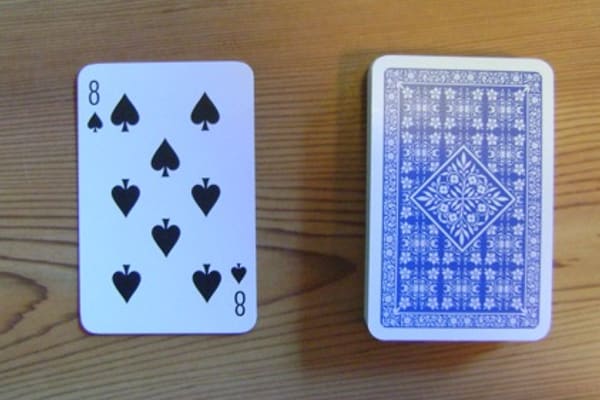
- Place the remaining cards face-down as the draw pile. Flip the top card face-up beside it to start the discard pile.
- If the starter card is a special-rank card (like an Ace or Jack), the group may silently apply that card's base-rule effect on the player to the dealer's left; the dealer does NOT explain this.
- The player to the dealer's left takes the first turn. Play proceeds clockwise by default.
Basic Turn Flow
- On your turn, play one card from your hand face-up onto the discard pile; it must match the top card by either rank or suit.
- If you cannot or choose not to play a matching card, draw one from the draw pile. Your turn then ends (some groups let you play immediately if the drawn card matches; others do not, and this is itself a hidden rule).
- When you play your second-to-last card you must say 'Mao' aloud, and when you play your last card you must say 'Mao Mao' (or equivalent). Forgetting either costs a penalty card, but the exact phrase is group-specific.
- If a rule was broken, any player may announce the penalty aloud (for example, 'Penalty for failure to say Mao') and hand the offender a draw card, but the judge names only the symptom (the act) and never the underlying rule.
Common Base Rules (What Groups Usually Play With)
Every Mao group has its own set, but the following are nearly universal starting points. A first-time player will discover most of these within 2 to 3 hands.
- 7 of any suit: the next player must draw 2 cards and skip their turn, unless they also play a 7 (stacking).
- 8 of any suit: skip the next player.
- Jack of any suit: reverse the direction of play.
- Ace of any suit: player must name a new suit for the next turn (wild). Some groups require saying 'I would like to change the suit to [name].'
- Queen of Hearts: player must say 'Have a nice day' when playing it; failure is a penalty.
- Penultimate card: player must say 'Mao' when only one card is left in hand.
- Final card: player must say 'Mao Mao' (or 'Game' or 'I have won') when playing the last card.
- No talking during play: casual conversation is a penalty; only required game phrases are allowed.
- Thanking the dealer: at the start of each hand, every player must say 'Thank you, dealer' once their hand is dealt; silence is a penalty.
- Point of order: any player may announce 'Point of order' to pause play; cards are placed face-down and players may discuss. The game resumes on 'End of point of order.'
Penalties
- A penalty is one extra card drawn from the stock and added to the offender's hand.
- Any player who notices a violation may call out the penalty, but the caller must only describe the act that triggered it, never the rule. Saying too much (explaining the rule) earns the caller a penalty of their own.
- Typical penalty calls: 'Penalty for failure to announce Mao', 'Penalty for playing out of turn', 'Penalty for looking at a card you did not play', 'Penalty for violation of the point of order.'
- If a player receives several penalties at once, the cards are drawn in sequence, one per violation.
- Some groups cap penalties at 3 per turn so a new player is not buried; others do not.
Winning a Hand and Adding a New Rule
- The first player to discard their last card (and correctly say the mandated final phrase) wins the hand and becomes the new Chairman.
- The Chairman announces: 'I would like to add a rule to the game.' This is the only time anyone explicitly references the rule layer.
- The Chairman writes the new rule on a slip of paper (or whispers it to a neutral party) and keeps it hidden. The rule takes effect on the next hand and stays in force for the rest of the session.
- The Chairman deals the next hand, says the sacred sentence again (with emphasis if there is still a newcomer at the table), and play resumes.
Common Variations
- Bartok: a well-documented Mao variant where the rule layer is shared openly (rules are announced as they are added, not hidden).
- Eleusis: a related rule-deduction game where one player is a hidden 'God' who invents a single sequence rule and the others must deduce it.
- Silent Mao: no talking whatsoever, even for required phrases; gestures replace spoken rule-calls.
- Bounded Mao: rules must fit on a single index card; once the card is full, no new rules can be added.
- Ceremonial Mao: the group adds ritualistic rules (stand up on a King, knock on a Queen, bow on an Ace) for theatre.
- Learner's hour: for the first hand, veterans explain the base rules openly so a new player can orient; after that, the sacred sentence resumes.
Tips for New Players
- Accept early penalties as tuition. Every penalty card is a data point about a rule you did not yet know.
- Watch what happens when a specific rank is played: does the next player draw? Skip? Reverse? Say something?
- Copy the phrases other players say, even if you do not yet understand when they apply. The pattern usually emerges in a few hands.
- Do not ask direct questions. Experienced players will only smile and hand you a penalty.
- When you play what feels like a last card, say something; silence almost always earns a penalty. 'Mao' is a safe guess.
- If you hit a streak of penalties, call 'Point of order' to pause and mentally regroup; this is one of the few times open discussion is allowed.
Glossary
- Chairman: the previous hand's winner; deals the next hand and adds a rule.
- Sacred Rule: the only statement veterans may say aloud about the rules.
- Base Rules: the group's core set of hidden rules, accreted over many sessions.
- Penalty: one draw-pile card added to the offender's hand for a rule violation.
- Point of order: a formal pause during which cards are placed face-down and players may speak freely.
- Mao / Mao Mao: the ritual phrases said on the penultimate and final card, respectively.
- Stacking: playing another card of the same 'special' rank to pass along or compound its effect.
- Wild rank: a rank (commonly the Ace) that requires the player to nominate the next suit.
Tips & Strategy
Treat each penalty as free information; it tells you exactly which rule you just brushed against. Copy the phrases you hear veterans say before you know when to say them; pattern recognition beats guessing. Do not ask direct questions; veterans will only smile and hand you a card. When in doubt, say 'Mao' before you play your last card: silence is almost always the wrong answer. If you are overwhelmed, call 'Point of order' to pause play; this is the one time free discussion is allowed.
Pattern recognition is the core skill: each penalty is free labelled data about what triggered it. The expert Mao player shortens their information-gathering loop by playing safely (matching rank rather than suit, avoiding face cards) during the first hand of a new session, then exploring special-rank effects once the base rules are deduced. Conversely, when you are the Chairman, choose new rules that test pattern recognition (a specific phrase on a specific rank), not rules that are nearly impossible to infer.
Trivia & Fun Facts
No 'canonical' Mao exists; every group has its own accreted rule set. College orientation week and academic summer camps are notorious vectors for Mao transmission. The game has inspired academic papers on game-theoretic rule discovery and is sometimes assigned as a teaching tool in AI courses on reinforcement learning.
-
01What is the single sentence that Mao veterans may say aloud about the rules of the game?Answer 'The only rule I can tell you is this one.' This sentence, spoken by the dealer before each hand, is the only explicit statement of any rule permitted at the table.
-
02What title does the winner of a Mao hand hold, and what unique power does that title grant?Answer The winner becomes the Chairman: they deal the next hand, announce that a new rule is being added, and choose (usually in secret) what that rule will be. The new rule applies to every subsequent hand for the rest of the session.
History & Culture
Mao rose in university maths and computer science departments during the 1960s and 1970s, prized by those who enjoy deduction and pattern-matching. Its canonical name salutes Chairman Mao Zedong, a jokey nod to authoritarian rule-invention by the Chairman-for-a-hand. Related rule-deduction games include Eleusis (Robert Abbott, 1956), which formalised the 'secret-rule' premise as a pure logic puzzle, and Bartok, a more transparent cousin.
Mao is a subculture marker in university common rooms, hacker houses, and summer camps; invitation to play is a kind of social induction. The ritual 'sacred sentence' and penalty calls create a distinctive theatre, and the tradition of refusing to explain is itself the game's most characteristic feature. Mao has been referenced in xkcd, several hacker-community memoirs, and the folklore of specific maths departments.
Variations & House Rules
Bartok plays the same base game but makes the rule layer open. Silent Mao forbids all speech, replacing required phrases with gestures. Bounded Mao caps new rules to what fits on a single card. Ceremonial Mao favours theatrical rules (stand on a King, knock for a Queen). A common courtesy variant reserves the first hand for open instruction to a newcomer.
When teaching Mao to newcomers, some groups run a single 'open' hand where base rules are explained aloud, then resume the sacred tradition for subsequent hands. A gentler rule cap (no more than 10 added rules per session) keeps the learning curve humane. Writing each added rule on an index card and keeping the deck face-down next to the Chairman keeps disputes resolvable without spoiling the mystery.


