
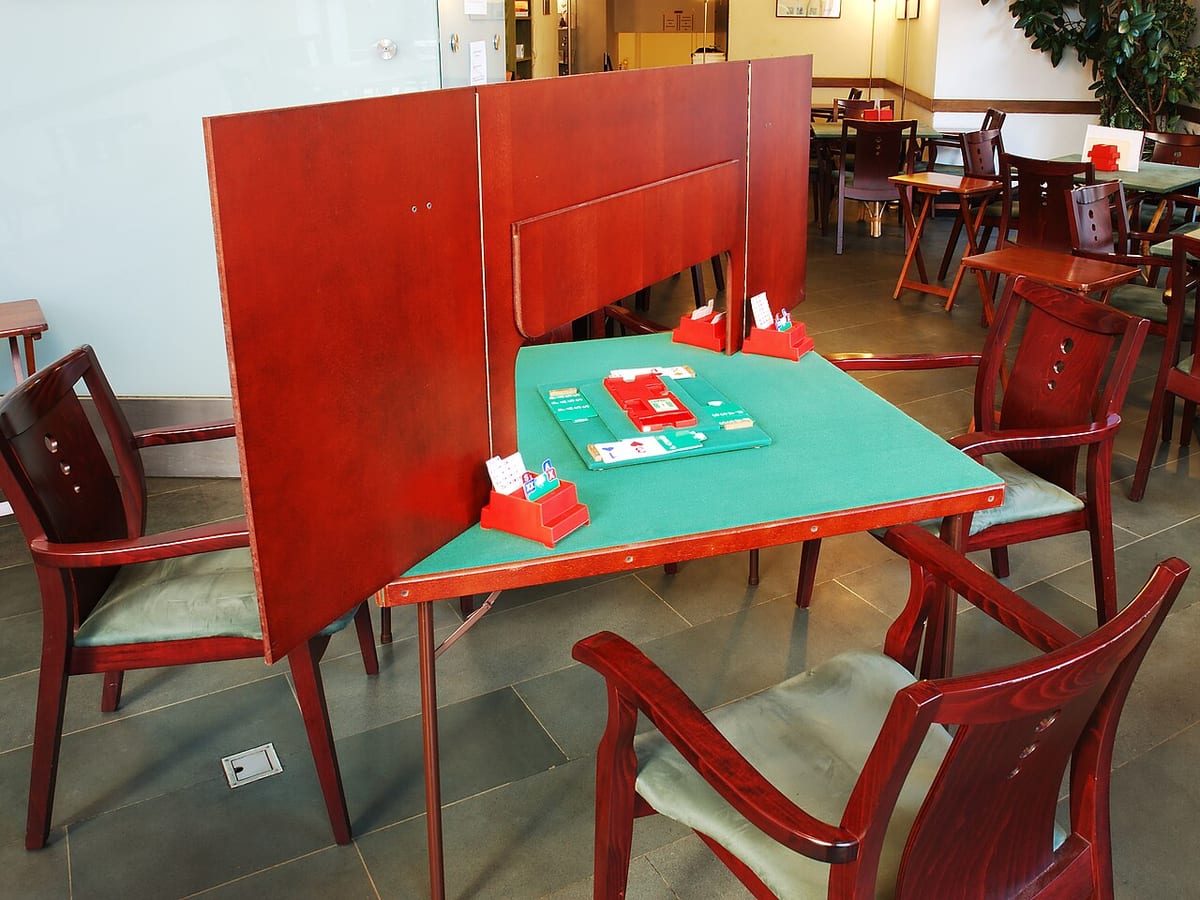
How to Play
Minibridge strips contract bridge down to its trick-taking core: players count high card points instead of bidding, the stronger partnership's dummy hand goes face up immediately, and declarer picks the trump suit and target before a single card is led. It is the standard first lesson used by bridge clubs and courses worldwide to teach beginners declarer play and defense before tackling a real auction.
Minibridge is a simplified introduction to contract bridge that keeps the game's core trick-taking play but removes its hardest obstacle for newcomers: the auction. Instead of bidding, the 4 players simply count their high card points using the standard 4-3-2-1 scale for [A], [K], [Q], and [J], and the partnership with the higher combined total takes on the contract. Within that partnership, the player with FEWER points becomes declarer and the player with MORE points becomes dummy, laying their hand face up on the table immediately, so declarer can see both hands before choosing a trump suit (or no trump) and a target number of tricks. From that point on, play proceeds exactly like ordinary bridge: the same follow-suit rules, the same trick-by-trick sequence, and the same all-or-nothing feel of trying to make a stated contract against 2 defenders. Developed and promoted by bridge organizations such as the English Bridge Union and the World Bridge Federation, Minibridge is now the standard first lesson in most bridge courses worldwide, letting beginners learn declarer play, defense, and point counting in a single sitting before ever opening a bidding box.
Quick Reference
- Deal a standard 52-card deck so each of the 4 players in 2 fixed partnerships gets exactly 13 cards.
- Each player counts their own high card points ([A]=4, [K]=3, [Q]=2, [J]=1) and announces the total.
- The partnership with the higher combined total declares; within it, the player with FEWER points becomes declarer and the player with MORE points becomes dummy, laying their hand face up.
- Declarer studies both visible hands and names a trump suit (or no trump) plus a target number of tricks.
- The defender to declarer's left leads the first card; dummy then plays no further active role.
- Declarer plays from both hands each trick; players must follow suit if able, and the highest card of the suit led wins unless trumped.
- Compare tricks won to the contracted target: declarer's side succeeds by meeting or beating it, defenders succeed by holding declarer short.
- Classes commonly award simple points per trick made or short before introducing full bridge scoring.
- Because there is no competitive auction, a side can never be pushed past its own point-count guideline for the contract level.
Players
Exactly 4 players in 2 fixed partnerships, seated so that partners sit across the table from each other, conventionally labeled North-South against East-West. Minibridge, like full contract bridge, is built entirely around 2 competing partnerships of exactly 2 players each; there is no way to play it with 3 or 5. A single deal plays quickly, usually 5 to 10 minutes including the point count and dummy reveal, which is why Minibridge lessons often run through several deals in one class session.
Card Deck
- One standard 52-card pack, no jokers, dealt out completely so each of the 4 players holds exactly 13 cards.
- Card rank order within each suit (high to low): A, K, Q, J, 10, 9, 8, 7, 6, 5, 4, 3, 2.
- High card points (HCP): [A] is worth 4, [K] is worth 3, [Q] is worth 2, [J] is worth 1, and every other card is worth 0. The 4 aces, 4 kings, 4 queens, and 4 jacks in a full deck add up to exactly 40 points, split unevenly between the 2 partnerships on any given deal.
- No trump indicator card or bidding box is used; the trump suit, if any, is chosen later by declarer after seeing both hands, not bid for during an auction.
Objective
Count your side's combined high card points to discover whether your partnership or the opponents holds the stronger combined hand, then, if your side is stronger, have declarer choose a trump suit (or no trump) and a target number of tricks that the visible combined hands can realistically make. The opposing partnership's objective is to defend well enough to stop declarer from reaching that target.
Setup
- Shuffle the standard 52-card deck and deal all 52 cards clockwise, one at a time, so each of the 4 players receives exactly 13 cards.
- Each player sorts their own hand by suit and counts their personal high card points: 4 for each [A], 3 for each [K], 2 for each [Q], 1 for each [J].
- Starting with the dealer and moving clockwise, each player announces their point count aloud, or writes it down where everyone can see it.
- Add the 2 partners' point counts together for each side. The partnership with the higher combined total becomes the declaring side; a tie is usually broken by house convention, such as leaving the choice with the dealer's side, since it is rare enough not to disrupt most lessons.
- Within the declaring side, the partner with FEWER points becomes declarer; the partner with MORE points becomes dummy and immediately spreads their entire hand face up on the table, organized by suit, for everyone to see.
Gameplay
- Choosing the contract: with both partnership hands now visible to declarer, their own hand plus dummy's exposed hand, declarer studies the combined 26 cards and chooses a trump suit, or no trump, based on which suit the 2 hands hold the most cards in together. A combined holding of 8 cards or longer in a suit is the normal guideline for choosing it as trumps.
- Setting the contract level: declarer also announces how many tricks out of 13 the partnership will try to win, guided by the combined point count. A common teaching guideline is that 20 to 24 combined points suggests a partscore target, 25 to 32 points suggests trying for game (9, 10, or 11 tricks depending on the trump suit, or 3 no trump), and 33 or more points suggests a slam attempt (12 or 13 tricks).
- Opening lead: the defender to declarer's LEFT plays the first card of the first trick, face up, before dummy is touched again.
- Dummy's role: once the opening lead is made, dummy takes no further active part in the hand. Declarer plays cards from BOTH their own hand and dummy's exposed hand, calling out which card to play from dummy on each trick.
- Following suit: each player must follow the suit led if able; a player with none of that suit may play any card, including a trump.
- Winning a trick: the highest card of the suit led wins the trick, unless a trump is played, in which case the highest trump played wins. Whoever wins a trick leads the next one.
- Playing out the hand: this continues for all 13 tricks. The defenders, seeing only their own 13 cards and dummy's exposed hand, must infer declarer's holding from the play itself, since there was no auction to reveal it in advance.
Scoring
Compare how many tricks the declaring side actually won to the contracted target. If declarer's side wins at least as many tricks as announced, the contract succeeds; typical teaching scoring simply awards a fixed number of points per trick made, or per trick short for the defense if the contract fails. Clubs and classes that want more competitive tension can switch straight to the standard bridge scoring table, including trick points, game and partscore bonuses, and penalties for going down, once students are comfortable with Minibridge's simpler, bidding-free contract. Because there is no competitive auction, no side can be pushed past its own point-count guideline for the contract level, which keeps the arithmetic simple while still teaching the core idea that overreaching on a weak hand costs you and underbidding a strong one leaves points on the table.
Winning
A single deal is won by whichever side reaches its stated target: the declaring side succeeds if it takes at least as many tricks as announced, and the defenders succeed if they hold declarer to fewer tricks than that. Over a full lesson or session, players typically rotate through several deals, keeping a running score, and whoever has scored the most across all the deals played that session is the overall winner. Because a fresh point count and a new contract choice happen on every single deal, no single hand carries pressure the way a long rubber of full bridge does, which is exactly what makes Minibridge approachable for a first-time trick-taking player.
Common Variations
- Full contract bridge: once players are comfortable choosing a trump suit and contract level from a visible dummy, the natural next step is real bridge, where a competitive auction of bids replaces the simple point-count handover and dummy is revealed only after the opening lead, not before the contract is even set.
- Bidding Minibridge: some clubs add a single simple round of bidding, such as each player naming 1 suit they hold length in or passing, on top of the point-count total, as a bridge between Minibridge and a full auction.
- Duplicate Minibridge: the same deals are replayed at multiple tables, as in duplicate bridge, so a class or club can compare how different declarers handled the identical combined holding.
- Two-player teaching drills: some teaching materials adapt the point-count-and-dummy idea into a 2-player practice format, similar in spirit to Honeymoon Bridge, purely so a student and a tutor can drill declarer play without needing 4 people at the table.
Tips and Strategies
- Recount before you commit. A single miscounted jack can hand the contract to the wrong side or send declarer chasing a target the hands cannot make; recount your 13 cards' points before announcing them.
- Look for an 8-card fit first. When choosing trumps, prioritize any suit where the combined 26 cards of your side hold 8 or more cards together over a suit where you are only strong individually; a long combined trump suit is usually more valuable than a few extra scattered high cards.
- Match the level to the point count, not to hope. Declarers who round their target up 'just in case' regularly go down; use the standard combined-point guideline for partscore, game, and slam as a check on optimism.
- Play dummy's clear winners early when safe. As declarer, cashing dummy's established winning cards before the defense can develop their own long suit is a simple, teachable habit that prevents easy defensive tricks later.
- Defenders should count the missing points. With 40 points in the deck and the declaring side's total already announced, defenders can subtract to know almost exactly how the remaining points split between declarer and their own partner, narrowing down what the unseen declarer's hand is likely to hold.
Glossary
- High card points (HCP): the 4-3-2-1 count for [A], [K], [Q], and [J] used to value a hand without bidding.
- Declarer: the player, from the stronger partnership, who chooses the contract and plays both hands after the point count.
- Dummy: declarer's partner, who lays their hand face up after the point count and takes no further active decisions.
- Contract: the trump suit (or no trump) and target number of tricks declarer commits to before play begins.
- Opening lead: the first card played, always by the defender seated to declarer's left.
- Partscore, game, slam: the 3 broad point-count tiers used to guide the target trick count, borrowed directly from full contract bridge's scoring tiers.
Tips & Strategy
Treat the point count as a discipline, not a formality: recount your 13 cards before announcing, since a single miscounted honor can hand the contract to the wrong side. When choosing trumps as declarer, favor whichever suit the visible 26 cards hold 8 or more cards of together over a suit where only your own hand is individually strong, and set your target using the standard 20-24, 25-32, and 33-plus point tiers for partscore, game, and slam rather than optimism. As dummy, resist the urge to influence the play once your hand is face up; the entire point of the exposed dummy is that declarer alone decides how to combine both hands. Defenders should subtract the declaring side's announced total from 40 to know almost exactly how the remaining points split between declarer and their own partner, turning a blind, auction-free defense into a solvable counting problem.
Minibridge isolates 2 of contract bridge's 3 core skills, point counting and declarer or defensive card play, by removing the third, competitive bidding, entirely. This makes it an unusually good tool for testing pure card-play instinct: because both hands are visible to declarer before a single card is led, mistakes in the play stand out clearly as play errors rather than being tangled up with an earlier bidding misjudgment. The most transferable skill Minibridge teaches toward real bridge is trump selection from a known combined holding; recognizing an 8-card-or-longer fit is the same evaluation a bidder makes blind during a real auction, just performed here with full information. Defenders, meanwhile, get uniquely clean practice at count-based inference, since subtracting the announced declaring total from the deck's fixed 40 points hands them a nearly exact read on the unseen hands that a real, bidding-based defense rarely gets this cleanly.
Trivia & Fun Facts
A full deck's 40 high card points, 4 for each ace, 3 for each king, 2 for each queen, and 1 for each jack, mean that a perfectly even deal would give each of the 4 players exactly 10 points, which almost never happens in practice and is part of why point counting feels meaningful even on a beginner's very first hand. Because dummy's hand is exposed before the contract is even chosen, a Minibridge declarer can see literally half the deck before making a single decision, far more advance information than a declarer ever gets in a real auction-based bridge hand. Several national bridge federations, including the English Bridge Union, distribute free printed Minibridge score cards and teaching guides specifically because the format is treated as the standard on-ramp into competitive bridge worldwide.
-
01In Minibridge, which partner in the stronger partnership becomes the dummy?Answer The partner with MORE high card points lays their hand face up as dummy, while the partner with fewer points becomes declarer and plays both hands.
-
02How many high card points are in a full 52-card deck, and how are they distributed?Answer 40 points total, 4 for each of the 4 aces, 3 for each king, 2 for each queen, and 1 for each jack.
History & Culture
Minibridge was developed in the second half of the 20th century by bridge teachers looking for a way to introduce trick-taking play and declarer technique without first requiring students to learn a full competitive auction, historically the single biggest barrier to recruiting new bridge players. The format was refined and popularized by national bridge bodies, most visibly the English Bridge Union and the World Bridge Federation, which built Minibridge into standardized beginner courses and printed teaching material used in schools and clubs. Because it needs no bidding boxes, conventions, or auction rules, Minibridge could be taught to complete beginners, including schoolchildren, in a single class period, and it has since become a near-universal starting point recommended by national bridge federations before students move on to a real auction.
Minibridge occupies a specific, practical niche in the bridge world: it is not played competitively or for its own sake so much as it is the near-universal doorway national federations use to recruit new players into the game. Its adoption by bodies including the English Bridge Union and the World Bridge Federation as standard beginner curriculum reflects a broader, decades-long effort by the bridge community to reverse an aging player base by lowering the barrier to a game long seen as intimidatingly technical. By deferring the auction, historically the single hardest concept for a first-time student, Minibridge lets complete beginners experience the satisfaction of playing out a full deal and defending a contract within their very first lesson, a pedagogical shortcut credited with keeping introductory bridge courses accessible in schools, retirement communities, and community clubs long after the game's mainstream popularity outside dedicated clubs has faded.
Variations & House Rules
Bidding Minibridge layers 1 simple round of bidding, often just naming a suit held in length or passing, on top of the ordinary point-count handover, giving students a gentle first taste of competitive bidding before dropping them into a full auction. Duplicate Minibridge deals the identical hands to multiple tables in the same class or club session, letting a teacher compare how different declarers used the same dummy and combined point count. Full contract bridge is the natural graduation point: the same follow-suit, trick-winning, and dummy-play rules carry over unchanged, but the point-count handover is replaced by a full competitive auction, and dummy is revealed only after the opening lead rather than before the contract is even chosen. Some teaching materials also adapt Minibridge's point-count-and-dummy idea into 2-player drilling formats, similar in spirit to Honeymoon Bridge, purely to practice declarer play without needing 4 people at the table.
Classes teaching absolute beginners often skip announcing an exact contract level at first and simply have declarer name a trump suit, playing the hand out and comparing tricks won to the standard point-count guideline afterward, before introducing a stated target. Clubs that want more competitive tension can switch straight to full bridge scoring, including partscore and game bonuses and penalties for going down, once students are comfortable with the point count and dummy play. Adding a single simple bidding round, as in Bidding Minibridge, is a common next step for classes ready to move partway toward a real auction. For very young or first-time players, capping the contract at a fixed number of tricks regardless of point count keeps early sessions focused purely on trick-taking mechanics rather than target-setting.


