
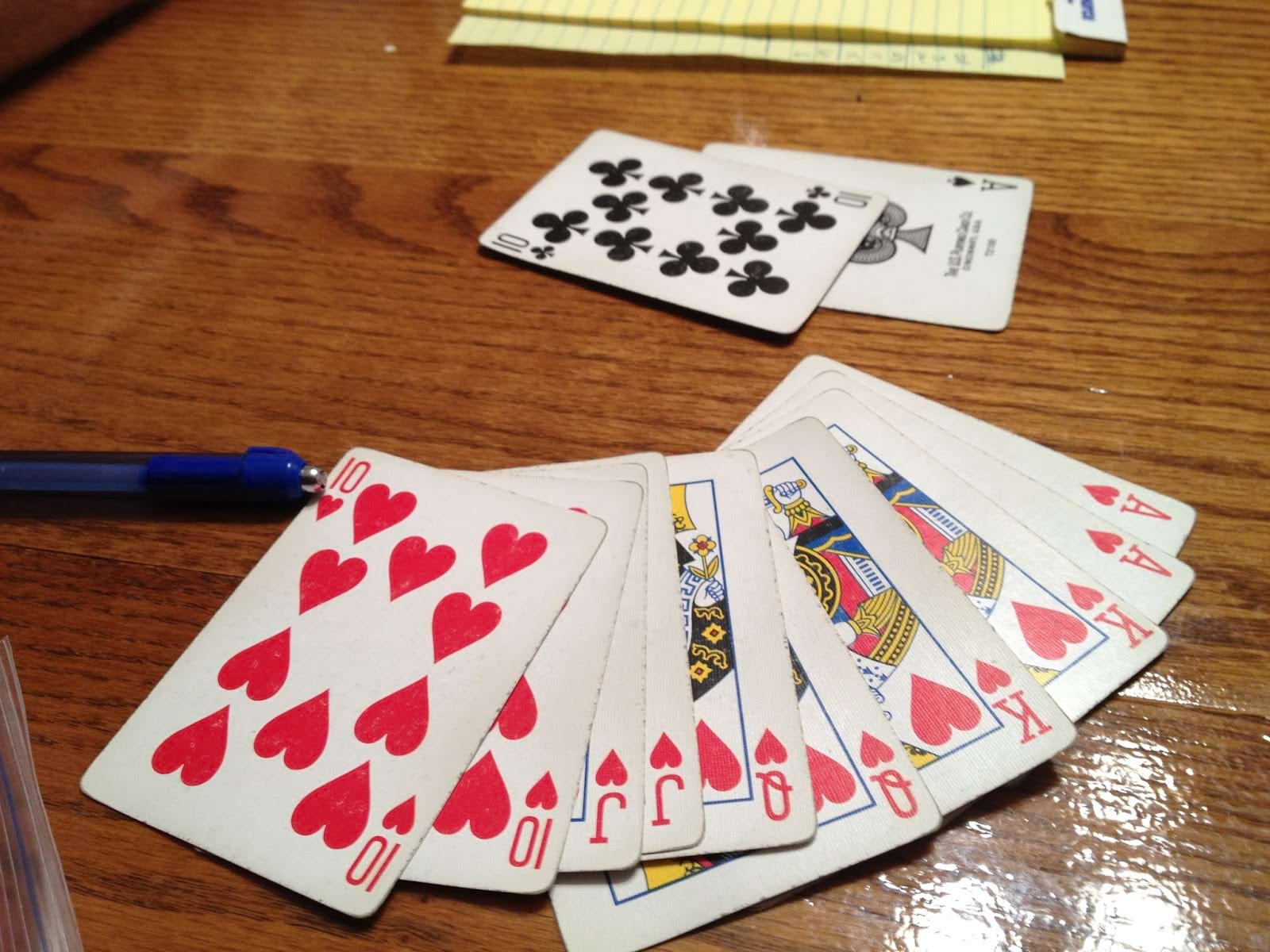
How to Play
The classic American 4-player partnership trick-and-meld card game using a 48-card specialised Pinochle deck (two copies of A/10/K/Q/J/9 in each suit). Players bid, declare melds, then take tricks capturing Aces, Tens, and Kings for points; first partnership to 500 or 1000 wins.
Pinochle is the classic American 4-player partnership trick-and-meld card game descended from 19th-century German Bezique. Played with a specialised 48-card Pinochle deck (two copies of Ace, Ten, King, Queen, Jack, Nine in each suit), Pinochle combines a bidding auction, a meld-declaration phase in which players score for predefined card combinations, and a trick-taking phase in which every Ace, Ten, and King captured is worth points. The card ranking within each suit (Ace high, then Ten, King, Queen, Jack, Nine) is unusual because the Ten outranks everything below the Ace; this is a defining Pinochle quirk. The bid winner names trumps and must reach their bid through meld plus captured tricks; failure 'sets' them by subtracting the bid from their score. Standard target is 150 meld + 250 trick points totalling 500 or 1000 points per partnership, with the first to 1000 typically winning the match.
Quick Reference
- 4 players in 2 partnerships. Use a 48-card Pinochle deck (2 of each A/10/K/Q/J/9 per suit).
- Deal 12 cards each. Ranking within suit: A, 10, K, Q, J, 9.
- Clockwise bidding opens at 250 minimum; highest bidder names trumps.
- Declare melds face up for immediate partnership score (Run 150, Pinochle 40, Royal Marriage 40, Aces Around 100, and so on).
- Follow suit and overhead if able; trump if void; overtrump if able.
- Highest trump or highest of led suit wins the trick.
- Trick captures: A=10, 10=10, K=5, others 0. Last trick +10.
- Make bid: score full meld + tricks. Fail bid: lose bid value (set).
- First partnership to 500 or 1000 wins the match.
Players
4-player partnership (the canonical form, partners seated opposite). 2-player Pinochle and 3-player cutthroat forms exist. This guide describes the 4-player partnership game; 2-player notes are in Common Variations. Play runs clockwise; deal rotates clockwise after each hand. A match to 500 or 1000 points typically lasts 45 to 90 minutes.
Card Deck
A 48-card Pinochle deck, equivalent to two copies of a Piquet pack: 2 Aces, 2 Tens, 2 Kings, 2 Queens, 2 Jacks, 2 Nines in each of the four suits. Construct one from two standard 52-card decks by keeping only the 9 through Ace of each deck. Card ranking within a suit (high to low): Ace, Ten, King, Queen, Jack, Nine. This is the distinctive Pinochle ranking, with the Ten unusually placed between the Ace and King.
Objective
Score points by declaring melds (specific card combinations held in your hand) before trick play, and by capturing Aces, Tens, and Kings during trick play. The bid winner (and their partnership) must reach their bid total to score positively that hand; failure subtracts the bid. First partnership to 500 points (or 1000 in longer matches) wins.
Setup and Deal
- Choose first dealer by drawing high card. The deal rotates clockwise after each hand.
- Shuffle the 48-card Pinochle deck thoroughly. Deal 12 cards to each player in packets of 3 or 4 (groups vary; 4-3-4-1 and 3-3-3-3 are both common).
- Pick up hands and sort by suit. Evaluate for melds and trick-taking strength.
Bidding Phase
- Starting with the player left of the dealer and proceeding clockwise, each player may bid (a number representing the partnership's commitment) or pass.
- Minimum opening bid: 250 points (some groups use 200 or 300).
- Bid increments: 10 points each increase (some groups use 5).
- Passing: Once you pass, you are out of the auction for that hand.
- Winning the auction: The highest bidder names the trump suit. Their partnership must achieve a combined meld + trick total of at least the bid value to 'make' the bid.
- All-pass: If all four players pass, the hand is void and the cards are reshuffled and redealt by the next dealer.
Meld Declaration
- After trumps are named, each player shows all melds held in their hand by placing the cards face up on the table. Melds are scored immediately for the player's partnership.
- Run (Flush) in trumps: A-10-K-Q-J of trumps = 150 points.
- Royal Marriage: K-Q of trumps = 40 points.
- Common Marriage: K-Q of any non-trump suit = 20 points.
- Pinochle: Jack of Diamonds + Queen of Spades = 40 points.
- Double Pinochle: two Jacks of Diamonds + two Queens of Spades = 300 points.
- Aces Around (100 Aces): one Ace of each suit = 100 points.
- Double Aces Around: two Aces of each suit = 1000 points.
- Kings Around (80 Kings): one King of each suit = 80 points.
- Queens Around (60 Queens): one Queen of each suit = 60 points.
- Jacks Around (40 Jacks): one Jack of each suit = 40 points.
- Dix: Nine of trumps = 10 points each (both nines = 20).
- Reuse rule: A card already used in one meld may also be used in a second meld of a DIFFERENT category (e.g., the Queen of Spades can count in both a Pinochle with the Jack of Diamonds AND in Queens Around). The same card cannot, however, be used in two melds of the same category (a marriage and the run, for example, both use the K-Q pair and the K-Q cannot meld twice).
- After scoring, meld cards are returned to their owner's hand and play proceeds to the trick phase.
Trick-Taking Phase
- The bid winner leads the first trick with any card.
- Follow suit and overhead if possible: Each subsequent player must play a card of the led suit; if they can beat the current highest card of the suit (using A-10-K-Q-J-9 ranking), they must play higher. If following suit but not able to head, any card of the suit is fine.
- Void in led suit: must trump if possible. A player who cannot follow suit must play a trump if they hold one. If they can beat the current highest trump in the trick, they must play higher.
- Void in led suit AND void of trumps: Play any card; it cannot win.
- Winning a trick: The highest trump in the trick wins; with no trumps, the highest card of the led suit (A-10-K-Q-J-9 order) wins. Two identical cards (both Aces of Spades, say): the first played wins. Winner leads the next trick.
- Last trick bonus: The partnership winning the last trick of the hand scores 10 extra points on top of any captured cards.
Scoring
- Card capture values (per card taken in tricks): Ace = 10 points, Ten = 10, King = 5, Queen = 0, Jack = 0, Nine = 0. (Some older rule sets use A=11, T=10, K=4, Q=3, J=2, but the modern American convention is the simpler 10-10-5-0-0-0 system.)
- Total card-capture points available per deal: (2 Aces × 10 + 2 Tens × 10 + 2 Kings × 5) × 4 suits = 200 points, plus 10 for last trick = 240.
- Alternative traditional scale: Aces 11, Tens 10, Kings 4, Queens 3, Jacks 2 = total 240 in tricks plus last-trick 10 = 250; choose one scale and stay with it.
- Making the bid: Partnership's combined meld + captured trick points must be at least the bid. If so, they score exactly the amount earned (meld + captures). The defending partnership scores whatever meld + captures they earned that hand.
- Failing the bid (going set): The bidding partnership LOSES the full bid value (negative) for the hand; the defenders still score their own melds and captures.
- Match target: First partnership to 500 points wins a short match, 1000 points wins a standard match. If both cross on the same hand, highest total wins.
Winning
The first partnership to reach the agreed target (typically 500 or 1000 points) at the end of a hand wins the match. If both partnerships cross the target on the same hand, the higher score wins; in case of a tie on the same total, play one more hand.
Common Variations
- Double-deck Pinochle: Uses 80 cards (two 48-card Pinochle decks minus the Nines) with 4 players receiving 20 cards each; played to 500. Higher meld values and richer gameplay.
- Two-hand Pinochle: 2 players, 12 cards each dealt from a 48-card deck; the remaining 24 cards form a stock with a face-up trump; player drawing mechanics similar to Bezique. No partnership play.
- Three-hand (cutthroat) Pinochle: 3 players, 15 or 16 cards each; each plays individually against the other two. The bid winner plays alone against the two opponents.
- Auction Pinochle with Widow: 3-player variant in which 15 cards are dealt plus a 3-card widow; the bid winner picks up the widow, declares melds, and buries 3 cards back before play.
- Firehouse Pinochle: American firehouse favourite with partnership play, simpler scoring and a fixed dealer rotation.
- Check Pinochle: A version with additional bonuses ('checks') for specific achievements during play.
Tips and Strategy
- Remember that every card has a duplicate somewhere. When an Ace of Spades falls, one more Ace of Spades is still unseen (either in another hand or already played earlier).
- During bidding, evaluate meld + estimated trick points conservatively: 40 meld + 40 trick (partner estimate) should lead to a 100-point bid, not a 150. Overbidding by 30 points is easier than it looks and costs you the bid.
- Lead high trumps (Ace of trumps, then Ten of trumps) early to exhaust opponents' trumps before they can ruff your off-suit Aces.
- Save the trump Nine (the Dix) as a throw-away late rather than leading it; it scores 10 meld points already but can save a key captured Ace by trumping on the correct trick.
- Communicate with your partner through natural leads: leading a side-suit Ace tells your partner you expect to win that suit; leading a low card in an untouched suit asks your partner to take the trick if strong.
- When defending against a high bid, lead your short side suits early to force opponents to burn trumps; their trump shortage will let your Aces through later.
Glossary
- Pinochle deck: The 48-card specialised deck with two of each Ace, Ten, King, Queen, Jack, Nine in every suit.
- Meld: A scoring combination declared from your hand after bidding and before trick play.
- Pinochle (the meld): Jack of Diamonds + Queen of Spades; 40 points.
- Run: A-10-K-Q-J of the trump suit; 150 points.
- Marriage: K-Q of the same suit; 40 in trumps, 20 in non-trumps.
- Arounds: Four cards of the same rank, one per suit (Aces, Kings, Queens, or Jacks).
- Dix: The trump Nine; worth 10 meld points each.
- Bid: The committed point total the winning partnership must reach through meld + tricks.
- Set (Going Set): Failing to make the bid; the bid amount is deducted from the partnership score.
- Last Trick: The final trick of the hand, worth an extra 10 points on top of captured cards.
Tips & Strategy
Evaluate meld plus trick points conservatively when bidding; overshooting by 30 is easy. Lead your high trumps (Ace then Ten) early to strip opponents before off-suit Aces go out. Remember every card has a duplicate in the deck, so an Ace seeing one copy fall does not imply the second copy is gone. Natural leads communicate hand strength to your partner without verbal signals.
Pinochle's strategic depth rests on accurate bid evaluation and partnership signalling. The bid winner's estimate of the partnership's combined meld plus trick potential must be within 10 to 20 points of reality; consistent overbidding by 30 or more sets the partnership hand after hand. Signalling through natural lead choices (strong suit leads, low-card requests for partner help) turns Pinochle into a two-player-per-side puzzle rather than a pair of independent 1-player decisions. Card memory is also central because every card has a duplicate and tracking which of each pair has been played is decisive in the endgame.
Trivia & Fun Facts
The name Pinochle likely derives from the German 'Binokel' (itself from the French 'binocle' meaning 'eyeglasses' or 'pince-nez'), which may have referred to the two-card Pinochle meld resembling the two lenses of glasses. In 1970s America Pinochle was the second-most-played card game after Poker; today it retains strong followings in the Midwest (Kansas City is a particular hotspot) and in German-American cultural clubs.
-
01In Pinochle, which specific two cards form the meld known as a 'Pinochle'?Answer The Jack of Diamonds and the Queen of Spades together; worth 40 points.
-
02What is the unusual Pinochle card ranking within a suit, and which card does it place between the Ace and King?Answer Ace, Ten, King, Queen, Jack, Nine from high to low; the Ten ranks unusually between the Ace and the King.
History & Culture
Pinochle arrived in North America with German and Austrian immigrants in the mid-19th century, descending from the French game Bezique (which in turn descended from the older Reversis family). The American Pinochle deck was standardised in the late 1800s by New York and Chicago card companies, and by 1900 Pinochle was the leading American card game in urban German-American communities. Double-deck Pinochle was developed in the 1950s and is the dominant competitive form today. The American Playing Card Company first printed dedicated Pinochle decks in 1887.
Pinochle occupies a specific cultural niche in the United States as the card game of German-American heritage communities, played continuously from the 1860s to the present in social clubs, firehouses, church basements, and family kitchens. It is deeply embedded in Midwestern American life (Kansas City, Milwaukee, Cleveland especially) and was for much of the 20th century the second-most-played American card game after Poker. The Pinochle deck itself is still manufactured by major American card companies and is sold commercially in most US stores.
Variations & House Rules
Double-deck Pinochle (80 cards, no Nines, 20-card hands) is the dominant competitive form. Two-hand Pinochle uses Bezique-style stock draw for 2 players. Three-hand cutthroat has each player on their own. Auction Pinochle with Widow is a 3-player variant with a 3-card widow for the bid winner. Firehouse Pinochle is a simplified partnership form popular in American firehouses. Check Pinochle adds bonus 'checks' for in-play achievements.
For beginners, use the simpler 10-10-5-0-0-0 capture-value scale and reduce the target to 300 points. For deeper play, switch to Double-deck (no Nines, 20 cards each, target 500). Adjust the minimum opening bid up or down based on experience level (200-300 for casual, 250-350 for serious). Print a meld scoring card for each player during learning sessions.


