
How to Play
China's signature card game. Two Peasants team up against one Landlord in a fast-paced climbing game with chain combos, bombs, and a joker rocket that beats everything.
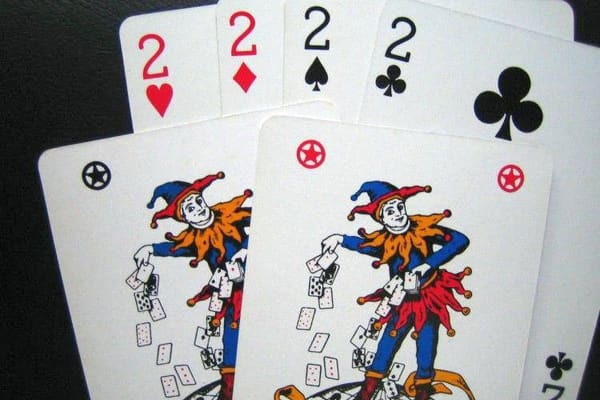
Dou Dizhu, meaning 'Fight the Landlord,' is the most popular card game in modern China and one of the most-played card games in the world, with hundreds of millions of players across living rooms, tea houses, and mobile apps. It is a three-player climbing and shedding game played with a 54-card deck (standard 52 cards plus a red and a black joker). Before each hand, the three players bid (0 to 3 points) for the Landlord role; the highest bidder becomes the Landlord, takes 3 bonus cards from the kitty for a 20-card hand, and plays alone against the other two, who form a temporary Peasant partnership for that hand only. The Landlord leads any legal combination (solo, pair, trio, trio with kicker, chain, pair-chain, airplane, bomb, or rocket); each subsequent player must play the same category at higher rank or pass. Two consecutive passes return the lead to the last player who played. Bombs (four-of-a-kind) beat any non-bomb combination, and the rocket (both jokers together) beats every other play in the game. The first side to empty a hand wins: Landlord wins alone, or Peasants both win if either Peasant empties their hand before the Landlord. Each bomb or rocket in the hand doubles the final stake, so pots can swell quickly in wild hands.
Quick Reference
- 3 players. Use a 54-card deck (52 cards + red and black jokers).
- Deal 17 cards to each player; 3 kitty cards face-down in the centre.
- Bid 1, 2, or 3 for the Landlord role; winner picks up the kitty for 20 cards.
- Play a legal combination: solo, pair, trio (± kicker), chain, pair-chain, airplane, bomb, or rocket.
- Next player plays the same type at higher rank, OR passes. Two passes returns the lead.
- Bombs beat any non-bomb; the rocket (both jokers) beats everything.
- Base stake = winning bid (1, 2, or 3). Each bomb or rocket doubles the stake.
- Spring (Peasants play zero cards) doubles again; anti-spring doubles if Landlord only leads.
- Landlord wins: each Peasant pays the stake. Peasants win: Landlord pays each.
Players
Exactly 3 players. Play is counter-clockwise by default (table orientation varies by region). No fixed partnerships: one player is Landlord for the current hand and the other two are Peasants who cooperate only for that hand. The deal rotates each hand; losing the bid or losing a hand has no effect on who deals next. A casual hand takes 2 to 6 minutes; app sessions are often bo3 or bo5. Online rooms (QQ Games, JJ Games, Happy Landlord) routinely host millions of concurrent players.
Card Deck
One standard 52-card French-suited pack plus 2 jokers, total 54 cards. Card ranking (high to low, suits ignored for ranking): Red Joker > Black Joker > 2 > A > K > Q > J > 10 > 9 > 8 > 7 > 6 > 5 > 4 > 3. Suits do not affect rank or play; only rank and combination type matter. 2s outrank Aces (a key peculiarity shared with Big Two and other East Asian climbing games). Jokers rank above 2s and can only be played as a solo card, in trio-with-kicker or airplane-with-kicker slots, or as the rocket (both jokers together).
Objective
Landlord: be the first player to empty your 20-card hand. Peasants: either one of you (not necessarily both) must empty your 17-card hand before the Landlord does. The Peasant team wins together; neither individual Peasant's exact finishing order matters. A single shedding-out ends the hand; unplayed cards remain in losers' hands for point tallying.
Setup and Deal
- Shuffle the 54-card deck thoroughly (remove any jokers beyond the red and black standard jokers).
- Deal 17 cards face down to each player, one at a time. Leave the final 3 cards face down as the kitty (also called the 'bottom' or 'dipai').
- Each player picks up and sorts their hand privately.
- Run the bidding round (see Bidding). The winning bidder becomes the Landlord.
- The Landlord reveals and picks up the 3 kitty cards, adding them to their hand for a total of 20 cards. The Peasants see the revealed kitty before it is taken, so both sides gain information.
- The Landlord leads the first trick with any legal combination.
Bidding
- Starting with the player to the dealer's left (or a random starter in some app rulesets), each player in turn may bid 1, 2, or 3 points, raise the current highest bid, or pass.
- A later player may only make a higher bid than any previous bid; equal or lower bids are not allowed.
- Bidding continues around the table until two players have passed OR a player bids 3 (which is the maximum and ends the auction immediately).
- The highest bidder becomes the Landlord and picks up the 3-card kitty. If all three players pass, the cards are collected, reshuffled, and re-dealt.
- The bid amount becomes the hand's base stake. Typical bid amounts are 1, 2, or 3 points, and the final payout is multiplied by bombs and rockets played.
- Online variants: Many apps use a two-phase call-and-grab bidding system (Jiao Dizhu / Qiang Dizhu) where an initial call is followed by an optional grab, doubling the base stake when grabbed.
Valid Combinations
- Solo: a single card. Beaten only by a higher single card (or a bomb or rocket).
- Pair: two cards of the same rank. Jokers cannot form a pair together (they form the rocket instead).
- Trio: three cards of the same rank. Plays alone or with a kicker.
- Trio with solo kicker: a trio plus one extra card of any rank. Beaten only by a higher trio plus any kicker.
- Trio with pair kicker: a trio plus a pair. Beaten only by a higher trio plus any pair.
- Chain of solos (straight): 5 or more consecutive single cards of any suits, from 3 up to Ace (never including 2s or jokers). Minimum 5 cards; longer chains are legal.
- Chain of pairs: 3 or more consecutive pairs, from 3-3 up to A-A (never 2s or jokers). Minimum 3 pairs (6 cards).
- Chain of trios (airplane): 2 or more consecutive trios, from 3-3-3 up to A-A-A.
- Airplane with wings: a chain of trios plus the same number of solo kickers (airplane with solo wings) OR the same number of pair kickers (airplane with pair wings). Example: 3-3-3-4-4-4 + 7-8 or 7-7-8-8.
- Four with two kickers: four-of-a-kind plus two solo kickers (different ranks) OR two pairs. This is NOT a bomb; it is beaten by any higher four-with-kickers, a true bomb, or a rocket.
- Bomb: four-of-a-kind played alone. Beats any non-bomb combination. Higher bombs beat lower bombs.
- Rocket (nuke): both jokers played together. The single highest combination in the game; beats every other play including bombs.
Gameplay
- Leading: The Landlord leads any legal combination. Subsequent trick leaders play any legal combination after two consecutive passes (see below).
- Following: The next player in turn may play a strictly higher combination of the same type and same card count, OR pass. Example: a lead of 7-7-7 can only be followed by a higher trio (8-8-8 or higher), or a bomb, or the rocket.
- Bombs beat everything non-bomb: a bomb (four-of-a-kind) can be played over any non-bomb combination regardless of type. A higher bomb beats a lower bomb.
- Rocket beats everything: the rocket (both jokers) beats any other play, including any bomb.
- Passing: A player may always pass rather than play. When two players pass in succession, the last player to play collects the lead and starts a new trick with any legal combination.
- Chains and airplanes are strict: only chains of the same length can be compared. A 6-card chain (3-4-5-6-7-8) cannot be beaten by a 5-card chain even at higher rank.
- Winning: The first player to discard every card wins the hand. If the Landlord runs out first, Landlord wins; if either Peasant runs out first, the Peasant partnership wins (both Peasants score together).
Scoring
- Base stake: The winning bid (1, 2, or 3 points) is the base stake for the hand.
- Bomb / rocket multiplier: Each bomb AND the rocket, played by either side during the hand, doubles the base stake. Four bombs means stake × 16.
- Spring (chun): If the Landlord wins and neither Peasant played a single card during the hand, the stake is doubled (spring bonus, also called 'no-play shutout').
- Anti-spring (fan chun): If the Peasants win and the Landlord only played their first lead (played no further cards after opening), the stake is doubled.
- Payout: If the Landlord wins, each Peasant pays the Landlord the final stake. If the Peasants win, the Landlord pays each Peasant the final stake. So a 3-point hand with 2 bombs and no spring pays Landlord 12 points from each Peasant (total +24 / -12-12), or loses Landlord 12 to each Peasant if Peasants win.
- Match scoring: Most groups play a fixed number of hands (often 10, 20, or multiples) or until one player reaches a target chip total. Online apps track Elo-style ratings.
Winning
A single hand ends the instant one player empties their hand. The Landlord wins alone if they shed first; the Peasant team wins together if either Peasant sheds first. The stake is paid individually between the Landlord and each Peasant, so the Peasants each win or lose the same amount, independent of which Peasant went out. There is no tiebreaker: the game is strictly about shedding speed, not captured points.
Common Variations
- Classic 3-player (Doupa): the core game described above. Default rule set on paper decks and most apps.
- Call-score and Grab-score bidding (Jiao/Qiang): bidding replaced with an initial call (jiao dizhu), followed by up to three grab-landlord (qiang dizhu) rounds that multiply the base stake each time.
- Four-player Dou Dizhu: played with 2 decks (108 cards). Deal 25 cards each, keep 8 as the kitty. Landlord plays alone or with a chosen partner (partner-style) against the other two. App-specific rule sets vary.
- Laizi Dou Dizhu: one or two cards are designated as laizi (wilds) that can substitute for any card in combinations. Laizi hands often allow laizi-bombs with just three natural cards plus a wild.
- Happy Dou Dizhu (Kaixin Dou Dizhu): adds bonuses for special starting hands (shuangwang = double jokers in hand from the deal, straight-run = full 12-card sequence).
- Three-Person No-Kitty (Sanren Xueren): no kitty; each player gets 18 cards; Landlord chosen by a simpler bid. Faster hands, less swingy.
- Running score (Paodezhu / Run Fast): South Chinese cousin; 15 cards each to 3 players with 3 kitty, faster shedding with different bomb rules. Many groups use this as a quicker alternative.
Tips and Strategy
- As Landlord, lead the longest chain or the biggest airplane you can build on your first play. Getting out of singles early is the Landlord's main edge, since the kitty gives them 3 extra cards that often plug holes in chains.
- As a Peasant, communicate through plays: leading a low single (a 3 or 4) signals that you have no strong hand and your partner should take control; leading a pair or trio signals strength. Never bomb a lead your partner made; only bomb the Landlord.
- Count the 2s and jokers continuously. There are 4 twos and 2 jokers (6 control cards total). Once all are gone, any remaining chain or high trio becomes unstoppable except by a surviving bomb.
- Hold the rocket for a pivotal moment. The rocket can end any hand. Use it to win the lead when you are one trick away from shedding out, not on a trivial single.
- Bombs pay for themselves. Every bomb doubles the stake. Even an opponent's bomb played against you increases the penalty, but your own bomb used to seize the lead and finish the hand is net-positive.
- Peasant with shorter hand leads aggressively. Whichever Peasant has fewer remaining cards should try to shed out; the other Peasant should break up their hand to feed kickers and low cards rather than racing.
- As Landlord, save a low-rank solo for the last card. If you are forced to end on a single, a 3 or 4 wins only if every higher single is exhausted, which is rare; plan the last card carefully.
Glossary
- Dizhu (地主): 'Landlord.' The solo player who plays alone against the two Peasants.
- Nongmin (农民): 'Peasant.' One of the two cooperating defenders.
- Dipai (底牌): The 3-card kitty added to the Landlord's hand after bidding.
- Jiao Dizhu / Qiang Dizhu: Call-Landlord / Grab-Landlord bidding phases used in many modern apps.
- Bomb (zhadan): four-of-a-kind played as a single combination. Beats any non-bomb play.
- Rocket (wangzha): both jokers together; the highest combination in the game. Beats any bomb.
- Chain (shunzi): 5 or more consecutive single cards, never including 2s or jokers.
- Airplane (feiji): 2 or more consecutive trios, played alone or with same-count kickers (wings).
- Spring (chun): shutout bonus; Landlord wins while Peasants played zero cards, doubling the stake.
- Laizi: a designated wild card in laizi variants; substitutes for any card in combinations.
Tips & Strategy
As Landlord, dump your longest chains and airplanes early to leverage the 3-card kitty advantage. As a Peasant, communicate through plays (low single means 'I am weak, take control'; pair means 'I am strong') and never bomb your partner. Count 2s and jokers continuously: once all 6 control cards are gone, any remaining high trio or long chain is effectively unbeatable. Hold the rocket for the pivotal moment when it will win you the hand, not for a trivial single.
Dou Dizhu is fundamentally a tempo and information game. The Landlord's 3-card kitty both strengthens their hand and reveals 3 cards to both Peasants, shifting information balance. Winning depends on three axes: (1) who controls the lead through the long middle of the hand, (2) when to deploy bombs and the rocket relative to the multiplier, (3) how efficiently the losing side plays defensive kickers to waste the Landlord's chains. Peasant coordination through honest plays (weak lead, strong follow) is more valuable than signalling.
Trivia & Fun Facts
Dou Dizhu is one of the most-played card games in history, with over 500 million registered players across Chinese online platforms. Tencent's online version is consistently among the top-ranked card games in app-store charts. Competitive Dou Dizhu tournaments with six-figure prize pools run in Beijing, Shanghai, and Chengdu. The name 'Fight the Landlord' is a direct echo of mid-20th-century Chinese land-reform rhetoric.
-
01What does 'Dou Dizhu' literally mean in Chinese, and how many extra cards does the Landlord gain from the kitty?Answer It means 'Fight the Landlord'; the Landlord picks up the 3 kitty cards, bringing their hand to 20 cards (versus 17 for each Peasant).
-
02Which single combination in Dou Dizhu beats every other play, including any bomb?Answer The rocket, made by playing both the red joker and the black joker together.
History & Culture
Dou Dizhu emerged in the Wuhan area of Hubei province, central China, in the mid-20th century, building on the older Chinese climbing games Pao Dezhu (Run Fast) and Zheng Shangyou (Climbing). The modern 3-player bidding structure was codified in the 1980s and 1990s, and explosive national popularity came with QQ Games and similar online platforms in the 2000s. China's General Administration of Sports recognised Dou Dizhu as an official competitive mind sport in 2009.
Dou Dizhu is arguably the single most-played card game in the modern world by active player count, dominating Chinese internet café and smartphone gaming for two decades. It is played across every generation and class in mainland China and by the Chinese diaspora worldwide. The game is an official mind sport in China, features in televised tournaments, and has spawned an entire online subculture with streamers, coaches, and professional teams. Its theme of two workers cooperating against a powerful solo opponent gives it a distinctively modern Chinese character.
Variations & House Rules
Four-player Dou Dizhu uses 2 decks (108 cards) with a 25-card hand and 8-card kitty. Laizi Dou Dizhu designates a wild card that can fill any slot in a combination. Happy Dou Dizhu rewards rare starting hands (double jokers, full runs) with extra multipliers. Pao Dezhu (Run Fast) is a faster 15-card cousin. Call-and-grab bidding (Jiao/Qiang) replaces the numeric 1-2-3 bid with a sequence of optional 'grabs' that each double the stake.
Beginners should drop the bomb-and-rocket doubling rule and play for a flat stake per hand; the base strategy is easier to learn without the compounding multiplier. For a quicker session, play to a fixed number of hands (5 or 10) rather than a chip target. Online apps let you tune the base stake, spring multiplier, and laizi wildcards independently; start with defaults and adjust after a few sessions.


