
How to Play
Mariáš is the Czech and Slovak national 3-player card game with a 32-card deck, a layered contract system from base game to durch and betl, King-Queen marriages scoring 20/40, and the declarer playing alone against two defenders.
Mariáš is the national card game of the Czech Republic and Slovakia, a sophisticated three-player (rarely four-player) trick-taking game played with a 32-card German-suited or Bohemian-pattern deck. The signature feature is a system of contracts, from the base game (reach 51+ of the deck's 90 card points) up through kilo/sto (100 points with a trump marriage), sedma (win the last trick with the 7 of trumps), betl (lose every trick), and durch (win every trick). King-Queen pairs (called marriages, or 'hlášky') declared when leading score 20 non-trump or 40 trump. Winning bidders play alone against the other two defenders, and contracts may be multiplied by flek (double) and re (redouble) challenges. Mariáš is considered by Czech and Slovak card-players the truest test of hand evaluation and trick-counting skill; it has remained the dominant pub and family card game across both countries since the early 1900s.
Quick Reference
- 3 players, 32-card deck, ranks A, 10, K, Q, J, 9, 8, 7 (10 beats K).
- Deal 7 + 5 with 2-card talon; forehand or successor may choose trump.
- Declare additional contracts before trick 1; flek/re may double/redouble.
- Follow suit; if void, must trump; must overtake (Stich-Zwang).
- Declare King + Queen marriages when leading: 20 or 40 points.
- Highest trump or highest led suit wins.
- Ace = 10, 10 = 10, K = 4, Q = 3, J = 2, others 0. Total 80 + 10 last trick.
- Game: 51+ points = 1; Sto: 100+ = 4; Sedma: 2; Betl: 5; Durch: 10.
- Each contract settles separately with both defenders.
Players
Exactly 3 players, each for themselves. The declarer plays alone against the other two defenders for the deal. A four-handed partnership variant (Křížový Mariáš, 'cross Mariáš') exists but is regional; the three-player game described here is the dominant form. Deal rotates clockwise after each hand; play also runs clockwise.
Card Deck
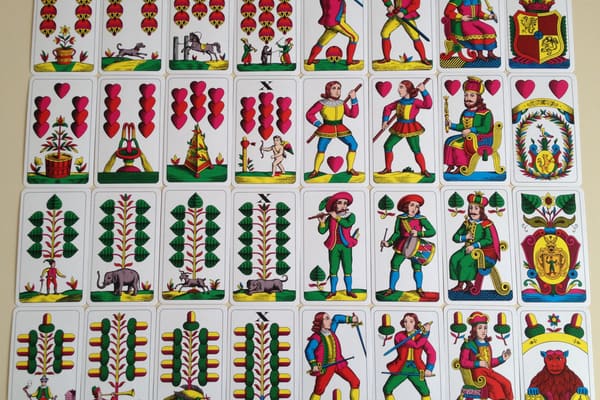
A 32-card deck: traditionally a Bohemian/German-suited pack with suits Acorns, Leaves, Hearts, Bells and ranks Ace (Eso), King (Král), Queen (Svršek/Ober), Jack (Spodek/Unter), 10 (Desítka), 9, 8, 7. A French-suited 32-card pack substitutes one-for-one. Card rank in trick-play, high to low: A, 10, K, Q, J, 9, 8, 7. Note that the 10 outranks the King (an Ace-Ten feature, as in Skat and Pinochle). Point values: Ace = 10, 10 = 10, King = 4, Queen = 3, Jack = 2, 9-7 = 0. Total card points across the deck = 80; plus 10 for winning the last trick = 90 total per deal. In betl and durch (misère/slam contracts), rank order changes to A, K, Q, J, 10, 9, 8, 7 (10 drops down between Jack and 9).
Objective
Win the bidding, choose (or accept) the trump suit, and fulfil your chosen contract. The base game requires capturing at least 51 of the 90 card points; higher contracts require 100 points with a trump marriage (hundred/sto), winning the last trick with the 7 of trumps (sedma), winning every trick (durch), or losing every trick (betl). Defenders share the goal of preventing the declarer from achieving the contract. Over a session the player with the most chips (or highest cumulative score) wins.
Setup and Deal
- Cut for first dealer; the deal rotates clockwise. The player to the dealer's right (forehand) is the leader for the first trick.
- Dealer shuffles, right-hand opponent cuts. Dealer then deals 7 cards face down to each player in a packet (the first packet), then 2 cards face down to one side as the talon, then 5 more cards to each player (the second packet), so each player holds 12 cards and the talon has 2.
- Volený Mariáš (the dominant form): Forehand looks at their first 7 cards. If these contain a King + Queen of one suit, forehand may announce that suit as the trump and become the declarer. Otherwise forehand passes the choice to the next player. If no one declares trump from the first packet, the forehand picks up the 2-card talon, adds it to their hand, and chooses any trump suit (becoming declarer). Once trump is named, every player picks up the remaining cards so all hold 10 in hand.
- Talon handling: The declarer takes the talon (2 cards) and discards any 2 cards of their choice face down. The discarded cards count toward the declarer's capture pile at end of deal.
- Contract declaration: After trump is named and the talon is handled, the declarer may announce additional contracts: sto/kilo (100 points with a trump marriage required), sedma (win trick 10 with the 7 of trumps), betl (win zero tricks), or durch (win all tricks). Multiple contracts may be announced together (e.g., 'sto + sedma').
- Flek and re: Before the first card is led, any defender may say 'flek' to double the stakes of any announced contract; the declarer may reply 're' to redouble, and so on through tutti (×8) in traditional Bohemian tables.
- The player to the dealer's right (forehand) leads to the first trick.
Gameplay
- Leading: The leader plays one card face up.
- Following suit: Each player in turn must follow the led suit if able. If unable to follow suit, they must trump if they hold a trump. If unable to follow suit and holding no trump, they may discard any card.
- Heading the trick: When following suit, a player must play a higher card of the led suit than the highest card currently on the trick if they have one (Stich-Zwang, obligatory overtaking). The same rule applies to trumps: if trumping, you must overtrump the highest trump already on the trick if possible.
- Marriages (hlášky): A player holding King + Queen of one suit may, when leading one of the pair, announce the marriage and immediately score 20 (non-trump suit) or 40 (trump suit). Only one marriage may be announced per lead; the second card of the marriage stays in hand until later.
- Winning a trick: Highest trump wins, or highest card of the led suit if no trump was played. The trick winner gathers the cards face down into their capture pile and leads the next trick.
- End of deal: Play all 10 tricks. Count captured card points plus the 10-point bonus for winning the last trick.
Scoring
- Card point values: Ace = 10, 10 = 10, King = 4, Queen = 3, Jack = 2, 9 = 8 = 7 = 0. Deck total 80, plus 10 for the last trick = 90.
- Base game (hra): Declarer must capture at least 51 of the 90 card points. Pay/receive 1 chip per opponent (base stake). Failure pays the same to each defender.
- Sto/kilo (hundred): Declarer must hold the trump King + Queen marriage AND capture at least 100 total points including the 40-point marriage. Pay 4 chips per opponent. Failure pays the same.
- Sedma (seven): Declarer must win the last trick (trick 10) with the 7 of trumps. Pay 2 chips per opponent. Can be combined with sto. Failure: pay 2 per opponent.
- Betl (misère): Declarer must win zero tricks. No trump suit; ranks are A, K, Q, J, 10, 9, 8, 7. Pays 5 chips per opponent. Failure on even one captured trick pays the same to defenders.
- Durch (slam): Declarer must win every trick. No trump; ranks A-7. Pays 10 chips per opponent. Any lost trick pays the same to defenders.
- Flek (double) and re (redouble): Multiply the stakes ×2, ×4, ×8, and so on for each escalation level.
- Match target: Play a fixed number of deals (often 9 per player as dealer) or to an agreed chip total; high scorer wins the session.
Winning
Each deal is settled independently. A declarer succeeding at all announced contracts collects from both defenders; failing pays both defenders. Over a full session (typically 9 to 27 deals) the player with the most chips wins the session. Ties are broken by playing one extra round of three deals.
Common Variations
- Volený Mariáš (Chosen Mariáš): The dominant Czech form described above; forehand chooses trump or passes to next player.
- Licitovaný Mariáš (Auction Mariáš): A full auction replaces the forehand-chooses rule; 2-card talon plus 5-5-5 dealing, with players bidding contracts in ascending order.
- Křížový Mariáš (Cross Mariáš): 4-player partnership version with partners opposite, each dealt 8 cards, no talon. Slower but more coordinated defensive play.
- Slovak Mariáš: Contract set is slightly different and bidding conventions vary; also uses Slovak-pattern decks.
- Hunting Mariáš (Honba): A cutthroat variant where all three players bid individually and the highest-bidding non-declarer becomes co-declarer for partnership purposes.
- Mariášek (Junior Mariáš): Simplified teaching version with no higher contracts; pure base-game play until novices learn.
Tips and Strategy
- Count trumps from the first trick. With 8 trumps total and 2 or 3 in your hand, know exactly how many the opponents hold combined; after 2 rounds of trumps you should know the exact trump distribution.
- Declare sto only with the trump marriage + solid 60 points in other winners. 40 (marriage) + 60 (card points) = 100 barely meets the threshold; include at least one Ace outside trumps as insurance.
- Bid sedma only when holding 7 of trumps + enough high trumps to clear the opponents' trumps before trick 10. The 7 of trumps is the lowest trump; you must strip all higher trumps from defenders before the final trick.
- Marriages score more than the cards they contain. A trump marriage is 40 points for just the K + Q of trumps (which together score only 7 card points); declaring the marriage is almost always worth the loss of initiative.
- Defender coordination is unspoken but systematic. By convention, the defender on lead against sto plays their highest card in a short suit to signal which suit the co-defender should lead through the declarer.
- Never accept a stand-alone 'durch' hand unless you hold 7+ trumps and the Ace of non-trump suits. Durch's reward is high but one lost trick zeros the bid.
Glossary
- Hra (base game): The standard contract requiring 51+ of 90 card points.
- Sto/kilo (hundred): 100+ card points with the trump marriage included.
- Sedma (seven): Win the last trick with the 7 of trumps.
- Betl (misère): Win zero tricks; no trump suit.
- Durch (slam): Win every trick; no trump suit.
- Flek / Re / Tutti: Defender's double / declarer's redouble / further escalation, multiplying stakes ×2, ×4, ×8.
- Hláška (marriage): King + Queen of one suit; scores 20 (non-trump) or 40 (trump) when declared at the lead.
- Talon: 2-card reserve pile; claimed by declarer in Volený Mariáš.
- Forehand: Player to dealer's right; leads to the first trick.
- Stich-Zwang: Obligation to overtake the current highest card of the led suit if possible.
Tips & Strategy
Count trumps from trick 1; with only 8 trumps total you should know exact distribution by trick 3. Declare sto only when holding the trump marriage plus an Ace-reinforced hand of 60+ other points. As a defender, signal suits to your co-defender through your highest-card lead conventions.
Expert Mariáš is defined by defensive coordination. Because defenders cannot talk, they rely on implicit conventions: the higher non-trump lead signals the direction; the first discard when forced shows the weakest side suit. A declarer who cannot read these signals will fail contracts at twice the rate of an experienced player.
Trivia & Fun Facts
The name Mariáš refers to the marriage (hláška) declarations, which are the central scoring mechanic. Professional Czech players often abbreviate the base contract by shouting 'hra!' (game) and a trump suit, such as 'hra červený' (hearts game); the entire ritual can take less than 3 seconds per deal.
-
01What gives Mariáš its name?Answer The hláška (marriage) declaration of King + Queen of one suit, which scores 20 points in non-trump suits or 40 in trumps when announced while leading.
-
02What is the contract 'sedma' and what card wins it?Answer Sedma requires the declarer to win the final (10th) trick with the 7 of trumps, the lowest trump; the declarer must first strip every other trump from the defenders' hands.
History & Culture
Mariáš descends from the 18th-century Austrian game Mariage, itself a relative of Sixty-Six. It developed its modern Czech form in the 19th century and became the dominant Czech pub card game by 1900. The Czech Mariáš Federation formalises tournament rules; pan-Slavic Mariáš tournaments regularly draw 500+ players from Czechia, Slovakia, Moravia, and Hungarian-Slovak border regions.
Mariáš sits alongside Czech beer and hockey as one of the three defining elements of Czech cultural identity. Every Czech pub has a Mariáš table; the game is played across every social class and demographic. Slovakia accords it equal status, and the Federation of Czech Mariáš regulates competitive rules nationwide.
Variations & House Rules
Volený Mariáš (forehand chooses trump) is the dominant Czech form. Licitovaný Mariáš uses a full auction. Křížový Mariáš adds a fourth player in partnerships. Slovak Mariáš varies contract set and card patterns. Junior Mariášek is the simplified teaching form.
Beginners should start with Volený Mariáš and only the base game contract; introduce sto, sedma, betl, and durch one at a time over several sessions. House clubs often cap flek/re escalation at tutti (×8) to prevent runaway bidding.


