
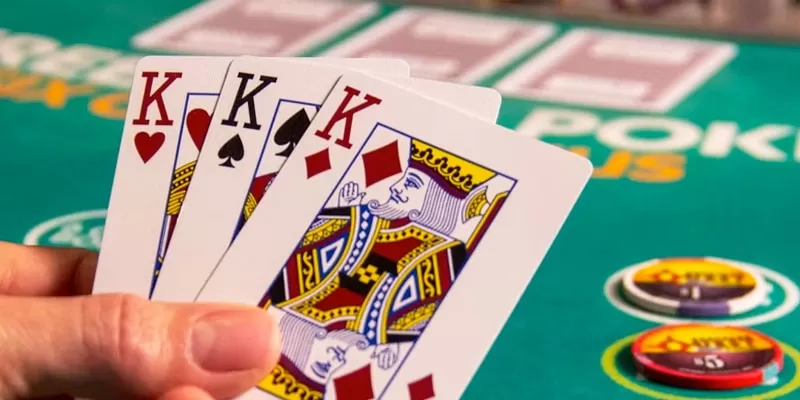
How to Play
Turkish Poker (Türk Pokeri) is the Turkish stripped-deck version of five-card draw poker. Deck is sized to player count: 24/28/32/36 cards for 2/3/4/5 players. Two betting rounds bracket a single draw of up to 4 cards. The hand rankings are reordered for short-deck probability: Flush beats Full House, and Three of a Kind beats Straight. Opener needs a pair of Kings or better; best hand at showdown wins.
Turkish Poker (Türk Pokeri) is the Turkish variant of five-card draw poker played with a stripped (short) deck and a reordered hand-ranking table that reflects the changed probabilities of a short pack. Each player is dealt 5 cards face-down and two betting rounds bracket a single draw phase in which players may exchange up to four cards with the dealer. What makes the game distinctly Turkish is the deck and the rankings: the deck has the low pips stripped out, and because flushes are rarer but triples and straights are more common in a short deck, the hand ranking places the Flush above the Full House and the Three of a Kind above the Straight. The number of cards (and thus which low cards are stripped) depends on player count: 24 cards for 2 players (A down to 9), 28 for 3 (A-8), 32 for 4 (A-7), 36 for 5 (A-6). The opening bet requires a pair of Kings or better (pre-draw open), and a minor straight / minor straight flush is allowed (A-9-10-J-Q in the 24-card game, or the lowest possible straight using the deck's lowest card). The player with the highest-ranked 5-card hand after the final betting round wins the pot. Play is fast (under 2 minutes per hand), bluff-heavy thanks to the short deck, and the reordered rankings give new players a very different feel from Vegas-style draw poker.
Quick Reference
- 2-5 players; short deck: 24/28/32/36 cards for 2/3/4/5 players.
- Each player antes; deal 5 cards face-down.
- Pre-draw betting round; opener needs pair of Kings or better.
- Draw phase: discard 0-4 and draw replacements (4-card draw gets 3 first, then 1 more after all served).
- Post-draw betting round; showdown among players still in.
- Rankings top-down: Royal Flush, Straight Flush, Minor Straight Flush, Four of a Kind, Flush, Full House, Three of a Kind, Straight, Minor Straight, Two Pair, Pair, High Card.
- Best hand wins the pot; ties split.
Players
2 to 5 players, each playing for themselves. The deck size adjusts to the player count so that dealing 5 cards each plus a reasonable draw reserve is possible. Two-player games are the most bluff-heavy (every hand is a duel); five-player games have the most unpredictable hand distributions because 25 of the 36 cards are dealt. There are no partnerships. The first dealer is chosen by drawing the highest card; deal rotates clockwise.
Card Deck
Use a stripped (short) deck tuned to the player count: 2 players = 24 cards (A, K, Q, J, 10, 9 of each suit), 3 players = 28 cards (A through 8), 4 players = 32 cards (A through 7), 5 players = 36 cards (A through 6). Four suits [♠][♥][♦][♣]. Ace is normally high but can also count as low to form a straight (or straight flush) using the deck's lowest rank: for example in the 24-card game the 'minor straight' is A-9-10-J-Q, and in the 32-card game it is A-7-8-9-10. No jokers. No wild cards.
Objective
Win the pot by either (1) having the highest-ranked 5-card hand at the showdown, or (2) betting your opponents out of the hand before the showdown by making a bet no one is willing to call.
Setup and Deal
- Agree on stakes (ante, minimum bet, maximum raise or no-limit, the bring-in for the opener).
- Each player places the agreed ante into the pot before the deal.
- Shuffle the correct short deck for the player count; cut.
- Deal 5 cards to each player, face-down, one at a time, clockwise.
- The player to the dealer's left is first to act in the pre-draw betting round.
Gameplay
- Pre-draw betting round: Starting with the player to the dealer's left, each player in turn either checks-to-the-opener (passes without opening; allowed until someone opens), opens (makes the first bet), calls (matches the current bet), raises (increases the current bet), or folds. The first player to bet (the opener) must hold at least a pair of Kings. A player who opens without the required hand, if caught, loses the hand and their stake; if discovered only after the draw, local rules apply. If every player passes, the hand is dead: the ante stays, everyone re-antes, and the next player deals.
- Draw phase: After the pre-draw round, starting with the opener (or the player to the dealer's left if the hand survived without opening), each active player in turn may discard from 0 to 4 cards face-down and receive the same number of replacements from the top of the stock. Special rule for a 4-card draw: the player discards 4 and receives only 3 replacements first; after all players have been served their draws, each 4-card drawer receives their last (fourth) replacement from the top of the remaining stock. This avoids the stock running out for later players.
- Post-draw betting round: Starting with the opener, the second betting round begins. Now any active player may check, bet, call, raise, or fold. If all players check, the showdown is free; if any player bets, others must call to stay in.
- Showdown: All players still in the hand reveal their 5 cards. The player with the highest-ranked hand (per the Turkish Poker ranking table below) wins the pot. Ties split the pot evenly.
Scoring
- Turkish Poker hand rankings (highest to lowest): (1) Royal Flush (Floş Royal), A-K-Q-J-10 all same suit; (2) Straight Flush (Floş), any straight all same suit using the high-Ace run; (3) Minor Straight Flush (Minör Floş), the Ace-low straight flush (e.g., A-9-10-J-Q in the 24-card game); (4) Four of a Kind (Kare); (5) Flush (Renk), 5 cards same suit, not in sequence; (5 beats 6 below); (6) Full House (Ful); (7) Three of a Kind (Üçlü), three same rank plus two mismatched; (7 beats 8 below); (8) Straight (Kent); (9) Minor Straight (Minör Kent), the Ace-low straight; (10) Two Pair (Doper); (11) Pair (Per); (12) High Card (Yüksek Kart).
- Why Flush beats Full House: In a short deck of 24-36 cards, suits contain only 6-9 cards, so gathering 5 same-suited cards is statistically rarer than gathering a triple plus a pair; the ranking reflects this probability inversion.
- Why Three-of-a-Kind beats Straight: Fewer cards between consecutive ranks mean straights are more common in a short deck than in a 52-card deck; triples are relatively rarer and thus rank higher.
- Tie-breakers are the standard poker conventions: pair-vs-pair by rank, high card by highest card, kicker by kicker.
Winning
The player with the best 5-card hand at the showdown wins the pot. If all opponents fold before the showdown, the last remaining player wins without revealing their hand. Hands are typically played as a session rather than to a fixed target; the session winner is the player with the most chips or money when everyone agrees to stop. For tournament play, fix a chip starting stack and play to elimination.
Common Variations
- Jacks-or-better opener: Reduce the opening requirement from Kings-or-better to Jacks-or-better. Speeds the game by causing fewer dead hands.
- Aces-or-better opener: Stricter opener; fewer hands survive to the draw.
- No minor straights: Strip the minor straight and minor straight flush from the rankings; Ace is strictly high.
- Standard poker rankings: Use American/international ranking (Full House beats Flush; Straight beats Three of a Kind). Some modern Turkish players prefer this.
- High-low split: Half the pot to the highest hand and half to the lowest; the lowest qualifying hand often needs to be 8-high or worse.
- Blind betting (Karanlık): The first player may bet without looking at their cards for a special small-blind raise.
- Check-raise allowed or disallowed: House-rule choice; disallowing check-raises makes the second round simpler but less tactical.
- Four players with 36 cards: Some houses use the 5-player deck (36) for 4 players for more drawing room.
Tips and Strategy
- Open only with a real pair of Kings or better. The opener penalty is real; bluffing the opening bet in Turkish Poker is heavily punished in strict tables.
- The ranking inversion changes everything. Do not rely on American-poker intuition: a flush beats a full house, and three of a kind beats a straight. A hand like (three Kings) beats (an Ace-high straight). Calibrate your calls to the actual local ranking.
- Draw strategy shifts toward flush-hunting. Because flushes are rare and rank high, holding 4 same-suited cards and drawing 1 is a high-equity play in Turkish Poker (higher than in standard poker where a flush draw is often worse-equity than a made pair).
- Avoid drawing 4 cards. The 4-card draw signals a weak starting hand (you kept only one card) and telegraphs your situation to opponents. Also, the split-draw stock-management rule means you may get an inferior fourth replacement.
- Use the post-draw round to read tells. A player who bet strongly pre-draw and then checks post-draw usually missed their draw; consider raising.
- Position matters. Acting late in the post-draw round lets you read opponents' confidence; the button-equivalent (player to the dealer's right) has the strongest position.
- Track the short-deck odds. In a 32-card deck for 4 players, 20 cards are dealt and 12 remain; the probability that a given unseen rank is in the stock is meaningfully trackable. Count aggressively.
- Bluff with near-miss draws. A busted 4-card flush draw still has 2-3 mismatched high cards; a well-timed post-draw raise can fold out a middling pair.
Glossary
- Türk Pokeri: Turkish name for the game. Literally 'Turkish poker'.
- Opener: The player who makes the first bet in the pre-draw round; must hold at least a pair of Kings (in the standard opener rule).
- Draw: The mid-hand phase where players exchange up to 4 cards for new ones.
- Floş (Flush): 5 cards of the same suit, not in sequence. Ranks above Full House in Turkish Poker.
- Floş Royal (Royal Flush): A, K, Q, J, 10 of the same suit. Highest hand.
- Minör Floş (Minor Straight Flush): The Ace-low straight flush, using the deck's lowest rank as the bottom of the run.
- Kare (Four of a Kind): Four cards of the same rank.
- Ful (Full House): Three of a kind plus a pair. Ranks below Flush in Turkish Poker (unlike standard poker).
- Üçlü (Three of a Kind): Three cards of the same rank. Ranks above Straight in Turkish Poker.
- Kent (Straight): Five cards in consecutive rank, mixed suits.
- Minör Kent (Minor Straight): The Ace-low straight.
- Doper (Two Pair): Two distinct pairs.
- Per (Pair): Two cards of the same rank.
- Yüksek Kart (High Card): No matching cards; ranked by highest single card.
- Karanlık (Dark / Blind): Betting without looking at one's cards.
Tips & Strategy
Remember the rank inversion: Flush beats Full House, Three of a Kind beats Straight. Open only with Kings or better (opener penalty is real). A four-flush draw is a high-equity play in Turkish Poker, because flushes are rare and rank high. Avoid 4-card draws; they telegraph weakness and the split stock-management rule may hurt your last card.
Turkish Poker's short deck means hand-reading is different in kind, not just in degree, from American poker. Triples and straights are common, flushes are rare, and the opener rule means that any first bet is a semi-credible signal of a Kings-or-better pair. Expert play combines the probability recalibration (value-bet flushes, fold triples to large bets) with sharp tells from the draw phase: a 1-card draw means a 4-card drawing hand (likely flush); a 2-card draw means either three-of-a-kind plus kicker filling or two pair plus discard; a 3-card draw means a single pair plus three kickers replaced (usually the weakest line); a 4-card draw means a Kings kept solo (rare but signals a strong probe).
Trivia & Fun Facts
The Turkish hand-ranking order (Flush > Full House, Three of a Kind > Straight) is mathematically more consistent than standard American poker, which always uses the same ordering regardless of deck size. Modern short-deck poker (popularised in high-stakes Asian card rooms as 6+ Hold'em) uses the same inversions, making Turkish Poker an unwitting ancestor of the short-deck craze in world poker since the late 2010s.
-
01In Turkish Poker, why does a Flush rank higher than a Full House (the opposite of American poker)?Answer Because the deck is stripped to 24-36 cards, so each suit has only 6-9 cards. With fewer same-suit cards available, assembling a five-card flush is statistically rarer than assembling a full house (three of a kind plus a pair). The hand ranking reflects actual short-deck probability; standard American poker's ordering only holds true for the 52-card deck. The same reasoning makes Three of a Kind beat a Straight in the short deck.
History & Culture
Turkish Poker evolved in Turkey in the early to mid 20th century, a localisation of European draw poker played with the short packs common in Central Europe and the Balkans for Skat and similar games. The adjusted hand ranking reflects genuine short-deck probability: in a 32-card deck a Flush is less probable than a Full House, and a Straight is more probable than Three of a Kind, so placing Flush above Full House and Three of a Kind above Straight restores the probability-based ordering that American 52-card poker maintains by coincidence. The game is sometimes played in Turkish coffeehouses and home games as a social alternative to Texas Hold'em; its draw format keeps hands short and involves less capital commitment than a Hold'em session.
Turkish Poker is played in Turkish coffeehouses, family gatherings, and home games across Turkey and the Turkish diaspora, especially in Germany, the Netherlands, and the United States. It sits alongside Okey (a tile game) and Tavla (backgammon) as the canonical Turkish social gambling game. The reordered hand ranking gave it a distinctive identity in mid-20th-century Turkish urban culture; the game is sometimes taught alongside elementary probability lessons in Turkish high schools as a real-world example of how changing a game's parameters changes its optimal strategy.
Variations & House Rules
Opener variants allow Jacks-or-better or Aces-or-better thresholds. No-minor-straights removes the Ace-low straight. Standard-rank Turkish uses American ordering. High-low split splits the pot between best and worst hand. Karanlık allows dark (blind) bets. The 36-card-for-4-players variant gives 4 players more drawing room.
For a casual home game with 4 players, use the 36-card deck (the 5-player size) so the draw has more cards available; this reduces the chance of running short during the 4-card-draw split. For a stricter tournament, use the fixed deck size per player count and enforce the Kings-or-better opener penalty. For new players, allow standard American rankings on a short deck to avoid the cognitive flip until they are comfortable with the draw format.


