
How to Play
Buck Euchre is an every-player-for-themselves version of Euchre played with the standard 24-card Euchre deck: there are no partnerships, trick wins subtract points from a fixed starting score, and the maker or any player who stays in a hand and wins nothing pays a steep penalty instead.
Buck Euchre strips away the fixed partnerships of standard Euchre so that all 4 players compete individually for themselves, using the same 24-card Euchre pack (9 through Ace in each suit) and the same right-bower/left-bower trump ranking as the parent game. After the deal, the next card of the stock is turned face up to propose a trump suit: if it is a club, clubs becomes trump automatically and every player is locked into the hand, but for any other suit the players bid in turn to order up the turned suit or, failing that, to name a different one outright. Once trump is set, the player who established it (the maker) must win at least 3 of the 5 tricks or be 'set'; every other player then privately decides whether to stay in and gamble for tricks or drop out and sit the hand out safely. Scoring runs backwards from a fixed starting total, most commonly 25 points: each trick a player wins subtracts a point from their own score, while heavy 5-point penalties are added for a set maker or for anyone who stays in but wins no tricks at all. The first player to reach or pass zero wins outright, and sweeping all 5 tricks in a single hand wins the match immediately regardless of the running score. The format turns Euchre's cooperative bidding into a purely selfish gamble, since every player answers only for their own hand and nobody has a partner to bail them out.
Quick Reference
- 24-card Euchre deck (9 through Ace in each suit); deal 5 cards to each of the 4 players.
- Turn the next card face up: a club makes clubs trump automatically, otherwise bidding decides trump.
- Once trump is set by anyone other than the automatic-clubs rule, every non-maker chooses to stay in or drop out.
- Follow suit if you can; the left bower counts as trump, not its printed suit.
- Play any card, including a trump, if you cannot follow suit.
- The highest trump, or the highest card of the suit led if no trump was played, wins the trick.
- Winning a trick subtracts 1 point from your own score; a maker needs at least 3 of the 5 tricks or adds 5 points instead.
- Any non-maker who stayed in but won 0 tricks also adds 5 points; a player who dropped out is unaffected either way.
- Taking all 5 tricks in one hand wins the match instantly, and otherwise the first player to reach zero or below wins.
Players
Exactly 4 players, each competing individually with no partnerships of any kind; this is the core feature that separates Buck Euchre from standard partnership Euchre. Turn order and the deal both rotate clockwise, and the first dealer is usually decided by a cut of the deck (low card deals). A single hand plays in about 2 to 4 minutes since only 5 tricks are dealt each time, but because a running score typically falls by only 1 to 5 points per player per hand, a full match down to zero often takes 30 to 60 minutes or more. A well-documented 3-player 'cutthroat' deal exists using an extra face-down widow hand; see Variations.
Card Deck
- One 24-card Euchre pack: remove the 2s through 8s from a standard 52-card deck, leaving 9, 10, J, Q, K, A in each suit.
- Rank order in the three non-trump suits: A (high), K, Q, J, 10, 9 (low).
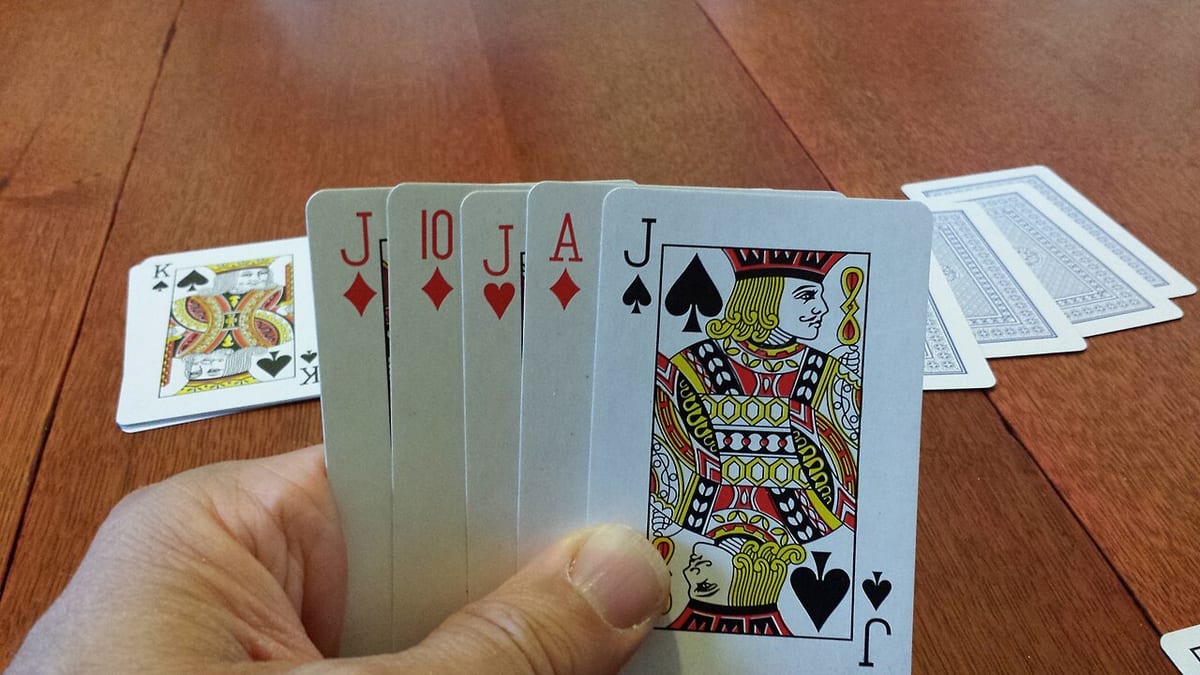
- Trump suit rank order: the right bower (the Jack of the trump suit itself) is the highest card in the game, followed by the left bower (the Jack of the OTHER suit sharing trump's colour, which switches allegiance for the rest of the hand), then A, K, Q, 10, 9 of trump. Example with hearts as trump: , , , , , , .
- No joker is used in the standard game.
Objective
Buck Euchre is scored downward: every player starts a match at a fixed total, most commonly 25 points, and the winner is whoever first reaches zero or drops below it. Each trick you win subtracts 1 point from your own total, so taking tricks is always good, but the hand's trump maker must take at least 3 of the 5 tricks or be 'set', which adds a costly 5 points instead of subtracting anything for the tricks they did take, and any other player who chooses to stay in the hand but wins zero tricks also adds 5 points. Because scores move independently for all 4 players, a single hand can help one player, hurt a second, and leave a third completely unchanged if that player dropped out of it.
Setup and Deal
- Agree the starting score before the match begins; 25 points per player is the standard choice, though 15 or 20 is common for a shorter session.
- Shuffle the 24-card deck and deal 5 cards to each player, face-down, in two rounds dealt clockwise starting to the left of the dealer (commonly 3 cards then 2, or 2 then 3).
- Turn the next card of the remaining stock face up on top of the stock; its suit is the proposed trump for this hand.
- If the turned card is a club, skip bidding entirely: clubs is trump for the hand, every player must play, and nobody may drop out.
- Otherwise, proceed to Trump Selection below before any card is played.
Trump Selection
- First round: starting with the player to the dealer's left and going clockwise, each player in turn may order up the turned suit as trump or pass. Ordering up confirms that suit as trump for the hand and makes that player the maker; the dealer then picks the turned card up into their hand and discards one card face-down.
- If the first three players all pass, the dealer may take up the turned card themselves, becoming the maker, or turn it face down and decline it.
- Second round, only if the dealer declines: starting again to the dealer's left, each player in turn may name any suit other than the turned-down suit as trump; the first player to name a suit becomes the maker.
- If every player passes in the second round too, the hand is played with no trump suit at all: the highest card of the suit led simply wins each trick, and, exactly as with an automatic clubs trump, nobody may drop out of a no-trump hand.
Staying In or Dropping Out
- Once trump has been established by order-up or by naming (not by the automatic clubs rule and not on a no-trump hand), every player other than the maker decides, in turn starting to the maker's left, whether to stay in or drop out of the hand.
- Staying in means you will play the hand and may subtract points for any tricks you win, but you must add a 5-point penalty if you end the hand with zero tricks.
- Dropping out removes you from the hand entirely: your cards are set aside face-down, unplayed, and your score neither rises nor falls no matter how the hand turns out.
- The maker never has the option to drop out; having made trump, the maker is already committed to needing at least 3 tricks.
- When clubs is trump automatically or nobody names any trump, there is no drop-out step at all: every player must play the hand and risks the same 5-point penalty for taking zero tricks.
Gameplay
- Lead: the player to the dealer's left leads to the first trick, playing any card they choose.
- Follow suit: each other active player, in clockwise turn, must play a card of the suit led if they hold one; the left bower now belongs to the trump suit for this purpose, not its printed suit.
- Play any card if void: a player with no card of the suit led may play any card in hand, including a trump, which beats every card of the suit actually led.
- Win the trick: the highest trump played wins the trick outright; if no trump was played, the highest card of the suit led wins. The trick's winner leads the next trick.
- Finish the hand: play continues until every active player's hand is empty (5 tricks total); players who dropped out simply take no turn and are skipped entirely.
Scoring
- Maker takes 3 or more tricks: subtract 1 point from the maker's score for each trick they personally won.
- Maker takes fewer than 3 tricks (is 'set'): add 5 points to the maker's score instead of subtracting anything for the tricks they did win.
- Non-maker who stayed in and won at least 1 trick: subtract 1 point for each trick won.
- Non-maker who stayed in and won 0 tricks: add 5 points.
- Player who dropped out: score is completely unchanged by that hand, since they took no part in it.
- Instant win: if any single player takes all 5 tricks in a hand, they win the match immediately, regardless of every player's running score at that moment.
- No-trump or automatic-clubs hands: every player still subtracts 1 point per trick won, and every player adds 5 points for taking zero tricks, since nobody may drop out of these particular hands.
Winning
The match ends the instant any player's running score reaches exactly zero or drops below it after a hand is scored, and that player wins outright. A single hand also ends the match immediately if one player sweeps all 5 tricks, regardless of anyone's point total at that moment. Because most hands move a score by only 1 to 5 points and dropping out costs and gains nothing, a player who senses they are close to zero can gamble by staying in almost every hand, while a player safely ahead can drop out of risky hands to protect their position. Exact ties for the winning total are rare, since scores fall in small, uneven steps for each of the 4 players separately, and the traditional rules do not define a specific tiebreaker beyond noting that the moment a score reaches zero, that player has won.
Variations
- Dirty Clubs: a named house version of the same base game that typically starts each player at 20 points instead of 25; instead of ordering up or naming a suit, a single bidding round has players bid how many of the 5 tricks they promise to win, and the winning bidder may swap any one card from their own hand for the turned-up card before play begins.
- Three-player cutthroat deal: four 5-card hands are dealt instead of the usual four hands plus stock, with the extra hand left face-down as a widow that nobody looks at; groups playing this way often start at a lower total, such as 15 points, and forbid any player already at 5 points or fewer from dropping out, so the game cannot stall out near the finish.
- Adjustable starting score: shortening the match to 15 or 20 points per player instead of 25 is a common, harmless house adjustment for a faster session, with no other rule changes.
Tips and Strategy
- Only order up or name trump with real strength, such as both bowers or the right bower plus two more trumps; the maker cannot drop out and needs 3 tricks, so a weak trump call risks the full 5-point set penalty for no upside.
- Watch how many players stay in before you decide. If most players drop out of a hand, the remaining active hands are effectively playing a smaller, higher-variance game where each trick matters more to the final trick count.
- Drop out of hands where you hold only low off-suit cards and no trump, since a stay-in that ends in zero tricks costs the same 5 points as being the set maker, with none of the maker's upside from ordering trump in the first place.
- Lead trump early once a maker with real strength has committed you to stay in, to flush out remaining trumps before your own side-suit cards get ruffed by a later player.
- Recompute risk as your own score nears zero. Near the end of a match it is often correct to stay in and gamble for a single trick even from a mediocre hand, since only reaching zero first matters, not how far below it you finish.
Glossary
- Trick: one round of play in which every active player contributes exactly one card; 5 tricks make up a full hand.
- Trump: the suit chosen to outrank all others for the current hand.
- Right bower: the Jack of the trump suit; the single highest card in the game.
- Left bower: the Jack of the other suit sharing trump's colour; the second-highest card, counted as trump for the hand.
- Follow suit: to play a card of the same suit that was led, when you are able to.
- Upcard (turned card): the card turned face up after the deal to propose a trump suit.
- Maker: the player who established trump for the hand, either by ordering up the upcard or by naming a suit.
- Set (euchred): when the maker fails to win at least 3 of the 5 tricks, triggering the 5-point penalty.
- Widow: an extra, unseen hand dealt face-down in the 3-player version of the game.
Tips & Strategy
Only order up or name trump when you hold real strength such as both bowers, since the maker cannot drop out and a failed call costs a full 5-point penalty; conversely, drop out of any hand where you hold no trump and only low off-suit cards, because a stay-in that wins no tricks costs exactly as much as being the set maker with none of the potential upside. Track how many other players have stayed in before committing to risky trump leads, since a hand with several drop-outs plays very differently from one where everybody is still in.
Because dropping out costs and gains nothing while staying in risks a 5-point penalty for zero tricks, the stay-in decision in Buck Euchre is really a bet on whether your hand can win at least 1 trick, not on whether it can win the hand outright; hands with even one guaranteed trick-taker, such as the right bower, are usually worth staying in for, while hands with no trump and no high off-suit cards are usually worth dropping. The maker's decision is stricter still, since ordering up trades a fixed 5-point downside against a variable reward that only appears once 3 tricks are actually banked, which is why experienced players call trump noticeably less often in Buck Euchre than in a partnership game where a partner can help make up the difference.
Trivia & Fun Facts
Because the maker can never drop out of their own hand, calling trump in Buck Euchre is a one-way commitment: even a maker who realizes mid-bid that their hand is weak still has to fight for 3 tricks or eat the full 5-point penalty. A single player sweeping all 5 tricks ends the entire match on the spot, so a bold 'march' can be worth more than several ordinary hands combined even if that player's running score was still far from zero. Unlike standard partnership Euchre, where a bad hand can be carried by a strong partner, Buck Euchre offers no such safety net, since every one of the 4 players scores entirely on their own individual result each hand.
-
01In Buck Euchre, what happens the instant any player takes all 5 tricks in a single hand?Answer They win the entire match immediately, no matter what any player's running score is at that moment.
-
02Why can the maker never choose to drop out of a hand in Buck Euchre?Answer Because ordering up or naming trump commits that player to needing at least 3 of the 5 tricks; the drop-out option exists only for the other players who did not make trump.
History & Culture
Buck Euchre descends directly from partnership Euchre, itself brought to North America by German and Alsatian immigrants in the early 19th century and popularized across the Pennsylvania Dutch communities and later the American Midwest. As Euchre spread into casual, mixed, and larger social gatherings where fixed 4-player partnerships were not always convenient, players adapted it into a purely individual, 'every player for themselves' form that could be played for small stakes or simply for bragging rights, tracked with a descending point total instead of the rising team score of standard Euchre. The name 'buck' likely echoes the same individual, self-reliant framing found in the older poker expression 'passing the buck', referring to a marker once used to track whose turn or obligation was whose, though the exact origin is not firmly documented. The closely related 'Dirty Clubs' name comes directly from the rule that turns clubs into an automatic, no-bidding trump suit whenever it is turned up.
Buck Euchre represents one of the most widespread American adaptations of Euchre away from its original fixed-partnership format, turning a cooperative bidding game into a purely individual one without discarding its signature bower ranking or its 24-card deck. It is typically passed down informally within families and regional card-playing circles rather than played in organized tournaments, and it is frequently cited alongside 'Dirty Clubs' and other named house versions as evidence of how many distinct scoring systems the core Euchre trick-taking mechanism has supported across different communities and eras.
Variations & House Rules
Dirty Clubs keeps the same 24-card deck and downward scoring but replaces order-up bidding with players bidding a specific number of tricks they promise to win, letting the winning bidder swap one card with the turned-up card, and typically starts the match at 20 points instead of 25. The three-player cutthroat deal removes one seat but keeps all 4 hands in play by leaving one as a face-down widow nobody sees, usually paired with a lower 15-point starting score and a rule barring players near zero from dropping out. Groups can also simply shorten any version of the game by starting at 15 or 20 points instead of the traditional 25, without touching any of the trump, trick, or scoring rules.
New groups can lower the starting score from 25 to 15 for a much shorter introductory match while every other rule stays identical, which is an easy way to learn the drop-out decision without committing to a long session. Tables that find the automatic clubs-trump rule too punishing can agree to treat a turned club exactly like any other suit, running full order-up bidding on it instead, though this removes the game's traditional 'Dirty Clubs' nickname along with the rule. Adding the three-player widow-hand deal is a natural way to keep the game playable when only 3 people are available without changing the deck or scoring system at all.


