
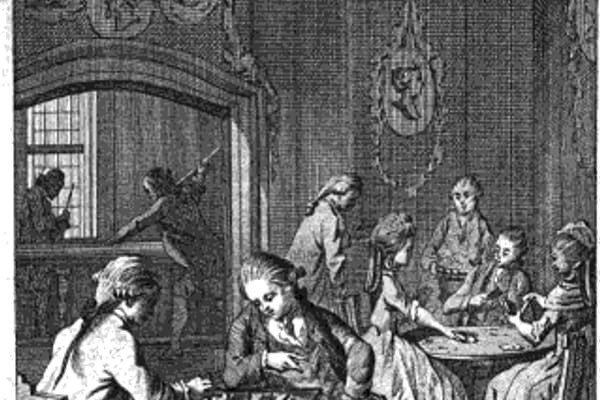
How to Play
Boston is a classic French four-player trick-taking game from the 1770s, named in sympathy with the American Revolution. Players bid solo against three opponents on the number of tricks they will take, over a ladder that includes both trick-count and misère contracts.
Boston is a classic French trick-taking card game from the late 18th century, reportedly named in sympathy with the American revolutionary cause when word of the Boston Tea Party reached Europe. Four players use a standard 52-card deck and receive 13 cards each. The auction is the heart of the game: in turn order, players bid how many tricks they will win playing solo against the other three, choosing trumps from a ranked order of preference suits. The bid ladder climbs from 'Simple Boston' (win 5 tricks) through bids to take 6, 7, 8, 9, 10, 11, and 12 tricks, all the way up to 'Chelem' (win all 13), and also includes special misère bids in which the goal is to take zero tricks. A successful bidder is paid from a central pool by each opponent; a failed bidder pays penalties to the table. Boston was one of the most popular card games in continental Europe from the 1770s until the rise of Whist and Bridge, and it is the direct parent of Solo Whist.
Quick Reference
- 4 players, standard 52-card deck, deal 13 cards each.
- Preference suits: Diamonds, Hearts, Clubs, Spades (high to low).
- Dealer antes a fixed amount into a central pool before bidding.
- Bid once per round; ladder runs Boston (5), 6, 7, ..., 12, Chelem (13), with misère contracts slotted in.
- Declarer names trump (or misère) and plays solo; eldest leads first.
- Follow suit if able; highest trump or highest card of led suit wins the trick.
- Making the bid: each opponent pays declarer per the agreed schedule, plus overtricks.
- Failing the bid: declarer pays each opponent the contract amount and per-trick penalty.
- Misère fails the moment declarer takes a single trick.
Players
4 players, each playing individually; there are no fixed partnerships, although opponents cooperate informally against whoever wins the auction. The first dealer is chosen by cutting the deck for the lowest card, and the deal rotates clockwise after each hand. Every hand features one declarer (the winning bidder) against three defenders.
Card Deck
One standard 52-card French deck, no Jokers. Card ranking within each suit, high to low: Ace, King, Queen, Jack, 10, 9, 8, 7, 6, 5, 4, 3, 2. The four suits have a fixed preference hierarchy used to settle ties in bidding: Diamonds (highest), Hearts, Clubs, Spades (lowest). When trumps are named, higher preference suits outrank lower ones at the same bid level.
Objective
As declarer, win at least the number of tricks you contracted (or take exactly zero tricks on a misère bid), thereby collecting from each opponent. As a defender, stop the declarer from making their contract and collect from the declarer instead.
Setup and Deal
- Agree the currency (chips, counters, or fractional units). The dealer places a fixed dealer's ante, for example 10 chips, into a central pool to kick off the hand.
- Shuffle the 52-card deck. The player to the dealer's right cuts.
- Deal 13 cards to each player, typically four, then four, then five at a time, clockwise.
- No stock remains; the entire deck is in play.
- The player to the dealer's left (eldest) bids first in the auction.
The Bidding Ladder
- Starting with eldest, each player in turn makes one bid or passes. A player who passes may still come back in on a later round; the auction continues while at least one player is still bidding.
- Boston (5 tricks): The lowest contract. Declarer names trumps and commits to taking five tricks.
- Six tricks, Seven tricks, ..., Twelve tricks: Straight trick-count contracts, each step outranking the one below it.
- Petite Misère (0 tricks, no trump): Declarer commits to winning no tricks, then discards one card face-down so each player holds 12; no trump is named. This outranks a bid of 7 tricks.
- Grande Misère (0 tricks with all 13 played, no trump): Same misère goal, but no discard. Outranks 8 tricks.
- Misère Ouverte (open misère): Declarer lays their hand face-up on the table after the first trick; otherwise plays as grande misère. Outranks 10 tricks.
- Chelem (13 tricks): A grand slam; declarer wins every trick. Highest possible bid.
- Resolving ties: If two bidders call the same trick count, the higher preference suit wins (Diamonds > Hearts > Clubs > Spades).
- Everyone passes: If all four players pass without a bid, the hand is thrown in, each player puts a small penalty into the pool, and the deal passes to the left.
Gameplay
- Once a contract is fixed, eldest leads the first trick (unless the misère rules change the lead; on a misère, the player to declarer's left still leads).
- Follow suit if you can. If you have no card of the suit led, you may play any card, including a trump if trumps exist.
- The trick is won by the highest trump played to it, or by the highest card of the led suit if no trump was played.
- The winner of each trick leads the next. Continue until all 13 (or 12, on petite misère) tricks are played.
- Misdeal: If any player has the wrong number of cards, the cards are gathered and redealt by the same dealer.
- Revoking (failing to follow suit when able) costs the offender three tricks transferred to the opponents and usually voids the bid.
Scoring and Payments
- Making a straight bid: Each opponent pays the declarer from a schedule that grows steeply with the contract: for example, 5 tricks = 10 chips each, 6 = 15, 7 = 20, 8 = 40, 9 = 60, 10 = 90, 11 = 130, 12 = 180, 13 (Chelem) = 400. Exact amounts are agreed before play.
- Overtricks: Each trick taken beyond the contract earns a small bonus per player, often 5 chips.
- Failing a bid: The declarer pays each opponent the full contract amount plus an overtrick-style penalty per missing trick. Everyone except the declarer is paid.
- Misère contracts: If the declarer takes even a single trick, the misère fails; payments follow the scale above.
- The central pool: The dealer's ante (and any forfeited-hand penalties) is collected by the successful declarer in addition to their payments.
Winning
Boston is traditionally played in sessions rather than to a fixed target. A session lasts an agreed number of deals (often 4, 8, or 16 so each player deals the same number of times), after which players settle up and the player with the largest chip total wins the session. Casual groups may also play to a target score such as 500 chips.
Common Variations
- Boston de Fontainebleau: A highly elaborate French variant with more than a dozen named bids including Piccolissimo (exactly one trick) and versions of misère ouverte after the first card.
- Russian Boston: A partnership version in which opposite players form teams; the auction works similarly but payouts are shared.
- Boston Whist (English Boston): A simplified three- or four-player version leaning toward standard Whist, with the preference suits reduced to two.
- American Boston: Used a 52-card deck but often capped the highest bid at 12 tricks and introduced fixed trumps for each deal.
Tips and Strategy
- Count your sure tricks before you bid. Aces, long trump holdings, and protected Kings are reliable winners; anything depending on a finesse is not.
- The preference-suit rule rewards bidding in Diamonds or Hearts at the same trick count; always bid the higher-ranked suit when your hand is roughly balanced between them.
- Misère is deceptively hard. A single low card exposed to a forced lead of a short suit can take an unwanted trick. Look for a hand void in at least two suits and with no middle-rank cards in a third.
- As a defender, signal length by playing your lowest card in a suit led by partner. This tells them whether to continue the suit or switch.
- Do not over-ruff: if the declarer is long in trumps, saving your trumps to cover later high cards is usually better than racing to ruff an early plain-suit trick.
Glossary
- Declarer: The player who won the auction and plays solo against the other three.
- Defenders: The three players opposing the declarer; they pool only to stop the contract, not to share points.
- Trick: Four cards played in turn, one from each hand; won by the highest trump, or highest card of the led suit.
- Trump: The suit named by the declarer in the contract; trumps beat any card of any other suit.
- Preference suits: The ranked order of suits (Diamonds, Hearts, Clubs, Spades) used to resolve equal bids.
- Misère: A contract in which the declarer wins the hand by taking zero tricks.
- Chelem: A grand slam; taking all 13 tricks.
- Revoke: Failing to follow suit when able; a scoring offence that usually costs the hand.
Tips & Strategy
Count your sure tricks and treat finesses as wishful thinking when bidding. Diamonds and Hearts outrank Clubs and Spades at the same bid level, so pick the higher preference suit whenever your strength is roughly balanced. Misère bids reward short, polarised hands with no middle cards; bid them only when you can see a clear path to zero tricks.
The preference-suit hierarchy creates a key bidding tension: a marginal hand in Diamonds can outrank a stronger hand in Clubs at the same trick level. Experienced players weigh not just their own strength but the level at which opponents are likely to come in, especially because an overcalled trick count is rarely worth the risk.
Trivia & Fun Facts
Boston's enormous popularity in continental Europe meant that playing it in the 1770s and 1780s was, in some circles, effectively a declaration of support for the American rebels, turning the card table into a subtle venue for political expression.
-
01Which four-suit ordering is used to resolve equal-trick bids in Boston?Answer Diamonds (highest), Hearts, Clubs, Spades (lowest), known as the preference suits.
History & Culture
Boston emerged in France in the 1770s, with its name widely attributed to sympathy for the American revolutionary cause, and in particular the Boston Tea Party. It became the dominant salon card game of continental Europe for nearly a century and is the direct precursor of Solo Whist.
Boston bridges card history and political history: born as continental Europe's homage to the American Revolution, it became the staple of 18th-century salons and helped define the trick-taking style that produced Solo Whist, Skat, and eventually Bridge.
Variations & House Rules
Boston de Fontainebleau expanded the bidding ladder with more than a dozen named contracts, while Russian Boston introduced partnership play. Simpler English and American versions trimmed the ladder and brought the game closer to Whist.
Agree the payment schedule before the first hand; groups differ widely on how sharply rewards and penalties escalate. For a shorter session, cap the bids at 10 tricks and drop the misère ouverte level; for a longer one, add Piccolissimo (exactly one trick) and Chelem Ouvert (open grand slam).


