
How to Play
Mus is the celebrated Basque partnership card game with four sequential betting rounds (Grande, Chica, Pares, Juego), a unique pre-betting card-exchange phase, and the legal facial-signal system used to coordinate with your partner.
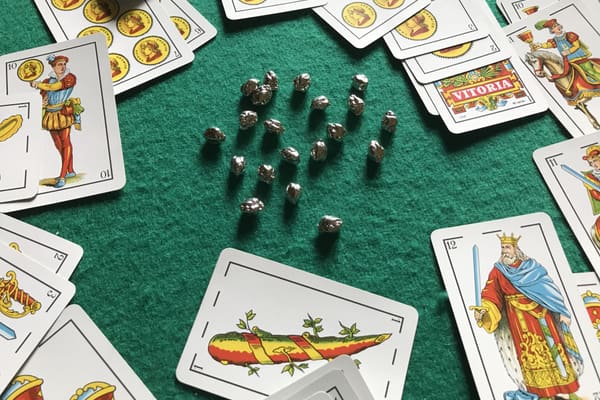
Mus is the legendary Basque partnership card game, sometimes called the national card game of the Basque Country and arguably Spain's most strategically rich card game. Four players in two partnerships use a 40-card Spanish deck and bet across four sequential rounds (Grande, Chica, Pares, Juego) with a unique pre-betting card-exchange phase ('Mus') and an open table-talk system of legal partner signals (keinuak). Bets are paid in stone counters; 5 stones make 1 amarreko; 6 amarrekos make a juego (game), 3 juegos make a vaca (cow), and the match is best of 3 vacas.
Quick Reference
- 4 players in two fixed partnerships use a 40-card Spanish deck.
- Deal 4 cards each; 3s count as Kings and 2s as Aces (8-Kings rule).
- Mano (right of dealer) speaks first.
- Mus phase: agree to discard and redraw, or refuse with Mus ez.
- Bet through 4 rounds in order: Grande, Chica, Pares, Juego/Punto.
- Use keinuak (winks, eyebrows, lip bites) to signal your partner.
- Ordago = all-in on this category, settles the vaca instantly if accepted.
- Envido = 2 points minimum bet; rejected bets pay 1.
- Pares: pair=1, trips=2, two-pair=3.
- Juego: 2 (3 if exactly 31); Punto: 1.
- Score in order Grande > Chica > Pares > Juego up to the 30/40 target.
Players
Mus is played by exactly 4 players in two fixed partnerships, partners sitting opposite each other. The dealer rotates anti-clockwise after each hand. Variations for 2 and 3 players exist but are rarely played; this guide describes the canonical 4-handed game.
Card Deck
- Use a 40-card Spanish deck (Coppe, Denari, Spade, Bastoni; or Cups, Coins, Swords, Clubs; remove the 8s, 9s and any jokers).
- Card rank within a suit, high to low: Rey (King), Caballo (Knight), Sota (Jack), 7, 6, 5, 4, 3, 2, As (Ace).
- The 8-Kings / 8-Aces convention (universal in standard Mus): All 3s count as additional Kings (giving 8 'Kings' total) and all 2s count as additional Aces (giving 8 'Aces' total) for the Grande, Chica and Pares rounds. The original 3s and 2s keep their face-card-pip names only for the Juego/Punto round, where their numerical value matters.
- Card values for Juego (the 31+ round): King, Knight, Sota, 3 = 10 points each. Ace and 2 = 1 point each. 4 through 7 = face value.
Objective
Win 2 of 3 vacas (cows) in the match. A vaca is best-of-3 juegos (games). A juego is the first partnership to 30 or 40 points (40 in Spain proper, 30 in Basque country); points come from accepted bets and from the special declarations Pares and Juego across the four rounds of each hand.
Setup and Deal
- Choose first dealer by any fair means (often by lowest card cut). The deal then rotates anti-clockwise after each hand.
- Shuffle. The player to the dealer's right cuts. Deal 4 cards face-down to each player one at a time, anti-clockwise.
- The player to the dealer's right (mano, the eldest hand) speaks first in every round of betting.
The Mus (Discard) Phase
- Starting with the mano and proceeding anti-clockwise, each player in turn says either 'Mus' (I want to discard and redraw) or 'Mus ez' (no mus; we go straight to betting).
- If ALL FOUR players say Mus, each may now discard 1, 2, 3 or 4 cards face-down and the dealer deals replacements. The Mus question is then asked again, and another round of discards may follow. This continues until at least one player says Mus ez.
- Once any player refuses Mus, the discard phase ends and play proceeds to Grande.
- Signal phase: Partners may use the legal silent gestures (see Signals section below) to communicate hand strength to each other during the Mus discussions and at any point before the bets begin.
The Four Betting Rounds
- Each round is fought separately, in this fixed order: 1) Grande (highest hand), 2) Chica (lowest hand), 3) Pares (pairs/trips/two pair), 4) Juego (cards totalling 31 or more, OR Punto if no one has 31).
- Round 1: Grande. Mano speaks first. Each player may pass ('paso'), open a bet ('envido', minimum 2 points), or after a bet, accept ('quiero'), reject ('no quiero'), or raise ('mas <number>' or 'envido mas dos'). When the bet is rejected, the bidding side wins 1 point automatically. When all pass, the round is held until showdown for 1 token point. At showdown the partnership with the player holding the highest card-by-card hand wins (compare top card; if tied compare second card; if still tied compare third, then fourth; all evaluated under the 8-Kings rule).
- Round 2: Chica. Same betting structure as Grande, but at showdown the partnership with the LOWEST card-by-card hand wins (i.e. lowest top card under the 8-Aces rule).
- Round 3: Pares. Players first declare 'Pares' (I have pairs) or 'No Pares'. Only players who declared Pares contest this round. Same betting structure. At showdown, the hands rank: Duples (two pairs / four of a kind) > Medias (three of a kind) > Pares (single pair). Within the same rank, the higher card breaks ties. The Pares-holding partnership(s) score 1, 2, or 3 points for the strength of their best Pares (1 for a pair, 2 for trips, 3 for two pair / four of a kind), in addition to the bet stake.
- Round 4: Juego. Players first declare 'Juego' (I have 31 or more) or 'No Juego'. If at least one player declares Juego, the round is contested as Juego: at showdown, the best score is exactly 31 (best), then 32, 40, 37, 36, 35, 34, 33 (note 38-39 impossible without 8s/9s). Pre-bet declaration scores 2 points (3 if exactly 31) plus the bet stake. If NO ONE has Juego, the round is renamed Punto: bid for the highest total under 31; pre-bet declaration scores 1 point plus the bet.
- Ordago (all-in). At any point during any betting round, a player may say 'Ordago' (literally 'there it is'), staking the entire match on this single category. If accepted ('quiero'), hands are immediately revealed and whichever side wins that category wins the entire match (the vaca, in some rules the entire match). If rejected, the calling side scores 1 point.
Legal Partner Signals (keinuak)
- Mus is one of the few games where partner signaling is OPEN and EXPECTED. Only these specific facial gestures are permitted; anything else is cheating.
- Two Kings: Bite the centre of the lower lip.
- Three Kings: Bite one side of the lower lip.
- Two Aces: Stick out tongue.
- Three Aces: Stick tongue out to one side.
- Single pair: Tilt head briefly.
- Three of a kind (medias): Purse lips to one side.
- Two pair (duples): Raise eyebrows.
- 31 (Juego = exactly 31): Wink.
- 30 points: Lift both shoulders.
- 29 points: Lift right shoulder; 28 points: lift left shoulder.
- Bad hand: Close eyes briefly.
- Signals can be delivered any time before the betting in that category begins, but only by partners (not opponents); the opponents may try to spot them. False signals are forbidden.
Scoring
- Tokens: Bets and round wins are paid in stone counters. 5 stones = 1 amarreko (a larger counter).
- Bet structure: Minimum opening bet is 2 points (envido). Raises are added on top (e.g. 'envido mas dos' raises by 2). 'Quiero' (accept) commits both sides to the staked amount; 'no quiero' (reject) gives the opener 1 point only.
- Showdown points: When a round was passed by both sides ('al paso'), the winning team scores 1 token point at the end of the hand.
- Pares declarations: Single pair = 1, three of a kind (medias) = 2, two pair (duples) = 3 (in addition to any bet won).
- Juego declarations: Holding 31+ = 2 points (3 if exactly 31). Punto (no one has 31) = 1 point.
- Game target: First partnership to 30 (Basque) or 40 (Spain) points wins one juego. 6 juegos won = 1 amarreko in some accountings; in modern Spain-wide rules 30/40 is the juego target and the match is best-of-3 vacas, where each vaca is best-of-3 juegos.
- Order of payment: When a hand finishes, points are tallied in this category order: Grande, Chica, Pares, Juego. The instant a partnership crosses the juego target, scoring stops; further category wins do not score.
Winning
The match (the partida) is won by the first partnership to take 2 of 3 vacas. Each vaca is best-of-3 juegos. Each juego ends the moment one partnership reaches 30 (Basque) or 40 (Spain) points by the priority order Grande > Chica > Pares > Juego. An accepted Ordago at any time settles the entire vaca on the spot.
Common Variations
- 8 Kings (universal in Spain): The standard rule. 3s count as Kings, 2s count as Aces in Grande, Chica and Pares. Juego/Punto uses each card's numerical value.
- 4 Kings (Basque traditional): No swap; 3s and 2s keep their natural ranks throughout.
- Mus a la mano: Strict ordering rule: in showdowns of equal hands, the partnership containing the mano (eldest hand) wins. Universal in tournament Mus.
- Open Mus / Tournament Mus: Strict prohibition on any signal beyond the official keinuak; severe penalties for false signals.
- Mus a Pala: Played without the chip-tracking system; points are simply added to a running mental total.
Tips and Strategy
- Evaluate every hand in all four categories. A hand of King-King-2-2 is strong in Grande, weak in Chica, strong in Pares (duples), and OK in Juego. A hand of 4-5-6-7 is the worst possible hand (Tio Perete) and worth folding in every category.
- Bid bluffs in Grande and Chica. Partner cannot see your hand; a confident envido in a category your partner has signaled weak in tells them you have it covered, allowing them to push or fold accordingly.
- Use Ordago carefully. Ordago risks the entire vaca. Use it only when you have a near-certain category lock (e.g. four Kings in Pares) AND the score situation makes the gamble worthwhile.
- Memorise and use signals. The legal keinuak are mandatory tools, not optional flair. A team that does not signal cannot compete with one that does.
- Track called hands. When the opponent calls 'Pares!', they have at least a single pair; combined with their bidding aggression you can often deduce duples vs trips before showdown.
- Mind the 30/40 ceiling. Once a partnership is one or two points from the juego target, the bidding strategy flips: the leading team should stop opening bets in low-priority categories to keep their advantage tidy.
Glossary
- Mano: The eldest hand (player to the dealer's right); speaks first in every betting round and breaks ties in many showdowns.
- Mus / Mus ez: The pre-betting question 'discard and redraw?'; answered Mus (yes) or Mus ez (no, go to betting).
- Keinuak: The legal facial signals partners use to communicate hand strength.
- Envido: The minimum opening bet (2 points). Raises are 'envido mas <number>'.
- Quiero / No quiero: 'Accept' or 'reject' a bet. Rejection yields 1 point automatically to the opener.
- Ordago: The all-in declaration that, if accepted, settles the entire vaca on a single category showdown.
- Amarreko: A larger counter equal to 5 stone tokens.
- Vaca / Juego: A vaca is best-of-3 juegos; a juego is first to 30 or 40 points.
Tips & Strategy
Mus rewards two skills above all others: comprehensive hand evaluation across every one of the four categories before betting begins, and disciplined use of the legal keinuak (facial signals) with your partner. A team that signals confidently and accurately routinely beats one that simply bids based on individual hand strength.
Mus is a game of priorities. Each hand has a 'best category' for each player; the deepest skill is choosing which category to push hard and which to fold quickly. Bidding aggressively in your strong category while your partner signals weakness elsewhere lets your team capture the most points before the opponents catch on. Ordago is rarely correct; treat it as a bluff weapon in tight scores rather than an offensive tool.
Trivia & Fun Facts
Mus is one of the very few major card games in which partner signaling is not just allowed but mandatory by the rules. The list of legal facial signals (winks, eyebrow raises, lip bites) is fixed and any deviation is considered cheating. The hand 4-5-6-7 (the absolute worst possible hand, weak in every category) is nicknamed 'Tio Perete' (Uncle Pete) by Mus players.
-
01In Mus, what does a player do (or say) during the discard phase to indicate they want to keep their cards and proceed straight to betting?Answer They say 'Mus ez' (literally 'no Mus'), refusing the discard and forcing all four players to enter the four betting rounds with their current hands.
History & Culture
Mus is documented in the Basque Country at least since the 18th century and is often called the national card game of Euskal Herria. It spread through Spain and to Basque diaspora communities (notably in Argentina, Chile, the United States and France). The Spanish national Mus federation (Federacion Espanola de Mus) governs official tournament rules, and Mus tournaments draw tens of thousands of competing pairs annually.
Mus is foundational to Basque cultural identity and is played in homes, sociedades gastronomicas (private dining clubs), and tournaments across the Basque Country. It serves as a marker of belonging in Basque communities worldwide and is taught from childhood as part of cultural education.
Variations & House Rules
The 8-Kings rule is universal in modern Spanish-wide play. Tournament Mus (Open Mus) enforces strict signaling rules and harsh penalties for false signals. Basque traditional Mus uses 4 Kings (no rank swap) and a 30-point juego target instead of 40.
Beginners often skip the keinuak entirely for the first few hands, then add 1-2 signals per category as they grow comfortable. Adjust the juego target (30 for short games, 40 for traditional, 50+ for marathons) to match your evening's length.


